Key Takeaways
- Dual diagnosis is not a DSM-5 category. Clinicians diagnose each mental health and substance use disorder separately, which SAMHSA groups under co-occurring disorders 1.
- DSM-5 replaced abuse and dependence with one substance use disorder rated mild, moderate, or severe based on how many symptoms from the DSM-5 criteria list you meet 3.
- Telling substance-induced from independent disorders depends on timing, persistence after abstinence, collateral history, and toxicology, which is why early diagnoses should be provisional and reassessed 2, 10.
- Sequential handoffs lose the timeline and reassessment work the DSM-5 method requires, so integrated care with one team watching both conditions is the clinical standard worth asking for 8, 11.
The Term That Isn’t in the Manual
Here is something that may surprise you: open the DSM-5 and search for “dual diagnosis.” You won’t find it as its own diagnosis. There is no code, no checklist, no stand-alone definition. The phrase people hear in treatment centers, insurance forms, and family conversations is not a formal DSM-5 category at all.
What exists instead is a method. The manual asks clinicians to diagnose each condition on its own terms — a mental health disorder here, a substance use disorder there — and then document that they are happening in the same person at the same time. SAMHSA calls this “co-occurring disorders,” and the definition is deliberately broad: any combination of a DSM-5-TR mental disorder and a substance use disorder, with no required pairing 1.
That distinction matters more than it sounds. If you have been told you have a “dual diagnosis” and left the appointment unsure what was actually diagnosed, you are not missing something obvious. You were handed a shorthand, not a diagnosis.
The rest of this article walks you through what the DSM-5 does say — and how to tell whether your evaluation actually followed it.
How DSM-5 Actually Handles Two Diagnoses at Once
Each Disorder Gets Its Own Diagnosis
When a clinician works through the DSM-5, they are not looking for a single “co-occurring” code to drop onto your chart. They are building two or more separate diagnoses, side by side. One line might read major depressive disorder. Another might read alcohol use disorder, moderate. A third might name post-traumatic stress disorder. Each one has to meet its own criteria on its own terms 1.
That structure is why SAMHSA defines co-occurring disorders broadly: any combination of a DSM-5-TR mental disorder and a substance use disorder, with no required pairing 1. Depression plus alcohol use counts. Bipolar disorder plus stimulant use counts. PTSD plus opioid use counts. The combinations are not pre-packaged, which means your care should not be either. Commonly associated conditions include anxiety, depression, PTSD, bipolar disorder, ADHD, psychotic disorders, and personality disorders 5.
If you have ever left an evaluation with only one of your conditions written down, this is where things went wrong. A thorough DSM-5 workup treats each disorder as a real diagnosis that deserves its own name, its own severity rating, and its own treatment plan. You are not a label. You are a person with two or more clinical pictures that need to be seen clearly and treated together 4.
The Severity Continuum That Replaced Abuse and Dependence
If you were diagnosed before 2013, you may remember the old language: substance abuse or substance dependence. The DSM-5 retired that split. In its place is a single diagnosis — substance use disorder — rated on a continuum based on how many symptoms you meet from the DSM-5 criteria list.
- Two to three symptoms is mild.
- Four to five is moderate.
- Six or more is severe 3.
That shift matters more than it might look on paper. The old system treated “abuse” and “dependence” as different conditions, which encouraged clinicians (and insurers) to decide you were one or the other. The continuum reflects what addiction actually looks like in real life. People move along it. A moderate alcohol use disorder today can become severe after a stressful year, or ease back toward mild with sustained treatment and support.
The continuum is also a reminder that progress is real and measurable. Dropping from severe to moderate is not a failure to “fully recover.” It is a documented clinical change, and it is worth noticing. Every symptom you no longer meet is a step your treatment team can see on paper 8.
Substance-Induced or Independent? The Question That Decides Your Diagnosis
Why Timing Changes Everything
Here is the question that quietly shapes almost every co-occurring diagnosis: did the mental health symptoms come from the substance, or were they already there?
The DSM-5 treats this as a fork in the road. On one path is a substance-induced mental disorder — symptoms that showed up during intoxication, withdrawal, or soon after, and that will likely fade once the substance is out of the picture. On the other path is an independent mental disorder — a condition that exists on its own, with its own trajectory, that happens to be co-occurring with substance use. Same symptoms on the surface. Very different diagnoses underneath 2.
Timing is how clinicians tell them apart. SAMHSA’s guidance is direct about it: some mental disorders are really substance-induced mental disorders, and an abstinent period of weeks or sometimes months may be needed before an independent co-occurring disorder can be diagnosed confidently 2. That is not a bureaucratic delay. It is the clock the brain needs to show what it looks like when the substance is no longer driving the picture.
Think about what this means in practice. If you entered an evaluation while still in acute withdrawal and walked out with a diagnosis of major depressive disorder, that diagnosis is provisional at best. Your depression might be real and independent — or it might be the chemistry of withdrawal talking. A careful DSM-5 clinician will tell you which one they suspect, and when they plan to look again 4.
The Clinical Questions a DSM-5 Assessment Must Answer
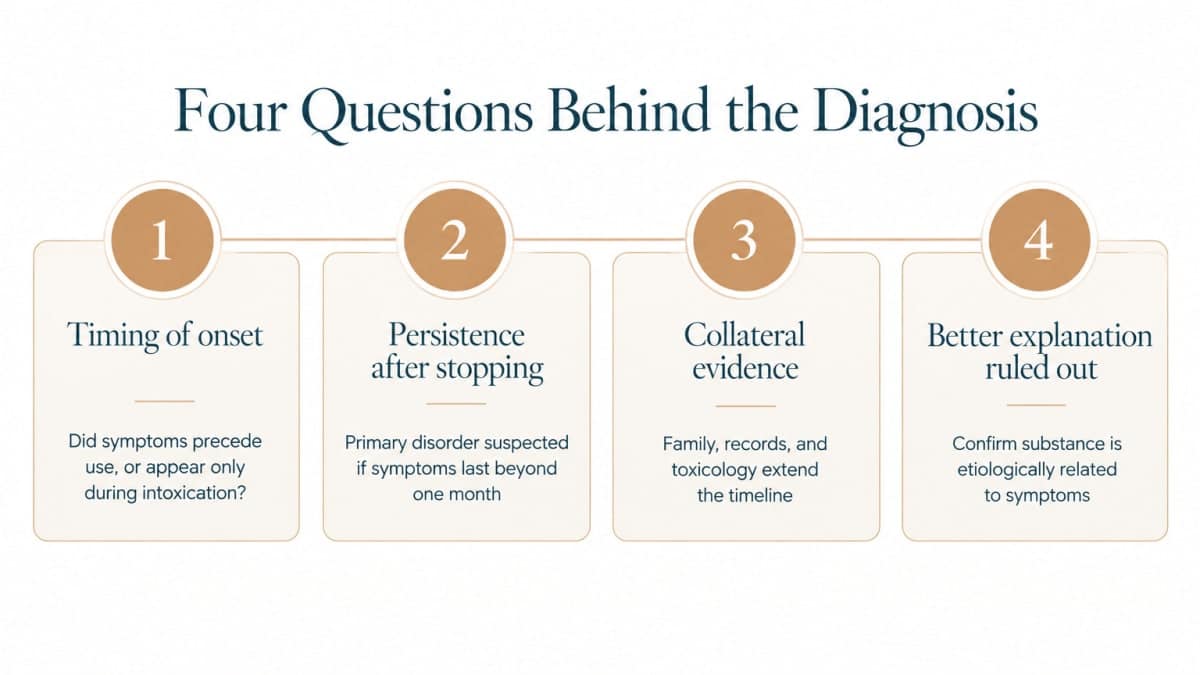
Behind the fork between substance-induced and independent sits a short list of questions a trained clinician has to answer, in order. None of them are optional, and none of them can be answered in a fifteen-minute intake.
When did the symptoms start, relative to the substance use? Did the hallucinations, the panic, the depression, the mood swings appear before you ever used — or only during intoxication and withdrawal? The DSM-5 is clear that symptoms arising only during or shortly after substance exposure point toward a substance-induced disorder until proven otherwise 2.
Do the symptoms persist after you stop? This is where the one-month benchmark becomes useful. In the psychosis literature, a primary psychotic disorder is considered when symptoms predate substance use, occur independently of exposure, or persist for at least one month after intoxication or acute withdrawal has ended 10. Persistence is evidence. Fading is also evidence.
What does collateral history and toxicology say? A single self-report in a crisis is not enough. Family accounts, old medical records, prior psychiatric notes, and current toxicology all help the clinician see a longer timeline than the person in front of them can usually recall 10. For substance-induced psychotic disorder specifically, the DSM-5 requires evidence that the substance is etiologically related and that a primary psychotic disorder does not better explain the symptoms 9.
Have other causes been ruled out? Medical conditions, medications, head injury, sleep deprivation, and other psychiatric conditions all have to be considered before a diagnosis is locked in 2.
Is this diagnosis provisional, and when will it be reassessed? SAMHSA’s guidance emphasizes provisional diagnosis and repeated reassessment, because intoxication and withdrawal can mimic or obscure psychiatric illness 2. A thorough assessment names what it does not yet know, and sets a date to look again.
If your evaluation moved through these questions — even imperfectly — you were given a real DSM-5 workup. If it skipped past them, you were given a label.
Where Misdiagnosis Happens Most Often
The gap between substance-induced and independent disorders is not evenly distributed. There are specific presentations where misdiagnosis happens again and again, and knowing them can help you recognize when a second opinion is reasonable.
Stimulant and cannabis psychosis. Methamphetamine, cocaine, and heavy cannabis use can produce hallucinations and delusions that look identical to a first episode of schizophrenia. The DSM-5 asks whether the psychosis started during or shortly after use, and whether it persists for at least a month after the substance has cleared 10. In the real world, people sometimes get a schizophrenia diagnosis in the ER before anyone has watched them through a full abstinent period. Sometimes it holds. Sometimes it quietly resolves 9.
Depression in early sobriety. The first weeks after stopping alcohol or opioids can look like severe depression — low mood, anhedonia, poor sleep, hopelessness. For some people, those symptoms lift as the nervous system recalibrates. For others, the depression stays, and it becomes clear it was always there underneath. Treating only one possibility ignores the other 2.
Anxiety during withdrawal. Panic, racing thoughts, and intense worry are hallmarks of withdrawal from alcohol, benzodiazepines, and stimulants. They are also hallmarks of an independent anxiety disorder. Timing and persistence are the only way to tell the difference reliably 2.
If any of this sounds like the evaluation you or your loved one received, you are not being paranoid for asking questions. Overlap between psychiatric symptoms and substance effects is exactly why NIMH stresses that accurate diagnosis is key and why comprehensive assessment by clinicians trained in both domains matters so much 4. A second look is not doubting your care team. It is doing what the DSM-5 itself asks of them.
What a Thorough Co-Occurring Assessment Looks Like
By now you have a sense of what the DSM-5 asks for. Here is what that looks like when a clinician actually does it well — a short mental checklist you can hold up against the evaluation you or your loved one received.
A full symptom timeline, not just a snapshot. A thorough assessment maps out when your mental health symptoms started, when your substance use started, and how the two have moved in relation to each other over months or years. SAMHSA’s screening guidance is explicit that establishing the timing of psychiatric symptoms relative to substance use, intoxication, withdrawal, and abstinence is central to co-occurring diagnosis 3.
Collateral information from more than one source. Family members, prior treatment records, old prescription histories, and school or work accounts fill in the gaps your memory cannot. This is especially important when psychosis, mania, or trauma are in the picture, because those states distort self-report 10.
Toxicology and a medical workup. Current substance levels, a physical exam, and basic labs rule out medical conditions that mimic psychiatric illness — thyroid problems, infections, head injury, medication effects 2.
Screening instruments plus a comprehensive diagnostic interview. Screening tools flag what to look at more closely. They do not replace a full diagnostic evaluation by a clinician trained in both mental disorders and substance use disorders 3, 4.
Clear severity ratings for each diagnosis. Your SUD should be rated mild, moderate, or severe based on how many of the DSM-5 criteria you meet 3. Your mental health diagnoses should carry their own specifiers where the manual provides them.
Provisional diagnoses with a reassessment plan. A good clinician names what they are confident about today, what they are watching, and when they will look again — often after a defined period of abstinence or stabilization. SAMHSA’s TIP guidance treats this reassessment as part of the diagnosis itself, not an optional follow-up 2, 8.
If most of these pieces were present, you got a real DSM-5 co-occurring assessment. If several were missing, that is useful information too. You can ask for them by name.
The Scale of the Problem — and Who Gets Missed
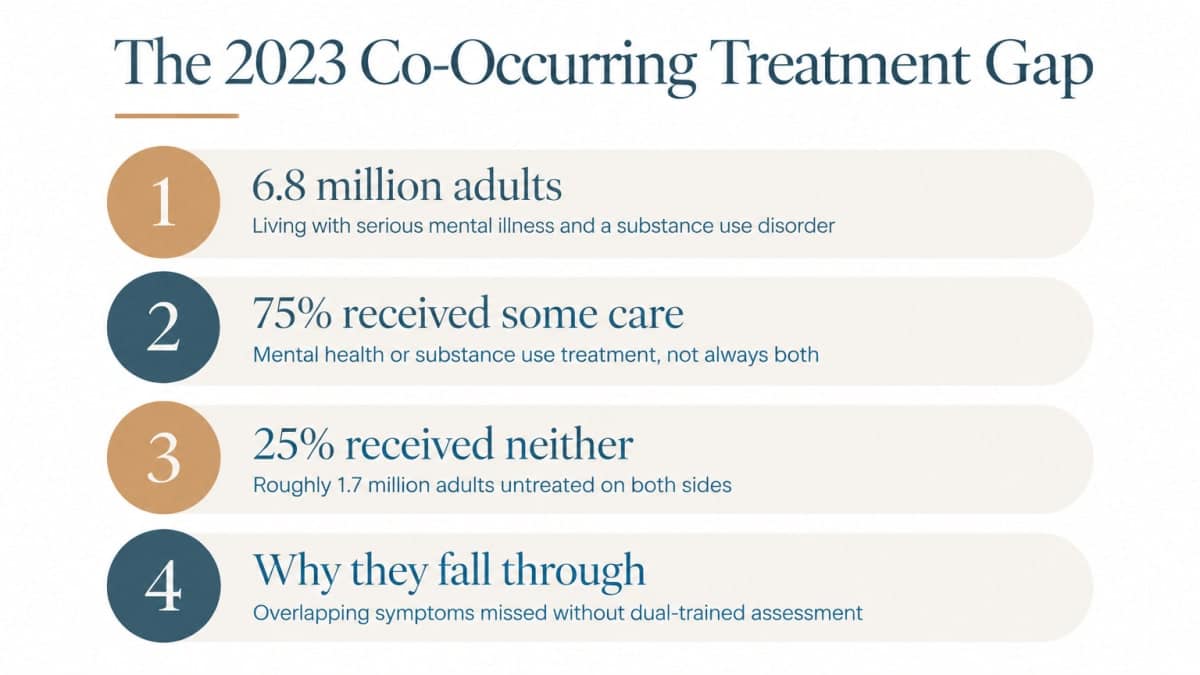
Here is the number worth sitting with. In 2023, about 6.8 million U.S. adults had co-occurring serious mental illness and a substance use disorder. Three-quarters of them — 75% — received either mental-health or substance-use treatment that year. The other 25% received neither 6. Subgroup patterns by age, sex, race and ethnicity, geography, and socioeconomic characteristics are available in SAMHSA’s detailed tables 7.
That is roughly 1.7 million adults with two serious conditions at once, walking through a year without care for either one. Not undertreated. Not partially treated. Untreated on both sides.
Some of that gap is about access, insurance, and geography. A real portion of it is about diagnosis. When a careful DSM-5 workup never happens — when psychiatric symptoms get written off as “just the addiction,” or substance use gets ignored because the mental illness feels more urgent — people fall into the space between two systems that were never designed to catch them together. The screening and assessment literature points at this directly: psychiatric and substance-related symptoms overlap, and without comprehensive assessment by someone trained in both, one side tends to get missed 3, 4.
You already know this if you have lived it. The emergency room that treated the overdose and discharged without a psychiatric follow-up. The therapist who treated the depression for a year without asking about drinking. The rehab that handled the opioid use but told the family the trauma piece was “for after.” Each handoff is a place where a diagnosis can quietly disappear.
The scale is not an abstraction. It is the reason the DSM-5’s methodology matters so much in practice — and why the next question for your own care is whether the evaluation you got actually did the work the manual asks for.
What DSM-5 Methodology Implies for Treatment
Why Sequential Care Keeps Failing Complex Cases
The DSM-5’s method — diagnose each condition separately, decide what is substance-induced versus independent, reassess over time — only works if someone is actually looking at both pictures at once. Sequential care, where you get sober first and then address the mental illness, or treat the depression first and then “deal with” the drinking, breaks that method before it starts.
Here is why that matters for complex cases specifically. If you have treatment-resistant schizophrenia alongside stimulant use, a program that detoxes you and then refers you out for psychiatric care is making a bet that your psychosis will stay stable without antipsychotic adjustments during the exact weeks your brain is most unstable. If you have rapid-cycling bipolar disorder with alcohol use, a mental health clinic that stabilizes mood without touching the drinking is treating around the condition that is destabilizing the mood in the first place. If trauma is driving opioid use, treating the opioid use disorder without the trauma leaves the engine running 11.
Each handoff between systems is also a handoff of information — and information tends to get lost. The timeline a careful DSM-5 workup depends on, the collateral history, the toxicology, the reassessment plan — those pieces rarely travel intact between a detox unit, an outpatient psychiatrist, and a therapist who were never in the same room 3, 8.
Integrated Care as the Clinical Consequence, Not a Slogan
“Integrated treatment” gets used loosely in marketing. The DSM-5 gives it a more specific meaning. If a diagnosis depends on watching symptoms across substance use, intoxication, withdrawal, and abstinence — and on reassessing provisional diagnoses as the picture clarifies — then the people doing the watching have to share a chart, a treatment plan, and a conversation. That is what integrated means in a clinical sense: one team, both conditions, from the first day 8.
In practice that looks like a psychiatrist and a therapist who talk about the same person each week, medication decisions that account for withdrawal timelines and psychiatric targets at the same time, and a treatment plan that names each DSM-5 diagnosis with its severity rating and a reassessment date. SAMHSA’s TIP 42 is built around this coordination for exactly this reason — co-occurring disorders are the audience it was written for 8.
Honest caveat: the research on what works best in these populations is still catching up. The 2024 review of the field describes a multimodal approach — contingency management, CBT, DBT, motivational interviewing, family interventions — as the practical foundation, while noting that pharmacologic evidence in people with active co-occurring SUD is often limited by small samples and trials that excluded them in the first place 11. Integrated care is not a guarantee of a clean outcome. It is the setting where DSM-5 diagnosis can actually be done well, and where the next adjustment to your treatment plan is a shared decision rather than a referral. That is the standard worth asking for.
How to Tell If Your Evaluation Was Thorough Enough
You can leave an evaluation feeling heard and still not know whether the diagnosis you were given is one the DSM-5 would stand behind. Here is a short set of questions you can bring to your own chart, or to the next appointment, to find out.
Can your clinician name each diagnosis separately, with its own criteria? You should hear specific conditions — major depressive disorder, PTSD, alcohol use disorder — not a vague “dual diagnosis” or “co-occurring issues” written on a form 1.
Is there a severity rating on your substance use disorder? Mild, moderate, or severe, tied to how many of the DSM-5 symptoms you meet. A chart that only says “addiction” skipped a step 3.
Did anyone map the timeline? When your mental health symptoms started, when the substance use started, and what happened to each during intoxication, withdrawal, and any periods of abstinence 3.
Was collateral information gathered? Family input, prior records, toxicology, a medical workup — the pieces that keep a diagnosis from resting on a single bad week 10.
Were any of your diagnoses labeled provisional, with a plan to reassess? That is a sign of a careful clinician, not an uncertain one 2.
If several answers are no, you are not stuck. Specialized integrated programs exist precisely for the complex cases where a second, more careful DSM-5 workup changes what treatment is possible.
Explore Care for Co-Occurring Conditions
Discuss how your mental health and substance use concerns may shape an integrated treatment approach.
Frequently Asked Questions
Is “dual diagnosis” an actual DSM-5 diagnosis?
No. The DSM-5 does not list “dual diagnosis” as its own condition. It is shorthand for what SAMHSA calls co-occurring disorders — any combination of a DSM-5-TR mental disorder and a substance use disorder in the same person, with no required pairing 1. Your clinician should diagnose each condition separately, by name, with its own criteria met.
How does a clinician tell the difference between a substance-induced mental disorder and an independent one?
Timing and persistence do most of the work. A substance-induced disorder shows up during intoxication, withdrawal, or shortly after, and tends to fade once the substance clears. An independent disorder either predates the substance use or persists after it stops — for psychosis, often at least a month after acute withdrawal ends 2, 10. Collateral history, toxicology, and ruling out other medical causes support the call 9.
How long does someone need to be abstinent before a reliable co-occurring diagnosis can be made?
There is no single number that fits every substance or symptom. SAMHSA’s guidance is that an abstinent period of weeks or sometimes months may be needed before an independent co-occurring disorder can be diagnosed confidently 2. Expect your clinician to call early diagnoses provisional and plan to reassess as acute withdrawal settles and a clearer picture emerges.
What did DSM-5 change about substance use disorder diagnoses?
It combined the old “abuse” and “dependence” categories into one diagnosis — substance use disorder — rated on a severity continuum. You meet mild with 2–3 symptoms from the DSM-5 criteria list, moderate with 4–5, and severe with 6 or more 3. That change lets your chart show where you are on a spectrum and track real movement rather than forcing a yes-or-no label.
What should a thorough co-occurring assessment include?
A full timeline of when psychiatric symptoms and substance use started and how they moved together, collateral information from family or prior records, toxicology and a basic medical workup, screening instruments plus a diagnostic interview by a clinician trained in both areas, a severity rating on your SUD, and provisional diagnoses with a reassessment date 3, 4. If several of those pieces are missing, it is fair to ask for them.
Why does separate-track treatment often fail for people with both diagnoses?
Because the DSM-5’s method depends on watching both conditions at once and reassessing as the picture changes. When a detox program and a psychiatrist and a therapist never share a chart, the timeline, toxicology, and provisional diagnoses get lost between handoffs 3, 8. Integrated care keeps both conditions in view from day one, which is what complex cases — treatment-resistant psychosis, bipolar with alcohol use, trauma-driven opioid use — actually need 11.
References
- Co-Occurring Disorders and Other Health Conditions. https://www.samhsa.gov/substance-use/treatment/co-occurring-disorders
- Chapter 4—Mental and Substance-Related Disorders: Diagnostic and Cross-Cutting Topics. https://www.ncbi.nlm.nih.gov/books/NBK571021/
- Chapter 3—Screening and Assessment of Co-Occurring Disorders. https://www.ncbi.nlm.nih.gov/books/NBK571017/
- Finding Help for Co-Occurring Substance Use and Mental Disorders. https://www.nimh.nih.gov/health/topics/substance-use-and-mental-health
- Common Comorbidities with Substance Use Disorders. https://nida.nih.gov/sites/default/files/1155-common-comorbidities-with-substance-use-disorders.pdf
- Key Substance Use and Mental Health Indicators in the United States: Results from the 2023 National Survey on Drug Use and Health. https://www.samhsa.gov/data/sites/default/files/reports/rpt47095/National%20Report/National%20Report/2023-nsduh-annual-national.htm
- Results from the 2023 National Survey on Drug Use and Health: Detailed Tables. https://www.samhsa.gov/data/sites/default/files/reports/rpt47100/NSDUHDetailedTabs2023/NSDUHDetailedTabs2023/2023-nsduh-detailed-tables-intro.htm
- Substance Use Treatment for Persons With Co-Occurring Disorders. https://library.samhsa.gov/product/tip-42-substance-use-treatment-persons-co-occurring-disorders/pep20-02-01-004
- Substance-Induced Psychoses: An Updated Literature Review. https://pmc.ncbi.nlm.nih.gov/articles/PMC8732862/
- Methamphetamine Psychosis: Epidemiology and Management. https://pmc.ncbi.nlm.nih.gov/articles/PMC5027896/
- Navigating the Complex Intersection of Substance Use and Psychiatric Disorders: A Comprehensive Review. https://pmc.ncbi.nlm.nih.gov/articles/PMC10889170/