Key Takeaways
- Prescott families often face a distance problem: advanced psychiatric care has historically meant driving to Phoenix, but integrated dual diagnosis programs in Yavapai County can now hold complex cases locally.
- Genuine integrated care means one clinical team, one shared plan, and board-certified psychiatry involved from day one, not a handoff between rehab and a later psychiatric referral 2.
- Before committing to a Prescott program, compare psychiatric coverage, whether the psychiatrist and therapist share one chart, how overnight crises are handled, tracked outcomes, and what cases the program honestly turns away.
When Rehab Ends and the Psychiatric Diagnosis Is Still There
You already know this pattern. The detox worked. The 30-day program ended with a handshake and a printout of aftercare recommendations. And then, within weeks, the bipolar cycling came back, or the PTSD flashbacks returned, or the depression that everyone politely called “situational” turned out to be something much older and heavier. The substance use followed. It always does.
If you are searching for dual diagnosis treatment in Prescott, Arizona, you are probably not doing it for the first time. You may be a spouse, a parent, or the person living inside the diagnosis yourself. Either way, you are tired, and you have earned the right to be skeptical of any program that promises a clean fix in four weeks.
Here is a fact that explains why this search has felt so hard. In a study using the Dual Diagnosis Capability in Addiction Treatment and Dual Diagnosis Capability in Mental Health Treatment indices, only 18% of U.S. addiction treatment programs and 9% of mental health programs met the criteria for being genuinely dual diagnosis capable 1. That means most facilities calling themselves dual diagnosis providers are not, by measured clinical standards, equipped to fully address both conditions together.
That gap is what this guide is about. What real integrated care looks like, what to ask before you commit to a Prescott-area program, and what to do when previous programs have already told you the case is too complex.
What Dual Diagnosis Care Actually Means
Two Conditions, One Clinical Team
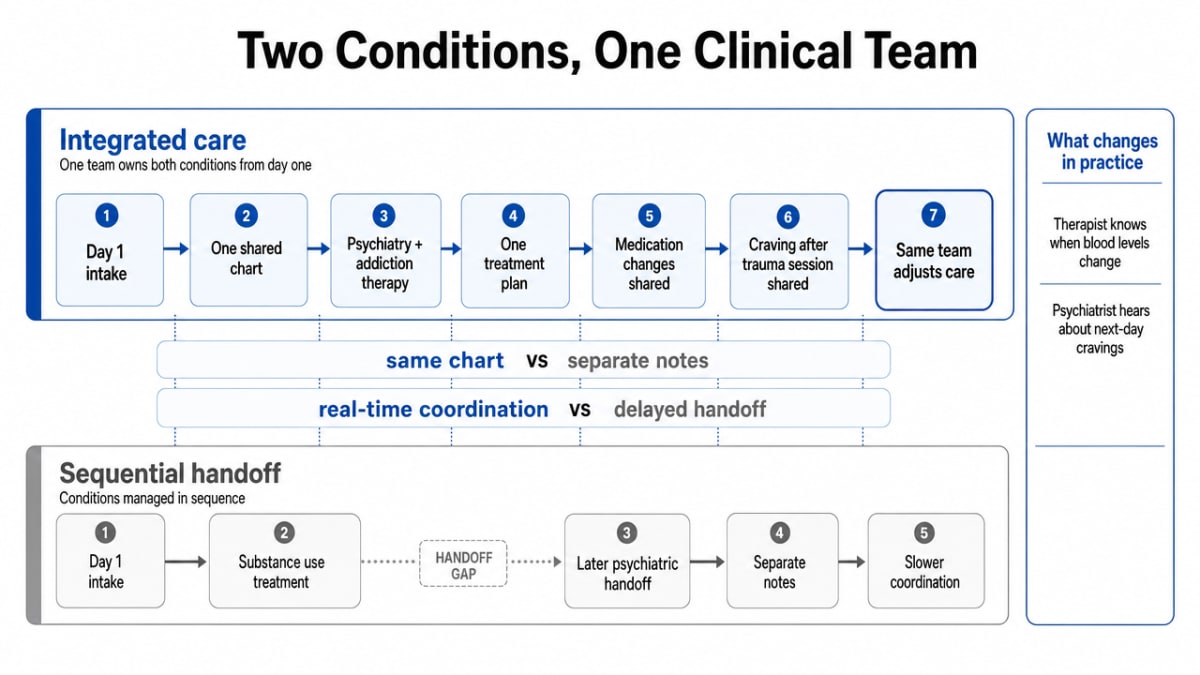
Dual diagnosis care is not a bigger rehab. It is not a rehab with a psychiatrist who visits on Tuesdays. It is a treatment model where one clinical team owns both the psychiatric diagnosis and the substance use disorder from the first day of care, working from one shared treatment plan.
That distinction sounds small on a brochure. In practice, it changes almost everything. When your family member walks into intake, the psychiatrist and the addiction therapist are looking at the same chart, comparing notes about the same person, and agreeing on what to try first. If the bipolar medication needs to shift because the drinking has stopped and blood levels are changing, the therapist knows. If a trauma session on Wednesday triggers a craving on Thursday, the psychiatrist hears about it before the next appointment.
SAMHSA’s Treatment Improvement Protocol on co-occurring disorders defines integrated treatment exactly this way: one team, one plan, both conditions addressed together rather than handed between separate systems 2. So when you call a Prescott-area program and hear the words “dual diagnosis,” the real question is not whether they use the label. It is whether the psychiatrist and the therapist are on the same team, in the same building, sharing the same notes about your person.
Why Sequential Care Keeps Falling Apart
You have probably lived through the sequential model already, even if no one named it for you. Detox first. Then a 30-day rehab. Then, eventually, a psychiatric referral once someone is “stable enough.” Then outpatient therapy in a different office with a different clinician who has not read the rehab notes.
Each handoff is a place where things break. The rehab discharge planner does not have a same-week appointment with a psychiatrist. The new psychiatrist starts a medication that interacts with the recovery plan. The therapist across town does not know what happened in group last month. Your family member, still fragile, is now the one carrying the information between providers. That is not a plan. That is a relay race with no baton.
SAMHSA’s evidence document is direct about the cost of this pattern: clients with co-occurring disorders who receive mental health care without integrated substance use treatment show consistently poor outcomes across substance use, psychiatric symptoms, hospitalizations, and functioning 7. If you have watched a relapse follow a discharge, you already know this in your body. The research just confirms what your exhaustion has been telling you. Sequential care asks the sickest people to hold the most fragile system together. It is not a moral failure when it breaks. It is the design.
The Six Outcomes Integrated Care Is Supposed to Move
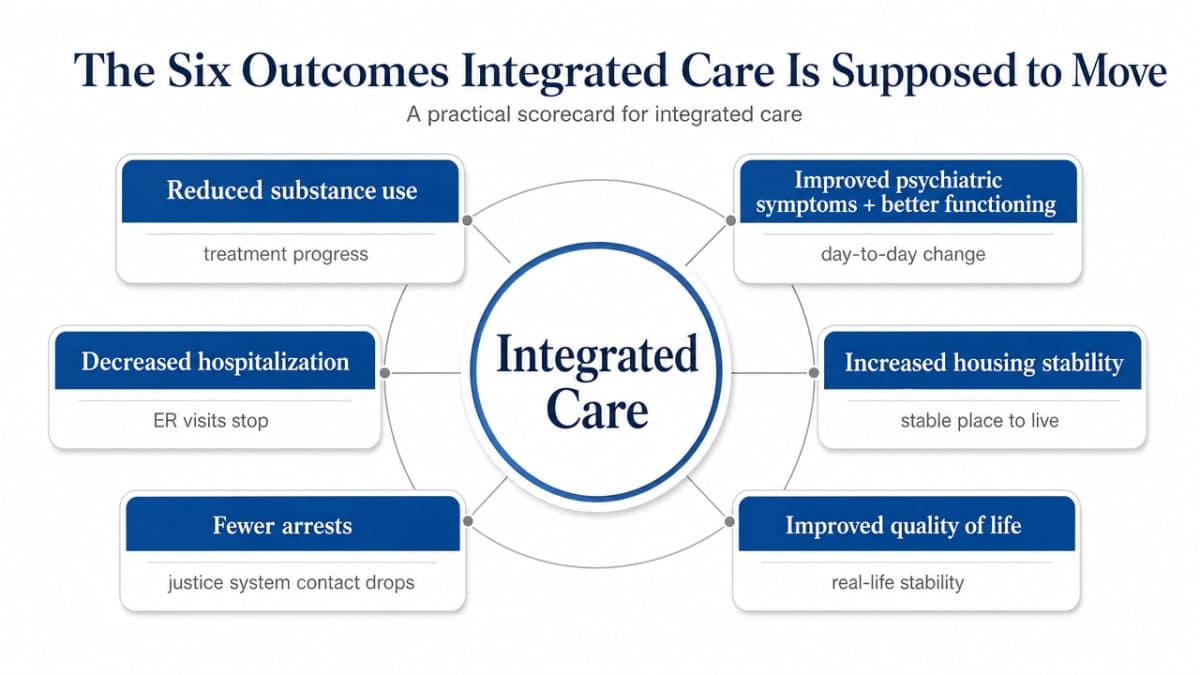
When a program tells you it delivers integrated care, you deserve to know what “working” actually means. SAMHSA’s Building Your Program guide, drawing on eight studies of integrated treatment for co-occurring disorders, identifies six specific outcome domains where integrated programs outperform non-integrated ones: reduced substance use, improved psychiatric symptoms and functioning, decreased hospitalization, increased housing stability, fewer arrests, and improved quality of life 4.
Read that list again slowly, because it is the closest thing you have to a scorecard. These are not soft outcomes. They are the things that actually change day-to-day life for the person in treatment and the family around them. Whether the psychiatric medication is finally holding. Whether the emergency room visits stop. Whether there is a stable place to live. Whether the arrest cycle ends. Whether waking up in the morning feels like something other than dread.
You can use this list as a plain-language question set when you interview a Prescott-area program. Ask which of these six they track. Ask how they measure them. Ask what their team does differently when a patient is not moving on one of them after 60 or 90 days. A program that treats dual diagnosis seriously will have language for each of these. A program that uses the term as marketing will pivot to talking about their amenities.
This is what integration is supposed to buy you. Not a promise. A measurable shift, across six specific dimensions of a life.
An Honest Read of the Research
Where the Evidence Is Strongest
You have been sold enough promises. Before you trust another one, it helps to know where the research on integrated dual diagnosis care is actually solid, and where it is still finding its footing.
The strongest evidence sits with people who look like the person you are trying to help: adults with serious mental illness and an active substance use disorder, treated in a program where one team owns both problems. SAMHSA’s review of experimental and quasi-experimental studies found that integrated programs consistently outperformed non-integrated ones on substance use, psychiatric symptoms, hospitalizations, arrests, housing, and quality of life 7. Not on one measure. Across the board.
Duration matters too. A systematic review of comprehensive integrated outpatient programs found that when care was sustained for 18 months or longer, patients showed significant reductions in substance use, higher remission rates, and less hospital use 3. Shorter add-on groups bolted onto traditional rehab did not produce the same results.
There is also a quieter finding worth naming. In an outpatient trial of integrated care for patients with substance use and co-occurring anxiety or depression, integrated treatment significantly increased motivation to stay in substance use treatment over 12 months 9. For a family watching someone quit programs early, engagement is not a soft outcome. It is the whole game.
Where the Evidence Is Nuanced
Honest is honest. Integrated care is not a magic word, and any program that talks about it as one should worry you a little.
A 2023 systematic review comparing integrated and non-integrated treatment in dual diagnosis populations found that integration held a clear advantage for improving psychiatric symptoms, but showed similar substance use outcomes and retention rates in some studies 6. Even SAMHSA’s own protocol notes that some integrated models, particularly intensive case management studies, are lower quality and do not consistently beat standard care 2.
What this means for you, practically, is this. Integration is the right direction, especially for stabilizing the psychiatric side of the picture and keeping people engaged long enough to benefit. But the label alone does not guarantee outcomes. What matters is how a specific program executes it: who is on the team, how long care lasts, whether the plan actually adapts when something is not working. The next section is about how to tell the difference from the outside.
Finding Real Dual Diagnosis Care in the Prescott Area
Yavapai County, Northern Arizona, and the Distance Problem
Prescott sits at about 5,400 feet in Yavapai County, roughly a hundred miles north of Phoenix and its dense concentration of specialty psychiatric hospitals. That distance matters more than it should. When a family here needs advanced psychiatric care for a complex dual diagnosis case, the default assumption has often been that someone has to leave. Drive down the mountain. Uproot. Trust a stranger in a city two hours away with a person who is already fragile.
There are real strengths to the local recovery landscape. Prescott has a long-standing sober community, active 12-step meetings, and a culture that takes early recovery seriously. Those are gifts, and they hold people up in ways that matter. But community support is not the same thing as clinical capacity. A strong meeting on Gurley Street cannot manage a clozapine titration. A sponsor cannot adjust a mood stabilizer when rapid cycling breaks through.
What has been missing in northern Arizona is not compassion. It is the coordinated clinical infrastructure to treat a serious psychiatric diagnosis and an active substance use disorder inside one program, without asking your family to choose between staying close and getting the level of care the situation actually requires. That is the gap you are trying to close.
Seven Questions to Ask Any Prescott Program Before You Commit
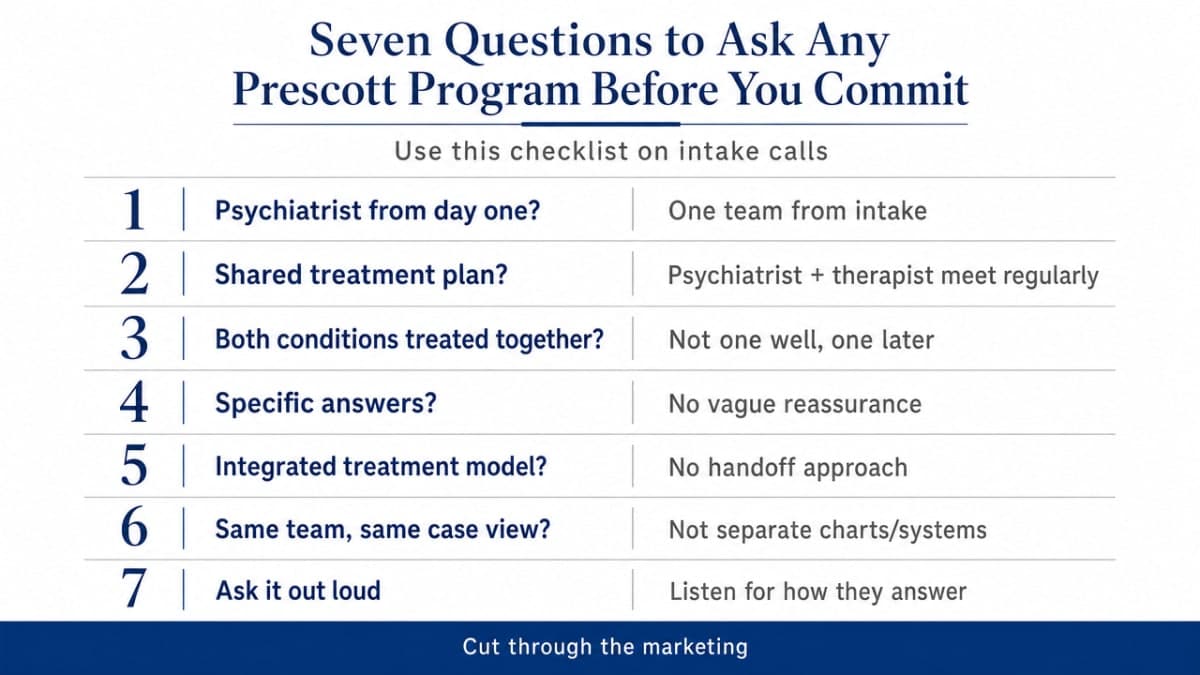
You have been on these calls before. The intake voice is warm, the website is polished, and by the end of the conversation you still cannot tell whether this program will actually treat both of your person’s conditions or just one of them well. Here are seven questions that cut through the marketing. Ask them out loud. Listen for specific answers, not reassurance.
- Is a board-certified psychiatrist part of the treatment team from the day of admission, or is psychiatry a consult service brought in later? SAMHSA’s definition of integrated treatment requires one team addressing both conditions together from intake, not a handoff model 2.
- Does the psychiatrist and the primary therapist work from the same treatment plan and meet regularly about the case? If they operate from separate charts in separate systems, that is sequential care wearing an integrated label.
- What is your program’s approach when someone stops making progress on medication? A serious program will describe protocol adjustments, second-generation options, and specialized approaches like clozapine when clinically indicated.
- How do you handle a psychiatric crisis at 2 a.m.? The presence of 24/7 board-certified psychiatric coverage separates programs that can hold complex cases from those that will transfer them out.
- What outcomes do you track, and can you speak to them? Any of the six SAMHSA outcome domains is a fair place to start 4.
- What kinds of cases do you turn away, and why? The honest answer here tells you more than any brochure. A program that has never turned anyone away may not be honest about its clinical ceiling. A program that can name what it is and is not built to handle is a program that knows itself.
You do not need all seven answers to be perfect. You need the pattern of the answers to feel like a team that has thought about your person’s situation before, not one improvising in real time.
When the Case Has Been Called ‘Too Complex’
What Root-Cause Psychiatric Assessment Looks Like
If a program has already told you the case is too complex, you know how that sentence lands. It sounds clinical, but it feels like a door closing. And often what it actually means is that the intake was not built to see what is going on underneath.
A standard rehab intake asks about substances, frequency, and last use. A psychiatric intake in that same rehab, if it happens at all, may be a 45-minute conversation that produces a working diagnosis and a starting medication. That is enough for uncomplicated cases. It is not enough for someone whose bipolar has been misread as “mood swings from drinking,” whose PTSD has been treated as generalized anxiety, or whose schizophrenia diagnosis has never been separated from years of stimulant use layered on top.
Root-cause assessment is slower and more layered. It means gathering a longitudinal history, not a snapshot. Prior hospitalizations, medication trials that worked and the ones that did not, family psychiatric history, trauma timeline, sleep architecture, substance use sequence relative to symptom onset. It means the psychiatrist and the therapist comparing what they each heard from the same person and reconciling the differences before a treatment plan gets written. StatPearls describes this kind of concurrent diagnostic work as central to managing co-occurring disorders well 10. It is what “too complex” often actually needs.
Advanced Psychiatry Without Leaving Northern Arizona
For a long time, the assumption in Yavapai County has been that advanced psychiatric care lives somewhere else. If the diagnosis was serious enough, families packed a bag and drove to Phoenix or Tucson. If the medication regimen needed to escalate to something like clozapine, with its required blood monitoring and titration protocols, you were quietly told the local options were limited.
That assumption is worth questioning now. Clozapine, for example, is one of the most effective medications for treatment-resistant schizophrenia, but it requires a program with the psychiatric coverage and monitoring infrastructure to run the protocol safely. The same is true for complex mood stabilizer combinations in rapid-cycling bipolar disorder, or for managing psychiatric medication alongside acute substance withdrawal without one destabilizing the other.
What a dual diagnosis program in Prescott can offer, when it is built for this, is 24/7 board-certified psychiatric coverage inside the same building where the therapy and the addiction work happens. That coverage matters most in the moments you cannot schedule. A dose reaction at 11 p.m. A dissociative episode after a Wednesday trauma session. A craving spike that raises a safety question before dawn. NIDA is direct that co-occurring conditions must be treated together, with coordinated psychiatric and addiction expertise, rather than triaged between separate systems 8. In Prescott, that used to mean leaving. It no longer has to.
Treatment Duration Set by Clinical Need, Not Insurance Days
Here is the quiet reason many complex cases fail. The clock ran out before the work was done.
Most residential programs are built around what insurance will authorize, which often means 28 to 30 days, sometimes extended a week or two if the utilization reviewer agrees. For a straightforward alcohol use disorder in someone with stable psychiatry, that window can be enough to launch aftercare. For someone with treatment-resistant depression stacked on opioid use, or bipolar disorder whose medication has never truly held, 30 days is barely the assessment phase. Discharge happens before the treatment has had a chance to prove itself.
The comprehensive integrated outpatient programs that produced the strongest outcomes in the research needed 18 months or longer of sustained care to show significant reductions in substance use and hospital utilization 3. That is a different order of magnitude than a billing authorization.
What you want to hear from a Prescott-area program is that treatment duration is a clinical decision, revisited as the person progresses, and defended on clinical grounds when insurance pushes back. Sometimes that means a shorter residential stay with a strong step-down. Sometimes it means holding longer because the psychiatric stabilization is not there yet. The point is that the clock belongs to the clinical team, not the payer.
How ViewPoint Approaches Dual Diagnosis in Prescott
You have read enough of this guide to know what to look for. Here is how ViewPoint Dual Recovery answers those questions inside northern Arizona.
ViewPoint is a Joint Commission-accredited psychiatric treatment facility built specifically for the cases most Prescott-area families have been told are too complex. Board-certified psychiatry is on the team from the day of admission, not brought in as a later consult. Psychiatrists and therapists work from one shared treatment plan and meet regularly about each case, which is the operational definition of integrated care that SAMHSA lays out 2.
Root-cause assessment goes beyond a standard intake. That means a longitudinal look at prior hospitalizations, medication history, trauma timeline, and how substance use has intersected with psychiatric symptoms over years, not weeks. For treatment-resistant presentations, the program is equipped for advanced medication strategies, including clozapine protocols for treatment-resistant schizophrenia and complex regimens for rapid-cycling bipolar disorder, so families do not have to drive to Phoenix for that level of care.
Length of stay is set by clinical trajectory, not by what a utilization reviewer will authorize this week. That matters because sustained integrated care is what the outcome research actually rests on 3.
If a previous program sent your person home too soon, or said the case was outside what they could hold, that is the conversation ViewPoint is built for. Call when you are ready.
See If Integrated Dual Diagnosis Care Fits
Gain clarity on next steps for complex dual diagnosis challenges in Prescott.
Frequently Asked Questions
What is the difference between dual diagnosis treatment and regular rehab?
Regular rehab focuses on stopping substance use. Dual diagnosis treatment addresses substance use and a psychiatric condition at the same time, inside one clinical team working from one shared plan. If your person has bipolar disorder, PTSD, schizophrenia, or serious depression alongside addiction, the psychiatric side cannot wait until after sobriety. NIDA is direct that co-occurring conditions must be treated together rather than handed between separate systems 8.
How do I know if a Prescott program is truly equipped to treat both conditions?
Ask whether a board-certified psychiatrist is on the team from day one, whether the psychiatrist and therapist share one treatment plan, and how the program handles a psychiatric crisis overnight. Listen for specific answers about integration, not brochure language. SAMHSA defines integrated care as one team owning both conditions together from intake 2. If the program uses the label but describes a handoff model, that gap is your answer.
My family member has already been through detox and 30-day rehab. Why did it not hold?
Yes, this has been hard, and it makes sense that you are tired. When rehab treats substance use but leaves the psychiatric diagnosis unaddressed, relapse is often the symptom, not the failure. SAMHSA’s evidence document shows that clients with co-occurring disorders who receive care without integrated psychiatric treatment consistently show poor outcomes on substance use, symptoms, and hospitalizations 7. The underlying condition kept driving. The program was not built to catch it.
Do we have to travel to Phoenix for advanced psychiatric care?
Not necessarily. For years, families in Yavapai County assumed complex psychiatric care, including protocols like clozapine for treatment-resistant schizophrenia, required a two-hour drive south. That is no longer the only option. A Prescott-area program built for dual diagnosis can provide 24/7 board-certified psychiatric coverage inside the same building where therapy and addiction work happen. Staying close to home while getting the right level of care is now a realistic conversation.
How long does dual diagnosis treatment usually take?
Longer than a 30-day rehab, and for good reason. A systematic review of comprehensive integrated outpatient programs found that sustained care of 18 months or longer produced significant reductions in substance use and hospital use 3. That does not mean 18 months of residential treatment for everyone. It means the clinical trajectory, not an insurance authorization window, should decide when someone steps down, steps up, or stays put.
What if previous programs said the case was too complex or treatment-resistant?
You have not run out of options. “Too complex” often means the intake was not built to see the whole picture, or the program lacked psychiatric depth to hold the case safely. Treatment-resistant presentations need root-cause assessment, advanced medication strategies, and a team that expects hard cases. StatPearls describes concurrent diagnostic and treatment work as central to managing co-occurring disorders well 10. Programs built specifically for complexity exist. Keep calling.
References
- Dual diagnosis capability in mental health and addiction treatment services: an international perspective. https://pmc.ncbi.nlm.nih.gov/articles/PMC3594447/
- Chapter 7—Treatment Models and Settings for People With Co-Occurring Disorders. https://www.ncbi.nlm.nih.gov/sites/books/NBK571024/?report=reader
- Review of integrated mental health and substance abuse treatment for patients with dual disorders. https://www.ncbi.nlm.nih.gov/books/NBK67188/
- Integrated Treatment for Co-Occurring Disorders: Building Your Program. https://library.samhsa.gov/sites/default/files/ebp-kit-building-your-program-10112019.pdf
- Integrating Treatment for Co-Occurring Mental Health Conditions. https://pmc.ncbi.nlm.nih.gov/articles/PMC6799972/
- Integrated vs non-integrated treatment outcomes in dual diagnosis: A systematic review. https://pmc.ncbi.nlm.nih.gov/articles/PMC10157410/
- Integrated Treatment for Co-Occurring Disorders: The Evidence. https://library.samhsa.gov/sites/default/files/ebp-kit-the-evidence-10242019.pdf
- Comorbidity: Substance Use Disorders and Mental Illness. https://nida.nih.gov/publications/drugfacts/comorbidity-substance-use-disorders-mental-illness
- The effectiveness of integrated treatment in patients with substance use disorders co-occurring with anxiety and/or depression. https://pmc.ncbi.nlm.nih.gov/articles/PMC3974008/
- Co-Occurring Disorders. https://www.ncbi.nlm.nih.gov/books/NBK571079/