Key Takeaways
- Dysphoric mania, now classified as a manic episode with mixed features, combines manic activation like sleeplessness and racing thoughts with depressive symptoms such as hopelessness, guilt, or irritability.
- The pattern is common rather than rare, showing up in roughly one in three bipolar manic or hypomanic episodes under DSM-5 criteria 7.
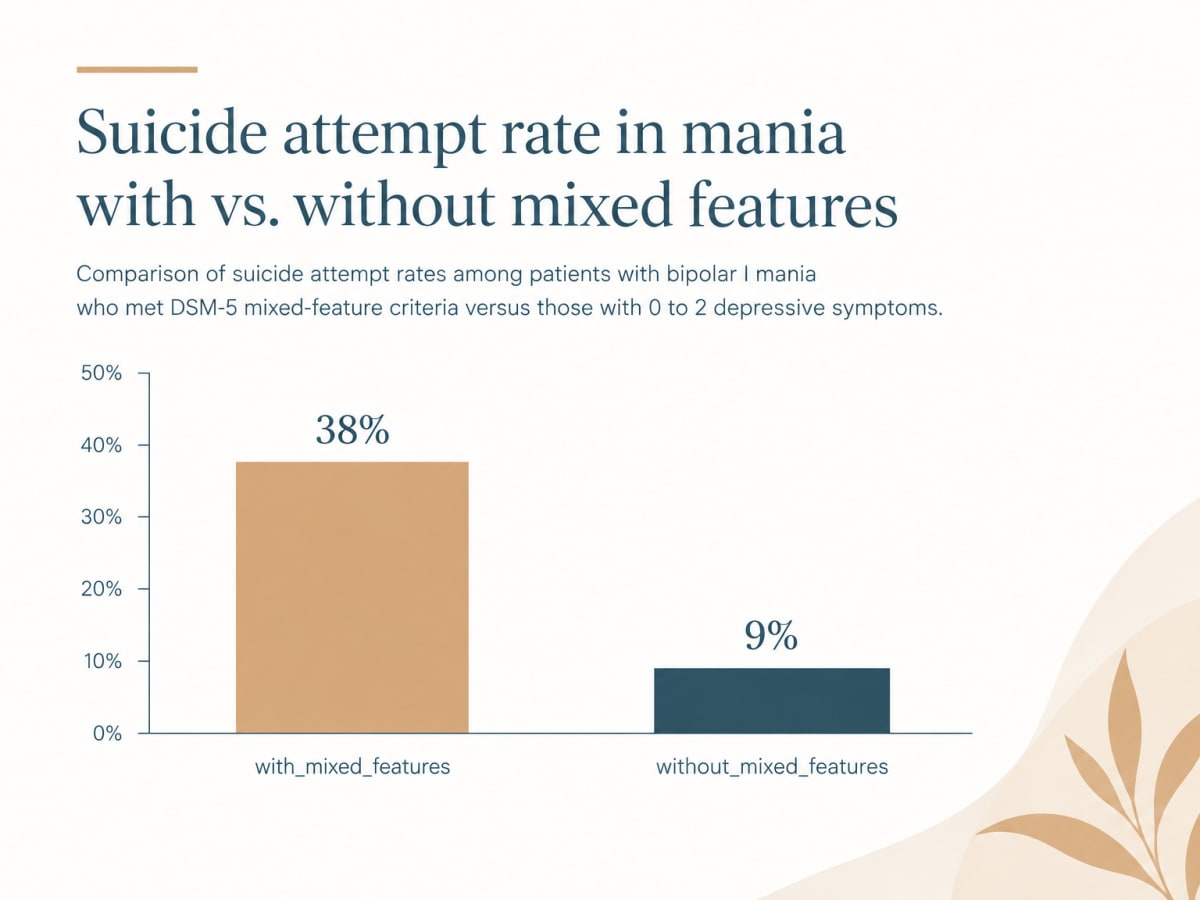
- Suicide risk climbs sharply when depressive symptoms layer onto mania, with 38% of mixed-features patients reporting past attempts versus 9% without that overlap 4.
- Antidepressant monotherapy can worsen the agitation underneath, so treatment should match the specific symptom mix, often favoring second-generation antipsychotics and careful reassessment for undertreated illness 10, 15.
When Mania Doesn’t Feel Like Mania
If you’ve ever felt wired and hopeless at the same time, there’s a name for what you’re going through. It’s not a glitch in your diagnosis. It’s not weakness, drama, or you being “too much.” The pattern of racing thoughts riding on top of a pit-of-the-stomach despair has been studied for decades, and clinicians have words for it: dysphoric mania, or in the current diagnostic language, a manic episode with mixed features.
Classic mania, the kind you’ve probably read about, tends to come with euphoria, grand plans, and an unshakable sense that everything is finally clicking. Dysphoric mania runs on different fuel. The engine of mania is still revving, so you can’t sleep, can’t slow your thoughts, can’t sit still. But instead of elation, you feel irritable, agitated, and flooded with hopelessness or guilt. Both polarities are turned up at once 2.
If that’s confusing to live inside, you’re not alone. It’s also confusing to describe to the people trying to help you. One doctor may call it a mixed episode. Another says mixed features. A relative Googles it and comes back with “dysphoric mania.” Same territory, different maps.
Over the next few sections, you’ll find a plain-language guide to what this pattern is, how to recognize it, why the risks deserve honest attention, and what thoughtful treatment actually looks like. If you’re in crisis right now, call or text 988 in the U.S. or go to your nearest emergency room. The rest can wait until you’re safe.
The Clinical Picture: From ‘Dysphoric Mania’ to ‘Mixed Features’
What the Term Originally Meant
The phrase dysphoric mania has been in the clinical vocabulary for decades. It was the shorthand clinicians used for a manic episode that didn’t look happy — one shot through with irritability, anxiety, hopelessness, or agitation instead of euphoria. An earlier review of the literature already treated it as a candidate for its own distinct state, flagging that these presentations seemed linked to greater severity, higher suicidality, more substance misuse, and poorer outcomes than straightforward euphoric mania 1.
The catch, even then, was that no two research groups agreed on where to draw the line. How many depressive symptoms counted? Did low mood need to be present, or was agitation enough? Because the thresholds kept moving, studies produced different prevalence numbers and sometimes contradictory conclusions about treatment response 1.
So if your clinician used “dysphoric mania” in a session, they weren’t speaking out of date. They were using the older, intuitive label for something your gut already recognized: a mania that hurts.
How the DSM-5-TR Changed the Language
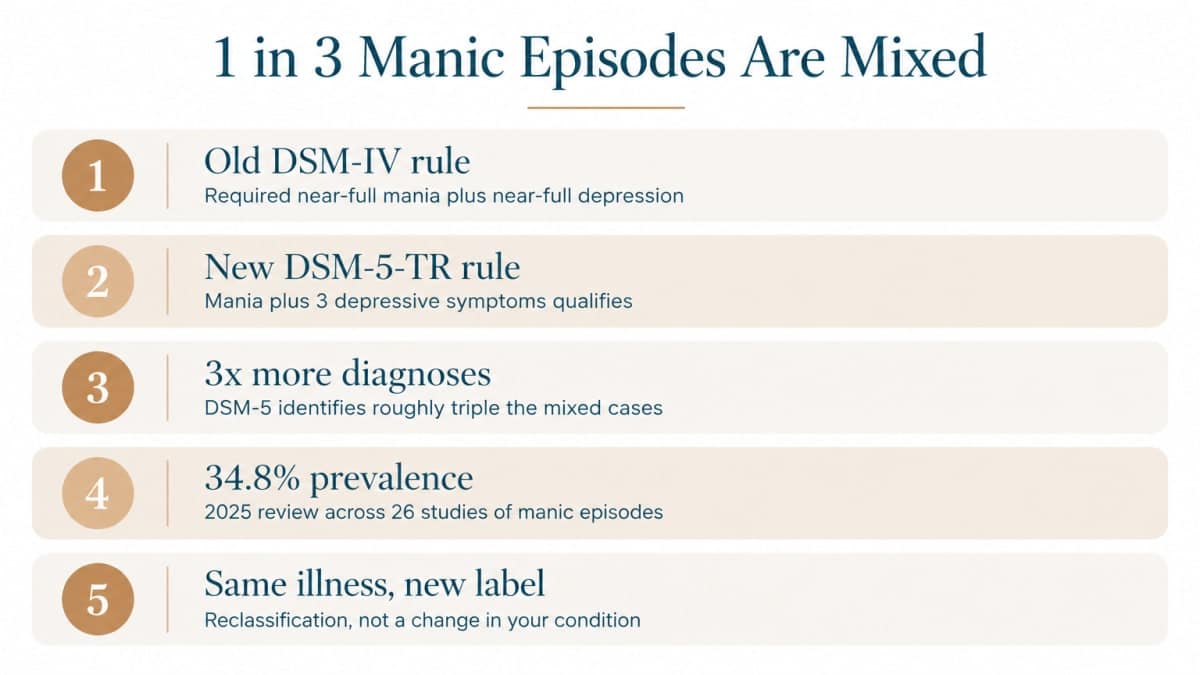
When the DSM-5 arrived, the diagnostic manual retired the old “mixed episode” category — which had required a near-full depressive syndrome layered on a near-full manic one — and replaced it with a “with mixed features” specifier. Under the current language, a manic or hypomanic episode qualifies for mixed features when at least three depressive symptoms (such as dysphoria, loss of interest, fatigue, guilt, psychomotor change, or suicidal thinking) show up during the episode 19. The DSM-5-TR kept this framework.
That shift matters more than it sounds. One head-to-head analysis found that DSM-5 criteria identified roughly three times as many patients with mixed features as the stricter DSM-IV-TR definition did 6. In other words, people who had been labeled as having “pure” mania under the old rules now meet criteria for mania with mixed features under the new ones.
The clinical weight behind that reclassification is substantial. In a prospective naturalistic study of 1,035 adults in bipolar I manic episodes, 34% met DSM-5 criteria for mixed features 4. A 2025 systematic review across 26 studies landed in nearly the same place: mixed features showed up in 34.8% of bipolar manic or hypomanic episodes 7.
Roughly one in three. That’s not a rare footnote in bipolar disorder. If your diagnosis seems to have shifted without your illness changing, this is often why.
Mania and Depression as Coexisting, Not Opposite
Most of us were taught to picture bipolar disorder as a seesaw: mania on one end, depression on the other, and you tip between them. That image is tidy, but it isn’t quite how the illness behaves for many people.
A post-hoc analysis of Stanley Foundation Bipolar Network data looked at this directly and found that patients carrying a heavier manic symptom load were also significantly more likely to carry a higher number of depressive symptoms at the same time 18. The authors described mania and bipolar depression as complementing, not opposing, poles — two dials that can both be turned up at once, not a single lever that swings one way or the other.
That dimensional view fits what dysphoric mania feels like from the inside. The racing thoughts and sleeplessness of mania don’t cancel out the heaviness and self-blame of depression. They stack. Understanding that your experience isn’t a diagnostic contradiction — it’s a well-described clinical pattern — is often the first piece of ground that stops shifting under you.
How to Recognize It in Yourself or Someone You Love
The Symptom Overlay: Activation Plus Despair
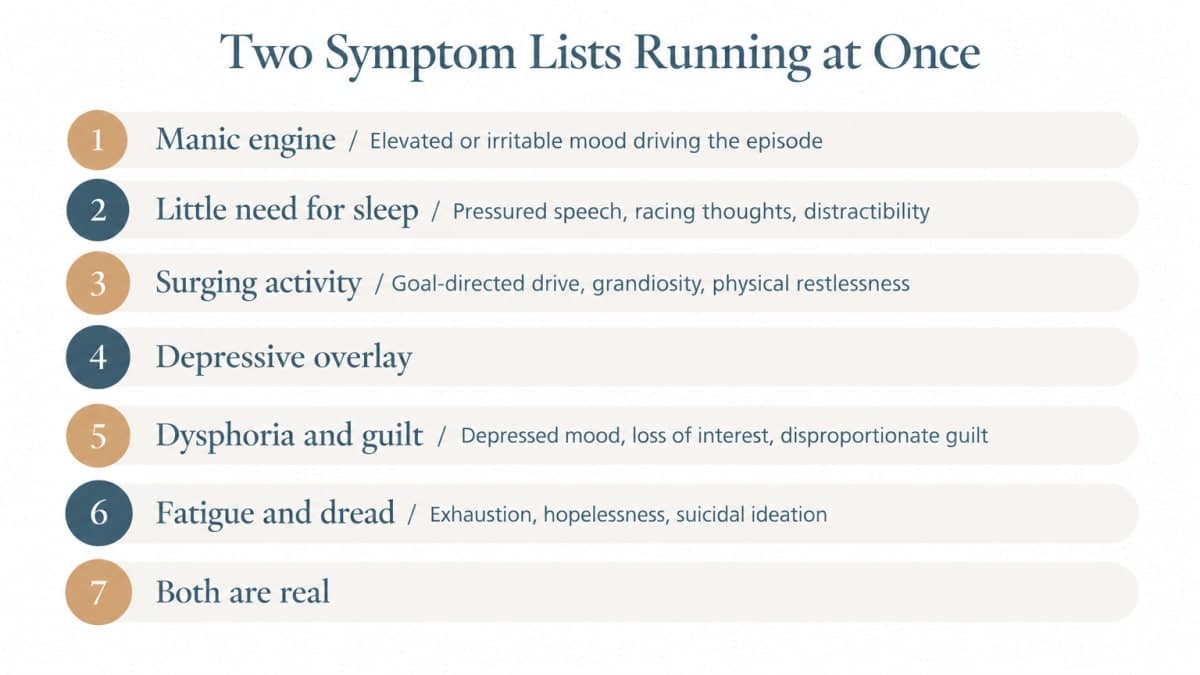
The quickest way to recognize dysphoric mania is to picture two symptom lists running at the same time instead of taking turns.
On the manic side, you have the familiar activation: elevated or irritable mood, inflated self-regard or grandiosity, a sharply decreased need for sleep, pressured speech, racing thoughts, distractibility, and a surge of goal-directed or physical activity 2. In classic euphoric mania, that engine usually comes paired with a sense of expansiveness — things feel possible, maybe even brilliant.
In dysphoric mania, the engine is still redlining, but the overlay is pulled from the depressive column. Clinicians evaluating adults with bipolar disorder look specifically for three or more intra-episodic depressive symptoms layered onto the mania or hypomania: prominent dysphoria or depressed mood, loss of interest, psychomotor changes, fatigue despite the activation, guilt that feels disproportionate, and suicidal ideation 19. The DSM-5-TR mixed-features specifier is built around that three-symptom threshold.
Put the two columns side by side and the pattern becomes legible. You are not sleeping, your thoughts are sprinting, your body cannot settle — and you feel hopeless, worthless, raw, or convinced something terrible is coming. One list is pressing the accelerator. The other is pouring dread into the tank. Both are real. Both belong to the same episode.
If that overlay matches what you’ve been trying to describe to people who look confused when you say “manic depression at the same time,” you now have the vocabulary clinicians use for it.
What a Day or Night Can Actually Feel Like
Symptom lists are useful. They are also abstract. Here is what the overlay can look like in a 24-hour window.
It is 2 a.m. You slept maybe ninety minutes. Your mind is sprinting through old arguments, half-formed projects, and intrusive thoughts about everyone you’ve let down. You can’t lie still, so you clean a drawer, then abandon it. You start three texts and send none. Your jaw is tight. There is a hum under your skin that will not stop.
By 10 a.m. you are at work or in class, talking too fast, snapping at people who don’t deserve it, convinced you are going to be fired and also furious with the person who might fire you. You pick a fight with someone you love and feel sick about it before the sentence is finished.
By late afternoon, the hopelessness lands heavier. You are still buzzing — still can’t nap, still can’t eat a full meal — but a quiet voice is already asking whether any of this is worth continuing. The guilt about the morning’s blowup starts to build.
If any of that sounds disturbingly specific, it isn’t because you are broken in a unique way. It is because this pattern has a shape, and clinicians have been documenting it for a long time.
What to Watch for If You’re the Family Member
From the outside, dysphoric mania rarely looks like the big, obvious mania in a movie. It can look like your person is unraveling in a quieter, meaner way.
Watch for the combination, not any single sign. Sleep collapses — three or four hours a night, often less, without the usual next-day crash. Speech speeds up, but the content turns dark: self-blame, catastrophic predictions, grievances replayed on a loop. Agitation shows up in the body: pacing, leg-bouncing, unfinished tasks scattered across the house. Irritability spikes over small things, and apologies come loaded with hopelessness instead of relief.
Keep the 988 Suicide and Crisis Lifeline saved in your phone. If direct safety is in question, do not leave them alone, and go to the emergency room. Specialists know this pattern, and it is treatable.
Why the Risks Deserve Honest Numbers
Suicidality in Mixed Mania
You deserve the real numbers, not a vague warning. In the same prospective naturalistic study of 1,035 adults in bipolar I manic episodes, 38% of those who met DSM-5 criteria for mixed features had attempted suicide, compared with 9% of those with zero to two depressive symptoms during their mania 4. That is a more than fourfold gap, and it shows up in a real-world clinical sample — not a selected group chosen to look worse.
A few honest caveats. This is observational research, so it describes an association, not a cause. The population studied was bipolar I mania specifically. And “suicide attempt” was measured over patients’ histories, not predicted for any single night. Still, the direction is clear and consistent with what earlier reviews found decades ago: when depressive symptoms layer onto manic activation, the risk of acting on suicidal thoughts climbs sharply 1.
What this means for you, practically, is that mixed presentations are not a time to “wait and see.” If you or your loved one is in a manic episode threaded with hopelessness, guilt, or thoughts of not wanting to be here, that combination warrants same-day clinical attention. Call 988, contact the treating psychiatrist, or go to the emergency room. The numbers earn that urgency.
How Anxiety, Irritability, and Agitation Change the Picture
Risk inside a mixed episode is not flat. It climbs with the intensity of the symptoms that make dysphoric mania so hard to sit with in the first place.
In the same 1,035-patient sample, researchers sorted bipolar I manic episodes with depressive symptoms by how severe the anxiety, irritability, and agitation were. In the severe subgroup, 71.9% reported suicidal ideation during the episode. In the mild subgroup, that figure was 47.6% 5. Both numbers are high. The gap between them is the point.
What that tells a clinician — and what it can tell you — is that the “wired, raw, can’t-settle” symptoms are not just unpleasant. They track with risk. If your person is pacing all night, snapping at everyone, and visibly keyed up, that is not the moment to minimize what they say about despair. Treating the agitation and anxiety aggressively, often alongside the mood symptoms, is part of keeping them safer. Specialists who work with mixed presentations build the safety plan around this gradient rather than around the diagnosis label alone.
Substance Use, Rapid Cycling, and Overlapping Complexity
Dysphoric mania rarely travels alone. Two companions show up often enough that any honest conversation about risk has to name them.
The first is substance use. A meta-analysis across 29 studies of 31,294 people with bipolar disorder found that 20.1% had a documented suicide attempt, with co-occurring alcohol or substance use disorders significantly raising those odds 14. Alcohol, stimulants, and withdrawal states can all mimic, mask, or inflame the agitation and sleeplessness of mixed mania, which is one reason clinicians screen carefully and why integrated treatment — mental health and substance use addressed together — matters when both are in play.
The second is rapid cycling, defined as at least four qualifying mood episodes in a year. A systematic review of 30 studies covering 13,698 people with bipolar disorder found 27.6% met rapid-cycling criteria, and rapid cycling is linked with greater morbidity and poorer treatment response 13. Rapid cycling is not the same thing as dysphoric mania, but these patterns often share patients, and together they describe the territory that gets labeled “complex bipolar”: mixed features, cycling frequently, often with substance use layered on top. Recognizing that overlap is what changes a treatment plan from generic to specific.
Why Standard Treatment Sometimes Falls Short
The Antidepressant Monotherapy Problem
One of the most common ways care goes sideways in dysphoric mania is that the depressive layer gets treated first — and alone. From the outside, the hopelessness, the fatigue despite not sleeping, the guilt, the suicidal thinking all look like a bad depressive episode. An antidepressant gets added. Sometimes two.
If a round of antidepressant monotherapy left you more wired, more irritable, or more hopeless, you were not failing the medication. The medication was aimed at half the picture.
What the Evidence Actually Supports
Here is the honest state of the evidence: it is thinner than most people assume. One review of treatments specifically for DSM-5-defined mixed features in bipolar I and II identified only two randomized controlled trials and six post-hoc analyses — all evaluating second-generation antipsychotics — and concluded that there is preliminary support for this class but not enough data to confidently endorse or reject particular agents, especially the traditional mood stabilizers under the newer definition 10. A broader review of mixed states reached a similar verdict, with limited randomized support for olanzapine, aripiprazole, asenapine, valproate, and carbamazepine in the populations that have been studied 9.
A 2026 systematic review and meta-analysis of 22 studies involving 3,525 participants — focused on depressive episodes with mixed features rather than manic episodes with mixed features — found the most consistent randomized signal for antipsychotic treatment overall, with reported benefits for lurasidone and ziprasidone versus placebo 11. On the regulatory side, cariprazine is FDA-labeled for acute manic or mixed episodes associated with bipolar I disorder, and divalproex (Depakote ER) is labeled for acute manic or mixed episodes associated with bipolar disorder, though those labels reflect the mixed-episode framework used in registration trials rather than a precise match to today’s mixed-features specifier 16, 17.
For severe or pharmacotherapy-resistant mania when rapid control is needed, the VA/DoD guideline supports considering ECT alongside pharmacotherapy 3. The practical read: there are real options, but no single “right answer,” and matching the regimen to your specific symptom mix matters more than searching for a magic pill.
True Treatment Resistance vs. Undertreated Illness
Before you decide — or anyone decides for you — that treatment has “stopped working,” it’s worth separating two very different situations that get called the same thing.
The International Society for Bipolar Disorders consensus definition of treatment-resistant bipolar depression sets a specific bar: failure to achieve a significant and sustained response after at least two approved, adequately dosed pharmacological treatments given for sufficient duration, with documented adherence 15. The definition is for bipolar depression rather than mania, but the logic travels. Each of those words — adequate dose, sufficient duration, adherence — is doing real work.
A lot of what gets called resistance is actually something more fixable: a dose that was never raised to a therapeutic range, a trial cut short after two weeks, a mood stabilizer paired with an antidepressant that was never stopped, undiagnosed alcohol or stimulant use quietly shaping the picture, or a diagnosis that didn’t yet account for mixed features. Pinning down which situation you are in — true resistance or undertreated illness — is often the single most useful thing a careful psychiatric reassessment can do.
What Specialized Care for Complex Bipolar Looks Like
When mixed features, rapid cycling, and substance use overlap, the care plan has to get more specific — not more aggressive, more precise. Here is what that usually involves.
A thorough reassessment comes first. That means a careful episode history, a symptom-by-symptom look at the overlap of mania and depression during the current episode, a direct conversation about alcohol and drug use (including stimulants, cannabis, and withdrawal states), a structured suicidality assessment, and a detailed review of every past medication trial — dose, duration, response, side effects, and whether you actually took it as prescribed. That last piece is how clinicians separate true treatment resistance (as defined for bipolar depression) from undertreated illness 15.
From there, the medication strategy is built around your specific mix rather than a generic bipolar protocol. Second-generation antipsychotics have the clearest preliminary randomized evidence in mixed presentations 10, and the VA/DoD guideline supports considering ECT alongside pharmacotherapy for severe or treatment-resistant mania when rapid control is needed 3. When substance use is in the picture, mental health and addiction are treated together from day one, not handed off between programs.
Specialized care also means time. Stabilizing a mixed episode, adjusting medications, letting a trial run long enough to judge honestly, and building a safety plan your family can actually use is not a two-week project. If standard outpatient care has not held, a specialty psychiatric program that works with complex bipolar presentations — including options in Prescott, Arizona — is a reasonable next step.
Get Clarity About Complex Mood Symptoms
Discuss whether specialized care may fit your dysphoric mania symptoms and what treatment options could be considered.
Frequently Asked Questions
Is dysphoric mania the same thing as a mixed episode?
They overlap, but the terms come from different eras. “Dysphoric mania” is the older clinical shorthand for a manic episode shot through with irritability, agitation, or hopelessness 1. “Mixed episode” was the DSM-IV-TR category that required a near-full depressive syndrome layered on a near-full manic one. The current DSM-5-TR uses a “with mixed features” specifier when at least three depressive symptoms show up during mania 19.
How is dysphoric mania different from regular mania?
Classic mania usually comes with euphoria, expansiveness, and a feeling that things are clicking. Dysphoric mania keeps the manic engine — reduced sleep, racing thoughts, pressured activity — but swaps euphoria for irritability, anxiety, agitation, guilt, or hopelessness 2. You’re wired and miserable at the same time, not wired and elated. That overlap is what makes the pattern feel so disorienting and so hard to describe.
Can antidepressants make dysphoric mania worse?
They can. When an antidepressant is used alone in a presentation that already carries manic activation, agitation, and racing thoughts, it can intensify the symptoms you were hoping to calm. The VA/DoD guideline notes that evidence for the mixed-features specifier is limited and urges individualized treatment rather than defaulting to standard depression protocols 3. If a trial left you more wired or more hopeless, that’s worth telling your prescriber directly.
How do I know if my loved one is experiencing dysphoric mania and not just a bad depression?
Look for activation running underneath the despair. Someone in “just” a severe depression typically slows down. In dysphoric mania, sleep collapses to a few hours without a next-day crash, speech speeds up even as content turns dark, and the body won’t settle — pacing, bouncing, restless hands 2. When energy and hopelessness rise together, that overlap is the signal to call a clinician the same day, not wait.
What should I do if someone with dysphoric mania is talking about suicide?
Take it seriously and act now. In mixed mania, suicidal ideation reached 71.9% in the severe anxiety-irritability-agitation subgroup of one 1,035-patient study 5. Stay with your person, remove access to firearms and lethal medication amounts, and call or text 988 in the U.S. If they can’t be kept safe, go to the emergency room. Contact their psychiatrist the same day so the treatment plan can be adjusted.
Why hasn’t standard bipolar treatment worked for me?
Several reasons are more common than true treatment resistance. A dose may never have reached a therapeutic range, a trial may have ended too soon, an antidepressant may still be driving agitation, or undiagnosed substance use may be shaping the picture. The ISBD consensus — developed for bipolar depression rather than mania — defines true resistance as failure after two adequately dosed, adequately long trials with documented adherence 15. A careful reassessment often reveals which situation you’re actually in.
References
- Clinical and research implications of the diagnosis of dysphoric or mixed mania or hypomania. https://pubmed.ncbi.nlm.nih.gov/1359799/
- Bipolar Disorder. https://www.nimh.nih.gov/health/publications/bipolar-disorder
- VA/DoD Clinical Practice Guideline for Management of Bipolar Disorder — Provider Summary. https://www.healthquality.va.gov/guidelines/MH/bd/VA-DOD-CPG-BD-Provider-SummaryFinal508.pdf
- Evaluating depressive symptoms in mania: a naturalistic study of patients with bipolar disorder. https://pmc.ncbi.nlm.nih.gov/articles/PMC4425329/
- Suicidality and symptoms of anxiety, irritability, and agitation in patients experiencing manic episodes with depressive symptoms: a naturalistic study. https://pmc.ncbi.nlm.nih.gov/articles/PMC5012613/
- Prevalence rates and clinical implications of bipolar disorder “with mixed features” as defined by DSM-5. https://pubmed.ncbi.nlm.nih.gov/25462405/
- Mixed features in depressive and bipolar disorders: An updated systematic review. https://pubmed.ncbi.nlm.nih.gov/41448395/
- Mixed symptoms in major depressive and bipolar disorders: A systematic review. https://pubmed.ncbi.nlm.nih.gov/28922738/?dopt=Abstract
- Mixed states in bipolar disorder — changes in DSM-5 and current treatment recommendations. https://pubmed.ncbi.nlm.nih.gov/28417647/
- Treatment of mixed features in bipolar disorder. https://pubmed.ncbi.nlm.nih.gov/27618746/
- Treatment of depressive episodes with mixed features: A systematic review and meta-analysis. https://pubmed.ncbi.nlm.nih.gov/41421054/?fc=None%26ff=20251222235619%26v=2.18.0.post22+67771e2
- Rapid cycling in bipolar disorder: a systematic review. https://pubmed.ncbi.nlm.nih.gov/25004199/
- Prevalence and outcomes of rapid cycling bipolar disorder. https://pubmed.ncbi.nlm.nih.gov/37429185/
- Attempted suicide in people with co-occurring bipolar and substance use disorders: systematic review and meta-analysis. https://pubmed.ncbi.nlm.nih.gov/24955564/
- Defining Treatment-Resistant Bipolar Depression. https://pubmed.ncbi.nlm.nih.gov/40808269/
- VRAYLAR. https://www.accessdata.fda.gov/drugsatfda_docs/label/2025/204370s014s015s016s017lbl.pdf
- Depakote ER. https://www.accessdata.fda.gov/drugsatfda_docs/label/2025/021168s048lbl.pdf
- Mania and bipolar depression: complementing not opposing poles—a post-hoc analysis of mixed features in manic and hypomanic episodes. https://pmc.ncbi.nlm.nih.gov/articles/PMC8593087/
- The clinical characterization of the adult patient with bipolar disorder: a systematic review. https://pmc.ncbi.nlm.nih.gov/articles/PMC9453915/