Key Takeaways
- In Prescott, evidence-based care means named protocols like CBT and DBT delivered with staff training, fidelity checks, and documentation — not marketing adjectives layered onto a program description 10.
- For co-occurring psychiatric and substance use disorders, SAMHSA names integrated treatment — one team, one plan, both diagnoses on the table together — as the standard of care 9.
- Local decisions should map the full continuum: 988, the statewide crisis line at 1-844-534-HOPE, Yavapai County’s 877-756-4090, county outpatient services, and specialized psychiatric care for complex cases 2, 5, 8.
- Before committing, compare programs on named modalities, fidelity monitoring, psychiatry-therapy coordination, measurement instruments like PHQ-9 and PCL-5, length of stay logic, and whether board-certified psychiatry is reachable at 2 a.m.
What “Evidence-Based” Actually Means When a Program Claims It
You have probably seen the phrase on every treatment website you have opened this month. “Evidence-based.” It sits next to words like holistic and personalized, and after a while it stops meaning anything at all. If you have already been through a program that promised evidence-based care and watched a loved one relapse or deteriorate anyway, your skepticism is earned. It is also useful. Hold onto it.
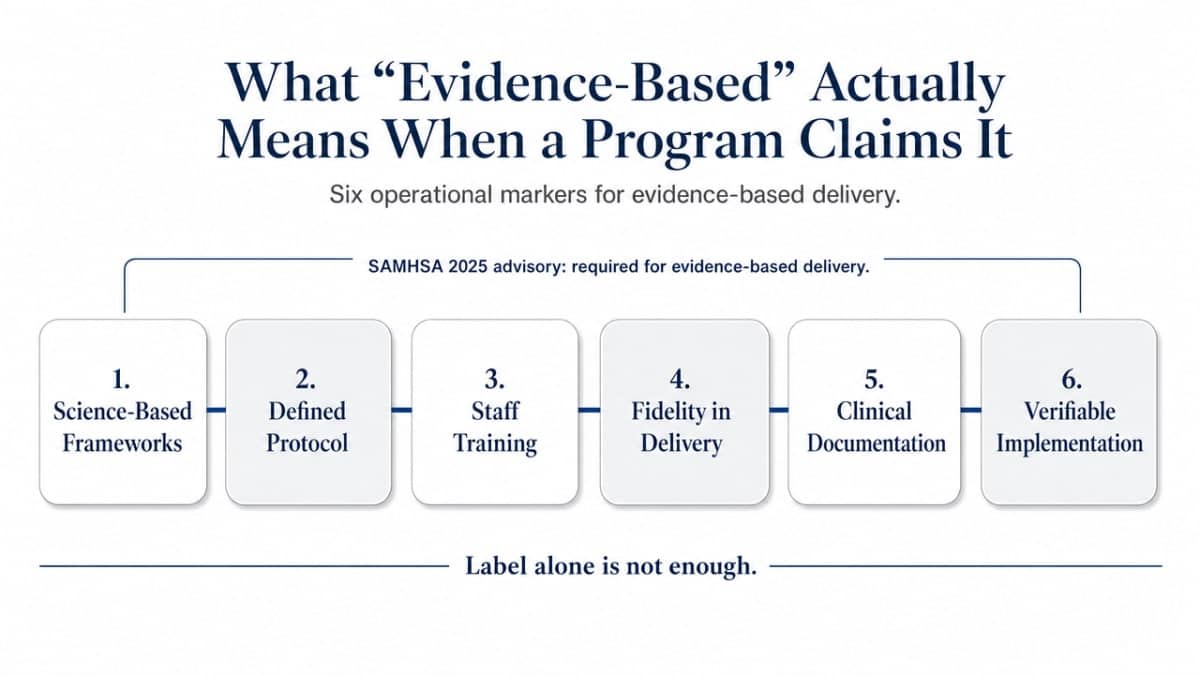
At the federal level, the term has a specific spine. SAMHSA’s Evidence-Based Practices Resource Center defines it through toolkits, treatment improvement protocols, clinical guidelines, and other science-based materials that clinicians are expected to actually follow 10. The point is not the label. The point is the underlying protocol, the training required to deliver it, and the documentation that proves it happened.
SAMHSA’s January 2025 advisory on contingency management makes those operational markers unusually concrete. To count as evidence-based delivery, a program is expected to:
- use objective targets that can be measured,
- provide reinforcement or feedback promptly,
- train staff in the specific protocol,
- monitor fidelity to that protocol over time,
- keep written documentation of what was delivered, and
- sustain the intervention long enough to matter — a minimum of 12 weeks in the case of contingency management 1.
Loose usage of the term skips most of that. A program can call itself evidence-based because someone on staff was trained in CBT ten years ago, or because a group room is labeled “DBT skills” without a certified therapist running the curriculum as designed.
So when you evaluate a program, you are really asking six questions:
- Which named protocols?
- Trained by whom?
- Delivered with what fidelity checks?
- Measured against which outcomes?
- Documented how?
- For how long?
A program that can answer plainly is describing evidence-based care. A program that answers in adjectives is describing marketing.
ViewPoint Dual Recovery builds its clinical foundation on DBT, CBT, and psychiatric best practices — named modalities with tested protocols behind them, delivered by an integrated team of board-certified psychiatrists and licensed therapists. That is the standard the federal literature actually describes.
The Clinical Modalities Behind Real Evidence-Based Care
Cognitive Behavioral Therapy: Strong Recommendation, Honest Limits
CBT is probably the modality you have heard named most often, and for good reason. When researchers apply the GRADE system — the same framework used to rate medical interventions — CBT for substance use disorders earns a strong recommendation backed by moderate-quality evidence, producing small to moderate effects on substance use across diverse populations 11. That is not a modest endorsement. It puts CBT in the small group of psychosocial treatments that have been tested rigorously enough to be called evidence-based in the technical sense of the phrase.
For the dual diagnosis reader, the picture gets more specific. A review of behavioral therapies for co-occurring substance use and mood disorders found that CBT produces a moderate but durable effect on both substance use and depressive symptoms — meaning the gains do not evaporate the moment sessions end 13. Durability matters when you are dealing with rapid-cycling bipolar disorder, recurrent depression, or trauma-driven substance use, where the risk is not just a bad week but a repeating pattern.
That is why CBT works best as one instrument in a coordinated plan, not as a standalone promise. At ViewPoint, CBT is delivered by clinicians trained in the protocol and integrated with psychiatric care, so the thinking-and-behavior work in session is calibrated against what the medication is doing and what your history has already tried. That is what evidence-based delivery looks like when it is more than a label.
DBT and Skills-Based Work for Distress Tolerance
If CBT is the modality that changes how you think about a situation, DBT is the modality that teaches you what to do when the situation is already on fire. Dialectical Behavior Therapy was built for people whose emotional intensity had made other therapies stall — self-harm, chronic suicidality, the kind of dysregulation that treatment-resistant mood disorders and complex trauma tend to produce.
The core of DBT is skills:
- Distress tolerance, so a craving or a flashback does not end in a relapse or an ER visit.
- Emotion regulation, so the swing from numb to overwhelmed becomes something you can actually track.
- Interpersonal effectiveness, so relationships stop reliably making things worse.
- Mindfulness, so you can notice what is happening before you react to it.
These are teachable, practiceable behaviors — not insights you are expected to have on your own between sessions.
For someone with a dual diagnosis, that matters in a practical way. Cravings and mood spikes tend to arrive together, and a skill you have rehearsed under lower pressure is the one you can reach for when pressure is high. A skill you have only read about in a workbook is not.
At ViewPoint, DBT concepts are woven into individual and group therapy, and the skills work is coordinated with psychiatric care so that pharmacological stabilization and behavioral skill-building reinforce each other rather than running on separate tracks. You should not have to translate between your psychiatrist and your therapist. That is their job.
Psychiatric Medication Management for Complex and Treatment-Resistant Cases
Therapy is one leg of the stool. For treatment-resistant schizophrenia, rapid-cycling bipolar disorder, and severe depression that has not moved with first-line agents, the medication decisions carry equal weight — and they get harder, not easier, the further you get from a textbook presentation.
Advanced medication management means a few specific things:
- A psychiatrist who takes a detailed history of what you have already tried, at what doses, for how long, and with what side effects, so you are not repeating the same three months that failed you last year.
- Titration decisions made against measurable symptom change, not calendar deadlines.
- Clozapine considered on its own clinical merits when the criteria fit, with the required blood monitoring and coordination handled inside the facility rather than punted to you.
- Honest conversations about which side effects are transient and which are dealbreakers you get to name.
SAMHSA’s federal treatment protocol for co-occurring disorders is direct on this point: integrated treatment planning, in which psychiatric and substance use decisions are made together rather than in parallel silos, is the standard of care for people carrying both diagnoses 9. That is because a medication choice for bipolar disorder in someone with active alcohol use is a different decision than the same choice in someone who is fully abstinent, and pretending otherwise produces bad outcomes.
ViewPoint keeps board-certified psychiatry at the center of treatment, which is not a luxury feature for stable outpatients — it matters when a medication change produces an unexpected reaction at 2 a.m., or when a patient in early stabilization needs a same-day adjustment rather than a wait-list appointment two weeks out. That responsiveness is what evidence-based psychiatric care actually requires when the cases are complex.
Integrated Treatment for Co-Occurring Psychiatric and Substance Use Disorders
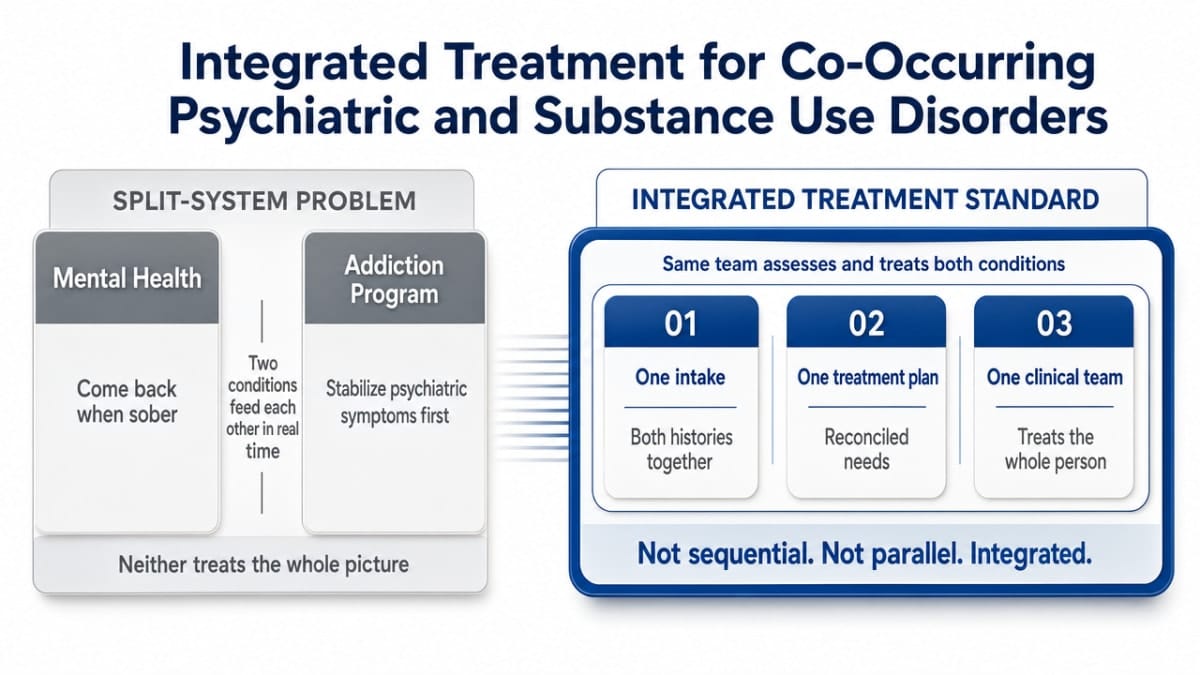
If you carry both a psychiatric diagnosis and a substance use disorder, you already know the split-system problem. Mental health providers ask you to come back when you are sober. Addiction programs ask you to get your psychiatric symptoms under control first. Neither will treat what is actually happening, which is that the two conditions feed each other in real time.
The evidence for what to do inside that integrated plan is more specific than the marketing sometimes suggests. In co-occurring mood and substance use populations, CBT shows a moderate but durable effect on both substance use and depressive symptoms, and contingency management shows robust effects on substance use when it is delivered with fidelity 13. Durable is the operative word. You are not looking for a spike of motivation that fades by month three. You are looking for gains that hold up under stress, after discharge, when the group room is no longer down the hall.
What integrated care looks like day to day at ViewPoint is simpler than it sounds. Your psychiatrist and your therapist share the case, not just the chart. Medication choices for bipolar disorder or schizophrenia are made with your current substance use pattern on the table, because a mood stabilizer decision for someone actively drinking is a different decision than the same one for someone in stable abstinence. Trauma work is paced against psychiatric stability, so exposure does not outrun what your nervous system can handle that week. Skills you learn in DBT group get referenced in your individual sessions and reinforced by the psychiatric team, so you are practicing the same tools everywhere instead of translating between clinicians.
That coordination is what “integrated” is supposed to mean. When it is real, the small wins start showing up in places you can measure — a week of steady sleep, a craving you rode out with a skill instead of a substance, a medication adjustment that landed without a crisis. Those are not small at all.
How Outcomes Are Actually Measured in Rigorous Programs
“Success rate” is the vaguest term in behavioral health, and it usually means whatever the program wants it to mean. A rigorous program measures specific things, on a schedule, using instruments you could name — and it can tell you what changed between admission, discharge, and follow-up.
SAMHSA’s guidance on co-occurring care in youth and young adults is a useful model here because it lists what an evidence-based CBT protocol is expected to move:
- frequency of marijuana use,
- frequency of general substance use,
- severity of PTSD symptoms,
- severity of depressive symptoms, and
- frequency of trauma-associated cognitions 12.
That is not marketing language. Those are five distinct variables, each of which can be tracked with a validated scale and each of which tells you something different about how someone is actually doing.
Applied to adults in dual diagnosis care, the measurement discipline looks similar. Depressive symptoms get tracked with an instrument like the PHQ-9 rather than a clinician’s impression. PTSD severity gets tracked with the PCL-5 or a comparable scale. Substance use gets counted honestly — days of use, quantity, longest abstinence interval — instead of collapsed into a pass/fail. Cravings and trauma-related thoughts get logged over time so patterns show up, not just endpoints.
Retention matters too, because a modality delivered for two weeks is not the same intervention as one delivered for twelve. SAMHSA’s contingency management advisory sets a 12-week minimum for that reason 1. Whatever the modality, ask how long people typically stay and how the program knows when someone is ready to step down.
Functional recovery is the outcome that eventually matters most and gets measured least. Are you sleeping. Are you eating. Are you calling one person you trust. Are you taking your medication without a fight. Are you employed, or in school, or caring for someone. Those are the small wins that predict whether the clinical gains will hold once the group room is no longer down the hall.
At ViewPoint, symptom tracking, medication response, and behavioral targets are documented across the integrated team so that your psychiatrist and your therapist are looking at the same picture week to week. That is what makes outcome measurement useful — not as a report card, but as a real-time signal about what to adjust next.
Where ViewPoint Sits in Prescott and Yavapai County’s Care Continuum
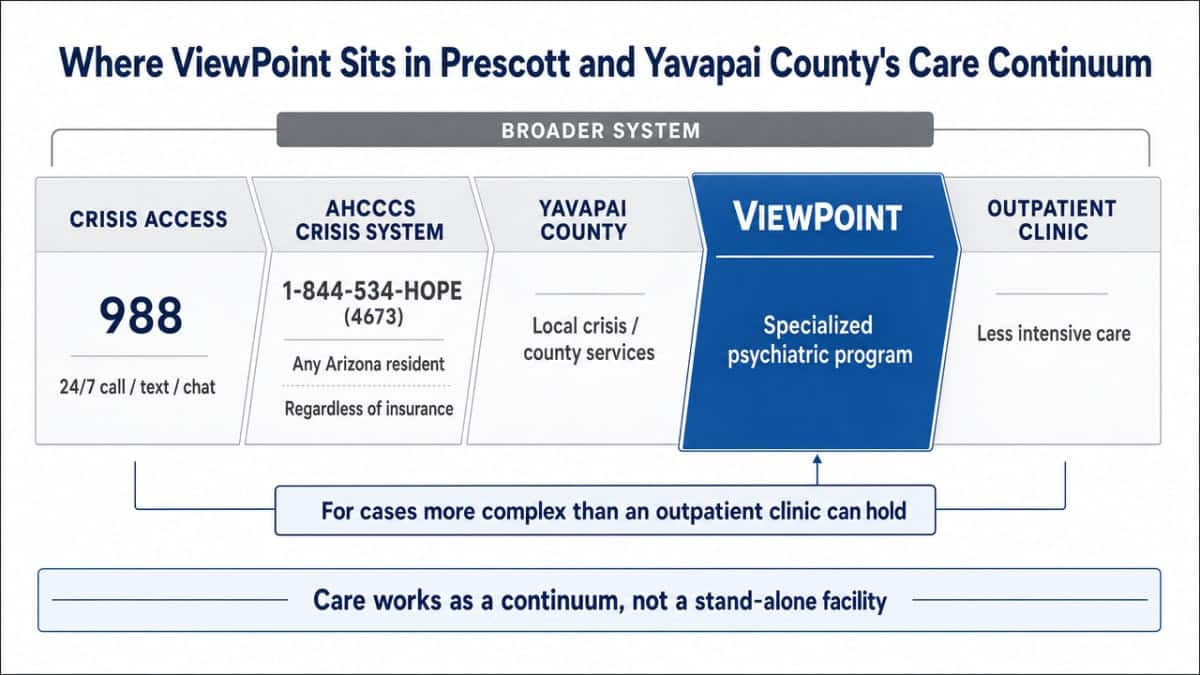
No treatment facility should stand alone, and the good ones do not pretend to. If you are evaluating care in Prescott, it helps to see the whole map first — where the crisis doors are, where the county services fit, and where a specialized psychiatric program like ViewPoint belongs when the case is more complex than an outpatient clinic is equipped to hold.
Start with crisis access, because that is the layer that has to be reachable at 2 a.m. on a Saturday. In Arizona:
- 988 is the front door for suicide, mental health, and substance-related crises, with 24/7 call, text, and chat staffed by trained counselors 2.
- The AHCCCS crisis system runs alongside it, with the statewide behavioral-health crisis line at 1-844-534-HOPE (4673) available to any Arizona resident regardless of insurance 5.
- Locally, the Yavapai County crisis line at 877-756-4090 is another 24/7 entry point that connects residents to mobile teams and stabilization services 8.
Save all three. You should not have to think about which one to try first when you are already in a hard moment.
One layer up from crisis, the county runs its own behavioral-health infrastructure. Yavapai County offers counseling, psychiatric services, medication management, and substance-use treatment including medications for opioid use disorder across Prescott, Prescott Valley, and Cottonwood 6. Prescott Community Health Services operates from 1090 Commerce Drive as a public-health coordination point 7. Arizona’s behavioral-health delivery is also organized around integrated contracting that pushes physical and behavioral care to coordinate rather than sit in separate silos 4, and AHCCCS parity oversight gives you a channel to raise coverage concerns when a plan is not honoring behavioral-health benefits the way it should 3.
ViewPoint Dual Recovery sits one level deeper in that continuum. When a case is treatment-resistant, dual diagnosis, or complicated by rapid-cycling bipolar disorder or a clozapine decision, county outpatient services and crisis lines are the wrong tool — not because they are inadequate, but because they were built for a different job. ViewPoint is the layer designed for the cases other programs describe as too complex, with board-certified psychiatry and an integrated therapy team inside the same facility. Knowing that geography — crisis, county, specialized psychiatric care — is what lets you use each piece for what it actually does well.
What to Ask Before You Commit to a Program
The intake call is the interview. You are not being difficult by asking hard questions — you are doing the work a good clinician would want you to do. Here is what to ask, and what a substantive answer sounds like.
Which specific modalities do you use, and who is trained in them? You want named protocols — CBT, DBT, integrated co-occurring treatment — not category words. Ask who on staff is trained, in what, and how recently. SAMHSA’s own framing of evidence-based practice is built around specific toolkits, treatment improvement protocols, and clinical guidelines that clinicians follow 10. If the answer stays at the level of “we use evidence-based approaches,” you have not learned anything yet.
How do you check that those modalities are actually delivered the way they were tested? Fidelity monitoring is the difference between a program that runs CBT and a program that says the word. SAMHSA’s contingency management advisory names the operational markers: written protocols, staff training in the specific model, documentation of what was delivered, and sustained duration long enough to matter 1. Ask what that looks like inside their walls.
How is integrated care actually coordinated between psychiatry and therapy? For co-occurring cases, the federal standard is integrated treatment — one team, one plan, both diagnoses on the table together 9. Ask whether the psychiatrist and therapist meet about your case, how often, and whether medication decisions are made with your current substance use pattern in the room.
What outcomes do you measure, on what schedule, using which instruments? A good program can name the scales — PHQ-9, PCL-5, days of use, longest abstinence interval — and tell you when they are administered.
How long do people typically stay, and what determines readiness to step down? Duration should be driven by clinical response, not by an insurance calendar. If the answer is a fixed 28 or 30 days regardless of the case, you are not talking about individualized care.
What happens at 2 a.m.? Ask who is reachable, how quickly, and whether board-certified psychiatry is available around the clock or only during business hours. For treatment-resistant cases, that answer changes everything.
A program that answers these plainly is describing evidence-based care. That is the call worth making.
When Previous Treatment Didn’t Work: A Note for Families and Referring Clinicians
If you are reading this because someone you love has already been through two, three, or five programs, or because you are a clinician trying to find the right next referral for a patient who keeps cycling, this section is for you. The exhaustion is real. So is the fear that the next program will look like the last one.
A history of “failed” treatment is not usually a failure of the patient. It is often a mismatch between the acuity of the case and the design of the program. Standard outpatient care, and even many residential programs, are built around a middle of the distribution — people whose psychiatric and substance use presentations respond to first-line protocols delivered on a typical timeline. Treatment-resistant schizophrenia, rapid-cycling bipolar disorder, and trauma-driven co-occurring illness sit outside that middle. When a program without integrated psychiatric depth tries to hold those cases, the plan comes apart in predictable ways: a mood stabilizer is chosen without the substance use pattern in the room, trauma work outruns stability, or a discharge date arrives before symptoms have actually moved.
The federal standard for those cases is not more of the same. It is integrated treatment, delivered by a team that assesses and treats both diagnoses together rather than in sequence 9. For referring clinicians, that is the practical filter to apply: does the next program have board-certified psychiatry inside the walls, does it use named modalities like DBT and CBT with clinicians trained in them, and does it document what changed against measurable targets?
For families, the takeaway is smaller and heavier. Ask the six questions from the section above. A program that answers plainly — about modalities, fidelity, integration, measurement, duration, and 2 a.m. coverage — is describing the level of care a complex case actually needs. That call is where the next chapter starts.
Clarify Next Steps for Complex Case Care
Receive expert feedback on evidence-based options for treatment-resistant and dual diagnosis presentations.
Frequently Asked Questions
What does “evidence-based” actually mean in mental health treatment?
It means care built on tested protocols with published outcomes, delivered by trained clinicians who follow the protocol as designed. SAMHSA frames it through toolkits, treatment improvement protocols, and clinical guidelines that clinicians are expected to actually follow 10. A program can name its modalities, describe how staff are trained, and document what was delivered. If those answers are missing, the phrase is doing marketing work, not clinical work.
Which therapies does ViewPoint Dual Recovery use, and why those?
ViewPoint’s clinical foundation is DBT, CBT, and psychiatric best practices, delivered by an integrated team of board-certified psychiatrists and licensed therapists. CBT carries a strong recommendation as an evidence-based treatment for substance use disorders under the GRADE system 11. DBT builds the distress tolerance and emotion regulation skills that treatment-resistant mood and trauma cases actually need. Psychiatric medication management ties the behavioral work to the biology so the two reinforce each other.
Can ViewPoint treat co-occurring psychiatric and substance use disorders together?
Yes, and that is the point of the program. The federal treatment protocol for co-occurring disorders names integrated treatment — one team assessing and treating both diagnoses in a single coordinated plan — as the standard of care 9. At ViewPoint, your psychiatrist and therapist share the case rather than the chart alone, so medication decisions for bipolar disorder or schizophrenia are made with your current substance use pattern in the room.
How are treatment outcomes measured beyond vague “success rates”?
Through specific instruments on a schedule. Depressive symptoms get tracked with a scale like the PHQ-9, PTSD severity with the PCL-5, substance use as days of use and longest abstinence interval. Retention and functional recovery — sleep, medication adherence, work, relationships — get logged over time. That measurement discipline is what makes clinical decisions responsive week to week, and it is what separates real outcome tracking from a discharge summary written to sound reassuring.
What crisis resources are available in Prescott and Yavapai County right now?
Three numbers cover 24/7 access. 988 is the Suicide and Crisis Lifeline with call, text, and chat staffed by trained counselors 2. Arizona’s statewide behavioral-health crisis line is 1-844-534-HOPE (4673), available to any resident regardless of insurance 5. The Yavapai County crisis line is 877-756-4090, which connects to local mobile teams 8. Save all three now, before you need them. You should not have to decide which to try first in a hard moment.
What should I ask a program if previous treatment didn’t work?
Ask six things. Which named modalities do you use, and who is trained in them? How do you check fidelity to those protocols 1? How do psychiatry and therapy coordinate on integrated cases 9? What outcomes do you measure, on what schedule? How long do people typically stay, and what determines readiness to step down? Who is reachable at 2 a.m.? A program that answers plainly is describing evidence-based care worth calling.
References
- Using SAMHSA Funds To Implement Evidence-Based Contingency Management Services. https://library.samhsa.gov/sites/default/files/contingency-management-advisory-pep24-06-001.pdf
- 988 Suicide & Crisis Lifeline – Arizona Department of Health Services. https://www.azdhs.gov/prevention/chronic-disease/suicide-prevention/988-lifeline/index.php
- Mental Health Parity. https://www.azahcccs.gov/Resources/GovernmentalOversight/Mental_Health_Parity.html
- Behavioral Health Contracts. https://www.azahcccs.gov/AHCCCS/Initiatives/CareCoordination/behavioralhealth.html
- Crisis Hotlines. https://www.azahcccs.gov/BehavioralHealth/crisis.html
- Behavioral Health Services – Yavapai, AZ. https://www.yavapaiaz.gov/Resident-Services/Health-Services/Community-Health-Center-of-Yavapai/Behavioral-Health-Services
- Community Health Services – Yavapai, AZ. https://www.yavapaiaz.gov/Resident-Services/Health-Services/Community-Health-Services
- 24/7 Crisis Line. https://www.ycsoaz.gov/I-Want-To/Find/Find-Mental-HealthSubstance-Abuse-Resources/247-Crisis-Line
- Substance Use Disorder Treatment for People With Co-Occurring Disorders. https://www.ncbi.nlm.nih.gov/books/NBK571020/
- Evidence-Based Practices Resource Center | SAMHSA. https://www.samhsa.gov/libraries/evidence-based-practices-resource-center
- An Evaluation of Cognitive Behavioral Therapy for Substance Use Disorders. https://pmc.ncbi.nlm.nih.gov/articles/PMC10572095/
- Treatment Considerations for Youth and Young Adults with Serious Emotional Disturbances and Serious Mental Illnesses and Co-occurring Substance Use. https://library.samhsa.gov/sites/default/files/pep20-06-02-001.pdf
- Behavioral Therapies for Co-occurring Substance Use and Mood Disorders. https://pmc.ncbi.nlm.nih.gov/articles/PMC3693566/
- Cognitive behaviour therapy (CBT) for the treatment of co-occurring depression and substance use: current evidence and directions for future research. https://pubmed.ncbi.nlm.nih.gov/20887574/