

Key Takeaways
- An integrated care team treats mental health and substance use as one case under one plan, with shared communication, team consultations, and an identified single point of contact 1, 3.
- SAMHSA describes three delivery models — coordinated, co-located, and fully integrated — and only the fully integrated model offers one team sharing one chart, one plan, and team-reviewed medication decisions 2.
- Research shows integrated care clearly improves psychiatric symptoms, but a 2023 review found no significant advantage for substance misuse outcomes or treatment retention 6.
- Under the 2024 Part 2 final rule, a single written consent can cover ongoing treatment, payment, and operations, letting the team coordinate without repeated signatures 12, 13.
When One Program Treats the Mental Health Side and Another Treats the Addiction
If you’ve already been through a program that treated the depression but handed you a pamphlet for the drinking — or detoxed the opioid use but barely spoke to the trauma underneath — you’re not imagining the gap. You lived it. And so did the person you’re trying to help.
Historically, mental health care and addiction care developed in parallel systems rather than coordinated teams 7. You got sent to one place for the panic attacks and another place for the pills. Each team worked hard. Neither team saw the whole person. When one condition flared, the other usually did too, and nobody was coordinating the response.
An integrated care team is the answer to that fracture. It’s a group of clinicians — psychiatrists, therapists, prescribers, case managers, peer support specialists — who treat your mental health and substance use as the same case, from the same plan, starting on day one 1. One assessment covers both. One team meets about you. One point of contact knows the whole picture.
That’s the short version. The rest of this guide walks you through what the team actually looks like, how a typical week unfolds, what the research honestly shows, and how to tell real integration from a program that only puts the word on its website.
What an Integrated Care Team Actually Is
An integrated care team is a group of clinicians who treat your mental health and your substance use as one case, under one plan, with one point of contact who knows what’s happening on every side of it 1. That’s the working definition. Everything else is detail.
SAMHSA’s advisory, built on Treatment Improvement Protocol 42, lays out the core features:
- concurrent treatment of both conditions,
- providers trained in both areas,
- stage-matched interventions that meet you where you are,
- motivational approaches instead of ultimatums,
- peer support alongside professional care, and
- medication decisions reviewed by a multidisciplinary team rather than a single prescriber working alone 1.
AHRQ frames it a little differently but lands in the same place — a practice team working with you and your family through a systematic, patient-centered approach that can address mental health, substance use, health behaviors, and the stress-related physical symptoms that often come with both 4.
Here’s what that looks like in plain terms. One intake covers depression and drinking, not two separate paperwork stacks. The psychiatrist adjusting your medication knows what the therapist heard in session yesterday. The case manager helping you with housing talks to the prescriber about your cravings. Nobody is asking you to repeat your story for the fourth time this week.
Massachusetts practice guidance adds the operational muscle: admission screening for both conditions, team consultations, review systems, efficient communication between clinicians, and an identified single point of contact so you always know whose number to call 3. That last piece matters more than it sounds. When you’re in the hardest stretch of recovery, a named person who answers is the difference between staying in care and disappearing.
The Three Delivery Models: Coordinated, Co-Located, and Fully Integrated
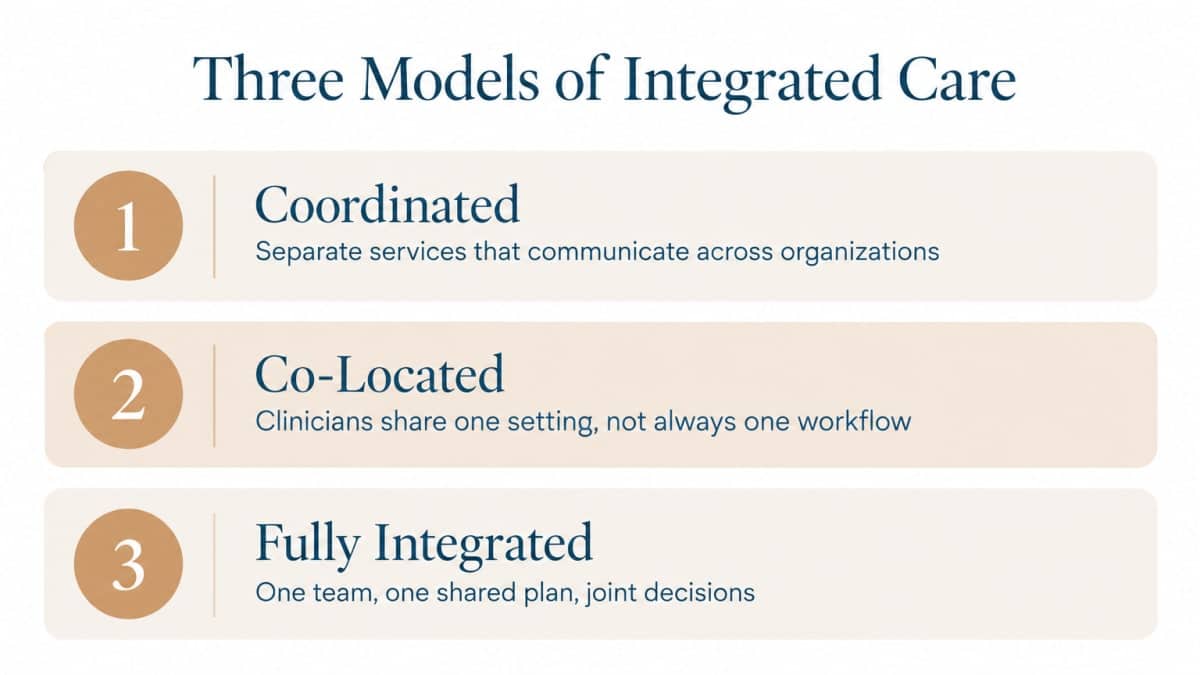
Not every program that says “integrated” means the same thing. SAMHSA names three delivery models — coordinated, co-located, and fully integrated — and the differences between them decide how much your right hand actually knows what your left hand is doing 2. Knowing which tier a program offers is the fastest way to tell whether you’re being promised real teamwork or just a shared waiting room.
Coordinated care is the lightest version. In this model, the two services remain separate but agree to communicate across organizations 2. Done well, this still beats parallel systems that never talk. Done poorly, it’s where you end up repeating your story on day one, day fifteen, and day thirty, and where medication changes on one side may not reach the clinician making decisions on the other.
Co-located care brings clinicians together in one setting 2. A systematic review of co-located mental health and alcohol-and-other-drug treatment found provisional evidence of reduced substance use and related harms, lower mental health symptom severity, better quality of life, and fewer emergency department presentations — while noting the evidence base is limited and the model doesn’t automatically produce shared workflows 9. Translation: being in the same location helps, but it isn’t the finish line.
Fully integrated care is one team working from a shared plan. The clinicians meet about your case and make decisions together. Screening at admission covers both conditions. Medications get reviewed by the whole team, not one prescriber working alone. An identified single point of contact knows what’s happening 1, 3. SAMHSA’s “no wrong door” principle lives here — whichever door you walk through, mental health or substance use, you get identified, assessed, and connected to care for both 2.
Why does this distinction matter for you? Because programs across all three tiers will use the word “integrated” in their marketing. A clinic can be technically coordinated and still describe itself as integrated care. When you’re calling programs for yourself or a loved one, ask directly: Do your psychiatrist and addiction clinicians share one record and one treatment plan? Do they meet about my case? Who is my single point of contact? The answers tell you which model you’re actually buying.
Coordinated care may be the right fit when geography or specialty needs force two organizations to collaborate. Co-location reduces friction. Full integration gives you the tightest clinical loop — and for complex co-occurring conditions, especially after a prior program failed one side, that tighter loop is usually what you’ve been missing.
Who Sits on the Team and What Each Person Does
A real integrated care team isn’t a long org chart. It’s a small group of people, each with a defined job, who share one plan for you. Here’s who you’re likely to meet and what each one actually handles.
- The psychiatrist
- The physician making diagnostic calls and leading medication decisions for both your mental health and substance use conditions. On an integrated team, they don’t prescribe in isolation — pharmacotherapy is discussed and monitored by the full multidisciplinary group, so the antidepressant, the mood stabilizer, and the medication for opioid or alcohol use disorder all get reviewed together instead of by separate prescribers who never compare notes 1.
- The therapist or counselor
- Runs your individual and group work. They’re trained in both domains — not just depression or just addiction — so a single session can hold trauma, cravings, and relapse triggers in the same conversation 3. Stage-matched means they meet you where you are, not where a workbook says you should be 1.
- The case manager
- Keeps the plan moving. Appointments, housing, benefits, transportation, follow-up after discharge — this is the person tracking the pieces that usually fall through cracks when conditions overlap. Assertive outreach, case management, and a longitudinal, stage-wise, motivational approach show up in the evidence as features associated with effectiveness in integrated dual-diagnosis care 7.
- The peer support specialist
- Brings lived experience. They’ve been where you are, and they translate clinical language into something human. SAMHSA names peer support as a core feature of integrated treatment, not an add-on 1.
- The prescriber for medications for addiction treatment
- Sometimes the psychiatrist, sometimes a separate addiction medicine physician or nurse practitioner — handles buprenorphine, naltrexone, or methadone decisions. CDC guidance specifically calls for integrating or co-locating opioid use disorder medication with psychiatric care so the two prescribing conversations happen in one loop, not two 11.
Over all of it sits the single point of contact — an identified named person you can actually reach, who knows what the psychiatrist changed, what the therapist heard, and what the case manager is chasing down. Massachusetts practice guidance recommends that integrated agencies have identified single points of contact 3. When you call a program, ask for it by name.
A Week Inside Integrated Care
Here’s what the structure actually feels like when you walk through the door. Not a brochure version — the real sequence of what happens, who you see, and when the team talks about you.
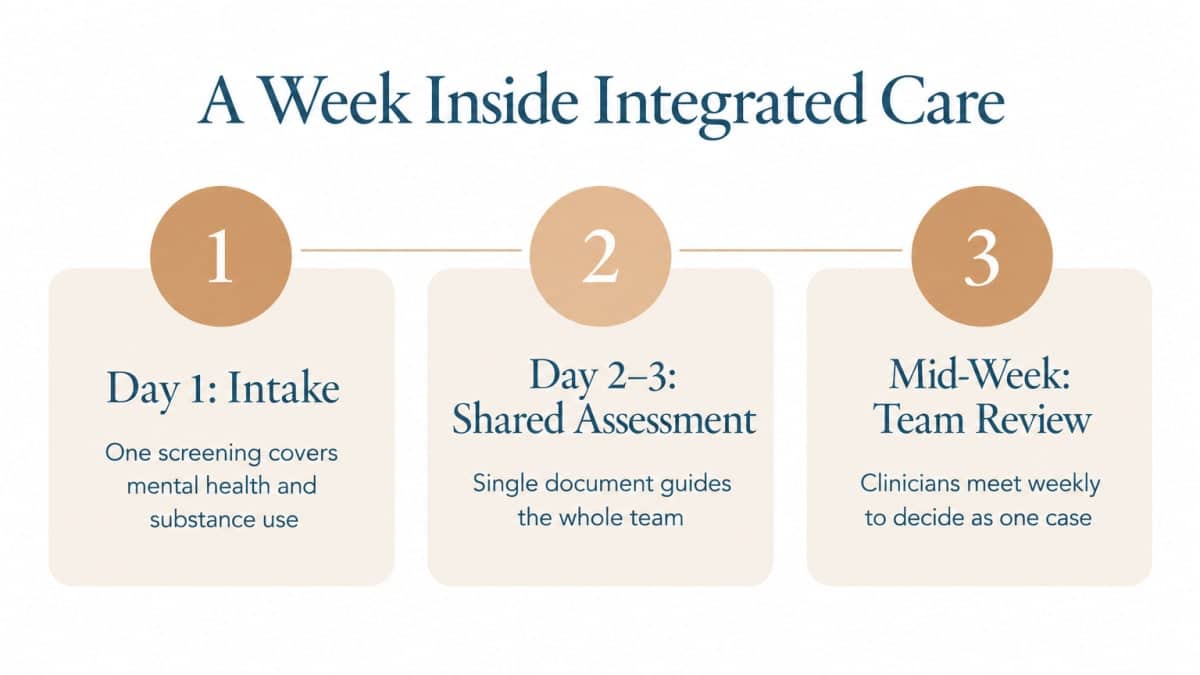
Day one. Admission screening covers both conditions in the same intake, not two separate forms sent to two separate departments 3. The clinician asking about your drinking also asks about your depression, your sleep, your trauma history, and the medications that worked or didn’t work in the past. If you walked in through the mental health door, the substance use questions still get asked. If you walked in through the addiction door, the psychiatric questions still get asked. That’s SAMHSA’s “no wrong door” principle in practice 1. You tell your story once.
Day two or three. A shared assessment pulls everything into one document — diagnoses on both sides, medication list, risk factors, social needs, what stage of change you’re in, what matters to you. The therapist and psychiatrist both read it. The case manager builds a plan around it 1.
Mid-week, team case review. This is the engine room. The psychiatrist, therapist, case manager, prescriber, and peer support specialist sit down together — usually weekly, sometimes more often early on — and talk about you as one case. The therapist shares what came up in session. The psychiatrist proposes a medication adjustment and the group weighs in, because pharmacotherapy on an integrated team is a group decision, not a solo one 1. The case manager flags that your housing voucher is stuck. The peer specialist mentions you seemed shaky at group yesterday. One conversation, one plan 3.
Throughout the week, coordinated treatment. Your medication appointment and your therapy session aren’t operating in parallel universes. The prescriber knows the therapist is working on grief this week and chooses accordingly. The therapist knows the dose changed on Tuesday and watches for side effects on Thursday. If you’re on medication for opioid or alcohol use disorder, those decisions sit in the same loop as your psychiatric medications instead of being managed by a clinician who never speaks to your prescriber 11. Group therapy, individual therapy, family sessions, and medication visits all point at the same plan.
Every day, your single point of contact. One identified person knows what’s happening across the team and answers when you call 3. You don’t get bounced from voicemail to voicemail trying to figure out who ordered what. If your partner needs to ask a question, they know who to ask.
Looking ahead, recovery support. Before you discharge, the team builds the next layer — outpatient appointments scheduled, prescriptions bridged, peer support continuing, family involved when it’s safe and wanted. The handoff isn’t a stack of referrals you have to chase alone. It’s warm, documented, and connected back to the people who already know you.
That’s a week. It isn’t dramatic. It’s just a group of people doing the un-dramatic work of staying on the same page about you — which, if you’ve been through fractured care before, might be the most radical thing you’ve experienced in treatment.
What the Evidence Shows and Where It Falls Short
Here’s the honest picture. Integrated care isn’t a miracle, and anyone selling it that way is skipping the research. What the evidence actually shows is a clear benefit in some areas, mixed results in others, and a few outcomes where integrated and non-integrated care look about the same. You deserve to know the difference before you choose a program.
Where Integrated Care Clearly Helps
The strongest signal in the research is for psychiatric symptoms. A 2023 systematic review of randomized controlled trials comparing integrated and non-integrated treatment for dual-diagnosis conditions found significantly better psychiatric symptom outcomes with integrated care 6. On the primary-care side, AHRQ points to a meta-analysis of 79 randomized trials and more than 20,000 patients showing collaborative care produced greater improvement in depression and anxiety outcomes than usual care 5. That collaborative-care evidence is strongest for common depression and anxiety and may not generalize to severe dual-diagnosis populations 5.
What this means for you: integrated care gives you better odds on the mental health side and a tighter clinical loop. It doesn’t do the recovery work for you. The therapy, the medication adherence, the relapse prevention — those still require your participation. Every step forward counts, and the team is there to make the next step easier to take.
A Real-World Example: Lower ED Use for a Complex Population
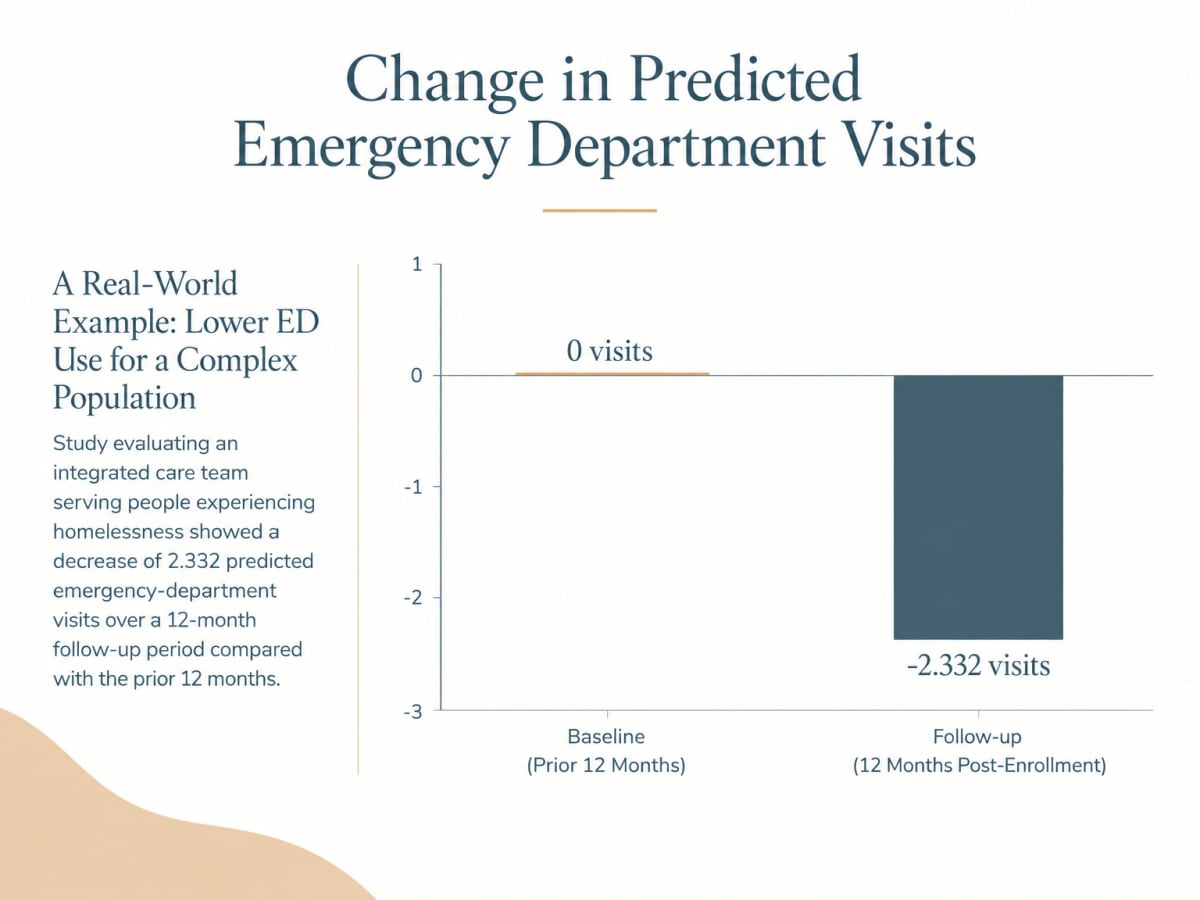
One recent study puts a number on what integrated teams can do for people whose lives are the hardest to coordinate. A 2025 evaluation of an M3 team — integrating primary care, behavioral health, and services addressing health-related social needs for people experiencing homelessness — found that participants experienced a decrease of 2.332 predicted emergency-department visits over the 12-month follow-up period compared with the prior 12 months 8. The study also reported improvements in mental health functioning and alcohol- and drug-use severity after enrollment 8.
Scope matters. This was a service evaluation of a specific team serving a specific population — people experiencing homelessness — over a specific 12-month window. The number doesn’t generalize to every patient in every integrated program, and the design doesn’t prove that integration alone caused every change. Early-adopter research has repeatedly shown that complex integrated models work well in trials but are difficult to scale cleanly in routine practice 10.
What it does show is this: when a team actually shares a plan for a person juggling medical, psychiatric, substance-use, and social needs, the chaos of repeated ER visits can soften. For a family watching a loved one cycle through emergency rooms, that softening is often the first sign the treatment is reaching the whole person — not just the condition on today’s intake form.
Privacy, Consent, and the 2024 Part 2 Rule
If you’ve ever been asked to sign a stack of paperwork at admission and wondered what you were actually agreeing to, this is the section nobody usually explains. Information sharing is how an integrated team works — the psychiatrist can only coordinate with the addiction counselor if the two of them can actually talk about your care. But substance use records carry extra federal protection, and the rules changed meaningfully in 2024. Here’s what that means for you.
Federal regulations at 42 CFR Part 2 give substance use disorder records a tighter layer of confidentiality than most other health information. A Part 2 program generally cannot share information identifying you as having or having had a substance use disorder unless Part 2 permits it 13. That protection exists for a reason — historically, people avoided treatment because they feared the record would follow them into jobs, custody disputes, or housing applications. The rule is designed to make seeking care feel safer.
The 2024 final rule, issued February 8, 2024 and effective April 16, 2024, updated how that protection works inside integrated care 12. The biggest practical change for you: you can now sign a single written consent that covers future uses and disclosures for treatment, payment, and health care operations, instead of signing a separate form every time one clinician needs to speak to another 12, 13. For an integrated team, that means the psychiatrist, therapist, case manager, and prescriber can share what they need to share about your care without stopping every workflow for a new signature.
The rule also permits certain redisclosures by HIPAA-covered entities and business associates while keeping special protections on the SUD record itself 12. Translation: your records don’t flow into the general medical system without limits. Compliance with the full rule is required by February 16, 2026 13.
None of this strips your control. You decide what gets shared and with whom. ONC’s guidance on consent management describes tools that let you make nuanced choices — sharing some information with your integrated team while segmenting other data — so you’re not forced into an all-or-nothing decision 14. Timely exchange of information drives better coordination, engagement, and outcomes 14, but your preferences shape the flow.
What to ask when you sign: Which clinicians on this team will see my substance use records? Is this consent one-time or ongoing? Can I revoke it, and how? Any program that can’t answer those three questions clearly isn’t ready to hold your trust.
Questions That Separate Real Integration From a Marketing Claim
Almost every program will tell you it offers integrated care. The word is on every website. What you need is a short list of questions that force a specific answer, because the gap between a brochure and a real team shows up fast once you ask for details.
Keep these in your pocket when you call. Write the answers down. If a program hedges on more than one or two, that’s your signal.
- Do your psychiatrist and addiction clinicians share one chart and one treatment plan? A fully integrated program says yes without pausing. A co-located program will say they’re in the same building but may work from separate records. A coordinated program will describe communication between organizations 2.
- Does my admission screening cover both mental health and substance use on day one? Massachusetts practice guidance recommends that all individuals be screened at admission for co-occurring disorders 3. If the intake form only asks about one side, the plan will only treat one side.
- Who is my single point of contact, and how do I reach that person? Ask for the role and the response time. An identified named person who answers is one of the clearest markers of real integration 3.
- How often does the team meet about my case, and who is in the room? You’re listening for a regular case review that includes the psychiatrist, therapist, case manager, and prescriber — not a monthly sign-off from a supervisor who never sees you 1, 10.
- Are medication decisions reviewed by the team or made by one prescriber alone? SAMHSA specifies that pharmacotherapy on an integrated team is discussed and monitored by the multidisciplinary group 1. Solo prescribing is a sign the integration stops at the office door.
- If I have opioid or alcohol use disorder, who prescribes the medication for addiction, and do they coordinate with the psychiatrist? CDC guidance calls for integrating or co-locating opioid use disorder medication with care for co-occurring mental disorders 11. The two conversations should sit in one loop.
- What does the handoff to outpatient care look like? Ask whether appointments are scheduled before discharge, whether prescriptions are bridged, and whether the receiving clinicians get a warm introduction. Early-adopter research consistently finds that complex models fall apart at scaling and transitions when this piece is weak 10.
- What are the limits of what integrated care can do? A program willing to tell you the truth — that psychiatric symptoms tend to improve, while substance use and retention outcomes are more mixed 6— is a program that respects your decision-making. One that promises a cure is selling something.
You don’t need a clinical background to use this list. You just need to listen for specifics. Real integration shows up in named roles, shared records, scheduled team meetings, and honest limits. Everything else is marketing.
Finding Care That Treats Both Conditions as One Case
If you’ve read this far, you already know what you’re looking for. Not a program that treats the depression and refers out the drinking. Not a building where two separate teams happen to share a parking lot. One team. One plan. One person who answers when you call.
That kind of care exists, and it’s worth the extra phone calls to find it. Ask the questions from the last section. Listen for named roles, shared records, scheduled case reviews, and honest limits about what integrated care can and can’t do 6. A program that answers plainly is a program ready to hold what you’re carrying.
You’ve already done the hardest part — recognizing that treating one condition while ignoring the other wasn’t enough. For complex co-occurring conditions, integrated psychiatric care through ViewPoint Dual Recovery is one option built around a shared-plan model. Whichever program you choose, keep asking until the answers match the care you need. Every call you make is a step forward.
See If Integrated Care Fits Your Needs
Discuss how coordinated mental health and substance use care may fit your situation.
Frequently Asked Questions
What is the difference between coordinated, co-located, and fully integrated care?
Coordinated care means two separate organizations treat your mental health and substance use conditions and agree to communicate between them. Co-located care brings the clinicians together in integrated or co-located treatment settings. Fully integrated care is one team sharing one chart, one treatment plan, and regular case meetings about you 2. The tighter the loop, the fewer gaps you fall through.
Who is on an integrated care team?
You’ll typically meet a psychiatrist leading diagnosis and medication decisions, a therapist trained in both mental health and addiction, a case manager tracking appointments and benefits, a peer support specialist with lived experience, and often a prescriber for medications treating opioid or alcohol use disorder 1, 11. One named person serves as your single point of contact across all of them 3.
Does integrated care actually work for co-occurring mental health and substance use conditions?
The honest answer is partly. A 2023 systematic review found significantly better psychiatric symptom outcomes with integrated treatment compared with non-integrated care, but no significant advantage for substance misuse outcomes or treatment retention 6. In primary care settings, collaborative care has shown gains for depression and anxiety, though this evidence is strongest for common depression and anxiety and may not generalize to severe dual-diagnosis populations 5. Integrated care tightens the clinical loop and improves your odds on the mental health side, but recovery still requires your active participation.
How is my privacy protected when the team shares my substance use records?
Federal 42 CFR Part 2 rules give substance use records tighter protection than most health information 13. The 2024 final rule lets you sign a single written consent covering future treatment, payment, and health care operations, so your integrated team can coordinate without stopping for a new form each time 12. You decide what gets shared and with whom, and you can revoke consent. Compliance with the full rule is required by February 16, 2026 13.
What questions should I ask to tell if a program is truly integrated?
Ask whether the psychiatrist and addiction clinicians share one chart and one treatment plan 2. Ask if admission screening covers both conditions on day one 3. Ask who your single point of contact is by name. Ask how often the team meets about your case and who is in the room 1. Ask whether medication decisions are reviewed by the group or made by one prescriber alone 1. Specific answers reveal real integration.
Who is my single point of contact on an integrated care team?
Your single point of contact is one named person who knows what every clinician on the team is doing and answers when you or your family call 3. Massachusetts practice guidance recommends that integrated agencies have an identified single point of contact for programs serving people with co-occurring conditions. If a program can’t name that person during your first phone call, the integration probably stops at the website.
References
- Substance Use Disorder Treatment for People With Co-Occurring Disorders. https://library.samhsa.gov/sites/default/files/pep20-06-04-006.pdf
- Managing Life with Co-Occurring Disorders. https://www.samhsa.gov/mental-health/serious-mental-illness/co-occurring-disorders
- Effective Treatment for Persons with Co-Occurring Disorders. https://www.mass.gov/doc/effective-treatment-for-persons-with-co-occurring-disorders/download
- The Academy for Integrating Behavioral Health and Primary Care. https://integrationacademy.ahrq.gov/sites/default/files/2025-04/AHRQ_Integration_Academy_Overview-508.pdf
- Define Your Vision. https://integrationacademy.ahrq.gov/products/playbooks/behavioral-health-and-primary-care/planning-for-integration/define-your-vision
- Integrated vs non-integrated treatment outcomes in dual diagnosis disorders: A systematic review. https://pmc.ncbi.nlm.nih.gov/articles/PMC10157410/
- Review of integrated mental health and substance abuse treatment for patients with dual disorders (1998 historical review). https://pubmed.ncbi.nlm.nih.gov/9853791/
- Integrated care for people experiencing homelessness: changes in emergency department use and behavioral health symptom severity. https://pubmed.ncbi.nlm.nih.gov/40448124/
- Health outcomes and service use patterns associated with co-located mental health and alcohol and other drug treatment: A systematic review. https://pmc.ncbi.nlm.nih.gov/articles/PMC10946517/
- Integrating Mental Health and Addiction Treatment into General Medical Care: Lessons from Early Adopters. https://pmc.ncbi.nlm.nih.gov/articles/PMC7606646/
- Linking People with Opioid Use Disorder to Medication Treatment. https://www.cdc.gov/overdose-prevention/hcp/clinical-guidance/linkage-to-care.html
- Fact Sheet 42 CFR Part 2 Final Rule. https://www.hhs.gov/hipaa/for-professionals/regulatory-initiatives/fact-sheet-42-cfr-part-2-final-rule/index.html
- Understanding Confidentiality of Substance Use Disorder (SUD) Patient Records or “Part 2”. https://www.hhs.gov/hipaa/part-2/index.html
- Behavioral Health Consent Management. https://healthit.gov/behavioral-health/consent-management/