Key Takeaways
- Integrated care runs along a continuum from coordinated to co-located to fully integrated, so the label alone tells you little about whether one team actually treats both conditions together 1, 8.
- Evidence supports integration most clearly for psychiatric symptoms; a 2023 systematic review including 11 eligible studies found no significant advantage for substance use or retention outcomes 4.
- Full integration becomes non-negotiable for severe or treatment-resistant cases like schizophrenia with substance use, rapid-cycling bipolar with alcohol, or trauma layered under opioids 9.
- On the admissions call, ask who writes the single treatment plan, how fast medication changes reach the therapist, and whether the team meets regularly about shared patients 7, 8.
When Half the Problem Gets Treated
If you’re reading this, you’ve probably watched someone you love — or lived it yourself — cycle through treatment that only addressed one side of what was actually going on. A rehab that handled the drinking but shrugged at the bipolar diagnosis. A psychiatrist who adjusted the mood stabilizer but didn’t ask about the nightly drinking. A detox stay followed by a discharge paper that said, more or less, “follow up with your mental health provider.”
That gap is where people fall. And if you’ve been through it once or twice already, you’re not failing. The model was.
Co-occurring conditions — a mental health disorder and a substance use disorder happening at the same time — need treatment that moves together, not in two separate lanes 1. The phrase for that is integrated care. The problem is that “integrated” shows up in almost every treatment brochure, and it can mean wildly different things depending on who’s saying it.
This guide walks you through the actual levels of integrated care, what each one looks like in a real week of treatment, what the research honestly supports, and how to tell — on an admissions call — which level a program is really delivering. You deserve answers that are specific enough to act on.
Integration Is a Continuum, Not a Label
“Integrated care” isn’t one thing; it’s a range. On one end, two separate providers phone each other every few weeks about the same patient. On the other, a single team sits in the same room, builds one treatment plan, and treats both the mental health condition and the substance use disorder together — same clinicians, same chart, same goals 1, 8.
Everything in between is still called “integrated” by somebody. That’s why the word has lost its edge. A clinic can honestly say they offer integrated care while running two parallel programs that barely speak.
Thinking of it as a continuum helps you ask sharper questions. Not “do you treat dual diagnosis?” but “where on the continuum does your program actually sit, and who makes the final call when my medications and my recovery plan collide?”
The Three Levels of Integrated Care
Coordinated Care: Separate Providers, Shared Messages
Coordinated care is the lightest-touch version of integration. Your mental health provider and your substance use provider work in different places, for different organizations, with different charts — but they communicate 1. Maybe your psychiatrist faxes a medication list to the outpatient addiction counselor. Maybe your therapist calls the prescriber when drinking spikes. Maybe there’s a signed release so each side can share notes.
In a real week, this looks like you keeping two calendars. Tuesday mornings with the psychiatrist across town. Thursday evenings with the group at the recovery center. You carry a lot of the connective work yourself — repeating your story, remembering which medication the other provider started, flagging a mood swing to the counselor who didn’t see last week’s lab results.
Coordinated care can be a reasonable fit when your conditions are relatively stable, when you’ve been in recovery for a while, or when geography makes a single integrated team impossible. It’s also better than nothing, which is often the realistic alternative in rural areas or on tight budgets.
What it can’t do well: respond quickly when things change. If your sleep collapses on a Sunday and you drink to cope, nobody on your care team sees the whole picture until the next scheduled check-in — and by then, the plan may already be weeks behind the reality.
Co-Located Care: Same Building, Different Teams
Co-located care puts the mental health and substance use providers under the same roof 1. You walk into one lobby, check in at one front desk, and see both your prescriber and your addiction counselor without driving across town. On paper, that’s a real improvement. In practice, it’s a mixed bag.
Some co-located programs operate as one team that happens to share a building. Others run as two separate programs that happen to share a parking lot. The difference is whether anyone sits down together and talks about you.
A good co-located week might look like this: you see the psychiatrist on Monday, group therapy for substance use on Tuesday and Thursday, and individual therapy on Wednesday — and the clinicians share a chart, bump into each other in the hallway, and send quick messages when something shifts. A weaker version is the same schedule, but each provider updates their own notes in their own system, and nobody notices that your new mood stabilizer and your relapse last weekend might be related.
Co-located care reduces the logistical burden on you, which matters more than it sounds. Showing up to one address, once, is easier than coordinating three. Still, proximity isn’t the same as collaboration. The honest question to ask is whether the teams actually meet about shared patients, or whether they just share Wi-Fi.
Fully Integrated Care: One Team, One Plan
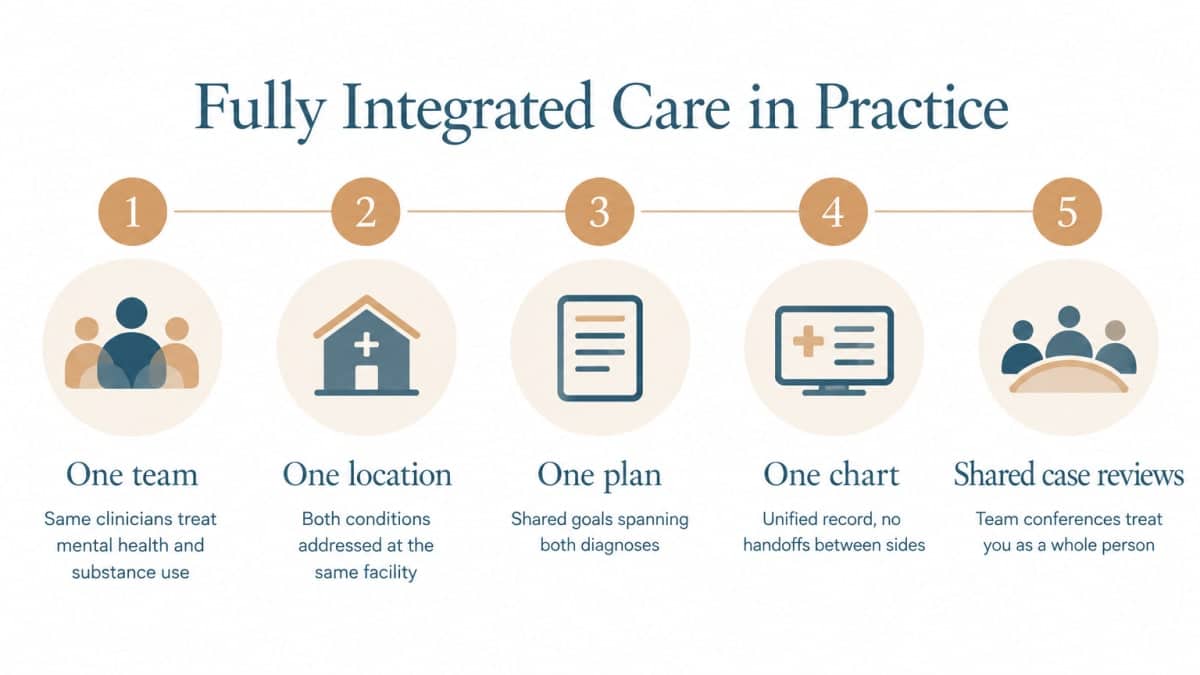
Fully integrated care is the top of the continuum. The operational test, drawn directly from the research base, is simple: the same clinicians or clinical team provide the mental health and substance use interventions, at the same facility, as part of one treatment plan 1, 8. There is no handoff between a “mental health side” and an “addiction side” because there are no sides.
In a real week, this looks different in ways you can feel. You tell your story once, to a team that already shares it. The psychiatrist who adjusts your mood stabilizer knows you drank on Friday because the counselor who heard about it on Saturday told the team on Monday. The therapist running your trauma work knows which medications are new, which are being tapered, and what your prescriber is watching for. When your sleep breaks down, the plan changes within days, not months — because the people who can change it are already in the room together 6, 7.
True integration also shows up in the paperwork you never see. One chart. One treatment plan with goals that cross both conditions. In practice, this often looks like shared case conferences where clinicians across disciplines review you as a whole person rather than as two parallel problems 7.
This is the level most families are picturing when they hear “dual diagnosis treatment.” It’s also the level most often promised and least often delivered. The next sections give you ways to tell the difference before you commit.
Don’t Confuse Levels of Integration with Levels of Care
Two very different ladders get mixed up in treatment conversations, and the mix-up costs families real time. The first is levels of integration — coordinated, co-located, fully integrated — which describes how the mental health and substance use sides of your treatment talk to each other 1. The second is levels of care, usually the ASAM scale, which describes the intensity and setting of your treatment: outpatient, intensive outpatient, partial hospitalization, residential, inpatient.
They answer different questions. Level of care asks: how much structure do you need right now, and where should you sleep tonight? Level of integration asks: when both conditions are in the room, is one team treating them together, or are two teams treating them in parallel?
You can be in a residential program (a high level of care) that still delivers coordinated-only integration — a strong clinical setting with weak clinical communication. You can also be in outpatient (a lower level of care) that is fully integrated, with one team managing both your medications and your recovery work. When you call an admissions line, ask about both ladders. They are not the same question.
What the Evidence Actually Shows
Here’s where you deserve honesty instead of a sales pitch. Integrated care is the right direction — but the research doesn’t say it fixes everything, and anyone who tells you otherwise is overselling.
The clearest signal comes from a 2023 systematic review examining randomized controlled trials comparing integrated and non-integrated treatment for dual diagnosis, which included 11 eligible studies. Integrated treatment significantly improved psychiatric symptoms. For substance use and treatment retention, the review found no significant difference between integrated and non-integrated care across those studies 4. That is a narrower win than most brochures imply, and it matters: the mental health side of the equation moves more reliably than the substance use side when you combine them.
A 2019 Cochrane review on psychosocial interventions for people with severe mental illness and substance misuse reached a similarly cautious conclusion. No single psychosocial package was shown to beat standard care across retention, substance use, mental state, or global functioning in high-quality trials, and the authors frame integration as a long-term process rather than a short course of treatment 5. A separate 2019 review of integrated dual diagnosis treatment echoed that the clinical logic is strong while the comparative evidence remains uneven across outcomes and study designs 7.
So what does this mean for you? Integration isn’t magic. It is, on balance, better for stabilizing psychiatric symptoms — the piece that often drives relapse — and it removes the handoffs where people get lost. Expect progress on mood, psychosis, or anxiety sooner than on substance use, and expect the substance use work to take time. Programs that promise fast wins on both are not reading the same evidence you just did.
What a Real Integrated Assessment Looks Like
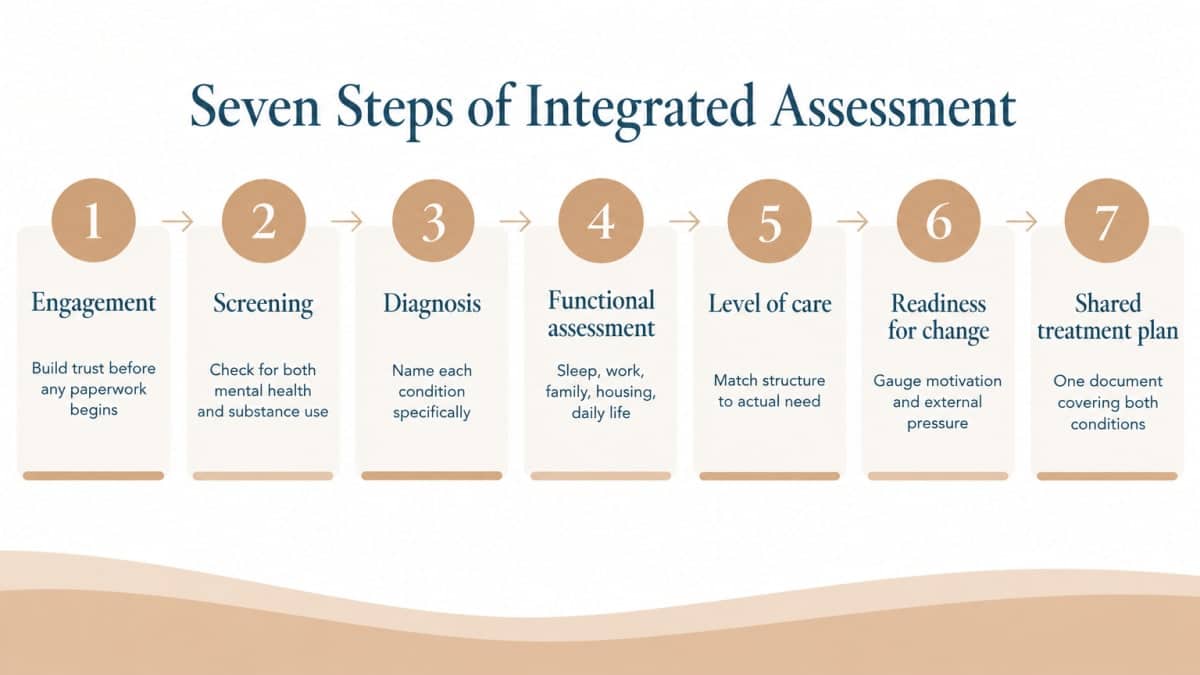
If you want to know how integrated a program really is, listen to how they describe the first week. A real integrated assessment isn’t a form and a urine screen. It’s a sequence — one that SAMHSA lays out in the counselor advisory based on TIP 42 — and skipping steps is a reliable sign that the care downstream will skip them too 2.
- The sequence starts with engagement. Before anyone fills out a questionnaire, someone sits with you long enough that you’re willing to tell the truth. That matters, because the next step — screening for both a mental health condition and a substance use disorder — only works if you’re honest about what you’ve been using, how often, and when the symptoms started.
- From there, the team moves into diagnosis, naming what’s actually going on rather than lumping it under “anxiety and drinking.” Then comes functional assessment: how are you sleeping, eating, working, parenting, paying rent? What has fallen apart, and what’s still holding? That picture drives the determination of level of care — outpatient, intensive outpatient, residential, inpatient — matched to how much structure you actually need 2.
- Next, the team gauges readiness for change. Someone who’s exhausted and willing needs a different plan than someone who’s been pressured into the chair by a judge or a spouse. The sequence ends with a shared treatment plan — one document, both conditions, concrete goals.
If your intake jumps straight from a form to a bed assignment, something got skipped. Ask which step.
How to Tell If a Program Is Actually Integrated
Questions to Ask on the Admissions Call
The admissions call is where you get the most honest answers you’re going to get, if you ask the right questions. Scripts hold up well for “do you treat dual diagnosis?” They fall apart under specifics. Try these.
“Who writes the treatment plan, and does it include goals for both the mental health condition and the substance use?” One plan, one document, both conditions. If the answer involves two separate plans that “complement each other,” you’re hearing parallel care 1.
“When my prescriber changes a medication, how does the therapist find out — and how fast?” You’re listening for a shared chart, a standing team meeting, or a direct message system. Not “the patient tells them” 7.
“How often does the team meet about shared patients, and who’s in the room?” A real answer describes a regular team meeting and names the clinical roles that attend 7.
“Does the same team handle both the psychiatric care and the substance use work, or are those different departments?” This is the operational test for full integration 8.
“What does the first week of assessment include?” Listen for engagement, screening for both conditions, diagnosis, functional assessment, level of care, readiness, and a shared plan 2. Missing steps now predict missed steps later.
Red Flags That Signal Parallel, Not Integrated, Care
Some answers tell you more than the admissions team realizes. Watch for these.
“We refer out for the psychiatric side.” That’s coordinated care at best, and it’s being described as integrated. Fine if it’s labeled honestly; a red flag if the marketing said otherwise 1.
Two separate intake forms, two separate assessments, two separate counselors — with no shared meeting on the calendar. Same building, different teams. Co-located, not integrated.
The therapist can’t tell you which medications you’re on without asking the nurse. Charts aren’t shared. Information travels by hallway.
Group schedules split cleanly into “mental health track” and “addiction track” with no crossover. People with co-occurring conditions get bounced between two curricula that were designed for someone else.
The admissions team can’t describe a regular team meeting about shared patients. Integration without routine clinical coordination is a slogan 7.
You’re told that substance use has to be “stable” before psychiatric treatment starts — or that psychiatric symptoms have to be “stable” before substance use work can begin. That’s the old sequential model the field moved away from, repackaged 6. Both conditions get treated at the same time, from the start, or it isn’t integrated.
When Complexity Makes Integration Non-Negotiable
For some situations, coordinated or co-located care can carry the weight. For others, it quietly collapses. If you’re dealing with schizophrenia and ongoing cannabis or alcohol use, rapid-cycling bipolar disorder with alcohol, or trauma layered under opioid use, the margin for miscommunication between a prescriber and a counselor shrinks to almost nothing. One missed signal between teams can mean a hospitalization, a relapse, or both.
A 2024 expert review on schizophrenia with co-occurring substance use disorder makes this plain: coordinated psychiatric and addiction treatment is identified as an important strategy for this population, and the review emphasizes reducing fragmentation between services 9. When antipsychotic decisions, substance use triggers, and psychosocial support aren’t held by the same team, continuity breaks down in the places where it matters most — medication adherence, early warning signs, and the small shifts that predict a crisis a week before it arrives.
What a Treatment Week Looks Like at Each Level
The clearest way to picture the difference is to walk through a Monday-to-Friday for the same person at each level.
In coordinated care, you drive to the psychiatrist on Tuesday, sit in a Thursday evening recovery group across town, and carry the story between them yourself. If you drink Friday night, your prescriber hears about it at the next appointment — maybe in two weeks. The release-of-information fax is doing the heavy lifting 1.
In co-located care, the schedule tightens. Monday is the prescriber, Tuesday and Thursday are substance use groups, Wednesday is individual therapy — all at one address. Whether that Friday slip reaches the psychiatrist by Monday depends on whether the teams share a chart or just a hallway.
In fully integrated care, Friday night shows up when the team next reviews shared patients. Clinicians across disciplines look at you together, adjust the mood stabilizer, add a trauma-focused session, and update one treatment plan — same team, same facility 7, 8. The gap between what happens to you and what the team knows closes to days instead of months.
Choosing the Right Level for Your Situation
There isn’t a universal answer. There is a reasonable one for your situation, and it comes from matching the complexity of what you’re dealing with to the level of integration you actually need.
If the mental health condition is stable, recovery has been in place for a while, and the risk of a fast crash is low, coordinated care can hold. Two providers who communicate are a legitimate option, especially when geography or finances narrow the field 1.
If you need regular contact with both sides and the logistics of two addresses keep breaking down, co-located care is a real step up — provided the teams meet, share a chart, and don’t just share a parking lot.
If the diagnosis is severe, the pattern includes repeated relapse, or you’re dealing with schizophrenia, rapid-cycling bipolar disorder, or trauma layered under opioid or alcohol use, push for fully integrated care. One team, one plan, both conditions treated from day one 8, 9. Specialized programs like ViewPoint Dual Recovery exist for exactly these situations — when the earlier levels haven’t been enough.
Explore Your Integrated Care Options
Get a clinical assessment to discuss whether integrated care fits your mental health and substance use needs.
Frequently Asked Questions
What’s the difference between coordinated, co-located, and fully integrated care?
Coordinated care means your mental health and substance use providers work in separate places but share information through calls, faxes, or releases. Co-located care puts them in the same building, though they may still operate as two teams. Fully integrated care means the same clinicians or clinical team deliver both treatments at one facility, under one plan 1, 8.
Is fully integrated care always better than coordinated or co-located care?
Not automatically. A 2023 systematic review examining randomized controlled trials, including 11 eligible studies, found integrated treatment significantly improved psychiatric symptoms but did not significantly improve substance use or retention compared with non-integrated care 4. Integration tends to help most when conditions are severe, complex, or treatment-resistant. For stable situations with low crisis risk, well-run coordinated care can be reasonable 1.
How is a level of integration different from an ASAM level of care?
They answer different questions. Level of care (ASAM) describes how much structure and supervision you need — outpatient, intensive outpatient, partial hospitalization, residential, or inpatient. Level of integration describes whether your mental health and substance use treatment are delivered by one team or two 1. You can be in residential care that is only coordinated, or outpatient care that is fully integrated.
What questions should I ask an admissions team to find out if a program is actually integrated?
Ask who writes the treatment plan and whether it covers both conditions in one document. Ask how quickly a therapist learns about a medication change. Ask how often the team meets about shared patients and who sits in the room 7. Ask whether the same clinicians handle psychiatric care and substance use work 8. Vague answers signal parallel care, not integration.
Why does integration matter more for complex cases like schizophrenia with substance use?
Because the margin for miscommunication is thin. A 2024 expert review on schizophrenia with co-occurring substance use disorder identifies coordinated psychiatric and addiction treatment as an important strategy and emphasizes reducing fragmentation between services 9. When antipsychotic decisions, substance triggers, and psychosocial support aren’t held together, early warning signs get missed and small shifts turn into hospitalizations.
What should a real integrated assessment include at intake?
SAMHSA’s advisory based on TIP 42 lays out the sequence: engagement, screening for both mental health and substance use conditions, diagnosis, functional assessment, determination of level of care, identification of readiness for change, and a shared treatment plan 2. If your intake jumps from a form straight to a bed assignment, steps got skipped — and the care downstream usually skips the same steps.
References
- Managing Life with Co-Occurring Disorders. https://www.samhsa.gov/mental-health/serious-mental-illness/co-occurring-disorders
- Substance Use Disorder Treatment for People with Co-Occurring Disorders: Advisory. https://library.samhsa.gov/sites/default/files/pep20-06-04-006.pdf
- Certified Community Behavioral Health Center (CCBHC) Certification Criteria. https://www.samhsa.gov/sites/default/files/ccbhc-criteria-2023.pdf
- Integrated vs non-integrated treatment outcomes in dual diagnosis disorders: A systematic review. https://pmc.ncbi.nlm.nih.gov/articles/PMC10157410/
- Psychosocial interventions for people with both severe mental illness and substance misuse. https://pmc.ncbi.nlm.nih.gov/articles/PMC6906736/
- Integrated Treatment of Substance Use and Psychiatric Disorders. https://pmc.ncbi.nlm.nih.gov/articles/PMC3753025/
- Integrating Treatment for Co-Occurring Mental Health Conditions. https://pmc.ncbi.nlm.nih.gov/articles/PMC6799972/
- Behavioral Interventions for Individuals Dually-Diagnosed with a Severe Mental Illness and a Substance Use Disorder. https://pmc.ncbi.nlm.nih.gov/articles/PMC4267848/
- Management of schizophrenia and comorbid substance use disorders: expert review and guidance. https://pmc.ncbi.nlm.nih.gov/articles/PMC11526640/