

Key Takeaways
- Sequential and parallel dual diagnosis models let psychosis and addiction destabilize each other in the handoff gaps, which is why integrated care is now the standard.
- Specialized care means one team writing one treatment plan for both diagnoses, with clozapine capability, long-acting injectables, and antipsychotics that continue through active substance use.
- Before committing, verify the clinical structure by asking who writes the plan, how often the full team meets, and whether one therapist addresses both the psychosis and the substance use.
- Push on medication specifics: clozapine initiation on-site, routine use of injectables, and a clear policy that psychiatric medications continue if substance use occurs during treatment 11.
- Length of stay should be set by clinical progress—stabilization, functional gains, step-down readiness—not a 28-day insurance calendar, with a real plan for relapse and continuity after discharge.
- Integrated care outperforms sequential models on hospitalizations, symptoms, and substance use, but recovery in schizophrenia with SUD is slower and more uneven than programs promising fast turnarounds admit 5.
Why most dual diagnosis programs fail people with schizophrenia
If you have already cycled through programs that treated the addiction one month and the psychosis the next, you know the pattern. The detox center hands off to the psychiatric unit. The psychiatric unit stabilizes symptoms and hands off to outpatient. Outpatient asks you to get sober before they can really work on the schizophrenia. Somewhere in that handoff, the antipsychotic gets changed, missed, or dropped, and the whole thing unravels.
That sequential-then-parallel model is what most dual diagnosis programs still deliver, and it is what the current standard of care has moved past. The American Psychiatric Association’s 2020 schizophrenia guideline is direct about it: care should ideally come from the same clinicians or same team treating both the psychotic disorder and the substance use disorder, not two teams trying to coordinate across systems 10. SAMHSA says the same thing in plainer language—integrated screening and integrated treatment produce better outcomes, including reduced substance use, improved psychiatric symptoms, and fewer hospitalizations 2.
The stakes when this is done poorly are not abstract. People with schizophrenia and a co-occurring substance use disorder have worse illness courses, more hospitalizations, higher suicidality, and more homelessness and legal problems than people with schizophrenia alone 6. The addiction accelerates the psychosis. The psychosis undermines addiction recovery. Treating them in sequence lets each one destabilize the other in the gap.
Most programs marketed as “dual diagnosis” are addiction programs that accept psychiatric patients. That is a different thing than a psychiatric program built to hold treatment-resistant schizophrenia and active substance use in the same clinical frame. The rest of this guide gives you the criteria to tell them apart before you commit.
What ‘specialized’ should actually mean clinically
One integrated team, not two coordinating teams
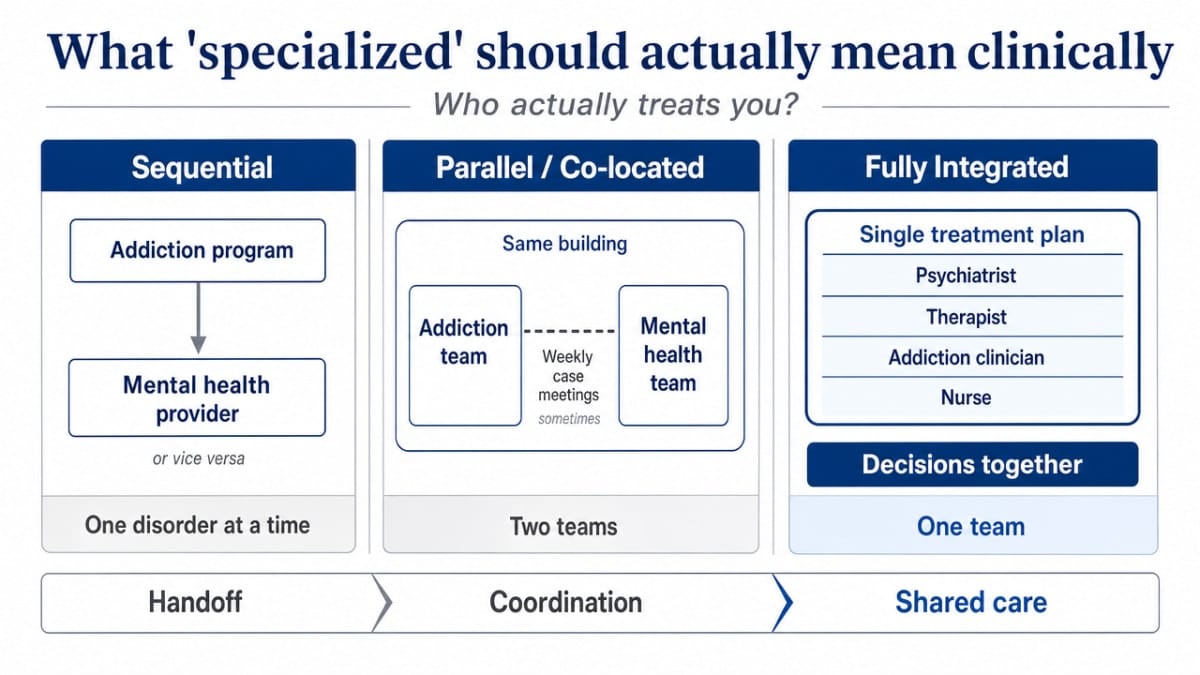
When you call a program, the first thing to figure out is who actually treats you. Not who is on staff—who sits in the room with your chart and makes decisions about both the psychosis and the substance use at the same time.
There are three basic structures you will run into. In a sequential model, one program treats the addiction, then hands you off to a mental health provider for the schizophrenia (or vice versa). In a parallel or co-located model, both services exist in the same building but two different teams run them, sometimes with weekly case meetings, often without. In a fully integrated model, one team—psychiatrist, therapist, addiction clinician, nurse—shares a single treatment plan for both disorders and makes decisions together. Fully integrated teams are the ones associated with better engagement and higher patient satisfaction 15.
The APA’s 2020 schizophrenia guideline is explicit that the integrated model is what should be offered when it is available: the same clinicians, or the same team of clinicians, providing treatment for schizophrenia and the substance use disorder 10. SAMHSA’s TIP 42 echoes this—concurrent care by the same providers or team is what is associated with improved outcomes for co-occurring disorders 3.
So ask directly: Does one team write one treatment plan that covers both diagnoses, or do two teams meet occasionally to compare notes? If the answer describes coordination between departments rather than a shared clinical decision, you are looking at parallel care with an integrated label on the brochure.
Medication expertise: clozapine, long-acting injectables, and continuing antipsychotics through active use
Medication is where a lot of specialized programs quietly stop being specialized. If your schizophrenia has not responded to two adequate trials of antipsychotic medication, you meet the working clinical definition of treatment-resistant schizophrenia, and the next step in the evidence base is clozapine 14. Clozapine is the most effective antipsychotic for treatment-resistant cases, but it requires ongoing blood monitoring, careful titration, and a psychiatrist comfortable managing its side effects. Many programs do not initiate it. Some will continue it if you arrive already on it, but cannot start it.
The second medication question is about long-acting injectable antipsychotics—medications given every two to four weeks by injection instead of daily pills. For someone whose substance use makes daily oral adherence unreliable, long-acting injectables can be the difference between staying on medication and cycling in and out of psychosis. A specialized program should use them routinely, not as an exception.
The third question is a philosophy question with a specific right answer. Ask what the program does if you use substances while in treatment. Atypical antipsychotics are first-line for schizophrenia with co-occurring SUD, and the clinical guidance is that antipsychotics should be continued even in the presence of continued substance use 11. A program that discharges you or pauses your psychiatric medication because of a positive drug screen is running an abstinence-first model, not an integrated one. That approach lets the psychosis destabilize the moment the substance use does, which is exactly the failure loop you are trying to escape.
Pharmacotherapy in this population works when it is coordinated with psychotherapy and psychosocial support inside one plan, not layered on top of separate services 7.
Residential intensity and clinically-determined length of stay
Outpatient dual diagnosis works for some people. For treatment-resistant schizophrenia with active substance use, it usually does not—at least not as the first level of care after a hard relapse or hospitalization. The environment has to hold you while the medication gets right and the substance use quiets down enough that therapy can land.
The strongest available evidence for residential intensity in this population comes from studies of integrated residential dual diagnosis programs. In one comparison of an integrated residential program (IDDT) against treatment-as-usual, patients in the integrated residential condition showed significant reductions in illicit drug and alcohol use, improvements across every psychiatric symptom domain measured, higher quality of life, and better social and community functioning—while the treatment-as-usual group had significantly higher dropout rates 4. Retention matters here because people who leave early do not get the benefit.
The other length-of-stay question is who decides when you leave. In a lot of programs, the answer is your insurance benefit. A 28-day stay is a billing artifact, not a clinical one. A specialized program for schizophrenia with co-occurring addiction should tell you plainly that length of stay is determined by clinical progress—stabilization of the antipsychotic regimen, movement out of acute substance use, functional gains in therapy—not by a fixed calendar.
If the intake conversation is dominated by what your plan will authorize before anyone has evaluated you, that is a signal. Ask directly: How do you decide when someone is ready to step down? What happens if my insurance runs out but the clinical team says I am not ready? The answer tells you whose timeline you are actually on.
Psychosocial components that belong under the same roof
Medication holds the floor up. It does not, by itself, rebuild the life. The psychosocial side of a specialized program is what actually moves recovery from symptom control into function, and it should live in the same building, under the same team, as the psychiatry.
Five components are worth naming specifically:
- Motivational enhancement meets you where you are on the substance use, rather than requiring you to already want abstinence before treatment starts.
- Cognitive behavioral therapy adapted for psychosis and substance use works on the thought patterns that drive both.
- Contingency management uses structured reinforcement for verified progress.
- Family psychoeducation pulls the people around you into the treatment plan, because a family that understands what schizophrenia is and how substance use interacts with it is a stabilizing force after discharge.
- Skills training—medication management, symptom recognition, coping strategies for cravings and voices—translates the clinical gains into daily life 11, 7.
The five guiding principles for psychosocial care in this population start with building a supportive therapeutic alliance and integrating evidence-based treatments for both the addiction and the mental illness in the same relationship 11. That last part is the piece to test. Ask whether your individual therapist will address both the psychosis and the substance use, or whether you will see one therapist for each. Ask whether groups are mixed—people with serious mental illness and substance use together, working on both—or split into a mental health track and an addiction track that never meet.
A program that separates these threads is asking you to do the integration work yourself, in your head, between sessions. That is not what specialized care means 8.
The evaluation checklist: questions to ask before you commit
Questions about the clinical team and structure
You need to know who is actually going to make decisions about your care, not who is listed on the website. The questions below are designed to break past the marketing language and get to the structure underneath.
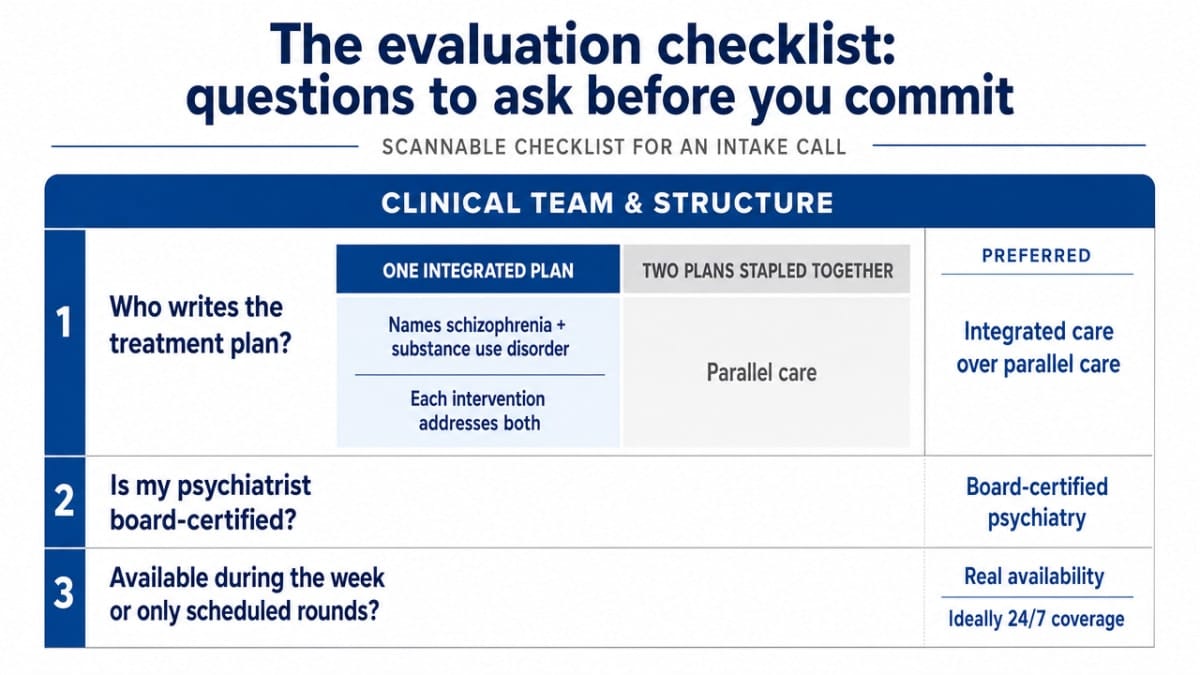
Ask: Who writes the treatment plan, and is it one plan or two? A specialized program should give you a single integrated plan that names both the schizophrenia and the substance use disorder and describes how each intervention addresses both. Two plans stapled together is parallel care.
Ask: Is my psychiatrist board-certified, and are they available during the week, or only for scheduled rounds? Treatment-resistant schizophrenia with active substance use is not a Tuesday-morning consult. You want board-certified psychiatry with real availability, ideally 24/7 coverage for medication decisions that cannot wait.
Ask: Does the same therapist address both the psychosis and the substance use, or will I see one therapist for mental health and another for addiction? The evidence base points toward a single therapeutic alliance that integrates both, not a split caseload 11.
Ask: How often does the full team meet about my case? In a fully integrated model, the psychiatrist, therapist, addiction clinician, and nursing staff share decisions weekly at minimum, and the answer to this question will be specific. If the answer is vague or describes interdepartmental meetings, that is parallel care with better branding 15.
Ask: What is your program’s specific experience with treatment-resistant psychotic disorders? A general dual diagnosis rehab may see a handful of schizophrenia cases a year. A specialty program sees them constantly, and the intake team should be able to describe that population plainly 10.
Questions about medications and psychiatric coverage
Medication questions are where you find out whether the psychiatry is real or nominal. Do not accept general reassurance here—the answers should be specific.
Ask: Can you initiate and titrate clozapine on-site? If clozapine is on the table for you—and if you have failed two adequate antipsychotic trials, it should be 14—you need a program that can start it, monitor the required labs, and manage side effects without transferring you out. “We can continue it if you come in on it” is not the same answer.
Ask: Do you use long-acting injectable antipsychotics routinely? For someone whose substance use disrupts daily oral adherence, injectables every two to four weeks can be the intervention that finally holds. A specialized program will describe how they use them, not treat the question as unusual.
Ask: What happens to my psychiatric medications if I use substances during treatment? The right answer is that antipsychotics continue even if substance use continues, because that is what the clinical guidance supports 11. If the answer involves pausing medication, discharging you, or requiring a clean drug screen before adjustments, you are looking at an abstinence-first program dressed as integrated care.
Ask: Who is on call overnight and on weekends for medication decisions? Acute psychiatric decisions do not observe business hours. The name and credentials of the after-hours coverage matter.
Ask: How do you coordinate with my outpatient psychiatrist after discharge? Continuity is a medication question as much as a therapy one 7.
Questions about length of stay, discharge, and continuity
The length-of-stay conversation tells you whose timeline the program actually runs on. Push here, because the answers shape everything that happens after admission.
Ask: How do you determine when someone is ready to step down? A specialized program will describe clinical markers—stabilization of the antipsychotic regimen, movement out of acute substance use, functional gains, ability to engage in outpatient care. If the answer opens with insurance authorization language, that is your answer.
Ask: What happens if my insurance runs out but the clinical team says I am not ready to discharge? Programs that operate on clinically-determined length of stay have a real answer to this question. Programs that do not will get uncomfortable.
Ask: What does step-down actually look like? Discharge from residential care into nothing is a common failure point. You want to hear about a specific plan: outpatient psychiatry appointments already booked, medication supply continuous, therapy scheduled, family involved 8.
Ask: How do you handle relapse after discharge? A specialized program treats relapse as a clinical event to respond to, not a violation of the program. Ask whether readmission is possible, how it is decided, and whether the same team resumes care.
Ask: What is your typical length of stay for someone with treatment-resistant schizophrenia and active substance use? If the answer is 28 or 30 days regardless of clinical picture, you have your answer about whose timeline is running the program 4.
What the evidence honestly says about outcomes
You deserve a straight answer here, not a sales pitch. Integrated care for schizophrenia with co-occurring substance use is the standard of care because it outperforms sequential and parallel models on the outcomes that matter most—reduced substance use, improved psychiatric symptoms, fewer hospitalizations, better housing stability 2. That is the direction the evidence points. It is not the whole story.
The honest picture is that outcomes are real but variable. A 2019 review of integrated psychosocial interventions found that some controlled trials showed no significant differences from usual care on substance use, functioning, or life satisfaction, and the review flagged methodological limits across the literature 1. What that means for you is this: the label “integrated” on a program’s website does not guarantee the outcomes. The fidelity of the model, the medication expertise behind it, and how long you actually stay engaged all shape what you get.
Where the evidence is strongest is in high-fidelity residential and long-term integrated programs. The three-year New Hampshire Dual Diagnosis Study followed patients with schizophrenia or schizoaffective disorder and co-occurring substance use disorders through integrated dual disorders treatment and found steady improvement across multiple domains: control of psychotic symptoms, remission from substance abuse, competitive employment, social contacts with people who did not use substances, and life satisfaction 5. That is a meaningful list, sustained over three years, in a population that most programs consider difficult to hold.
The same study is honest about the harder truth. Patients with schizophrenia and substance use disorders tend to have a slower, more uneven recovery arc than patients with bipolar disorder and substance use disorders 5. Progress is real, and it takes longer. If someone is promising you a fast turnaround for treatment-resistant psychosis with active substance use, they are selling you the wrong story.
Two more findings are worth keeping in mind as you evaluate programs. First, when integrated treatment is delivered well, it improves both functional and clinical outcomes for people with schizophrenia and co-occurring SUD—the addiction and the psychosis both respond, in the same person, under the same plan 6. Second, even in strong integrated programs, relapse happens, which is why continuity of care after discharge is not an add-on—it is part of the treatment 7.
What this means when you are choosing a program: ask for outcomes framed at one and three years, not just at discharge. Ask what happens when someone relapses six weeks after leaving. A program willing to talk about the slower arc, the variability, and the plan for setbacks is telling you the truth. That is the kind of program that has actually done this work.
Where ViewPoint Dual Recovery fits
If you have read this far and the checklist is starting to sound like the program you have not been able to find, that is the gap ViewPoint Dual Recovery was built to fill. The specialty is named directly: psychotic disorders with co-occurring substance use, treated by one integrated psychiatric team in a Joint Commission–accredited facility in Prescott, Arizona.
What that looks like in practice matches the criteria this guide has laid out. Board-certified psychiatrists lead treatment, not a rotating weekly prescriber. Clozapine protocols are handled on-site, which matters if you meet criteria for treatment-resistant schizophrenia and the next step in the evidence base is a medication most programs will not initiate 14. Long-acting injectable antipsychotics are part of routine practice for people whose substance use makes daily oral adherence unreliable. Psychiatrists and therapists share one treatment plan for both the psychosis and the substance use, rather than running parallel tracks and comparing notes.
Treatment duration is set by clinical progress—stabilization of the antipsychotic regimen, movement out of acute substance use, functional gains in therapy—not by a 28-day insurance calendar. That is the piece that lets integrated care actually work in the schizophrenia-plus-SUD population, where the recovery arc is slower and more uneven than it is in other dual diagnosis presentations 5.
ViewPoint’s Schizophrenia Treatment and Dual Diagnosis pages are the next resources to read if this is the level of specialization you or your family member needs.
If you are a referring clinician or discharge planner
A note for the professional readers: if you are a discharge planner, community psychiatrist, or case manager placing a patient with treatment-resistant schizophrenia and an active substance use disorder, the referral question is narrower than the family-facing checklist above. You already know what integrated care is. What you need to confirm is whether the receiving program can actually hold the case.
Three items usually settle it:
- Can they initiate clozapine on-site, not just continue it—because if your patient has failed two adequate antipsychotic trials, that is the next step in the evidence base 14.
- Is length of stay clinically determined, so your patient is not pushed back to you at day 28 with the antipsychotic still being cross-titrated.
- Is there a real warm handoff to outpatient psychiatry, with medications reconciled and appointments booked before discharge, because continuity is where these cases most often unravel 7.
ViewPoint’s Schizophrenia Treatment and Dual Diagnosis pages describe the intake pathway for referring clinicians, including how records exchange and post-discharge coordination are handled.
Find out if specialized dual diagnosis care fits
Receive expert clinical insight on next steps for complex psychosis and co-occurring substance use.
Frequently Asked Questions
What makes a program ‘specialized’ for schizophrenia with co-occurring addiction rather than a general dual diagnosis rehab?
One integrated team writes one treatment plan that addresses both the psychosis and the substance use, rather than two departments coordinating across a handoff. The APA’s 2020 schizophrenia guideline describes this directly: the same clinicians, or the same team of clinicians, providing care for both disorders 10. If two teams meet occasionally to compare notes, that is parallel care with a specialized label.
Do I have to be sober before a specialized program will treat my schizophrenia?
No. A program that requires abstinence before addressing the psychosis is running a sequential model, which the current evidence base has moved past. Clinical guidance is that atypical antipsychotics should be continued even in the presence of continued substance use, inside one integrated plan that treats both disorders at the same time 11. That is the standard you should expect from a specialty program.
Why does clozapine capability matter when choosing a program?
Treatment-resistant schizophrenia is defined as inadequate response to at least two adequate antipsychotic trials, and clozapine is the medication with the strongest evidence for that population 14. It requires blood monitoring, careful titration, and a psychiatrist comfortable managing its side effects. Many programs will continue clozapine if you arrive on it but cannot initiate it. If clozapine is on the table for you, that distinction rules out most facilities.
How long should residential treatment last for schizophrenia and co-occurring substance use?
Long enough for clinical progress, not for an insurance benefit to run out. Stabilization of the antipsychotic regimen, movement out of acute substance use, and functional gains in therapy are the markers that matter. A 28-day stay is a billing artifact. Integrated residential care shows meaningful reductions in substance use, symptom improvement, and lower dropout compared to treatment-as-usual when patients stay engaged long enough for the model to work 4.
What questions should I ask a program before admitting my family member?
Ask whether one team writes a single treatment plan for both diagnoses. Ask whether they can initiate clozapine and use long-acting injectable antipsychotics routinely. Ask what happens to psychiatric medications if substance use continues during treatment—the right answer is that antipsychotics continue 11. Ask who decides length of stay, and what the step-down plan looks like, including booked outpatient appointments and reconciled medications before discharge 8.
Does integrated care actually produce better outcomes than treating the disorders separately?
Yes, though the evidence is honest about variability. High-fidelity integrated programs improve both clinical and functional outcomes—psychiatric symptoms, substance use, employment, social contacts, and life satisfaction—sustained over years in the New Hampshire Dual Diagnosis Study 5. A 2019 review also found some trials showed no significant advantage over usual care, so program fidelity, medication expertise, and length of engagement determine what you actually get 1.
References
- Integrating Treatment for Co-Occurring Mental Health Conditions. https://pmc.ncbi.nlm.nih.gov/articles/PMC6799972/
- Managing Life with Co-Occurring Disorders. https://www.samhsa.gov/mental-health/serious-mental-illness/co-occurring-disorders
- Co-Occurring Disorders Treatment in Substance Use Disorder Programs (TIP 42, SAMHSA). https://www.ncbi.nlm.nih.gov/books/NBK424849/
- Treatment Outcomes of an Integrated Residential Programme for Patients with Schizophrenia and Substance Use Disorders. https://pubmed.ncbi.nlm.nih.gov/21447952/
- Three-Year Recovery Outcomes for Long-Term Patients with Schizophrenia and Substance Use Disorders. https://pubmed.ncbi.nlm.nih.gov/15885525/
- Substance Use Disorders and Schizophrenia. https://pmc.ncbi.nlm.nih.gov/articles/PMC6526786/
- Pharmacotherapy of Co-Occurring Schizophrenia and Substance Use Disorders. https://pmc.ncbi.nlm.nih.gov/articles/PMC4877030/
- Management of Schizophrenia and Comorbid Substance Use Disorders. https://pmc.ncbi.nlm.nih.gov/articles/PMC11526640/
- A systematic scoping review of interventions to integrate physical, mental, and addiction healthcare. https://pubmed.ncbi.nlm.nih.gov/32521251/
- The American Psychiatric Association Practice Guideline for the Treatment of Patients with Schizophrenia. https://www.med.unc.edu/psych/epi-nc/wp-content/uploads/sites/720/2024/01/APA-2020-guidelines-1.pdf
- Improving the Care of Individuals with Schizophrenia and Substance Use Disorders. https://pmc.ncbi.nlm.nih.gov/articles/PMC2599914/
- Co-occurring Substance Use Disorders in Patients with Schizophrenia: A Clinical Review. https://pmc.ncbi.nlm.nih.gov/articles/PMC6609303/
- Schizophrenia. https://www.nimh.nih.gov/health/topics/schizophrenia
- Treatment-Resistant Schizophrenia: Definition, Epidemiology and Management. https://pmc.ncbi.nlm.nih.gov/articles/PMC4447641/
- Integrated Care Models for Psychiatric and Substance Use Disorders. https://pmc.ncbi.nlm.nih.gov/articles/PMC5855435/