

Key Takeaways
- Licensure fears often outpace reality: the AMA, FSMB, and Joint Commission have narrowed acceptable questions to current impairment, not diagnostic history or past treatment 6, 9.
- HIPAA protection is layered, with psychotherapy notes and 42 CFR Part 2 substance-use records carrying stronger confidentiality than routine medical information most patients picture 7, 8.
- A ‘treatment-resistant’ label often reflects missed diagnosis or inadequate dosing and adherence rather than a true ceiling, making reassessment more useful than another medication switch 1.
- Concurrent treatment of psychiatric and substance-use conditions inside one integrated team, with clinical rather than insurance-driven length of stay, is the model guidelines endorse 3, 5.
The Real Reason You Haven’t Called Yet
You already know what’s happening. The sleep is gone. The drinking crept from two glasses to five. The intrusive thoughts have a rhythm now, and you’re rehearsing normal in the parking lot before you walk into the office. You are not confused about whether something is wrong. You are calculating the cost of admitting it.
That calculation is the barrier. Not the illness. A 2025 systematic review of healthcare professionals looking for psychological support found five recurring obstacles: privacy concerns, stigma, time constraints, doubts about treatment effectiveness, and role conflict, which is the dissonance of being the person others rely on 10. If you’ve been running that math in your head at 2 a.m., you’re not alone, and you’re right to take it seriously.
Here is what changes the equation. Most of what you fear about seeking care is built on assumptions that don’t hold up when you look closely. Licensure boards are not supposed to be asking what you think they’re asking 9. Federal privacy rules protect more of the clinical record than most patients realize 7. And the label “treatment-resistant” that may have been attached to your case in a prior outpatient setting often reflects a gap in how care was delivered, not a verdict on you 1.
The rest of this piece walks through each of those pieces honestly. What actually shows up on your record. What integrated care looks like when it’s done right. And why the decision to step away, quietly and on your own terms, can be the most clinically sound move you make this year.
What Actually Shows Up on Your Record
The Licensure Question, Rewritten
You have probably been carrying an old version of this question in your head. Something like: if I get treatment, the board will find out, and my career is done. That version is out of date, and in most jurisdictions it was never fully accurate to begin with.
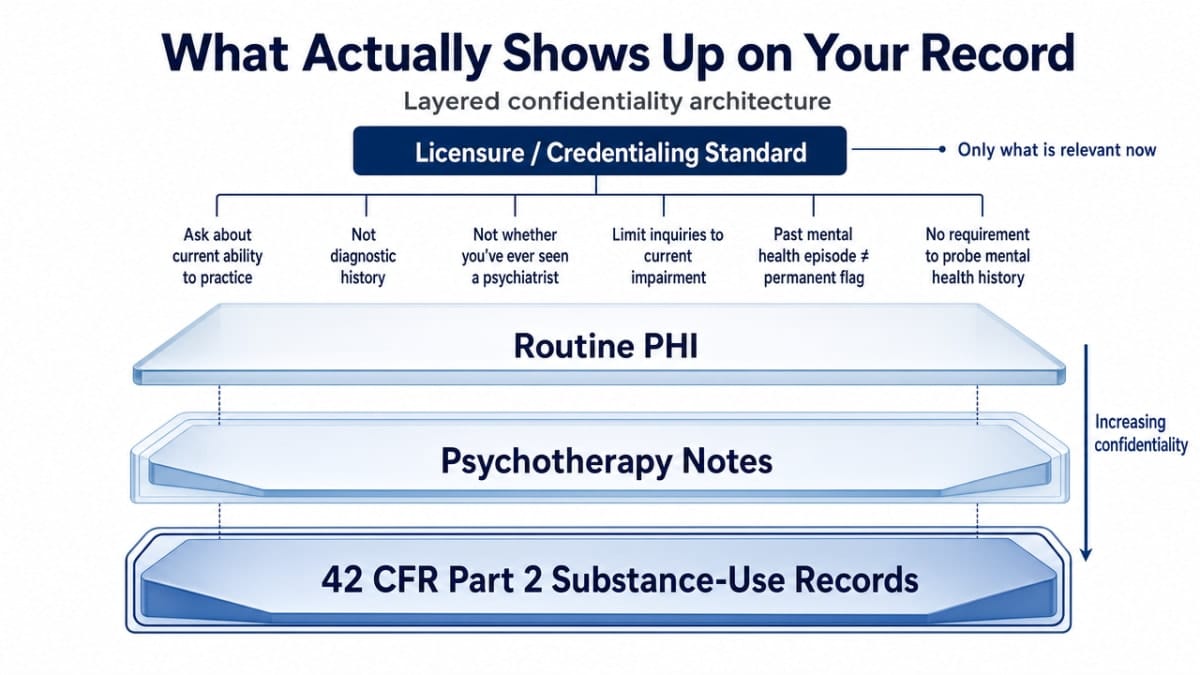
The American Medical Association has been direct on this point. Licensure and credentialing questions should ask only what can reasonably be tied to your ability to practice medicine right now, not your diagnostic history or whether you’ve ever seen a psychiatrist 6. The Federation of State Medical Boards has moved in the same direction, advising boards to limit inquiries to current impairment and to stop treating a past mental health episode as a permanent flag 9. The Joint Commission does not require probing mental health history at all 9.
That does not mean every state has caught up. Some applications still contain questions that are broader than they should be, and hospital credentialing files sometimes lag further behind. What it does mean is that the fear you have been running in your head, the automatic assumption that a course of treatment now becomes a career-ending disclosure later, deserves to be checked against what your specific board actually asks in the current cycle.
What HIPAA Protects, and What It Doesn’t
HIPAA is not one uniform wall. It’s a layered system, and the layers matter more to you than to almost any other patient.
Start with the routine layer. Under HIPAA, your treating clinicians can share information for treatment, payment, and healthcare operations without a separate authorization from you. That is how a psychiatrist and a therapist inside the same program coordinate care, and how a discharge summary gets to a follow-up prescriber. It is also the layer people mean when they wave a hand and say “HIPAA covers it.” It does, but not the way most patients picture.
The sensitive layer is different. HHS treats psychotherapy notes, meaning the private notes a therapist keeps separately from the medical record about the content of your sessions, as specially protected. They generally require your specific authorization to be disclosed, and they are not part of the routine flow of treatment, payment, and operations information 7. A subpoena, a records request from a credentialing body, a curious employer, none of that automatically reaches psychotherapy notes.
Substance use records add another layer. Records held by federally assisted substance use programs sit under 42 CFR Part 2, which is stricter than baseline HIPAA and limits disclosure even in situations where regular medical records would move 8. Coordination among your treating clinicians is still possible; broad external release is not.
The honest caveat: privacy is not invisibility. Your insurance claims, if you use insurance, create a paper trail through payers and possibly employer-sponsored plans. That is one of the arguments for private-pay care, and it comes up again later. But the clinical substance of what you say in a room with a psychiatrist or a therapist enjoys more protection than most patients realize, and the substance-use side of a dual diagnosis case enjoys the most protection of all 7, 8.
When ‘Treatment-Resistant’ Is the Wrong Label
The Three Pillars Prior Care Often Skips
Somewhere in your chart, a clinician may have used the phrase “treatment-resistant” about you. Maybe about a depression that never fully lifted on three SSRIs. Maybe about a bipolar course that keeps outrunning the current mood stabilizer. Maybe about anxiety that has quieted with benzodiazepines but never actually resolved. That label carries weight. It also gets applied more loosely than the literature intends.
A synthesis of the field describes treatment resistance as resting on three pillars:
- Correct diagnosis
- Adequate treatment, meaning the right medication at the right dose for a long enough duration, with real adherence
- Genuine inadequate response despite the first two 1
All three have to hold. If any one of them is shaky, what you have is not resistance. What you have is care that has not yet been delivered fully.
Consider how prior outpatient care can stall at pillar one. A busy professional presents with fatigue, poor sleep, low motivation, and a heavier drinking pattern. The working diagnosis becomes major depression. The alcohol use, the trauma history, the possibility of a bipolar spectrum condition, the thyroid picture, the stimulant use covering the fatigue, none of it gets the time it deserves. Two years of medication trials later, the case looks resistant. It is not. It is misdiagnosed.
Pillar two is where high-functioning patients stall the most. You are the person who titrated your own dose down because you had a deposition. You skipped the SSRI for a week on vacation. You never made it to a therapeutic clozapine level because the monitoring schedule collided with your call schedule. That is not resistance either. That is a treatment plan that never met the life it was prescribed into.
A careful reassessment of all three pillars, before another medication switch, is what changes trajectories in complex cases 1.
Complex Cases That Community Programs Turn Away
There is a second reason the label sticks incorrectly. Some cases are genuinely complex, and the community-level programs available to most patients are not built for them. When a program cannot hold the case, the patient often gets the label instead.
Treatment-resistant schizophrenia with a clozapine indication is a familiar example. Clozapine works when other antipsychotics have not, but it requires close hematologic monitoring, careful titration, and a team comfortable managing side effects that scare less-experienced prescribers. Rapid-cycling bipolar disorder is another. So is trauma-driven addiction where the substance use has been treated in isolation from the underlying PTSD, or a mood picture that shifts every time a stimulant or alcohol pattern shifts.
Community outpatient care, and even many residential programs, will refer these cases out. The referral often comes with the word “complex” or “resistant” attached. What the patient hears is a verdict. What the clinician usually means is closer to “this needs a setting with 24/7 psychiatry, integrated substance-use expertise, and enough time to reassess from the ground up.”
ViewPoint was built for that referral. A Joint Commission-accredited facility with board-certified psychiatry available around the clock, advanced medication protocols including clozapine, and an integrated team that treats the psychiatric condition and the substance use in the same room rather than handing you between agencies. If a prior program told you your case was too much for them, that is information about the program’s capacity, not a permanent statement about yours.

Treating the Substance Use and the Psychiatric Condition at the Same Time
Why Sequential Care Fails Professionals
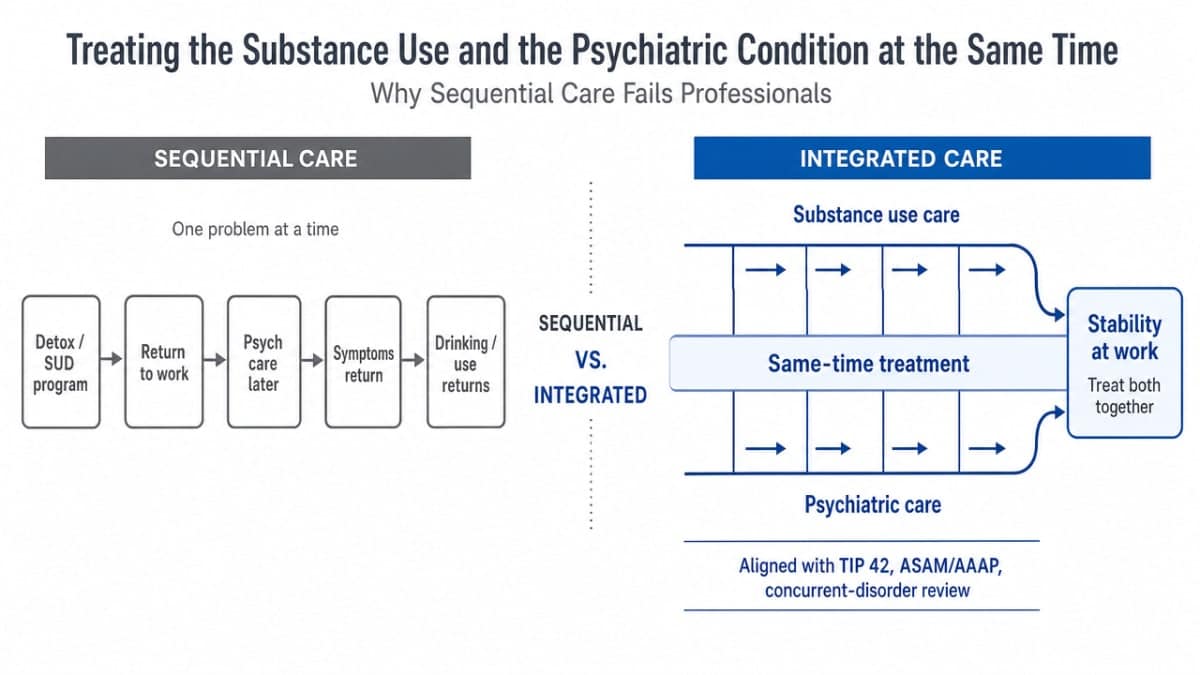
The old model, still common in a lot of communities, treats substance use and psychiatric illness as two separate problems that take turns. Get sober first, then we will look at the depression. Stabilize the mood, then we will address the drinking. If you are a professional whose life does not pause between appointments, that sequence is where things fall apart.
Consider what it actually asks of you. You take unpaid time to detox and complete a substance-use program that treats the alcohol or stimulant use as the primary issue. You return to work while the underlying anxiety, PTSD, or bipolar picture is still untreated, because the psychiatric arm is scheduled for later. Within weeks, the symptom that drove the drinking in the first place is back. So is the drinking. The relapse gets read as a personal failure rather than as evidence that the sequence was wrong.
Every major guideline in this area now points the other direction. SAMHSA’s TIP 42 framework calls integrated care the preferred model for co-occurring conditions 3. The ASAM/AAAP guideline on stimulant use disorder recommends treating substance use and co-occurring psychiatric conditions concurrently, with integrated behavioral care when available 2. A 2026 review of concurrent-disorder guidelines found broad consensus on dual or combined treatment across the field 5. Sequential care is not just harder on you. It is out of step with what the evidence has recommended for years.
What Integrated Care Actually Looks Like on a Weekday
Integrated care is easy to say and harder to picture. Here is what it looks like when it is done well.
Your psychiatrist and your therapist are on the same team, in the same building, reading the same chart. When your mood shifts on Tuesday, the medication conversation on Wednesday already accounts for what came up in Tuesday’s therapy session. When your substance-use counselor notices a pattern in your cravings, the psychiatrist adjusting your mood stabilizer knows about it before the next dose change. Nothing waits for a fax between agencies. Nothing gets lost in the translation between a mental health clinic and a separate addiction program.
Under the hood, that coordination has a real privacy architecture. HIPAA permits treating clinicians inside the same program to share information for treatment purposes without a separate authorization each time, which is why integrated teams can move at clinical speed 8. The extra-sensitive layers, psychotherapy notes and federally protected substance-use records, stay walled off from the routine flow and require your specific authorization to leave the building 7, 8.
The clinical work itself is concurrent. A pharmacologic plan for the psychiatric condition runs alongside the substance-use treatment rather than after it, because the evidence for co-occurring depression and substance use points to combined pharmacologic and psychotherapeutic care rather than a queue 4. If your case is complex, treatment-resistant schizophrenia, rapid-cycling bipolar, trauma driving the addiction, the same integrated team carries all of it. You are not the connective tissue between three programs. That was never a job you should have had.
Private-Pay as Clinical Independence, Not Luxury
The phrase “private-pay” gets read two different ways. One reading is about status, the kind of program with linen bedding and a horse. The other reading, which is the one that matters clinically, is about who gets to decide how long you stay and what medication you try next.
When insurance funds a psychiatric admission, a utilization reviewer is quietly part of the treatment team. Length of stay is negotiated against benefit design. Level-of-care decisions get pressure-tested against criteria that were not written with your specific case in mind. For a straightforward admission that fits the template, this works. For a professional whose case has cycled through prior outpatient care and picked up a treatment-resistant label along the way, it often does not. A careful reassessment of diagnosis, medication adequacy, and actual response, the kind of work that changes trajectories in complex cases, takes weeks and cannot be compressed to fit a benefit cycle 1.
Private-pay removes that party from the room. The clinical team decides when the mood picture is stable enough to step down. The psychiatrist decides whether a clozapine trial is warranted and how long the titration should take. The integrated team, treating the psychiatric condition and the substance use in the same setting rather than sequentially, keeps the concurrent model the guidelines actually recommend intact instead of splitting it across whatever two programs your plan happens to cover 3.
There is a privacy dimension too, and it is worth stating plainly. Insurance claims create a data trail through payers, and in employer-sponsored plans that trail can surface in ways patients do not always anticipate. Private-pay does not make you invisible, and no honest program will promise that. What it does is narrow the paper trail to the clinical record itself, where psychotherapy notes and federally protected substance-use records carry the strongest confidentiality protections available 7, 8.
ViewPoint’s model is built around this logic. Individualized treatment duration set by clinical need rather than benefit design. Board-certified psychiatry available around the clock, with advanced medication protocols including clozapine when the case calls for it. An integrated team so you are not the courier between agencies. Private-pay here is not the amenity. It is the mechanism that keeps the clinical decisions clinical.
Deciding to Step Away Without Blowing Up Your Life
The Conversation With Your Practice, Partners, or Firm
That distinction matters more than most professionals realize when they finally sit down to plan a leave. What your partners, your practice manager, or your managing attorney actually need to run the next four to six weeks is coverage information: what dates you will be out, who is picking up which cases or clients, how urgent matters get triaged. What they do not need, and in most cases are not entitled to ask, is the clinical reason behind the leave. “A medical issue that requires focused treatment” is a complete sentence.
Frame the conversation around continuity, not confession. Bring a coverage plan. Name the colleague who will hold your patient panel or your matter list. Set a check-in cadence that respects your treatment schedule rather than one that pulls you back into work at hour three of a residential day. If your role touches licensure or credentialing, remember what the AMA and FSMB have been saying for years: the questions that follow you belong to current impairment, not to the fact that you took time to address something 6, 9. A planned leave, handled well, is evidence of judgment, not the opposite.
What to Ask a Program Before You Commit
The intake call is where you find out whether a program is built for your case or hoping your case fits its template. Ask specific questions and listen for specific answers.
Start with who decides length of stay. If the answer involves a utilization reviewer or a fixed 30-day track, you have your answer. Individualized duration means the clinical team adjusts the plan as the case unfolds, which is the model the treatment-resistance literature actually calls for when diagnosis and adequacy need reassessment 1. Ask whether psychiatry is board-certified and available around the clock, and whether the program has experience with the specific medication protocols your case may require, clozapine among them.
Ask how the psychiatric and substance-use sides of the case are handled. The answer you want is concurrent, in the same team, with the same chart, because that is what SAMHSA’s TIP 42 framework and the current dual-disorder consensus describe as the preferred model 3, 5. Sequential care, or a handoff between a mental health arm and a separate addiction arm, is the pattern that fails professionals.
Ask about the privacy architecture in plain language. Who sees the chart. What triggers external disclosure. How psychotherapy notes and substance-use records are handled, since both carry protections beyond baseline HIPAA 7, 8. A program that answers these questions crisply has thought about patients like you before. That is the program worth the call back.
Confidential Assessment for High-Functioning Professionals in Crisis
Gain clarity on next steps with a discreet, expert-led evaluation tailored to complex professional needs.
Frequently Asked Questions
Will seeking mental health treatment automatically threaten my professional license?
No, not automatically. The AMA and FSMB have pushed boards to limit questions to current impairment, not diagnosis or past treatment 6, 9. The Joint Commission does not require probing mental health history at all 9. State applications still vary, so read the exact language on your renewal and, if useful, ask your state professional health program in confidence what actually triggers a report.
What information from treatment actually stays private, and what can be shared?
Your treating clinicians can share information among themselves for treatment purposes without a separate authorization each time. Psychotherapy notes, meaning the therapist’s private session notes, carry stronger protection and generally require your specific authorization to release 7. Federally protected substance-use records under 42 CFR Part 2 are stricter still and do not move freely even when routine medical records would 8.
I’ve already tried outpatient care and medication changes. Does that mean I’m treatment-resistant?
Not necessarily. True treatment resistance requires three things: a correct diagnosis, adequate treatment at the right dose and duration with real adherence, and a genuine inadequate response despite both 1. Prior care often stalls at pillar one or two, especially for professionals who titrated their own doses around work. A careful reassessment before another medication switch is what actually changes complex cases.
Why does private-pay treatment matter clinically, beyond the question of cost?
Insurance-funded admissions put a utilization reviewer inside your treatment plan, negotiating length of stay against benefit design. Private-pay removes that party, so the clinical team sets duration and medication strategy based on the case itself, the kind of reassessment complex presentations actually need 1. It also narrows the paper trail to the clinical record, where psychotherapy notes carry the strongest confidentiality protections 7.
Should my substance use and psychiatric condition be treated separately or at the same time?
At the same time. SAMHSA’s TIP 42 framework calls integrated care the preferred model for co-occurring conditions 3, and the ASAM/AAAP guideline recommends concurrent treatment of substance use disorder and psychiatric conditions with integrated behavioral care 2. A 2026 review of concurrent-disorder guidelines found broad consensus for dual or combined treatment 5. Sequential care is the pattern that most often fails professionals.
How do I explain a leave of absence to my practice, partners, or firm?
You owe them a schedule, not a diagnosis. “A medical issue that requires focused treatment” is a complete sentence. Bring a coverage plan: dates out, who is holding your patient panel or matter list, how urgent items get triaged. Set a check-in cadence that respects the treatment day. A planned leave handled with judgment is not the same disclosure risk as an unplanned collapse 6, 9.
References
- Treatment resistance in psychiatry: state of the art and new directions. https://pmc.ncbi.nlm.nih.gov/articles/PMC8960394/
- The ASAM/AAAP Clinical Practice Guideline on the Management of Stimulant Use Disorder. https://pmc.ncbi.nlm.nih.gov/articles/PMC11105801/
- Substance Use Disorder Treatment for People with Co-Occurring Disorders. https://library.samhsa.gov/sites/default/files/pep20-06-04-006.pdf
- Treatment for Substance Use Disorder With Co-Occurring Disorders. https://pmc.ncbi.nlm.nih.gov/articles/PMC6526999/
- Concurrent (Dual) Disorder Management Guidelines. https://pmc.ncbi.nlm.nih.gov/articles/PMC13117480/
- Stop probing physicians on irrelevant mental health history. https://www.ama-assn.org/practice-management/physician-health/stop-probing-physicians-irrelevant-mental-health-history
- Does HIPAA provide extra protections for mental health information compared with other health information?. https://www.hhs.gov/hipaa/for-professionals/faq/2088/does-hipaa-provide-extra-protections-mental-health-information-compared-other-health.html
- Ethical and Clinical Issues in Integrated Care Settings: Patient Privacy, Confidentiality, and the Case of Mental Health Records. https://pmc.ncbi.nlm.nih.gov/articles/PMC6519548/
- Myth or fact? Medical boards must probe mental health history. https://www.ama-assn.org/health-care-advocacy/administrative-burdens/myth-or-fact-medical-boards-must-probe-mental-health
- Barriers and facilitators to seeking psychological support among healthcare professionals: a systematic review. https://pmc.ncbi.nlm.nih.gov/articles/PMC11877873/