

Key Takeaways
- Treatment-resistant anxiety has a specific 2024 definition: two adequate medication trials from different classes plus one adequate therapy trial, measured against standardized scales like HAM-A or BAI 14.
- Many stuck cases are actually pseudo-resistance from undertitrated doses, short durations, poor adherence, mismatched therapy format, substance interference, or medical and diagnostic mimics that were never ruled out 14.
- The strongest path forward is an extended psychiatric reassessment that formally screens for unstaged trauma, co-occurring substance use, and bipolar-spectrum features before any new prescription is written 5, 7, 9.
- Rebuilding medication after reassessment means measurement-based dosing and comorbidity-specific choices rather than defaulting to benzodiazepines, which carry an FDA boxed warning for dependence, withdrawal, and overdose risk 4.
When two medications and months of therapy haven’t moved the needle
You have done the things people tell you to do. You tried an SSRI, waited through the first six weeks of nausea and strange dreams, and when it didn’t help enough, your prescriber switched you to another one, or to an SNRI. You showed up to weekly CBT, filled out the worksheets, practiced the breathing, named the cognitive distortions. And the baseline hum of anxiety is still there, still shaping your mornings, still deciding what you can and cannot do.
That is exhausting. It is also more common than most clinic websites admit. Roughly 19.1% of U.S. adults meet criteria for an anxiety disorder in a given year, and nearly a quarter of them have symptoms severe enough to seriously disrupt work, relationships, or daily functioning 18. A meaningful share of those adults have already cycled through the standard first-line options.
If that is you, the problem is almost never that you did not try hard enough. The more useful question is whether the plan you were handed was built to find out why anxiety was holding on in the first place, or whether it assumed that another SSRI and another round of worksheets would eventually land.
The rest of this piece covers what “treatment-resistant anxiety” actually means in current clinical consensus, the reasons a trial can look like a failure when it was never really an adequate trial, and the three co-occurring conditions that most often hide inside a stuck case: trauma, substance use, and bipolar-spectrum features.
What “treatment-resistant” actually means in anxiety care
For a long time, “treatment-resistant anxiety” was a shrug of a phrase. Clinicians used it loosely. Patients heard it as a verdict. In 2024, an international Delphi consensus of anxiety specialists finally gave the label a working definition, and it is more specific than most people realize.
Here is the threshold the consensus settled on. Pharmacological resistance means persistent, clinically significant anxiety after at least two adequate trials of first-line medications from different classes, with each trial generally lasting six to eight weeks at a therapeutic dose. Psychotherapy resistance means at least one adequately delivered trial of an evidence-based psychotherapy, typically CBT, that did not produce meaningful improvement. The overall label requires both: an adequate medication trial and an adequate therapy trial, usually spanning at least eight weeks, that together failed to move your symptoms enough 14.
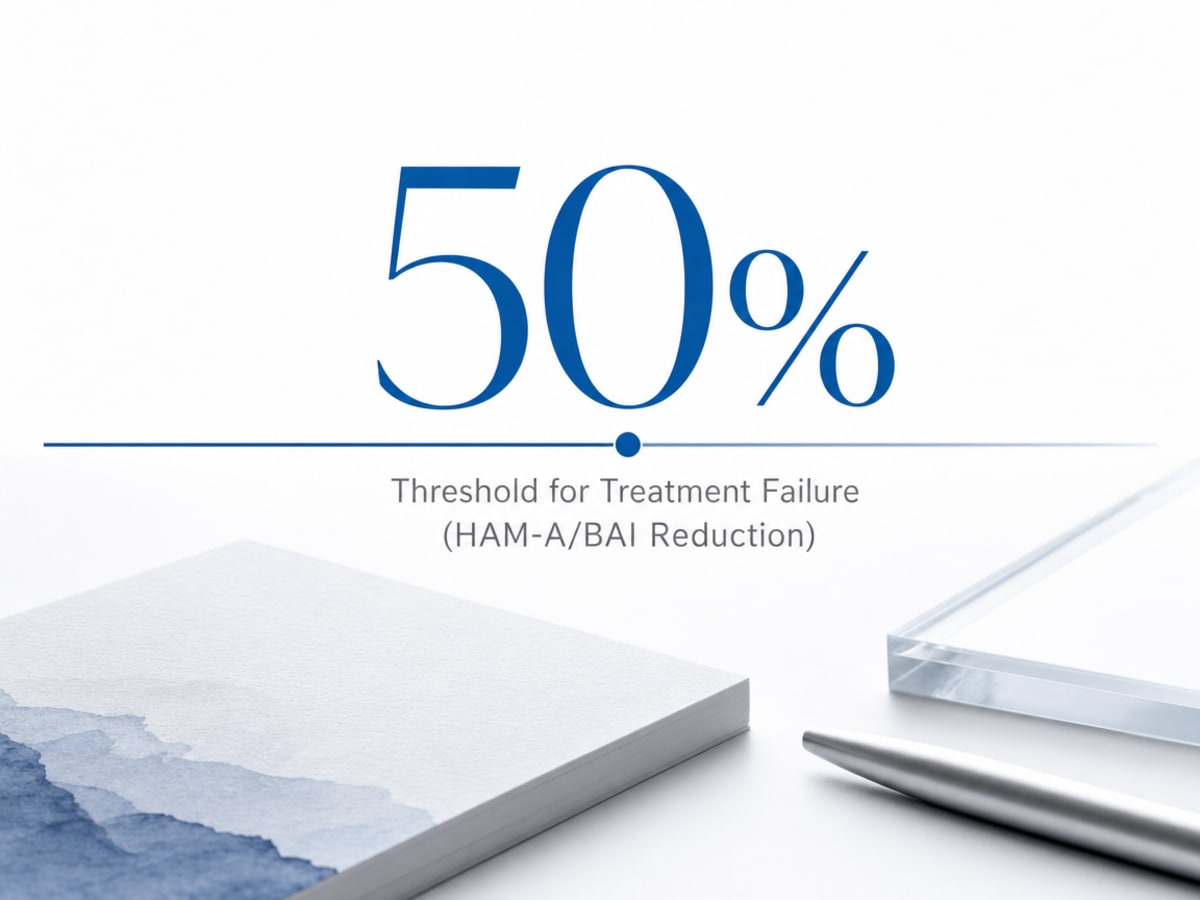
What counts as “enough” is also measurable. The consensus uses a less than 50% reduction on standardized scales such as the Hamilton Anxiety Rating Scale (HAM-A) or the Beck Anxiety Inventory (BAI) as the threshold for treatment failure, or a Clinical Global Impression-Improvement score worse than minimally improved 1, 14. If no one has ever scored you on one of those instruments before and after a trial, you have not actually been measured against the standard. You have been estimated against it.
That distinction matters, because the Delphi group is careful about one thing in particular. Before anyone calls your case treatment-resistant, they are supposed to rule out pseudo-resistance first: inadequate dose, insufficient duration, missed doses, a therapy format that did not fit, substance interference, or an unrecognized co-occurring condition 14. The label is meant to describe a well-measured failure of appropriate care, not a frustrating pattern of near-misses stacked on top of each other.
Pseudo-resistance: the six reasons a trial can fail before the drug does
Before you accept the treatment-resistant label, the Delphi group wants six specific things checked. Not as a formality. As the actual working list that separates a case that failed from a case that was never fully tested 1, 14.
- Dose.
- An SSRI started at 10 mg of escitalopram or 50 mg of sertraline and never pushed higher is not a completed trial of that medication. It is a starting point someone forgot to come back to. Many prescribers titrate up for depression and then stall at a dose that is below the therapeutic window for anxiety, where effective doses often sit at the upper end of the approved range. If no one revisited your dose after week four, that trial was underpowered against your symptoms.
- Duration.
- The consensus benchmark is six to eight weeks at a therapeutic dose before judging response 14. Side effects in weeks one and two are not the trial. Partial relief in week three is not the trial. If you switched medications at week four because something felt off, the first drug was never given a chance to work.
- Adherence.
- This is not a character question. Missed doses happen because mornings get chaotic, because the pharmacy ran out, because the side effects were worse on days you had meetings. If you took the medication inconsistently for stretches of the trial, the result reflects partial exposure, not failure. A prescriber who asks you to track adherence honestly is doing the right thing, not accusing you of anything.
- Therapy format fit.
- Weekly 50-minute CBT in a general outpatient clinic is one delivery format. It is not the only one, and it is not always the right one for every anxiety presentation. Exposure-based work for panic, intensive outpatient formats for severe GAD, and trauma-focused protocols for anxiety that is actually post-traumatic all look different in practice. If your therapy did not include the specific techniques your diagnosis called for, the format failed you more than you failed therapy.
- Substance interference.
- Three glasses of wine on weeknights, cannabis to sleep, a benzodiazepine prescription you fill monthly from a different clinician, caffeine stacked across the morning. Each of these changes how an SSRI or SNRI lands in your nervous system and can keep anxiety symptoms running underneath the medication 6, 10. The medication is not failing. It is being asked to work against a moving baseline.
- Medical and diagnostic mimics.
- Thyroid dysfunction, cardiac issues, perimenopause, sleep apnea, and medication side effects can produce or amplify anxiety symptoms. So can an unrecognized co-occurring condition such as PTSD, bipolar II, or an active substance-use disorder 6. If no one has ordered recent labs or formally screened for these, the medication trial was being judged against the wrong diagnosis the whole time.
If two or more of these six apply to your history, you are not treatment-resistant yet. You are under-assessed. That is a very different starting point for the next conversation.
Did your therapy actually fail, or did the format not fit?
There is a particular kind of discouragement that comes from finishing a course of CBT and feeling about the same as when you started. You showed up. You did the homework. You told the therapist the truth. And the thought you keep landing on is that therapy must not work for you.
Before you accept that, it is worth looking at what therapy you actually received.
A 2025 systematic review and network meta-analysis compared CBT delivery formats across 52 randomized trials and 4,361 adults with generalized anxiety disorder. Individual CBT outperformed remote CBT for anxiety-symptom reduction, and group CBT beat waiting-list control 2. Those are not small differences in a lab. They mean that a reader who did twelve video sessions on a tablet during lunch breaks received a different intervention than a reader who did twelve in-person sessions with structured exposure work. Same name on the invoice. Different dose of actual therapy.
Format is only one variable. The specific protocol matters too. A 2025 Bayesian network meta-analysis compared standard CBT with third-wave approaches like acceptance and commitment therapy, mindfulness-based cognitive therapy, and metacognitive therapy for adult GAD, and found that multiple protocols produce meaningful change, with relative strengths varying by outcome and follow-up window 3. If your therapy was general cognitive restructuring but your anxiety is driven by chronic avoidance, intolerance of uncertainty, or rumination, a different framework may reach what the first one did not.
Even when CBT works, it does not finish the job for everyone. A 2025 meta-analysis of CBT in late-life anxiety, specifically older adults, estimated a 54% remission rate, a 53% response rate, and a 33% average relapse rate after treatment 11. That population is not you if you are 38, so do not read those numbers as your personal odds. Read them as proof of concept: in a group where CBT clearly helps, close to half still need something more, and a third of initial responders slip back. Needing a different plan after a round of therapy is not a character flaw. It is a predictable part of the outcome curve.
So the honest question is not whether therapy failed you. It is whether the format, the protocol, and the intensity matched what your diagnosis actually required. If the answer is no, the next step is different therapy, not no therapy.
The three misses hiding inside most “resistant” anxiety
When a case does not respond to two medications and a round of therapy, and pseudo-resistance has been honestly ruled out, the next move is not another prescription from the same shelf. It is a second look at what the diagnosis has been all along. In practice, three co-occurring conditions account for most of the “resistant” cases that get redirected after a thorough reassessment: unstaged trauma, active substance use, and bipolar-spectrum features. Any one of them can keep anxiety symptoms running under a well-chosen SSRI. Any one of them can make textbook CBT feel like it is scraping the surface without ever reaching the layer that matters.
Trauma that was never formally staged
Here is a pattern worth naming. You have been in treatment for “anxiety” for years. Somewhere along the way a clinician asked whether anything difficult had happened to you, you said yes or sort of, and the conversation moved on. No one gave you the Primary Care PTSD Screen for DSM-5. No one walked you through a CAPS-5 interview. You never filled out a PCL-5 or an International Trauma Questionnaire. Your trauma was acknowledged, but it was never actually staged.
That matters because the symptoms of PTSD and complex PTSD overlap heavily with what gets coded as generalized anxiety: hyperarousal, trouble sleeping, scanning for threat, avoidance of places or people, a nervous system that will not stand down. The VA/DoD guideline recommends the PC-PTSD-5 for screening and structured clinician interviews such as CAPS-5 for diagnostic confirmation, with the PCL-5 for tracking symptom change over time 7, 15. The VA National Center for PTSD adds the International Trauma Questionnaire when complex PTSD is a possibility, and specifically flags the need to differentiate trauma presentations from depression, borderline personality disorder, and substance-use disorder 8.
If your care never included those instruments, the plan was built on a diagnosis that was never fully tested. An SSRI aimed at generalized worry works differently than a trauma-focused protocol aimed at re-experiencing and avoidance. Naming the trauma piece out loud, with the right tools, changes which medications and which therapy techniques belong in the next plan. It is not a smaller problem than anxiety. It is often the one driving it.
Substance use that keeps resetting the baseline
This one is harder to say out loud, so it often gets left out of the intake. Two or three drinks most evenings to come down from the day. Cannabis before bed because nothing else quiets your head. A benzodiazepine script that started as “just for flights” and now covers most Sundays. Caffeine stacked across a morning that already feels wired.
None of this makes you a stereotype. It does, however, change what your medication is being asked to do. A 2024 review of co-occurring anxiety and substance use describes the relationship as reciprocal: anxiety drives use, and intoxication, withdrawal, and anticipation each intensify anxiety through overlapping limbic circuitry 10. NIDA notes that co-occurring conditions produce symptoms that are more persistent, severe, and resistant to treatment when either diagnosis is addressed alone, and that integrated treatment produces better outcomes 16.
SAMHSA’s position is direct. Mental health and substance-use conditions should be screened for together, treated concurrently, and planned as if both are primary rather than sequencing one behind the other 5. Pharmacologic choices follow the same logic, with prescribers weighing how a given medication interacts with ongoing substance use before deciding what to switch, augment, or stop 6.
If substance use is in the picture, even at a level you consider mild, the honest next step is not another SSRI tried in isolation. It is a plan that treats the two together, because they have been running together the whole time.
Bipolar-spectrum signals that change the medication map
The third miss is quieter, and it is the one that most often arrives packaged as “my anxiety got worse after starting the second SSRI.” Bipolar-spectrum features are easy to overlook when the loudest complaint in the room is anxiety. A history of brief periods when you slept four hours and felt fine. Stretches of racing thoughts that did not feel like worry so much as acceleration. Irritability that burns hotter and shorter than your usual baseline. Family history of bipolar II that no one has asked about in detail.
These signals matter because they reshape the medication map. A 2024 review of bipolar disorder with co-occurring substance-use disorders describes how the combination complicates diagnosis, treatment, and prognosis, and reports that no single intervention is consistently effective across both mood and substance-use outcomes, which pushes care toward individualized, multimodal plans 9. An antidepressant pushed harder in someone with unrecognized bipolar II can increase instability rather than reduce anxiety.
This is why mood charting, a careful lifetime history, and family history belong in the reassessment, not just a current-symptom checklist. If a bipolar-spectrum pattern is there, the medication strategy changes before the next prescription is written. If it is not there, you have ruled it out with evidence instead of assumption.
What an extended psychiatric assessment actually contains
A standard 60-minute intake is built to confirm a working diagnosis and get you started on something. An extended psychiatric assessment is built to answer a different question: what has been missed, and what should the plan actually be aimed at. The time difference is not cosmetic. It is the difference between a provisional label and a complete picture.
In practice, a thorough reassessment runs across several hours, often split over more than one session, and uses specific instruments rather than general conversation. For trauma, that means the Primary Care PTSD Screen for DSM-5 as a first-pass screen, followed by a structured clinician-administered interview such as the CAPS-5 for diagnostic confirmation, and the PCL-5 for tracking symptom change over time 7, 15. When features suggest a chronic, interpersonal, or developmental trauma history, the International Trauma Questionnaire adds assessment of disturbances in self-organization that standard PTSD measures can miss 8.
For substance use, screening is paired with the mental health workup rather than left for later. SAMHSA’s framework calls for assessing mental, substance-use, and physical conditions together, because symptoms produced by intoxication, withdrawal, or a medical mimic can be mistaken for primary anxiety and keep the plan pointed at the wrong target 5, 6. NIDA frames this the same way: screen for both, treat both, and expect that unaddressed substance use will make the anxiety picture more persistent and more resistant to treatment 16.
For mood, the reassessment looks beyond this week’s symptoms. A detailed lifetime history, structured mood charting, and family history help surface bipolar-spectrum features that a current-symptom checklist can skip past, which matters because an unrecognized mood-spectrum pattern changes the medication strategy before anything is prescribed 9.
Two more pieces belong in the packet. A measurement-based baseline on a HAM-A or BAI so the next trial can be judged against a number rather than a memory 1, 14. And a treatment-history review that documents prior doses, durations, adherence, and therapy format, so pseudo-resistance is ruled out on paper rather than assumed away. At ViewPoint Dual Recovery, this extended assessment is the first step every plan is built on, led by board-certified psychiatrists, before any medication or DBT/CBT work is designed around the findings.
Rebuilding medication after reassessment, without defaulting to sedatives
Once the reassessment is done and the picture is clearer, the medication conversation changes. It stops being “let’s try the next SSRI on the list” and starts being a plan built around what the assessment actually found. If trauma is driving the hyperarousal, the medication strategy follows that. If substance use is in the mix, prescribing choices account for interactions, withdrawal timing, and what the nervous system is being asked to adjust to at the same time 6. If bipolar-spectrum features surfaced, antidepressant monotherapy is usually not the right next step, and mood stabilization moves to the front of the plan 9.
What replaces the sedative-first reflex is slower, and honestly, more useful. Measurement-based dosing with a HAM-A or BAI baseline so you can see whether the new trial is actually working 1. Augmentation strategies chosen for your specific comorbidity pattern rather than pulled from a generic ladder 1. And therapy rebuilt alongside the medication, not after it, because the two are supposed to carry the load together 12.
Where a structured program fits: ViewPoint as one application of this logic
Most of what this piece describes can happen in outpatient care, and for many readers it should. A good psychiatrist, a trauma-informed therapist, and a few weeks of honest reassessment can reset a stuck case without anyone leaving home.
A residential setting earns its place when the picture is more tangled than that. When unstaged trauma, active substance use, and bipolar-spectrum questions are all live at once, and no outpatient team has had the time or the vantage point to sort them out, the compressed structure of an intensive program can do in weeks what fragmented appointments have not done in years 5, 16.
ViewPoint Dual Recovery in Prescott, Arizona is one example of that model. Every plan starts with an extended assessment led by board-certified psychiatrists, not a 60-minute intake that confirms the diagnosis you walked in with. The findings from that assessment, not a default protocol, shape what the medication strategy and the DBT/CBT work actually look like. For a reader whose anxiety has already outlasted two medications and months of therapy, that sequence is the point. The plan is built from what the assessment surfaces, not from what the referral form said.
Find Out Why Anxiety Treatments Aren’t Working
Get a thorough review of your anxiety history and a tailored plan for next-step solutions.
Frequently Asked Questions
How many medication trials do I need before my anxiety is considered treatment-resistant?
The 2024 Delphi consensus sets pharmacological resistance at two adequate trials of first-line medications from different classes, each generally lasting six to eight weeks at a therapeutic dose, with less than a 50% reduction on the HAM-A or BAI 14. If your prior trials were shorter, undertitrated, or never measured on a standardized scale, you have an incomplete trial record, not a confirmed resistant case.
If weekly CBT didn’t work, does that mean therapy won’t help me?
Not necessarily. A 2025 network meta-analysis of 52 trials and 4,361 adults with GAD found that individual CBT outperformed remote CBT for anxiety-symptom reduction, meaning format and intensity change what the therapy actually delivers 2. A separate 2025 analysis showed third-wave approaches like ACT and metacognitive therapy produce meaningful change too 3. The honest question is whether the protocol matched your diagnosis, not whether therapy works.
Why would a prescriber hesitate to put me on a benzodiazepine long-term?
In 2020 the FDA updated the boxed warning on the entire benzodiazepine class to reflect risks of abuse, physical dependence, withdrawal, and overdose, especially when combined with opioids or alcohol 4. A careful prescriber will usually look for a different foundation when substance use is anywhere in your history, use the lowest effective dose for the shortest period if one is appropriate, and taper gradually rather than stop abruptly.
What makes an extended psychiatric assessment different from a standard 60-minute intake?
A standard intake confirms a working diagnosis and starts treatment. An extended assessment runs several hours, often across sessions, and uses specific instruments: PC-PTSD-5, CAPS-5, and PCL-5 for trauma 7, 15, the ITQ when complex PTSD is possible 8, integrated substance-use screening 5, mood charting and lifetime history for bipolar-spectrum features 9, and a HAM-A or BAI baseline so the next trial can be measured 1.
Could unrecognized trauma or substance use be the reason my anxiety hasn’t improved?
Yes, and this is one of the most common misses. NIDA reports that co-occurring conditions produce symptoms that are more persistent, severe, and resistant to treatment when either diagnosis is addressed alone 16. A 2024 review describes anxiety and substance use as reciprocal, with each intensifying the other 10. Unstaged trauma can also keep hyperarousal and avoidance running under a well-chosen SSRI if it was never formally assessed 17.
How do bipolar-spectrum symptoms change the medication plan for anxiety?
They change it significantly. A 2024 review of bipolar disorder with co-occurring substance-use disorders reports that no single intervention is consistently effective across both mood and substance outcomes, pushing care toward individualized, multimodal plans 9. An antidepressant pushed harder in someone with unrecognized bipolar II can increase instability rather than reduce anxiety, which is why mood stabilization usually moves to the front of the plan before another SSRI is added.
References
- [Treatment resistance in anxiety disorders-Definition and treatment options]. https://pubmed.ncbi.nlm.nih.gov/38436664/
- CBT treatment delivery formats for generalized anxiety disorder: a systematic review and network meta-analysis of randomized controlled trials. https://pubmed.ncbi.nlm.nih.gov/40506439/
- (Third-wave) cognitive behavioral therapy for generalized anxiety disorder in adults: A systematic review and Bayesian network meta-analysis. https://pubmed.ncbi.nlm.nih.gov/40367584/
- FDA requiring Boxed Warning updated to improve safe use of benzodiazepine drug class. https://www.fda.gov/drugs/drug-safety-and-availability/fda-requiring-boxed-warning-updated-improve-safe-use-benzodiazepine-drug-class
- Substance Use Disorder Treatment for People With Co-Occurring Disorders. https://library.samhsa.gov/sites/default/files/pep20-06-04-006.pdf
- General Principles for the Use of Pharmacological Agents to Treat Individuals with Co-Occurring Mental and Substance Use Disorders. https://library.samhsa.gov/sites/default/files/sma12-4689.pdf
- The Management of Posttraumatic Stress Disorder and Acute Stress Disorder. https://www.healthquality.va.gov/HEALTHQUALITY/guidelines/MH/ptsd/PTSD-in-Annals-2024.pdf
- Complex PTSD: Assessment and Treatment. https://www.ptsd.va.gov/professional/treat/txessentials/complex_ptsd_assessment.asp
- Psychosocial and Psychopharmacological Interventions for Comorbid Bipolar Disorder and Substance Use Disorders: A Review. https://pubmed.ncbi.nlm.nih.gov/40843035/
- The Limbic System in Co-Occurring Substance Use and Anxiety Disorders: A Narrative Review Using the RDoC Framework. https://pubmed.ncbi.nlm.nih.gov/39766484/
- A Systematic Review and Meta-analysis of Diagnostic and Treatment Outcomes for Cognitive Behavioral Therapy in Late-Life Anxiety. https://pubmed.ncbi.nlm.nih.gov/40581526/
- Generalized Anxiety Disorder: What You Need to Know. https://www.nimh.nih.gov/health/publications/generalized-anxiety-disorder-gad
- Psychotherapies. https://www.nimh.nih.gov/health/topics/psychotherapies
- The definition of treatment resistance in anxiety disorders: a Delphi method-based consensus guideline. https://pmc.ncbi.nlm.nih.gov/articles/PMC10785995/
- VA/DoD Clinical Practice Guideline for Management of Posttraumatic Stress Disorder and Acute Stress Disorder. https://www.healthquality.va.gov/guidelines/MH/ptsd/VA-DoD-CPG-PTSD-Full-CPG-Edited-111624-V5-81825.pdf
- Co-Occurring Disorders and Health Conditions. https://nida.nih.gov/research-topics/co-occurring-disorders-health-conditions
- Trauma and Stress. https://nida.nih.gov/research-topics/trauma-and-stress
- Any Anxiety Disorder – National Institute of Mental Health. https://www.nimh.nih.gov/health/statistics/any-anxiety-disorder