Key Takeaways
- Coverage for out-of-state psychiatric care hinges on which law governs your plan: Wisconsin’s section 632.89, federal MHPAEA for self-funded employer plans, Medicaid rules, or Medicare 6, 12.
- The May 2025 federal enforcement pause affects newer 2024 parity rule provisions, but statutory MHPAEA obligations and the 2021 CAA amendments remain fully in effect 2.
- Prior authorization, not whether behavioral health is covered, decides most out-of-state admissions, so verification calls should focus on level of care, documentation, and concurrent review cadence.
- Ask HR whether your plan is fully insured or self-funded, then request a written verification covering ten specific benefit and authorization questions before booking travel to an Arizona facility 8, 9.
Why three insurance calls gave you three different answers
If you’ve already called your insurance card’s member services line, then your HR benefits coordinator, then an admissions line at a treatment center, and gotten three different answers about out-of-state psychiatric care, that confusion isn’t your fault. Each person was reading from a different rulebook, and none of them told you that.
Here’s what’s actually happening. The coverage question for a Wisconsin resident looking at an Arizona psychiatric facility depends on which law governs your specific plan, not on a single national standard. A group policy issued in Wisconsin follows one set of mandates. A self-funded employer plan, even one administered by a familiar insurer logo, answers to federal regulators instead of the state 12. Wisconsin Medicaid applies its own prior-authorization rules for non-border, out-of-state services. Federal parity law sits on top of most of this, but a May 2025 enforcement statement from the Departments of Labor, Health and Human Services, and the Treasury paused parts of the 2024 parity rule while litigation plays out 2.
So when the member services rep gave you a quick “we don’t cover out-of-state,” and your HR contact said “you’ll need prior auth,” and the admissions coordinator said “we work with your plan all the time,” each was partly right and partly incomplete. The next sections sort out which rulebook is yours, so the answer stops moving.
The rulebook question: which law actually governs your plan
State-regulated Wisconsin policies under section 632.89
If your coverage comes from a group health policy issued in Wisconsin, an individual policy you bought here, or a self-insured state governmental plan, you’re likely in section 632.89 territory. This Wisconsin statute requires those plans, when they offer behavioral-health benefits, to cover inpatient hospital services, outpatient services, and transitional treatment arrangements for nervous and mental disorders and substance-use disorders 6, 7.
Here’s the piece most people miss. Section 632.89 tells your insurer what categories of care they must cover. It does not tell them which specific out-of-state facility they must send you to. A Wisconsin group plan can comply with the mandate while still steering you toward in-network providers and applying higher cost-sharing when you go out of network. That’s a legitimate distinction, and it’s where a lot of “we don’t cover out-of-state” misunderstandings come from. The service category may be covered. The specific Arizona facility may still require out-of-network benefits, prior authorization, or a single-case agreement.
Individual Wisconsin policies get a slightly different treatment. They’re subject to the law only to the extent the insurer elected to offer the coverage, but when they do offer it, the coverage must be offered on parity terms 6. So the first thing to check on your card isn’t the logo. It’s whether this is a Wisconsin-issued group or individual policy, because that places you under OCI’s authority and the section 632.89 framework.
Self-funded employer plans and federal MHPAEA oversight
Now here’s where a lot of Wisconsin families get tripped up. If your coverage comes through a large employer, there’s a good chance the plan is self-funded, meaning your employer pays claims directly out of its own budget and hires an insurance company only to administer the plan. The card looks the same. The customer service number is the same. The regulator is not.
Self-funded employer plans fall outside the Wisconsin Office of the Commissioner of Insurance and under federal oversight through the Department of Labor and ERISA 12. That means section 632.89 doesn’t apply to you. What does apply is the federal Mental Health Parity and Addiction Equity Act, which requires that financial requirements and treatment limitations for mental-health and substance-use benefits be no more restrictive than those for comparable medical and surgical benefits 12. Prior authorization, network composition, and out-of-network reimbursement all get scrutinized as nonquantitative treatment limitations under the parity framework 11.
Wisconsin Medicaid and the non-border authorization rule
If your coverage is Wisconsin Medicaid or BadgerCare Plus, the out-of-state question gets more structured. Medicaid generally requires prior authorization for nonemergency services from non-border out-of-state providers, and approval tends to depend on whether the needed service is reasonably accessible within Wisconsin or in a border community.
That phrasing matters. If an in-state program can provide the level of psychiatric care you need, Medicaid is unlikely to authorize a trip to Arizona. If your clinical picture is treatment-resistant, dual-diagnosis, or requires specialized protocols that in-state programs genuinely don’t offer, the authorization conversation becomes possible, but it still runs through a formal prior-authorization process rather than a casual network check.
This is also where Wisconsin DHS certification sometimes gets confused with insurance coverage. DHS certifies mental-health treatment programs operating inside Wisconsin 5. That certification framework has nothing to do with whether your Medicaid or commercial plan will pay for an Arizona facility. Those are two separate questions, decided by two separate agencies, under two separate rulebooks.
A decision tree for identifying your plan type
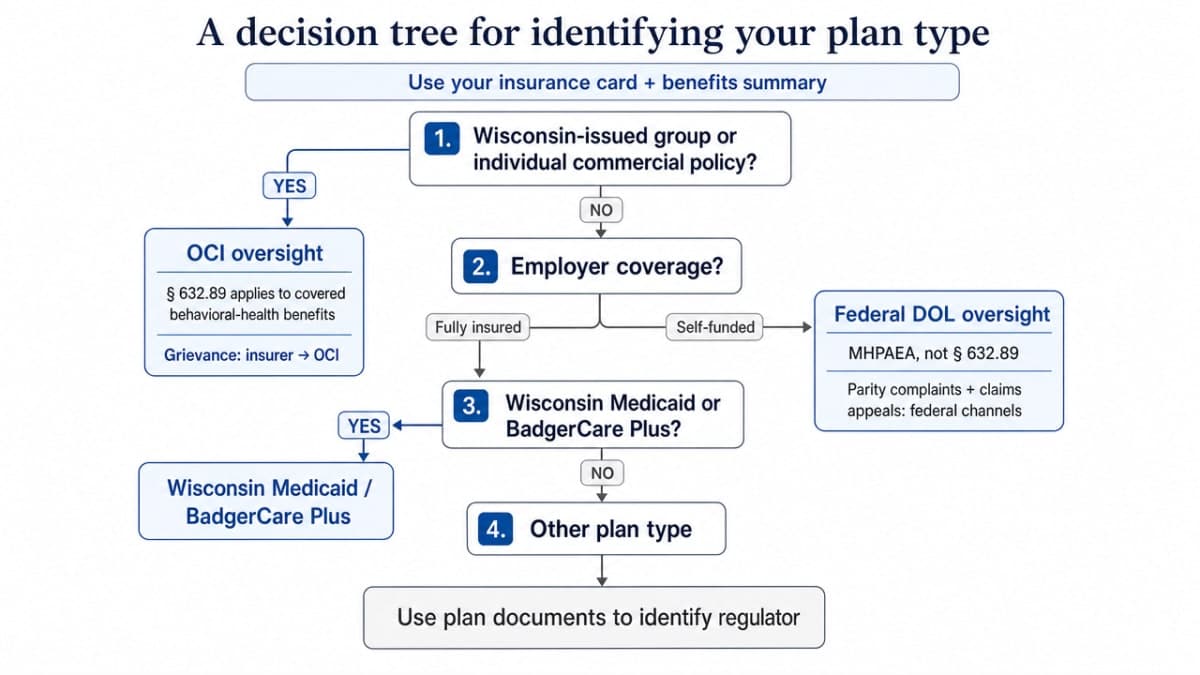
Pull out your insurance card and your most recent benefits summary. You’re going to answer four questions in order, and each answer routes you to a different regulator and a different set of rights.
- Is this a Wisconsin-issued group or individual commercial policy? If yes, you’re under OCI oversight and section 632.89 applies to covered behavioral-health benefits 6, 7. Your grievance path runs through the insurer and then to OCI.
- Is this employer coverage, and if so, is the plan fully insured or self-funded? Your HR benefits coordinator can answer this in one sentence. If self-funded, you’re under federal DOL oversight and MHPAEA, not section 632.89 12. Your parity complaints and claims appeals route through federal channels.
- Is this Wisconsin Medicaid or BadgerCare Plus? If yes, nonemergency out-of-state care generally requires prior authorization and a showing that the service isn’t reasonably accessible in Wisconsin or a border community.
- Is this Medicare or Medicare Advantage? Different federal rules apply, and the Medicare Advantage utilization-management picture looks notably different from commercial coverage.
One card. Four possible rulebooks. The verification call goes differently depending on which one is yours.
What parity law actually promises in 2025
Nonquantitative treatment limitations in plain language
Parity law uses an awkward phrase for something you’ve probably already run into. A nonquantitative treatment limitation, or NQTL, is any rule that restricts your mental-health or substance-use coverage that isn’t a simple number. Visit limits and copays are quantitative. Prior authorization, how a plan builds its network, how it pays out-of-network providers, and how it defines medical necessity are nonquantitative 11.
Why does this matter for an Arizona admission? Because parity law says those nonquantitative rules can’t be more restrictive, in writing or in practice, than the comparable rules the plan uses for medical and surgical care 12. If your plan rubber-stamps a knee surgery at an out-of-state orthopedic center but routes every out-of-state psychiatric admission through a two-week concurrent review, that gap is exactly what parity analysis is supposed to catch.
The federal rulemaking has gotten specific about this. Plans and issuers are expected to document comparative analyses of how they build networks, set out-of-network reimbursement rates, and apply prior-authorization criteria to behavioral health versus medical and surgical benefits 1, 11. You don’t have to run that analysis yourself. You do have the right to ask your plan for it in writing, especially if a denial starts to feel like a pattern rather than a one-off.
The May 2025 enforcement pause and what still applies
Here’s the honest part. On May 15, 2025, the Departments of Labor, Health and Human Services, and the Treasury issued a statement saying they will not enforce the portions of the 2024 MHPAEA final rule that are new compared with the 2013 rule, until the pending litigation reaches a final decision plus another 18 months 2. If you’ve read a 2024 article promising aggressive new data standards and network-adequacy enforcement, that article is now partially out of date.
What didn’t pause is the law itself. The agencies were clear that MHPAEA’s statutory obligations, including the 2021 Consolidated Appropriations Act amendments, remain in effect 2. Your plan still cannot apply more restrictive financial requirements or treatment limitations to mental-health and substance-use benefits than it applies to comparable medical and surgical benefits 12. Prior authorization for an Arizona psychiatric admission still has to be comparable to prior authorization for an out-of-state medical admission.
The practical read: don’t quote the 2024 rule’s newest provisions as a hammer in a 2025 appeal. Quote the underlying statutory parity requirements, document the comparison, and know that the floor beneath you hasn’t moved even though the ceiling is contested.
Prior authorization: the hinge of every out-of-state admission
Here’s the question that quietly decides most out-of-state psychiatric admissions. Not whether your plan covers behavioral health in theory. Not whether the Arizona facility accepts your insurance. The question is whether your plan’s utilization-management team will issue a prior authorization for this specific admission at this specific level of care, and how fast.
You can see how central prior authorization has become in the one dataset where federal auditors have actually measured it. In GAO’s analysis of Medicare Advantage behavioral-health benefits, approximately 79%–80% of analyzed plans required prior authorization for individual sessions in mental-health specialty, psychiatric, and outpatient substance-use services 4. That figure is scoped to Medicare Advantage. It is not a measurement of commercial Wisconsin plans, employer self-funded plans, or Marketplace policies. But it tells you that even for routine outpatient sessions in one large federal program, authorization is the default, not the exception. For a planned inpatient or residential admission in another state, assume prior authorization is required until a benefits representative tells you otherwise in writing.
The practical consequence is that your verification call should spend most of its time on three authorization questions, not on whether behavioral health is a covered benefit.
- Level of care: what level of care does the plan require you to request: acute inpatient, residential, partial hospitalization, intensive outpatient? Each has its own medical-necessity criteria, often drawn from ASAM or similar guidelines.
- Clinical documentation: what clinical documentation does the utilization reviewer need to see on the initial request, and from whom? A current psychiatric evaluation, prior treatment history, medication trials, and a specific level-of-care recommendation usually anchor the file.
- Concurrent review cadence: what is the concurrent review cadence once you’re admitted? A plan that reviews continued stay every three days behaves very differently from one that reviews every seven.
Getting those three answers in writing turns a vague “we’ll see” into a sequence you can actually plan around. That’s the shift from hoping for coverage to managing it.
The ten questions a written verification should answer
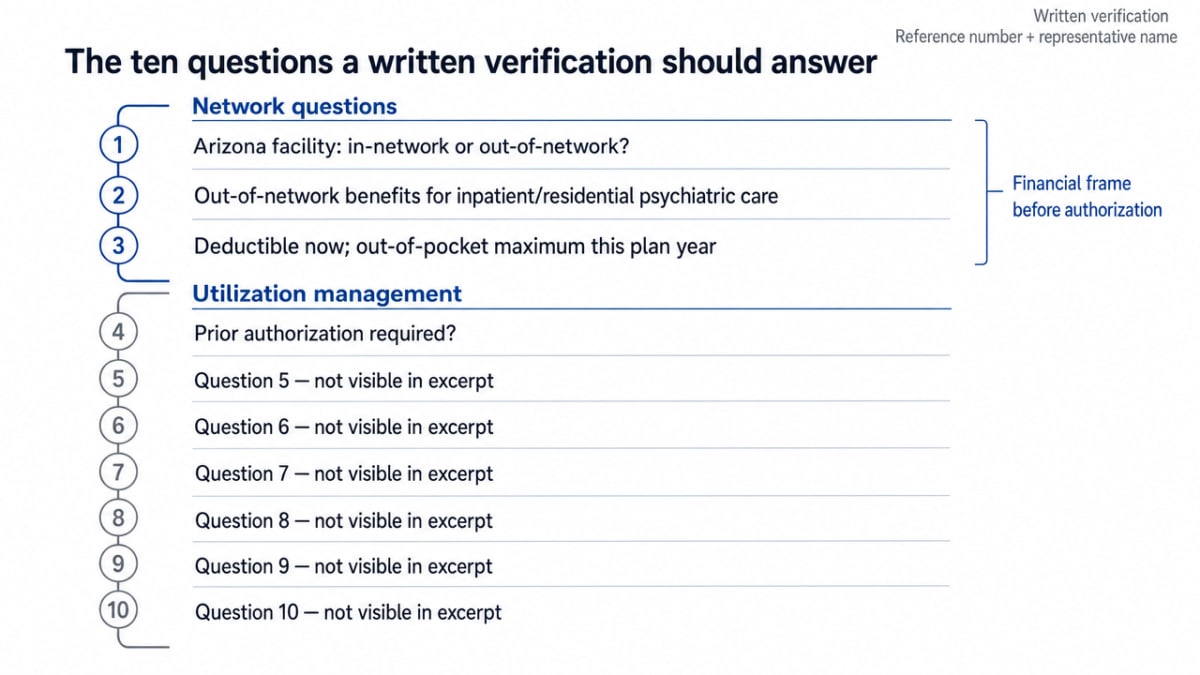
A good verification isn’t a yes-or-no phone call. It’s a document. Before anyone in your family gets on a plane, you want these ten answers written down, with a reference number and a representative’s name attached, so that the picture doesn’t shift the next time you call 9.
Start with the network questions.
- Is the Arizona facility in-network or out-of-network for your specific plan?
- What are your out-of-network benefits for inpatient and residential psychiatric care, stated as a coinsurance percentage after deductible?
- Where does your deductible stand right now, and what is your out-of-pocket maximum for the current plan year?
Those three numbers set the financial frame before authorization even enters the conversation. Then move to utilization management.
- Does this admission require prior authorization, and what level of care is being requested: acute inpatient, residential, partial hospitalization, or intensive outpatient?
- What medical-necessity criteria will the reviewer apply, and what clinical documentation needs to be on file at submission?
- If the facility is out-of-network, will the plan consider a single-case agreement, and who initiates that request?
Finally, protect the back end.
- What is the concurrent review cadence once admitted, in days?
- What are your appeal rights and timelines if authorization is denied or cut short 8?
- What is the claims mailing address or electronic payer ID for this specific plan?
- Based on everything above, what is the estimated patient financial responsibility for the full episode of care?
If the person on the phone can’t answer a question, write down that it was asked and left open. That gap is itself information you’ll want in writing.
Dual diagnosis coverage: when psychiatric and substance use overlap
If you’re looking at ViewPoint because the person you love has a psychiatric diagnosis and a substance-use problem that keep feeding each other, the verification call gets one layer more complicated. Two benefit categories are now in play, and the plan may authorize one while quietly limiting the other.
Here’s what to hold onto. Under federal parity law, covered mental-health, behavioral-health, and substance-use-disorder treatment has to receive coverage comparable to medical and surgical treatment under applicable plans 10. In Wisconsin, section 632.89 reaches both nervous and mental disorders and substance-use disorders, so a state-regulated group policy that offers behavioral benefits has to cover both categories on parity terms 6, 7. The categories can’t be separated to the member’s disadvantage.
In practice, ask the reviewer to authorize integrated dual-diagnosis treatment under the primary psychiatric diagnosis, with the substance-use component documented as co-occurring. Confirm that medication management for both conditions, including any addiction-focused pharmacotherapy, falls inside the authorized level of care. If the plan tries to split the stay, that split is the kind of nonquantitative limitation parity analysis is meant to question 11.
If the first answer is no: grievances, independent review, and single-case agreements
A denial is not the end of the conversation. It’s the start of a different one, with different rules and different timelines, and you have more leverage than that first phone call suggested.
Start with the written denial letter itself. It has to tell you why the plan said no, which policy language or medical-necessity criterion was applied, and what your appeal rights are. OCI’s grievance guidance walks Wisconsin members through the next step: identify the policy and the denial, explain the problem with specific dates and supporting facts, lean on the plan’s own language, and include medical records, a letter from the treating psychiatrist, and any prior-treatment history that supports the level-of-care request 8. If your plan is a Wisconsin-regulated commercial policy and the internal grievance fails, you generally have the right to an independent external review, where a reviewer outside the insurer looks at the clinical case fresh 8, 9. If your plan is self-funded, the appeal path runs through federal ERISA and MHPAEA channels rather than OCI, but the documentation discipline is the same 12.
There’s a parallel track worth running at the same time. Ask the Arizona facility to pursue a single-case agreement, sometimes called a letter of agreement, in which the plan treats an out-of-network admission as if it were in-network for this specific episode because no in-network provider offers comparable care. Single-case agreements are negotiated between the facility’s utilization team and the insurer, not by you, but your clinical story, prior failed treatment, and specific level-of-care need are the raw material that makes the request credible. Progress here is progress, even when the first answer was no.
What the No Surprises Act does and does not cover for a planned Arizona admission
You’ve probably heard about the No Surprises Act as a shield against out-of-network bills, and it is a real protection, but its edges matter for a planned psychiatric trip. In Wisconsin, OCI explains that the law caps cost-sharing at in-network levels for covered emergency services, even when the hospital or clinician is out of network, and for certain non-emergency services delivered by out-of-network providers at in-network facilities 13. That’s the shield.
That isn’t bad news so much as a reason to get the real numbers in writing first. The deductible, out-of-network coinsurance, and out-of-pocket maximum on your plan become the actual guardrails for a planned trip, not the surprise-billing rules.
How ViewPoint runs the verification on your behalf
After the first three phone calls, you probably don’t want to make a fourth. You shouldn’t have to. ViewPoint’s admissions team runs the verification work for you, then puts the answer in writing before you decide anything.
Here is what that looks like in practice. You share your insurance card, your subscriber information, and a short clinical summary. ViewPoint’s benefits team contacts your plan directly, identifies which rulebook applies to your coverage, and works through the ten questions a real verification should answer:
- in-network status
- out-of-network benefits
- where your deductible and out-of-pocket maximum stand
- prior-authorization requirements
- the level-of-care criteria the reviewer will apply
- single-case agreement potential
- concurrent review cadence
- appeal rights
- claims routing
- an estimated patient financial responsibility for the episode of care 8, 9
You receive a written coverage picture. Not a sales pitch, not a verbal maybe. If authorization is likely, you know the pathway. If a single-case agreement is the right play, ViewPoint’s team initiates that conversation with your insurer. If the plan isn’t a fit, you learn that before anyone books a flight. The decision stays yours. The paperwork stops being yours alone.
Clarify your next step with expert guidance
Receive a personalized treatment recommendation based on your unique clinical and insurance situation.
Frequently Asked Questions
Will my Wisconsin insurance pay for psychiatric treatment in Arizona?
Maybe, and the honest answer depends on which rulebook governs your plan. A Wisconsin-issued group policy under section 632.89 must cover inpatient, outpatient, and transitional behavioral-health services, but it does not have to send you to a specific out-of-state facility 6, 7. Out-of-network benefits, prior authorization, and medical-necessity criteria all shape the actual answer, which is why a written verification matters more than a verbal maybe.
How do I find out whether my plan is state-regulated or self-funded?
Ask your HR benefits coordinator one direct question: is our health plan fully insured or self-funded? Fully insured Wisconsin group policies fall under OCI and section 632.89 6. Self-funded employer plans fall under federal Department of Labor oversight and MHPAEA, not state law 12. The card looks identical either way, so the HR answer is the only reliable way to know which regulator hears your complaint.
What does a written insurance verification actually tell me?
A real verification answers ten questions in writing: in-network status, out-of-network benefits, deductible position, out-of-pocket maximum, authorization requirements, level-of-care criteria, single-case agreement potential, concurrent review cadence, appeal rights, and estimated patient responsibility 8, 9. You get a reference number and a representative’s name attached to the answer. That document stops the picture from shifting the next time you call, and it lets you plan around real numbers instead of guesses.
Does Wisconsin Medicaid ever cover out-of-state psychiatric care?
Sometimes, through prior authorization. Medicaid generally requires preapproval for nonemergency services from non-border out-of-state providers, and approval tends to depend on whether comparable care is reasonably accessible in Wisconsin or a border community. Treatment-resistant and dual-diagnosis cases that in-state programs genuinely can’t match may open that door, but the request runs through a formal clinical-review process. Wisconsin DHS certification of in-state programs is a separate question entirely 5.
If my insurer denies the admission, what are my options?
A denial starts a different conversation, not an ending. File an internal grievance using the plan’s own language, dates, medical records, and a treating psychiatrist’s letter 8. State-regulated Wisconsin policies carry independent external review rights after an internal denial 8, 9. Self-funded plans route appeals through federal ERISA and MHPAEA channels 12. Run a single-case agreement request from the facility side in parallel. Both tracks can move at once.
Does the No Surprises Act protect me from out-of-network bills at an Arizona facility?
Not for a planned admission you chose in advance. The No Surprises Act caps cost-sharing at in-network rates for covered emergency services and for certain non-emergency services delivered by out-of-network providers at in-network facilities 13. A scheduled Arizona psychiatric stay doesn’t fit either category, so your deductible, out-of-network coinsurance, and out-of-pocket maximum become the real guardrails. Get those numbers in writing before you commit to travel.
References
- New Mental Health and Substance Use Disorder Parity Rules. https://www.dol.gov/agencies/ebsa/laws-and-regulations/laws/mental-health-parity/new-mhpaea-rules-what-they-mean-for-plans-and-issuers
- Statement of U.S. Departments of Labor, Health and Human Services, and the Treasury Regarding Enforcement of the Final Rule on Requirements Related to MHPAEA. https://www.dol.gov/agencies/ebsa/laws-and-regulations/laws/mental-health-parity/statement-regarding-enforcement-of-the-final-rule-on-requirements-related-to-mhpaea
- Mental Health Care: Access Challenges for Covered Consumers and Relevant Federal Efforts. https://www.gao.gov/products/gao-22-104597
- GAO-24-106794, Accessible Version, BEHAVIORAL HEALTH: Information on Cost-Sharing in Medicare and Medicare Advantage. https://www.gao.gov/assets/880/871430.pdf
- Mental Health Treatment Programs: Certification. https://www.dhs.wisconsin.gov/regulations/mentalhealth/certification.htm
- Mandated Benefits for the Treatment of Nervous and Mental Disorders or Substance Use Disorders. https://oci.wi.gov/Documents/Consumers/PI-008.pdf
- Health Insurance Coverage for Mental Health and Substance Use Disorders. https://oci.wi.gov/Documents/Consumers/PI-019.pdf
- Health Insurance Grievances and Complaints. https://oci.wi.gov/Documents/Consumers/PI-217.pdf
- OCI Guide to Health Care Insurance. https://oci.wi.gov/Pages/Consumers/PI-225.aspx
- Fact Sheet on the Treatment of Opioid Addiction & Other Substance Use Disorders. https://oci.wi.gov/Documents/Consumers/PI-238.pdf
- Fact Sheet: Final Rules under the Mental Health Parity and Addiction Equity Act (MHPAEA). https://www.dol.gov/agencies/ebsa/about-ebsa/our-activities/resource-center/fact-sheets/final-rules-under-the-mental-health-parity-and-addiction-equity-act-mhpaea
- Mental Health and Substance Use: State and Federal Oversight of Compliance with Parity Requirements Varies. https://www.gao.gov/assets/gao-20-150.pdf
- OCI Protections from Surprise Medical Bills. https://oci.wi.gov/Pages/Consumers/PI-328.aspx