Key Takeaways
- Chicago’s public mental health footprint has shrunk since 1989, leaving five municipal clinics and thin acute psychiatric capacity across flagship hospitals like Rush, which lists 54 acute beds and zero long-term psychiatric beds 3.
- Municipal clinics, Living Rooms, and CARE crisis teams handle screening, therapy, and de-escalation well, but none can admit a loved one for weeks of concurrent psychiatric and substance use treatment 13.
- SAMHSA’s TIP 42 calls for mental illness and substance use to be treated concurrently by the same team, so families should filter programs by whether care is truly integrated rather than sequential 8.
- Before committing, compare bed availability timelines, on-site board-certified psychiatry, advanced medication protocols like clozapine, length-of-stay flexibility, insurance coverage, and whether the program screens for both conditions on day one 9.
Why placing a loved one in Chicago feels so hard right now
If you have spent the last few weeks on hold with intake lines, sitting in an ED waiting room, or leaving voicemails at every program that showed up in a search for dual diagnosis treatment, you are not doing this wrong. You are running into a real capacity problem, and it is not a reflection of how hard you have tried.
Chicago is a big city with serious talent in psychiatry and addiction medicine. It is also a city whose public mental health footprint shrank sharply over the last three decades. Since 1989, the city has closed 14 of its 19 municipal mental health centers, and the Chicago Department of Public Health now operates five, with a 2024 plan to reopen Roseland Mental Health Center and layer new services in Pilsen and at Legler Regional Library.1 That is meaningful progress, and it still leaves most of the acute, long-term work to a small handful of hospitals and private residential programs.
When your loved one has treatment-resistant symptoms and active substance use, the waitlists you hit are not random. They reflect a system where outpatient reach has grown faster than inpatient depth, and where hospitals themselves reserve only a slim share of beds for acute psychiatric care. Families end up cycling through short ED holds, brief inpatient stays, and outpatient referrals that cannot hold a high-acuity case together.
Take a breath. The next sections walk through what the local system can and cannot do, and where an accredited out-of-state option like ViewPoint Dual Recovery fits when the clock matters.
What dual diagnosis actually means when the case is complex
You have probably heard the phrase used loosely. In clinical terms, a co-occurring or dual diagnosis is exactly what it sounds like: a mental health disorder and a substance use disorder happening at the same time in the same person.10 That can look like bipolar disorder with alcohol use, PTSD with opioid use, or schizophrenia with stimulant use. The pairings matter because each condition changes how the other presents and how it responds to treatment.
What makes a case complex is usually not the label. It is the pattern. Symptoms that come back within days of discharge. Medications that helped briefly and then stopped working. A relative who cycles through detox, then a short psych hold, then an outpatient referral that cannot hold the weight of what is happening at home. If that sounds familiar, you are looking at what clinicians call treatment-resistant presentation, and it needs a different kind of setup than either problem alone.
The federal standard is clear on what that setup should look like. SAMHSA’s TIP 42 says treatment for co-occurring disorders should address mental illness and substance use concurrently, in the same program, with the same team, rather than sending someone from one specialty to another and hoping the handoffs hold.8 The related “no wrong door” principle asks any program a person enters to screen for the other condition on day one, not weeks in.9 Concurrent care is the target. Sequential referrals are what tend to fail your family.
The capacity problem inside Chicago’s hospitals and clinics
Municipal clinics: outpatient reach, not acute depth
When you call around Chicago looking for help, you will keep landing at the same handful of front doors. The Chicago Department of Public Health runs mental health centers in Englewood, Bronzeville, Greater Lawn, North River, Lower West, and Roseland, with partner sites at Legler and Woodson Regional Libraries offering counseling and telepsychiatry.12 These are real resources, and the staff at them work hard. But they are outpatient by design.
That design is not an accident. Since 1989, the city closed 14 of its original 19 municipal mental health centers, leaving CDPH with five today. The 2024 Mental Health System Expansion Working Group report lays out a plan to reopen Roseland Mental Health Center, add mental health services at the Lower West clinic in Pilsen, and co-locate behavioral health at Legler Regional Library, with groundwork for a Certified Community Behavioral Health Clinic to follow.1 That is genuine forward motion after decades of contraction. It is worth naming.
Here is the piece that trips up families: even a fully staffed municipal clinic is built for scheduled visits, therapy, medication follow-up, and telepsychiatry. It is not built to hold a person in acute psychosis, manage active withdrawal, or run a clozapine titration for treatment-resistant schizophrenia. If your loved one needs 24-hour psychiatric supervision, a municipal clinic will most likely refer out. That referral is where the search you are already living begins.
Hospital psych units: 54 acute beds inside a flagship system
Now scale up. When outpatient is not enough, the next door is usually a hospital emergency department, and from there, an inpatient psychiatric unit. This is where the math starts to feel unfair.
Look at Rush University Medical Center, one of Chicago’s flagship academic health systems. The Illinois Hospital Report Card lists Rush with 54 acute mental illness beds out of 678 total authorized beds, and zero long-term care psychiatric beds.3 That is roughly one in every twelve beds set aside for acute psychiatric care inside a hospital most people would name as a top-tier resource. The other 624 beds serve everything else: cardiac care, oncology, surgery, obstetrics, general medicine. Rush is not an outlier for choosing that ratio. It is representative of how large general hospitals in the United States allocate space.
What that means for your family is straightforward. If your loved one is admitted through the ED with acute symptoms, they may get a bed for a few days. The clinical goal on those units is stabilization and safe discharge, not the eight to twelve weeks of integrated psychiatric and substance use treatment a treatment-resistant case usually needs. There are no long-term psychiatric beds on that report at all.
You end up in a cycle you did not choose. ED to short inpatient stay to outpatient referral to another crisis. Each handoff is a chance for the plan to slip. When people describe Chicago’s psychiatric capacity as thin, this is what they mean. It is not that the clinicians inside these units are not skilled. They are working inside a system that was never resourced to hold the kind of case you are trying to place.
Crisis response and the ceiling of stabilization
Chicago has invested in front-door alternatives to the ED, and they matter. Living Rooms and Welcoming Centers offer a calmer setting for screening and short-term crisis support, and CDPH describes the Living Room model as a place to help people through screening and assessment of crisis and concerns in a natural, comfortable setting.13 The city’s Crisis Assistance Response and Engagement (CARE) teams pair a paramedic and a mental health clinician to answer 911 mental health calls without police as the first face at the door.
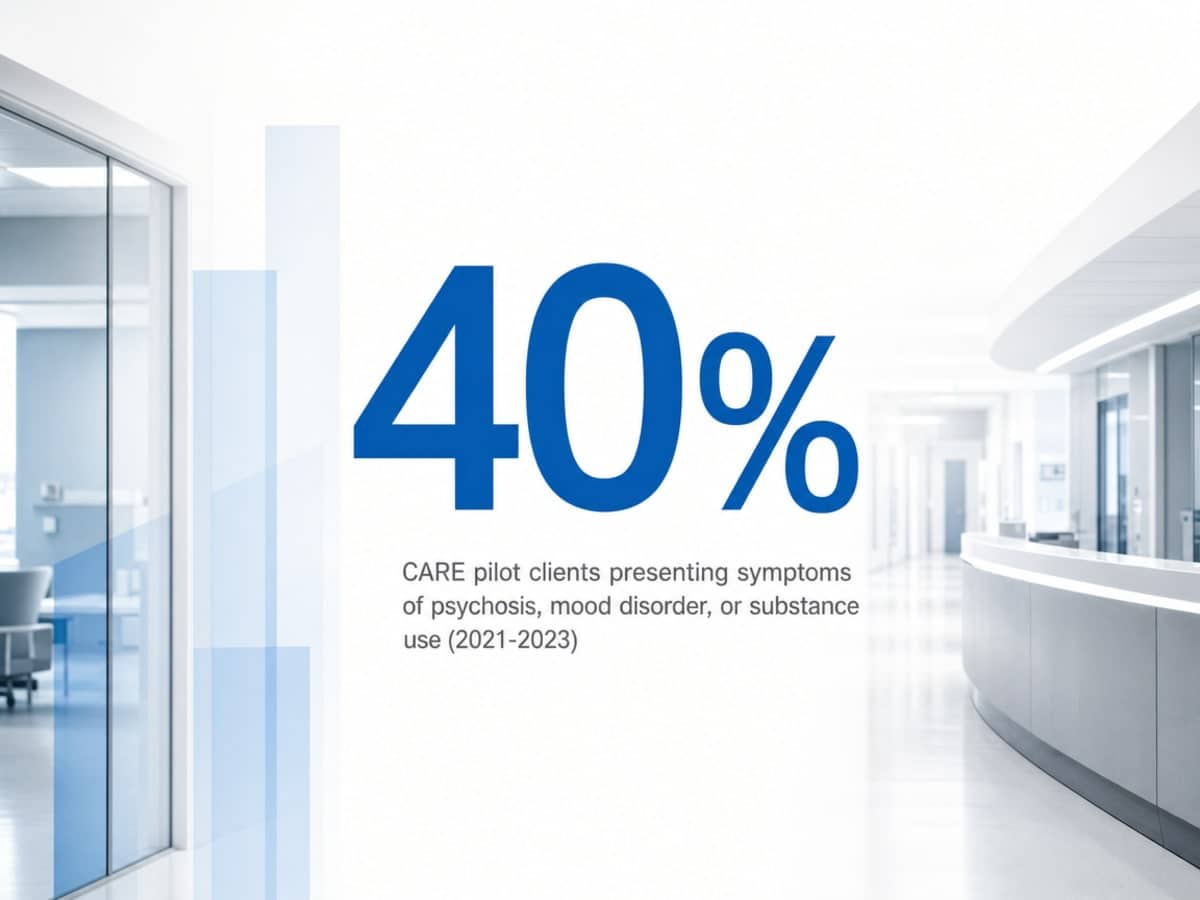
The University of Chicago Health Lab’s implementation evaluation of the CARE pilot studied operations between 2021 and 2023 and found that teams responded to 1,348 events and served 673 unique individuals, with roughly 40 percent of clients presenting one or more symptoms of paranoia or schizophrenia, depression or anxiety, or substance use disorders.2 Read that number again. Four out of every ten people a Chicago crisis team engaged with looked, clinically, a lot like the person you are trying to place.
Comparing Chicago’s care tiers against accredited residential
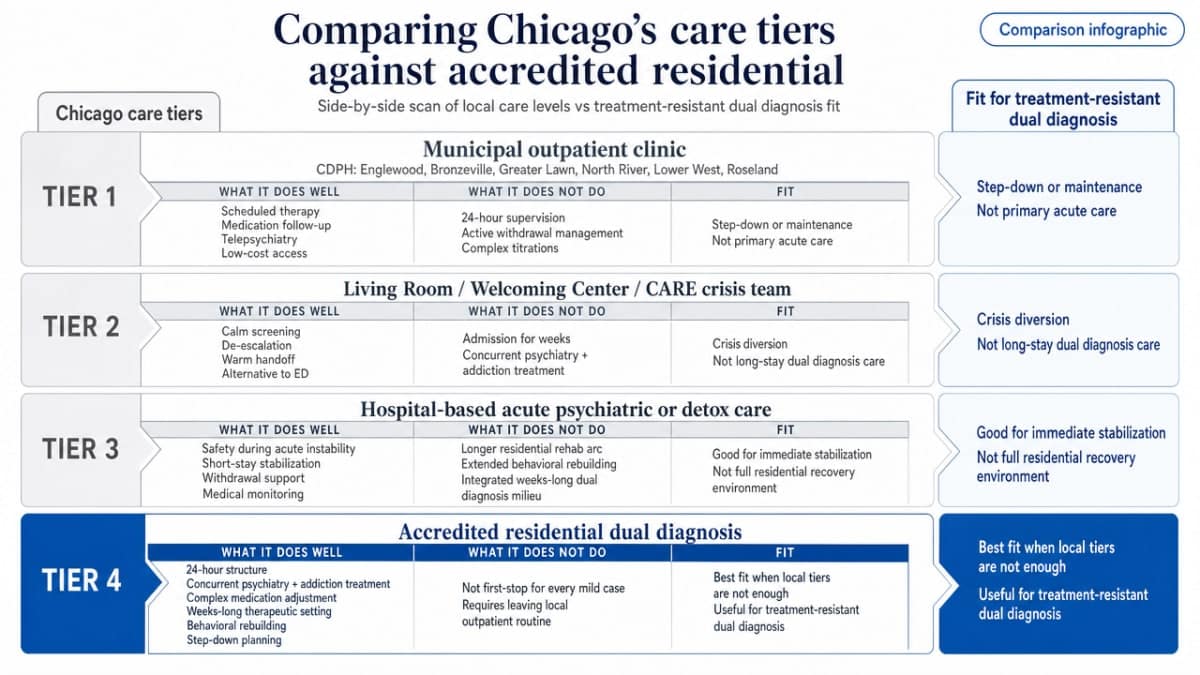
It helps to lay the options side by side. Chicago families usually cycle through four care tiers before they consider anything outside the region, and each tier does one job well and other jobs poorly. Seeing that on one page can save you weeks of guessing.
| Care tier | What it does well | What it does not do | Fit for treatment-resistant dual diagnosis |
|---|---|---|---|
| Municipal outpatient clinic (CDPH centers in Englewood, Bronzeville, Greater Lawn, North River, Lower West, Roseland) | Scheduled therapy, medication follow-up, telepsychiatry, low-cost access12 | 24-hour supervision, active withdrawal management, complex titrations | Useful for step-down or maintenance, not primary acute care |
| Living Room, Welcoming Center, CARE crisis team | Calm screening, de-escalation, warm handoff, alternative to ED13 | Admission for weeks of concurrent psychiatric and substance use treatment | Stabilization ceiling; cannot hold high-acuity cases downstream |
| Hospital ED and short inpatient psych unit (e.g., academic centers with limited acute beds) | Safety assessment, medication stabilization, brief admission3 | Long-term integrated care; most report zero long-term psychiatric beds | Bridges a crisis, rarely resolves the underlying pattern |
| Accredited residential dual diagnosis (in-region or out-of-state) | Concurrent psychiatric and substance use treatment on one team, length of stay set by clinical need8 | Immediate crisis response; not a 911 substitute | Designed for the case you are trying to place |
Notice the pattern. The first three tiers move a person along. The fourth tier is where the actual work of concurrent, integrated treatment happens, which SAMHSA’s TIP 42 identifies as the standard for co-occurring disorders.8 When a residential bed is not available locally, families often circle back through tiers one through three while the underlying condition worsens. That is the loop an accredited out-of-state option can interrupt.
When staying local is the right call, and when it isn’t
Staying in Chicago is often the better call, and it is worth naming when. If your loved one has a stable outpatient team they trust, a psychiatrist who already knows their medication history, and symptoms that respond to weekly therapy plus a monthly med check, do not blow that up. Continuity has clinical value. A CDPH clinic visit in Bronzeville or North River, a Living Room for a rough night, and a short hospital stay if things escalate can carry many people through hard stretches.12, 13
Local also wins when the family caregiver is the anchor. Some people cannot tolerate distance from a spouse or parent, and their engagement drops the moment that support is out of sight. If that is your relative, staying close matters more than program brochures.
The picture changes when you see a specific pattern: repeated stabilizations without traction, medications that need advanced strategies like clozapine, active substance use that keeps unraveling the psychiatric plan, and no local residential bed available in a timeframe that matches the crisis. When two or three of those are true at once, the loop itself becomes the risk. An accredited program that can admit this month, and hold the case for as long as the clinical picture requires, stops being a compromise. It becomes the plan.
What accredited out-of-state residential care can add
When you widen the search past Chicago, the thing that changes first is timing. An accredited residential program with current openings can often admit within days rather than weeks, which matters when your loved one is stable enough to travel today but might not be next Tuesday. That is not a knock on Chicago clinicians. It is a supply issue you have already felt.
The second thing that changes is clinical depth on one roof. Programs like ViewPoint Dual Recovery in Prescott, Arizona are Joint Commission-accredited and built specifically for treatment-resistant psychiatric cases and co-occurring substance use, with 24/7 board-certified psychiatry, advanced medication strategies including clozapine protocols for treatment-resistant schizophrenia, and trauma-focused therapy running alongside addiction treatment. That structure lines up with SAMHSA’s guidance that mental illness and substance use disorders should be treated concurrently by the same team, not passed between specialties.8 The “no wrong door” principle, where whichever program a person walks into screens for both conditions on day one, becomes easier to actually deliver when the psychiatrist and the addiction team share a hallway.9
The third thing is length of stay set by the case, not by an insurance clock or a bed shortage upstream. Treatment-resistant patterns rarely resolve in a two-week window. Having eight to twelve weeks available, with the option to extend if clozapine titration or trauma work needs more time, changes what the discharge plan can hold.
Distance is a real cost. For some families it is the right trade.
A placement playbook for Chicago families
Questions to ask any program before you commit
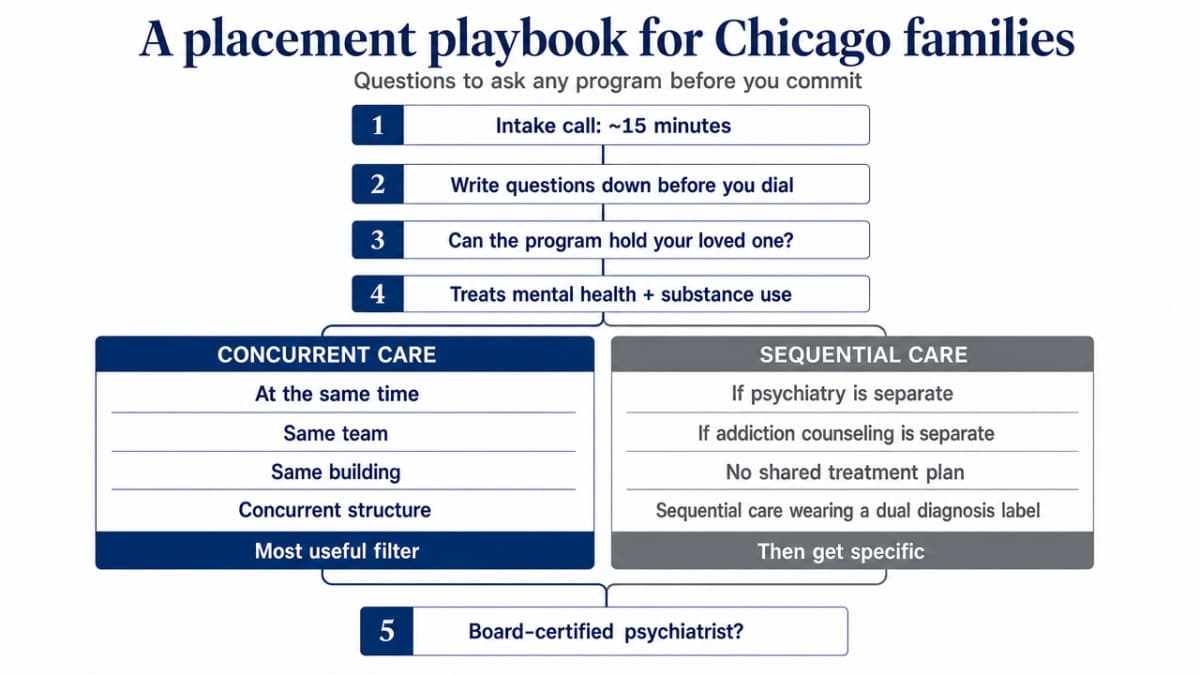
When you finally get an intake coordinator on the phone, you have maybe fifteen minutes to figure out if this program can actually hold your loved one. Write these questions down before you dial, because the pressure of the call will crowd them out otherwise.
Ask directly: does your program treat the mental health condition and the substance use at the same time, with the same team, in the same building? SAMHSA’s TIP 42 identifies that concurrent structure as the standard for co-occurring disorders, and it is the single most useful filter you have.8 If the answer is that psychiatry sees the patient on Tuesdays and addiction counseling meets on Thursdays with no shared treatment plan, that is sequential care wearing a dual diagnosis label.
Then get specific. Is there a board-certified psychiatrist on site, and how often will your relative actually see them? Do they run advanced medication strategies like clozapine for treatment-resistant schizophrenia, and who monitors the required labs? What is the current wait for a bed, in days, not weeks? Is length of stay set by the clinical picture or by an insurance authorization cycle? What does the discharge plan look like if symptoms have not stabilized by week six?
You are not being difficult by asking. You are doing the work the system needs you to do.
Documents and records that speed admission
Intake teams can move faster when the clinical picture arrives with the phone call. Start a single folder, digital or paper, and put everything in one place so you are not hunting for a discharge summary at 9 p.m.
Pull together the last two years of psychiatric and hospital records, including discharge summaries from any ED visits or inpatient stays, a current medication list with doses and dates, and notes on what has been tried and what failed. Add any psychological testing, a substance use history with the primary substances and last use dates, and lab work from the last six months if you have it. Insurance cards, front and back, and a photo ID for your loved one round out the packet.
If there is a guardianship order, power of attorney, or existing release of information, include those too. A signed release lets the receiving program call the outpatient psychiatrist at a CDPH clinic or the hospital that did the last admission and get the clinical story in one conversation instead of three.12 Every hour you save on records is an hour closer to a bed.
Insurance, travel, and the first 72 hours after arrival
Once a program has capacity, two logistics decide whether admission actually happens this week: benefits and travel. Call the number on the back of the insurance card and ask specifically about out-of-network residential mental health and substance use benefits, single case agreements, and whether the plan covers a Joint Commission-accredited facility outside Illinois. Most admissions teams will run a verification of benefits for free within a few hours if you give them the policy details.
For travel, a family escort on a direct flight is usually the calmest option when your loved one is stable enough to fly. If symptoms are shifting, ask the receiving program about medical transport services they have used before. Do not attempt a long drive with an actively psychotic or withdrawing person without clinical guidance.
The first 72 hours after arrival are heavy. Expect a full psychiatric and medical assessment, medication reconciliation, and a screening for both conditions on day one, in line with the “no wrong door” principle.9 Your relative may sound scared or angry on the first phone call home. That is normal. Ask the treatment team when family sessions start and put those dates on your calendar the same day.
A note for referring clinicians and case managers
Scope shift: this section speaks to the discharge planner, ACT team lead, or outpatient psychiatrist reading over a family’s shoulder. You already know the local bottleneck. What you need is a short read on when to route out.
Consider an accredited out-of-state referral when the case shows treatment-resistant symptoms, active substance use unraveling the psychiatric plan, and no local residential bed available in a clinically relevant window. Send records that reflect concurrent screening for both conditions on intake, in line with the “no wrong door” principle SAMHSA describes.9 A single-page clinical summary with medication trials, response, and current risk factors moves an admission decision faster than a records dump.
ViewPoint Dual Recovery accepts direct clinician referrals, runs clozapine protocols with on-site labs, and can usually confirm admission availability the same day you call. Confirm the admission timeline before you frame the option with the family.
Check Your Eligibility for Dual Diagnosis Care
Get expert input on next-step placement without waiting for a Chicago area bed to open.
Frequently Asked Questions
How fast can a Chicago family actually get a dual diagnosis bed locally?
Honestly, it varies wildly, and that uncertainty is part of what makes this so hard. Municipal outpatient intake at a CDPH clinic can often happen within a week or two, but that is not a bed.12A high-acuity residential dual diagnosis bed in the Chicago area can take weeks to open, especially for cases involving treatment-resistant schizophrenia or active withdrawal. If a program cannot give you a specific admission window on the first call, keep dialing.
What is the difference between a Living Room, a CDPH clinic, and residential dual diagnosis care?
A Living Room is a short-term, homelike space for crisis screening and de-escalation, not admission for weeks of treatment.13A CDPH clinic offers scheduled outpatient therapy, medication management, and telepsychiatry.12Residential dual diagnosis care is 24-hour treatment where psychiatry and substance use care run on the same team, which SAMHSA identifies as the standard for co-occurring disorders.8Each does one job. None substitutes for another.
When should we call 988 or go to an ED instead of pursuing a residential placement?
If your loved one is talking about suicide, showing intent to harm themselves or others, or in active medical danger from withdrawal, that is an emergency. Call or text 988, or go to the nearest ED.14Residential admission takes hours to days of coordination. It is not a substitute for immediate safety. Stabilize first, then work the longer-term placement.
Why would we consider an out-of-state program instead of staying in Chicago?
Two reasons usually drive that choice: timing and clinical fit. Local high-acuity beds are limited, and even flagship hospitals allocate a small share of capacity to acute psychiatric care.3An accredited out-of-state program with current openings can often admit within days and hold a case for the length of stay the clinical picture requires, rather than what a short inpatient window allows. If your loved one has cycled through stabilizations without traction, distance can be worth it.
What records and information should we gather before calling programs?
Put everything in one folder. Discharge summaries from the last two years, current medication list with doses, psychiatric evaluations, substance use history with last-use dates, recent labs, insurance cards front and back, and a photo ID. Add any guardianship documents or signed releases so the intake team can call previous providers directly. Having this ready can shave days off admission and helps the receiving team screen both conditions on day one.9
What does ‘integrated’ or ‘concurrent’ dual diagnosis treatment mean, and why does it matter?
Integrated care means the mental health condition and the substance use disorder are treated at the same time, by the same team, under one plan. SAMHSA’s TIP 42 identifies concurrent treatment as the standard because sequential handoffs, where psychiatry treats one thing and addiction counseling treats the other separately, tend to fail complex cases.8When symptoms and substance use feed each other, splitting the treatment splits the person. Ask every program if their care is truly concurrent.
References
- The People’s Vision for Mental and Behavioral Health: Mental Health System Expansion Working Group Report. https://www.chicago.gov/content/dam/city/sites/treatment-not-trauma/pdfs/MHSE/MHSE-Report-May-31-2024.pdf
- Chicago’s Crisis Assistance Response and Engagement (CARE) Pilot: Implementation Evaluation. https://urbanlabs.uchicago.edu/attachments/f245b687ea00b9e61794dcba5e5937f3451aa6e4/store/8c61d792e209a352a81298a621188987628b280c2d03a600a7efb3c995d9/CARE+Eval+Report+-+FINAL_REL.pdf
- Rush University Medical Center – Illinois Hospital Report Card: Authorized Beds. https://healthcarereportcard.illinois.gov/hospital/101213/staffing/authorized-beds
- Crisis Intervention Advisory Committee Recommendations. https://www.chicago.gov/content/dam/city/depts/mayor/Press%20Room/Press%20Releases/2019/December/CrisisInterventionAdvisoryCommitteeRecommendations.pdf
- Advisory: Low-Barrier Models of Care for Substance Use Disorders. https://store.samhsa.gov/sites/default/files/advisory-low-barrier-models-of-care-pep23-02-00-005.pdf
- City of Chicago 2024 Budget Equity Report. https://www.chicago.gov/content/dam/city/depts/obm/supp_info/budget-equity/2024-Budget-EquityReport.pdf
- Advisory: Substance Use Disorder Treatment for People with Co-Occurring Disorders. https://www.samhsa.gov/resource/ebp/advisory-substance-use-disorder-treatment-people-co-occurring-disorders-based-tip-42
- Substance Use Treatment for Persons With Co-Occurring Disorders. https://library.samhsa.gov/product/tip-42-substance-use-treatment-persons-co-occurring-disorders/pep20-02-01-004
- Managing Life with Co-Occurring Disorders. https://www.samhsa.gov/mental-health/serious-mental-illness/co-occurring-disorders
- Co-Occurring Disorders and Other Health Conditions. https://www.samhsa.gov/substance-use/treatment/co-occurring-disorders
- A Profile of Health and Health Resources Within Chicago’s 77 Communities. https://www.csu.edu/nac/documents/ProfileofHealthandHealthResourcesWithinChicagos77Communities.pdf
- CDPH Mental Health Centers. https://www.chicago.gov/city/en/depts/cdph/supp_info/behavioral-health/mental_health_centers.html
- Mental Health Crisis Resources in Chicago. https://www.chicago.gov/city/en/depts/cdph/supp_info/behavioral-health/cdph-suicide-prevention-initiative/mental-health-crisis-resources-in-chicago.html
- Governor’s Office Press Release on 988 Suicide & Crisis Lifeline. https://www.illinois.gov/news/press-release.25192.html
- Transformation Data & Community Needs Report – South Chicago. https://hfs.illinois.gov/content/dam/soi/en/web/hfs/sitecollectiondocuments/transformationdataandcommunityneedsreportdecember2022southchicago.pdf