Key Takeaways
- Illinois discharge planners face a gap between acute stabilization and outpatient care, where CMS Appendix AA and the Discharge Planning Rule set documentation floors but assume a receiving program equipped to catch complex handoffs 8, 9.
- Vet step-down partners on five concrete capabilities: rapid clinical review, clean records interoperability, integrated co-occurring treatment per SAMHSA 12, clozapine and complex medication competence, and documented safety-plan handoff within SAMHSA’s 7-day or 24-hour contact window 14.
- Illinois CCBHCs cover crisis response and outpatient continuity 10, 11, but with a 41.34% baseline for adult 30-day follow-up after hospitalization for mental illness 2, treatment-resistant, mid-titration, or high-risk patients often need a specialized residential step-down instead.
- For Illinois patients stuck in that gap, call a receiving program like ViewPoint Dual Recovery’s 24/7 admissions line, which offers clinical assessment, benefits coordination, and a stated capability to begin treatment within 48 hours of acceptance.
The Handoff Moment: When Stabilized Isn’t Ready
You’ve done the hard part. The patient is out of acute crisis, sleeping through the night, taking medications, no longer actively suicidal or psychotic. The attending says they’re ready for discharge. Utilization review agrees. But you’re the one holding the chart, and you know what the word “stabilized” actually covers and what it doesn’t.
Outpatient alone won’t hold this person. Maybe it’s a first-break schizophrenia case still cross-titrating antipsychotics. Maybe it’s a rapid-cycling bipolar patient who used fentanyl two weeks before admission. Maybe it’s a trauma survivor whose safety plan collapses the moment they’re alone in an apartment. The clinical floor is firm enough for them to leave the unit. It is not firm enough for them to be home by Thursday with a 10-day follow-up appointment and a bottle of pills.
That gap is the step-down problem. CMS expects you to transfer current illness and treatment information, post-discharge goals, and patient preferences to the receiving provider 9. Appendix AA expects your discharge summary to document medication plans, follow-up services, anticipated post-discharge problems, and community arrangements 8. Those requirements assume there is actually a receiving program equipped to catch what you’re handing off.
This guide is written for that moment: how to tell a strong psychiatric step-down partner from a brochure, and how to move a patient there without losing days.
Five Capabilities a Strong Step-Down Partner Must Prove
Rapid Clinical Review That Matches Your Discharge Window
You know the real timeline. The order goes in at 10 a.m., utilization review wants the bed cleared by 2, and the family is already in the parking lot. A step-down partner that promises to “call you back tomorrow” is a partner that will cost you a 48-hour hold on a unit that needs the bed.
What you should expect from a strong receiving program: a live clinician on the phone, a clinical review that works from your H&P and most recent psychiatric notes rather than a 12-page intake packet, and a timely acceptance decision. The reviewer should be able to speak to your attending in clinical terms about current medications, cross-titrations in progress, substance-use history, and any safety concerns documented during the stay.
Ask directly: Who takes the call at 7 p.m.? Who makes the acceptance decision, and on what timeline? Can they commit to a bed before benefits are fully verified, pending authorization? Programs built for hospital handoffs answer those questions without hedging. Programs built for self-pay inquiries will tell you someone will “circle back,” and that is your signal to call the next facility on your list.
Records Interoperability Under the CMS Discharge Planning Rule
CMS requires you to share current illness and treatment information, post-discharge goals, and the patient’s treatment preferences with the receiving provider 9. Appendix AA tells you what belongs in the discharge summary itself: reasons for admission, treatment delivered, baseline psychiatric and physical status, medication plans, follow-up services, and anticipated post-discharge problems 8. That is the floor, not the ceiling.
A strong step-down partner receives those records cleanly and tells you what they are missing. They should have a secure fax line, a direct email for clinical documents, or a records portal that your HIM team can actually use. They should confirm receipt and tell you, before the patient leaves your unit, whether anything is missing that would delay the first physician encounter:
- a current MAR,
- labs from the last 72 hours,
- the most recent psychiatric evaluation,
- any court orders or civil-commitment paperwork, and
- the safety plan.
The IDEAL framework from AHRQ is useful here as a shared language with families 5: what life looks like after discharge, medications, warning signs, test results, and follow-up appointments. If the receiving program can walk through those five areas with the patient and a family member on the admission call, your handoff is in a program that treats discharge planning as clinical work, not paperwork.
True Dual Diagnosis Integration, Not Parallel Referrals
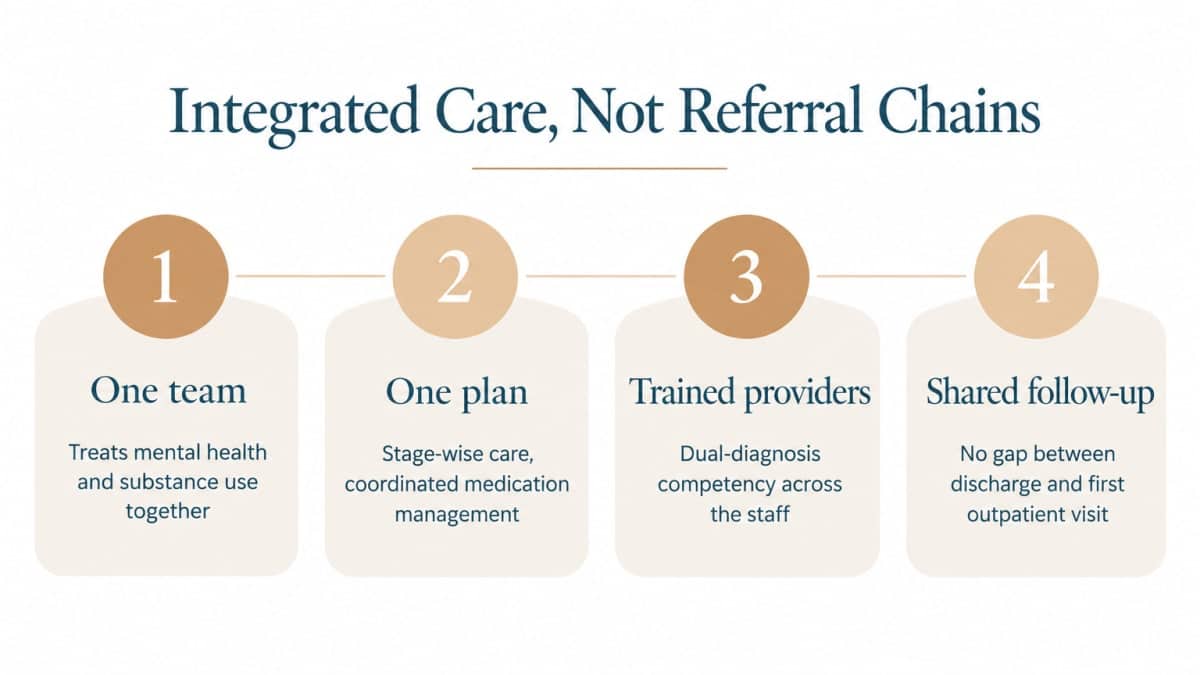
Here is where most referrals quietly fail. The patient stabilizes on the psychiatric unit, the discharge summary mentions a stimulant use disorder or an opioid relapse two weeks before admission, and the receiving program says, “We treat the mental health side; they can go to a separate SUD program after.” That is not integration. That is a referral chain, and your patient is the one holding it together.
The clinical case for doing both at once is hard to argue with. The CDC reports that 37% of people who died from overdose in 2024 had evidence of a mental health diagnosis such as a depressive, anxiety, or bipolar disorder 6. That is national mortality data, not a placement rule, but it tells you what you already see on the unit: the co-occurring patient who leaves without integrated follow-up is the patient at highest risk between discharge and the first outpatient appointment.
SAMHSA is explicit that integrated treatment is the preferred model for co-occurring disorders, meaning one coordinated team delivering mental health and substance-use interventions together, with trained providers, stage-wise care, and multidisciplinary medication management 12. The agency describes integrated care as providers delivering individualized services for both conditions in a single plan rather than sequencing them 7.
When you call a prospective step-down partner, ask: Does the same treatment team address both conditions, or are substance-use services run by a separate program with its own schedule? Who prescribes for co-occurring patients? Is there in-house capacity for MAT, or will the patient need to leave the campus to continue buprenorphine or naltrexone? If the answers describe two programs sharing a building, you are back to parallel referrals.
Advanced Medication Competence, Including Clozapine
Medication capability is where brochures and reality part ways. Plenty of residential programs will accept a stable patient on a standard antipsychotic and SSRI. Far fewer can hold a patient mid-clozapine titration, manage the weekly ANC draws, respond to a neutropenia alert, and keep the REMS enrollment current. Even fewer can do that on a Saturday.
Before you refer a treatment-resistant schizophrenia patient, a rapid-cycling bipolar patient on lithium plus an atypical, or anyone whose stabilization depended on a complex cross-titration, confirm the receiving program’s actual medication competence. Specifically:
- Can they initiate or continue clozapine in-house, including the lab monitoring and REMS reporting?
- Do they have a board-certified psychiatrist available 24/7, or only a nurse practitioner with weekly psychiatrist coverage?
- Can they manage long-acting injectables on the schedule the patient is already on?
- What happens if the patient needs a medication change at 11 p.m. on day three?
These are not edge-case questions. For the exact patient population a strong step-down receives, these capabilities decide whether the handoff holds or whether the patient is back in your ED by the following weekend. If the program hesitates on clozapine, you have a referral mismatch, not a step-down.
Documented Safety-Plan Handoff for Suicide-Risk Patients
If your patient was admitted for suicidal ideation, a plan, or an attempt, the transition itself is a risk period. SAMHSA’s care-transition guidance for suicide-risk patients is specific: send essential records at discharge, confirm the receiving provider got them, review the safety plan with the patient after discharge, and make first clinical contact within seven days, or within 24 hours when telephone contact is not possible 14. That is not an aspirational standard. It is the baseline a receiving program should already be built around.
A strong step-down partner will tell you, without being asked, how they handle each of those steps. They will confirm records receipt. They will review the safety plan with the patient during admission and update it with the home environment, access to lethal means, and any new stressors. They will document a first clinical contact that happens before the patient has been off your unit for a day.
SAMHSA’s 2025 crisis-care guidelines reinforce the same point from the system side: follow-up after an acute crisis is part of the crisis continuum itself, not an optional add-on, and it should be planned at every point along that continuum 13. When you hand off a suicide-risk patient, you are asking the receiving program to carry the clinical weight of that continuum for the next 30 to 90 days. Ask them to show you, in concrete terms, how they do it. The answer should include names, timeframes, and documentation, not reassurances.
Capability Comparison: What to Confirm Before You Refer
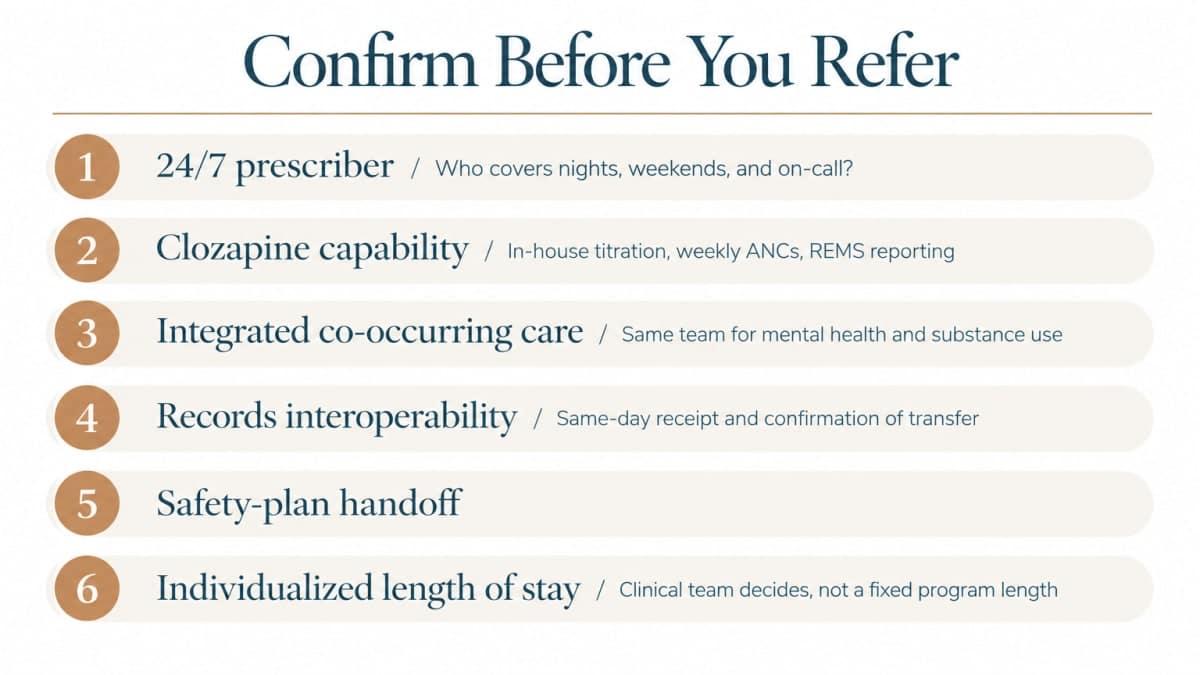
Before you pick up the phone, it helps to have the criteria in front of you. The capabilities below map to the five areas you just read, each tied to the federal rule or clinical standard that defines it. Treat it as a working checklist for the acceptance call, not a scoring rubric.
| Capability to confirm | What to ask the receiving program | Standard that defines it |
|---|---|---|
| 24/7 psychiatric prescriber coverage | Who prescribes at 11 p.m. on day three? Nurse practitioner only, or psychiatrist on call? | CMS Appendix AA expects documented medication plans and physician oversight of the post-discharge treatment picture 8 |
| Clozapine initiation and monitoring | Can you continue a clozapine titration in-house, run weekly ANCs, and handle REMS reporting on weekends? | Appendix AA discharge-summary requirements for medication continuity 8 |
| Integrated co-occurring treatment | Is the same team treating mental health and substance use, or two programs sharing a building? | SAMHSA integrated-care model for co-occurring disorders 12 |
| Records interoperability | How do you receive records, and will you confirm receipt today? | CMS Discharge Planning Rule on information transfer to receiving providers 9 |
| Safety-plan handoff and early contact | Who reviews the safety plan at admission, and when is first clinical contact logged? | SAMHSA care-transition practices for suicide risk, including 7-day or 24-hour first contact 14 |
| Individualized length of stay | Who decides discharge, and is the timeline driven by clinical progress or benefit days? | AHRQ IDEAL partnership framework for patient-centered discharge 5 |
Where Illinois CCBHCs Fit—and Where They Don’t
Illinois has built real infrastructure here, and it would be a mistake to ignore it. Certified Community Behavioral Health Clinics are required to provide 24/7 mobile crisis response, crisis intervention, and crisis stabilization, with specific attention to transitions from hospitals, nursing facilities, and residential treatment 10. Illinois Medicaid community-based behavioral health services, governed by 89 Illinois Administrative Code 140.453, round out the outpatient continuum many of your patients will land in eventually 11. For a patient who stabilized quickly, has stable housing, and needs an engaged outpatient prescriber plus therapy, a CCBHC referral is often the right next move.
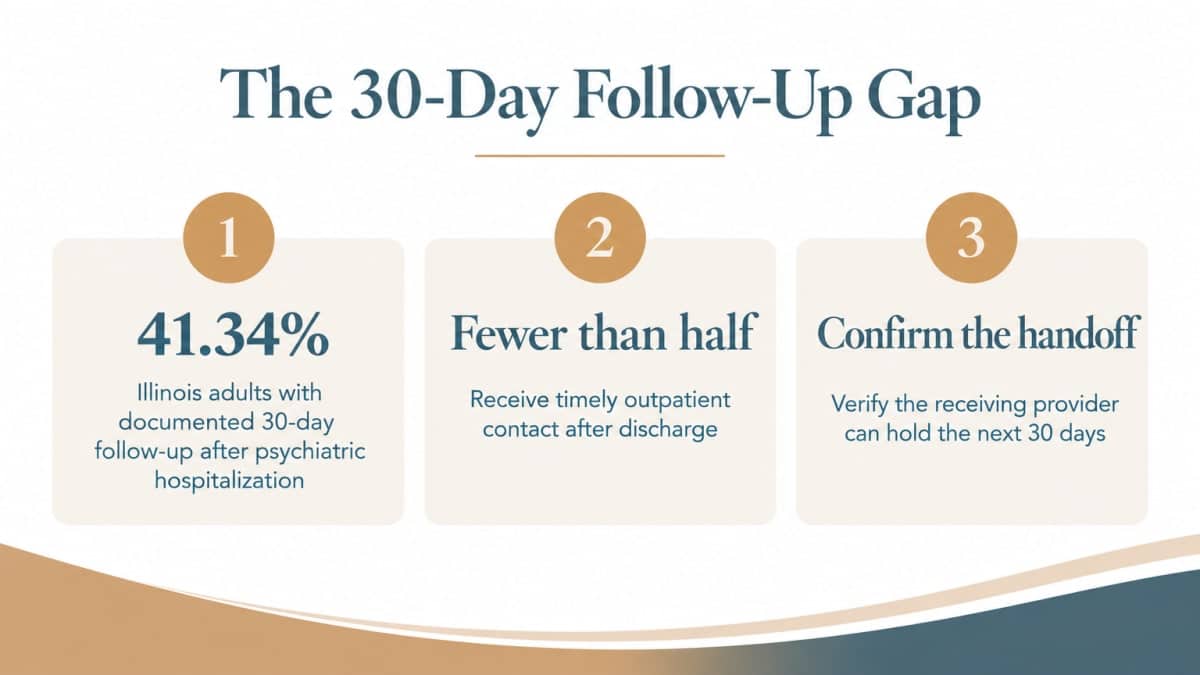
The gap shows up when the clinical picture is heavier than that. Illinois’s Medicaid Quality Strategy, approved by CMS in March 2025, reports a 41.34% baseline for adult 30-day follow-up after hospitalization for mental illness 2. That is a statewide managed-care measure of the 30-day follow-up window, not a verdict on any single CCBHC, and the state’s follow-up averages are improving across submeasures 1. Still, it tells you something honest about the system you are discharging into: on average, fewer than half of adult patients receive a documented 30-day follow-up visit after a psychiatric hospitalization.
So the question isn’t CCBHC or residential. It’s whether the next 30 days of this specific patient’s care can be held by an outpatient team seeing them two or three times a week. A treatment-resistant schizophrenia case mid-clozapine titration, a rapid-cycling bipolar patient with a recent fentanyl exposure, a trauma survivor whose safety plan depends on not being alone — these are the handoffs where a structured residential step-down carries the weight the outpatient system is not built to carry alone. Use the CCBHC when the clinical floor supports it. Escalate to a specialized residential step-down when it doesn’t.
What the Evidence Says About Transitional Programs
Here’s where you should push back on anyone who pitches you a branded “transitional care program” as a silver bullet. The 2024 Cochrane review of transitional-discharge interventions for people with schizophrenia pooled four studies and 462 participants and found that the interventions may make little or no difference in hospitalization, with the evidence rated very low certainty 4. That is not a reason to abandon coordinated transitions. It is a reason to stop buying the brand and start evaluating the components.
The 2024 scoping review on transitional care for patients with serious mental illness and multiple chronic conditions points in the same direction. It identified eight programs across 10 studies published from 2013 through 2024, with program lengths ranging from one month to 90 days, and found generally positive effects on quality of life and care connection but mixed results on readmission 3. The components that showed up again and again across those programs are the ones worth asking about: coaching, medication management, psychiatric providers, counseling, specialty-care linkage, and attention to social needs.
So the honest read is this. A “transitional program” label tells you almost nothing. The specific capabilities inside it tell you everything. When you evaluate a step-down partner, you are evaluating whether those six components are actually staffed, scheduled, and documented, not whether a program has a trademarked name for them.
ViewPoint Dual Recovery’s Admissions Pathway for Illinois Hospitals
The 24/7 Line and Clinical Review
Scope note: this section describes how one specific receiving program, ViewPoint Dual Recovery in Prescott, Arizona, is set up to take an Illinois hospital handoff. Use it as a model for the questions you should be asking any step-down partner, not as a stand-in for your own vetting.
ViewPoint operates a 24/7 admissions line and provides clinical assessment as part of its intake process. Because ViewPoint is a Joint Commission-accredited, Arizona-licensed program that specializes in treatment-resistant psychiatric conditions and co-occurring mental health and substance-use disorders, the clinical conversation can be framed around the issues your attending is managing — such as clozapine titration status, lithium levels, cross-tapers in progress, MAT continuation, and trauma history driving relapse risk. Confirm clinical review timing and the acceptance decision process with the admissions team on the call.
Benefits Verification, Treatment Plan, and Transport
ViewPoint’s admissions process includes benefits coordination alongside clinical assessment and treatment planning. Confirm with the admissions team how residential and dual diagnosis coverage will be verified and how authorization is handled relative to the clinical acceptance decision, so a stabilized patient is not sitting on your unit waiting for paperwork.
The initial treatment plan outlined on the admission call should cover the pieces that matter for a safe handoff: continuation of current psychotropics, any clozapine or long-acting injectable schedules already in motion, co-occurring substance-use interventions as part of the same plan rather than a separate referral 12, and the clinical reasoning for an individualized length of stay rather than a fixed 30-day block.
Transport is the piece that quietly derails handoffs when nobody owns it. Because ViewPoint’s facility is located in Prescott, Arizona, confirm with the admissions team how getting an Illinois patient to the program will be coordinated, who meets the patient on arrival, and what identification and medications travel with them before the discharge order is signed.
Records Receipt Confirmation and the First 72 Hours
Records receipt is where CMS compliance meets clinical reality. Under the CMS Discharge Planning Rule, you are required to transfer current illness and treatment information, post-discharge goals, and patient preferences to the receiving provider 9, and Appendix AA defines what belongs in the discharge summary itself 8. Ask the ViewPoint admissions team to confirm receipt of those documents and flag anything missing — the 72-hour labs, the most recent psychiatric evaluation, the safety plan — before your shift ends.
For a patient admitted with suicide risk, the first 72 hours should follow the SAMHSA care-transition framework: essential records sent before the first appointment, receipt confirmed, the safety plan reviewed with the patient on arrival, and first clinical contact logged well inside the seven-day window 14. Ask for a short written confirmation back to your unit: patient arrived, admitted, safety plan reviewed, first psychiatric encounter completed.
That closes the loop on your side of the chart. The patient is no longer in the gap you were trying to cover.
A Direct Line for Illinois Discharge Planners
You already know how to run a discharge. What you need, at 3 p.m. on a short-staffed Thursday, is a receiving program that picks up the phone and gives you a clinical review you can act on.
ViewPoint Dual Recovery’s admissions line operates 24/7 for exactly that call. The team provides clinical assessment, benefits coordination, and treatment planning, and states it can begin treatment within 48 hours of acceptance. The program is Joint Commission-accredited and Arizona-licensed, with a specialization in treatment-resistant psychiatric conditions and co-occurring mental health and substance-use disorders — the clinical profile most likely to leave an Illinois hospital in the step-down gap.
Call when you have a patient in the gap. That’s the handoff this team is built for.
Discuss a Psychiatric Step-Down Referral
Get guidance on whether specialized treatment may fit your patient’s needs and coordinate the next referral step.
Frequently Asked Questions
What records does an Illinois hospital need to send to a psychiatric step-down facility?
CMS requires you to transfer current illness and treatment information, post-discharge goals, and the patient’s treatment preferences to the receiving provider 9. Appendix AA adds the discharge summary itself: reasons for admission, treatment delivered, baseline psychiatric and physical status, medication plans, follow-up services, and anticipated post-discharge problems 8. Include the current MAR, labs from the last 72 hours, the most recent psychiatric evaluation, any court or commitment paperwork, and the safety plan.
How fast can ViewPoint Dual Recovery review and accept an Illinois hospital referral?
ViewPoint operates a 24/7 admissions line with clinical assessment and benefits coordination. The team states it can begin treatment within 48 hours of acceptance. Confirm the specifics of clinical review timing and transport coordination with the admissions team when you call.
When should a discharge planner choose a specialized residential step-down over an Illinois CCBHC?
Illinois CCBHCs are built for 24/7 crisis response, outpatient continuity, and community-based follow-up 10, and Medicaid community behavioral health services round out that continuum 11. Use a CCBHC when the clinical floor supports it. Escalate to a specialized residential step-down when the patient needs clozapine monitoring, mid-titration psychiatric oversight, integrated substance-use treatment, or a safety plan that cannot hold with two or three outpatient contacts per week.
What does true dual diagnosis integration look like at a step-down program?
SAMHSA defines integrated treatment as one coordinated team delivering mental health and substance-use interventions together, with trained providers, stage-wise care, and multidisciplinary medication management 12. Services are individualized and delivered through a single plan rather than sequenced 7. On the acceptance call, confirm that the same prescriber covers both conditions, MAT continues in-house, and group and individual work addresses psychiatric and substance-use goals together—not through a second program sharing the building.
How should a safety plan be handed off for a patient discharged with suicide risk?
SAMHSA’s care-transition practices are specific: send essential records before the first appointment, confirm the receiving provider got them, review the safety plan with the patient after discharge, and make first clinical contact within seven days, or within 24 hours when telephone contact is not possible 14. A strong receiving program documents each step by name and timeframe and sends you written confirmation that the patient arrived, the plan was reviewed, and the first encounter happened.
Can a step-down facility continue clozapine and other complex psychiatric medications?
Only if it is actually staffed for it. Appendix AA expects medication continuity to be documented in the discharge plan 8, but execution lives at the receiving facility. Confirm the program can continue a clozapine titration in-house, draw weekly ANCs, keep REMS reporting current on weekends, and manage long-acting injectables on the existing schedule. Ask any prospective receiving program to describe their specific clozapine and complex-medication capabilities before referring.
References
- External Quality Review Annual Report. https://www.hfs.illinois.gov/content/dam/soi/en/web/hfs/sitecollectiondocuments/il2025eqrtechnicalreport.pdf
- Revised version 2024–2027: Approved by CMS 3/13/25. https://hfs.illinois.gov/content/dam/soi/en/web/hfs/info/reports/quality/il20242027qs.pdf
- Transitional care programs to improve the post-discharge experience of patients with multiple chronic conditions and co-occurring serious mental illness: A scoping review. https://pubmed.ncbi.nlm.nih.gov/39432936/
- Transitional discharge interventions for people with schizophrenia. https://pmc.ncbi.nlm.nih.gov/articles/PMC11363221/
- IDEAL Discharge Planning Overview, Process, and Checklist. https://www.ahrq.gov/sites/default/files/wysiwyg/professionals/systems/hospital/engagingfamilies/strategy4/Strat4_Tool_1_IDEAL_chklst_508.pdf
- Substance Use & Mental Health. https://www.cdc.gov/mental-health/about-data/substance-use-mental-health.html
- Managing Life with Co-Occurring Disorders. https://www.samhsa.gov/mental-health/serious-mental-illness/co-occurring-disorders
- State Operations Manual – Appendix AA – CMS. https://www.cms.gov/regulations-and-guidance/guidance/manuals/downloads/som107ap_aa_psyc_hospitals.pdf
- CMS’ Discharge Planning Rule Supports Interoperability and Patient Preferences. https://www.cms.gov/newsroom/fact-sheets/cms-discharge-planning-rule-supports-interoperability-and-patient-preferences
- Illinois CCBHC Service Requirements Updated. https://hfs.illinois.gov/content/dam/soi/en/web/hfs/medicalproviders/ccbhc/Illinoisccbhcservicerequirements.pdf
- Medicaid Community-based Behavioral Health Services. https://hfs.illinois.gov/medicalprograms/behavioral/medicaidcommunitybasedbehavioralhealthservices.html
- Substance Use Disorder Treatment for People With Co-Occurring Disorders. https://library.samhsa.gov/sites/default/files/pep20-06-04-006.pdf
- 2025 National Guidelines for a Behavioral Health Coordinated System of Crisis Care. https://library.samhsa.gov/sites/default/files/national-guidelines-crisis-care-pep24-01-037.pdf
- Suicide Risk Practices in Care Transitions. https://www.samhsa.gov/sites/default/files/suicide-risk-practices-in-care-transitions-11192019.pdf