

Key Takeaways
- Transferring a deteriorating psychosis patient to residential or inpatient care is a level-of-care decision, not a treatment failure, and Missouri’s regulatory framework anticipates this escalation 10.
- Weight the vetting differently for each referral type: acute psychosis with active use demands integrated care, treatment-resistant schizophrenia demands pharmacologic depth, and rapid-cycling bipolar demands observation density.
- Hold any receiving facility to Missouri’s baseline: recognized capacity to evaluate, treat, and provide inpatient or residential care for serious and persistent mental illness or co-occurring diagnoses 1.
- Judge a program on psychiatric coverage hours, staff-to-patient ratios, and named evidence-based psychosocial interventions rather than schedules full of generic process groups 6.
- Confirm integrated dual diagnosis care means one treatment plan authored by a combined team, since integrated treatment outperforms parallel tracks for co-occurring psychosis and SUD 5.
- Require an integrated intake using standardized instruments to determine level of care, not an admissions coordinator decision based on a phone screen and referral packet 8.
- Test the referrer communication loop before sending records: named clinical contacts, scheduled updates, pre-discharge calls, and medication reconciliation are the operational bar 2.
- Out-of-state distance is a logistics problem, not a reason to lower clinical standards; apply the same rubric whether the facility is in Missouri or Arizona 1.
When Your Tuesday Med-Check Can’t Hold the Case Anymore
You know the moment. The patient you have been managing on your outpatient panel — the one whose auditory hallucinations were quiet enough on the current regimen, whose family had built a workable structure around med adherence, whose Tuesday 20-minute check has been the load-bearing beam of the whole plan — is deteriorating. Positive symptoms are back. Insight is thinning. There is either fresh substance use in the picture or you are starting to suspect it. The next appointment is not going to be enough, and you know it before the patient or family does.
This piece is a peer-to-peer vetting rubric, not a facility brochure. It walks through the three referral scenarios that change what you should be asking a receiving program, the Missouri and SAMHSA-anchored criteria you can defend to a utilization reviewer, and — in the last third — where ViewPoint Dual Recovery’s psychosis and dual diagnosis specialization maps onto that rubric for the specific patient sitting in your chart right now.
The Three Referral Scenarios That Change Your Vetting Weights
Acute Psychosis With Active Substance Use
This is the referral where the substance use is not incidental — it is shaping the psychosis, or the psychosis is driving the use, and you cannot cleanly separate the two at intake. The patient may be actively using stimulants, cannabis, or alcohol on top of an underlying schizophrenia spectrum diagnosis, and every partial stabilization you have achieved has collapsed the next time they use.
Your vetting weight here shifts hard toward integrated capability. A program that treats the psychosis on one hallway and the substance use on another, with separate treatment plans and separate clinicians who meet in a Thursday case conference, is not what this patient needs. SAMHSA’s TIP 42 is direct that “treatment should address both conditions to the extent possible and should not neglect one disorder over the other” 2, and Missouri’s own admission framework requires that co-occurring presentations receive “an integrated assessment identifying service needs as well as stage of readiness for change” 10.
When you call a receiving facility for this patient, the first question is not about amenities or length of stay. It is whether the psychiatrist and the addiction clinician write one treatment plan or two.
Treatment-Resistant Schizophrenia Needing Clozapine or Medication Redesign
The second scenario is the patient you have tried to help for years. Two or more adequate antipsychotic trials at therapeutic doses and durations, documented adherence at least during the LAI period, and residual positive symptoms that never quite quiet down. You have thought about clozapine. Maybe you started the conversation and the patient declined, or the REMS logistics in your outpatient setting made weekly ANC monitoring impractical, or the family needed a level of daily supervision during titration that no one in your network could provide.
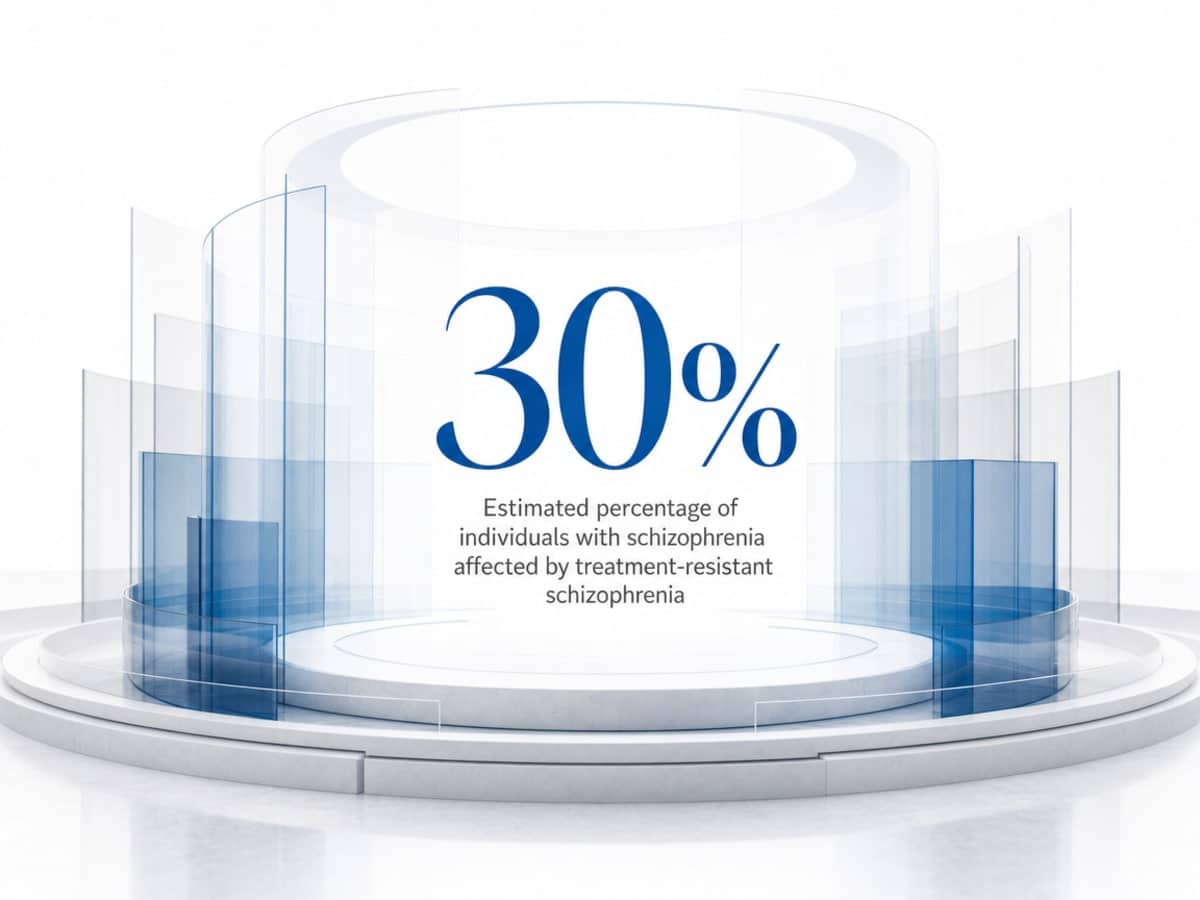
Treatment-resistant schizophrenia is not a rare edge case. Roughly 30% of individuals with schizophrenia meet criteria for treatment resistance and require “specialized, often multidisciplinary management” beyond standard care 4. That figure is scoped to the schizophrenia population, not all psychosis, and it is the population most likely to cycle between your outpatient office, an ED, and a short inpatient stay without ever getting a serious medication redesign.
For this scenario, your vetting weights shift toward pharmacologic depth. You are asking whether the receiving facility has clozapine protocols in place, whether the psychiatry coverage is 24/7 rather than a consulting arrangement, and whether the program length is driven by clinical response — titration, plasma level checks, side-effect management — rather than by a preset benefit window. A 21-day stay is not going to redesign a medication regimen that a decade of outpatient care could not touch.
Rapid-Cycling Bipolar With Psychotic Features
The third scenario is the patient whose diagnostic picture keeps moving. Rapid-cycling bipolar with psychotic features during mood episodes — grandiose delusions in mania, mood-congruent hallucinations in severe depression — often with a substance use overlay that has muddied every attempt at a clean medication trial. You have watched lithium, valproate, and second-generation antipsychotics get started and then dropped mid-cycle, either because the patient stopped taking them or because you could not tell in a 20-minute visit whether a side effect or a new episode was driving the change.
Your vetting weights here center on observation density and psychiatric availability. This patient needs a setting where mood state, sleep, and symptom expression can be tracked continuously rather than reconstructed from a family member’s phone call. Ask specifically about how mood charting is done, how often the attending psychiatrist actually sees the patient in the first two weeks, and whether the program will hold the patient long enough to see a full cycle emerge rather than discharging on the first stable week.
The Missouri Baseline: What Counts as an Appropriate Receiving Facility
Before you compare programs, it helps to name the floor Missouri already sets. RSMo 632.005 defines a mental health facility as “any residential facility, public or private, or any public or private hospital, which can provide evaluation, treatment and, inpatient care to persons suffering from a mental disorder or mental illness and which is recognized as such by the department” 1. That definition is doing quiet work: it presumes the receiving setting can perform evaluation, deliver treatment, and hold the patient at an inpatient or residential level of intensity — not just one of the three. When you are sending a psychosis patient out, the receiving program needs to clear all three functions, whether it sits inside Missouri or across a state line.
The second baseline is severity. Missouri’s Behavioral Health Healthcare Home criteria describe the population you are almost certainly working with when outpatient care runs out — someone who must “be diagnosed with a serious and persistent mental health condition…or be diagnosed with a mental health condition and substance use disorder” 12. That is the regulatory language for the patient on your schedule right now. Missouri’s Section 1115 SMI demonstration extends that recognition into inpatient reimbursement, making Medicaid enrollees ages 21–64 with a diagnosed SMI “eligible for short term stays in an IMD” 11, which tells you the state expects specialized inpatient psychiatric care to be part of the continuum, not a last-resort workaround.
Hold any receiving facility — in-state or out — to those three anchors:
- recognized capacity to evaluate and treat at the inpatient or residential level,
- an explicit fit for serious and persistent mental illness or co-occurring diagnoses, and
- a program built to receive patients whose severity has moved past what your outpatient setting was designed to carry.
A Vetting Rubric You Can Defend to a Utilization Reviewer
Psychiatric Coverage, Staffing Ratios, and Program Depth
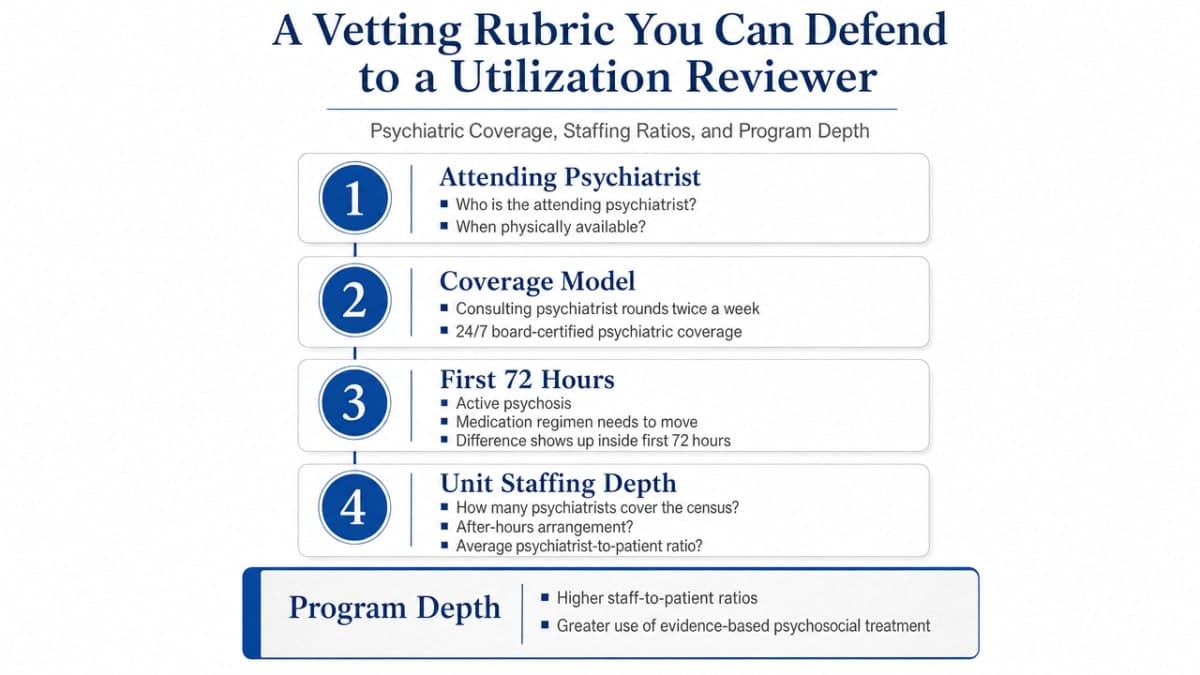
Start with the question that decides most of the others: who is the attending psychiatrist, and when are they physically available? A program with a consulting psychiatrist who rounds twice a week is a different clinical animal from one with 24/7 board-certified psychiatric coverage, and for a patient in active psychosis with a medication regimen that needs to move, the difference shows up inside the first 72 hours. Ask directly. How many psychiatrists cover the census, what is the after-hours arrangement, and what is the average psychiatrist-to-patient ratio on the unit your patient would enter.
Staffing depth is not a soft variable. Residential SMI outcomes research has found that programs with “higher staff-to-patient ratios and greater use of evidence-based psychosocial interventions” produce measurably better functional outcomes than those without 6. That finding is worth quoting verbatim to a utilization reviewer who wants to know why an out-of-network specialty program is clinically justified over a lower-cost generalist option.
Program depth is the third leg. What evidence-based psychosocial interventions does the program actually deliver — CBT for psychosis, social skills training, family psychoeducation, motivational interviewing for the SUD side — and which staff members are trained to deliver them? A schedule full of “process groups” led by rotating techs is not psychosocial treatment for psychosis. If the program cannot name the interventions, name who runs them, and describe how often your patient would receive each one, it is not the receiving facility this case needs.
Integrated Dual Diagnosis Capability, Not Parallel Tracks
The word “integrated” gets used loosely. Some programs mean it. Others mean they have a mental health track and an SUD track under one roof, with separate clinicians, separate treatment plans, and a weekly meeting where the two teams update each other. For a patient with active psychosis and a substance use disorder, that parallel arrangement is not integrated care — it is coordinated care at best, and the evidence has been clear for over a decade that “integrated treatment is more effective than nonintegrated treatment” for individuals with co-occurring disorders including schizophrenia and SUD 5.
Ask the receiving facility how the treatment plan is written. One plan, authored by a team that includes both psychiatric and addiction expertise, is integrated. Two plans stapled together are not. Ask who leads the case conference and whether the psychiatrist attends the addiction group content review, or only the medication meeting. Ask how the program handles a patient who uses on pass, refuses a UDS, or presents with a positive symptom flare that could be substance-induced — a program running truly integrated care will have one clinical response, not a jurisdictional debate.
The residential evidence base supports this weight. An integrated residential program for patients with schizophrenia and substance use disorder produced “significant reductions in illicit drug and alcohol use and improvements across psychiatric symptom domains and quality of life” 3. That is the outcome profile your patient needs, and it does not come out of parallel tracks. It comes out of programs designed from the intake forward to treat both conditions as one clinical picture.
Intake Assessment and Level-of-Care Determination
The intake assessment is where a receiving facility either confirms it can hold your patient or exposes that it cannot. Missouri’s own regulatory language is unambiguous: when a patient presents with both mental health and substance use needs, they “shall receive an integrated assessment identifying service needs as well as stage of readiness for change” 10. Any receiving program — in Missouri or elsewhere — should be doing the same thing at intake, not asking your patient to complete a psychiatric intake on Monday and an addiction intake on Wednesday with two different clinicians.
SAMHSA’s guidance for co-occurring assessment is more specific about the sequence. The assessment process should “screen for and detect co-occurring disorders” and “determine level of care,” using systematic evaluation rather than clinical impression alone 8. Ask the facility what standardized instruments they use at intake, who administers them, and how the results feed into the level-of-care decision. If the answer is that the admissions coordinator makes the call based on a phone screen and your referral packet, you are talking to a program that has already decided your patient fits before actually assessing them.
A credible intake will also tell you within the first several days whether their initial level-of-care determination is holding, or whether the patient needs a different intensity than the intake predicted.
Referrer Communication Loop From Intake to Discharge
This is the criterion most facilities describe well and most execute poorly. You are handing over a patient you have been treating, in some cases for years. You have context — family dynamics, prior medication failures, the specific auditory content that predicts relapse, the pharmacy the patient trusts — that the receiving facility does not, and you will be the clinician taking the patient back when the residential stay ends. The communication loop is a clinical variable, not a courtesy.
SAMHSA’s TIP 42 frames this as a coordinated sequence:
- screening and detection of co-occurring disorders,
- integrated assessment,
- level-of-care determination, and
- cross-provider coordination throughout treatment 2.
That last phrase — throughout treatment — is the operational bar. Ask the receiving facility what their referrer communication protocol actually looks like, in writing. When will you get the admission confirmation, when will you get the initial treatment plan, how often will you receive clinical updates, and who on their team is your named point of contact.
Press on the discharge side. A useful handoff is not a discharge summary faxed the day the patient leaves. It is:
- a scheduled call with you before discharge,
- a medication reconciliation you have reviewed,
- an aftercare plan that names your outpatient appointment and any Missouri community resources being pulled in, and
- a warm handoff of any new diagnoses or medication changes that will land on your Tuesday panel.
If the facility cannot describe that sequence, the loop will break at the moment your patient needs it most.
Addressing the Missouri-to-Arizona Question Directly
Let’s name it. You are a Missouri clinician, and the facility you are being asked to consider is in Prescott, Arizona. Two time zones, an air ambulance or commercial flight, and a family that will not be able to drop by on Sunday afternoons. That is a real cost, and pretending otherwise would be dishonest.
The question worth asking is what you are trading the geography for. For a patient with treatment-resistant schizophrenia who has cycled through the closest Missouri programs without a clozapine trial, or for a dual diagnosis case that in-state residential SUD programs have declined because the psychiatric acuity was outside their comfort zone, the trade can be defensible. SAMHSA’s own guidance acknowledges that residential SUD facilities historically “served clients with more serious SUDs but less severe mental disorders,” leaving a gap for individuals with co-occurring serious mental illness 8. If your patient sits in that gap and the nearest in-state option has already said no, the specialty match matters more than the mileage.
Where ViewPoint Dual Recovery Maps Onto the Rubric
Now apply the rubric to a specific facility rather than a category. ViewPoint Dual Recovery is a Joint Commission-accredited psychiatric treatment facility in Prescott, Arizona, licensed by Arizona ADHS and LegitScript certified. On the psychiatric coverage question, ViewPoint’s care is led by board-certified psychiatrists rather than a consulting arrangement — the kind of psychiatric leadership the treatment-resistant scenario in Section 2.2 actually requires when a clozapine titration or medication redesign is underway.
On dual diagnosis capability, ViewPoint’s clinical model is built around integrated psychiatric and substance use treatment rather than parallel tracks — psychiatrists and therapists collaborate on one treatment plan per patient, which is the standard SAMHSA’s TIP 42 sets when it directs that “treatment should address both conditions to the extent possible and should not neglect one disorder over the other” 2. That structural choice matters most for the acute-psychosis-with-active-use referral, where a parallel-track program tends to stall.
On program depth, ViewPoint’s stated specializations map onto the three referral scenarios directly: treatment-resistant schizophrenia with clozapine protocols, rapid-cycling bipolar requiring advanced medication strategies, and co-occurring mental health and substance use disorders. Treatment duration is set by clinical response rather than a preset benefit window, which is the operational answer to the medication-redesign patient whose regimen cannot be rebuilt in 21 days.
On the referrer communication loop, ViewPoint’s integrated care team model — where the attending psychiatrist and the primary therapist collaborate on each case — gives you a named clinical point of contact rather than a routing desk. That is the piece Section 4.4 argued was most often described well and executed poorly, and it is the piece you should test on the pre-referral call before you send records.
The Referral Call: What to Ask, What to Send, What to Expect Back
The pre-referral call is where the vetting rubric becomes a conversation. Before you dial, have the patient’s chart open and know the three things that will shape the intake decision:
- current medications and prior trials with doses and durations,
- the last 30 days of substance use and any recent UDS results, and
- the specific behaviors that pushed the case past your outpatient setting.
A receiving facility that cannot form a clinical impression from those three inputs on a 20-minute call is not one that will hold the case well once the patient arrives.
Ask who you are speaking with. If it is an admissions coordinator, ask when the psychiatrist or clinical director can call you back — for a treatment-resistant or acutely psychotic patient, you want a clinical voice on the line before records leave your office. Ask directly whether the program will accept a patient with active positive symptoms, whether clozapine can be initiated or continued on-site, and how they handle a patient who arrives more acute than the phone screen suggested.
Send a focused packet, not a full chart dump:
- the most recent psychiatric evaluation,
- medication history with prior trials,
- recent labs and any ANC trend if clozapine is in play,
- the last discharge summary from any inpatient stay, and
- a one-page referral note in your own words.
Missouri’s integrated assessment expectation 10cuts both ways — the receiving facility should be prepared to build on what you send rather than restart from zero.
What you should expect back:
- admission confirmation within 24 hours of arrival,
- an initial treatment plan within the first week,
- a named psychiatrist and therapist as your points of contact, and
- scheduled clinical updates through discharge 2.
If any of that is vague on the call, it will be vaguer once the patient is admitted. For a specific Missouri patient who fits the treatment-resistant or dual diagnosis profile this piece has described, calling ViewPoint Dual Recovery directly about that patient — rather than sending records into a general inquiry queue — is the version of this call that gets you a clinical answer the same day.
Consult on Complex Psychosis Referrals with Experts
Get tailored clinical insights for your most treatment-resistant psychosis cases, quickly and confidentially.
Frequently Asked Questions
Can a Missouri clinician legally refer a patient out of state to an Arizona psychosis program?
Yes. Missouri statute defines a mental health facility by its functional capacity to “provide evaluation, treatment and, inpatient care” 1, not by state boundary. What matters is that the receiving program is licensed and accredited in its own jurisdiction, meets the clinical bar your patient requires, and can coordinate care back to you. Verify accreditation, state licensure, and payer participation before the transfer.
What should I ask on the pre-referral call to confirm a facility can hold a patient with active psychosis and substance use?
Ask who provides psychiatric coverage and when they are physically on-site, whether the program can initiate or continue clozapine, and how positive-symptom flares are managed after hours. Ask whether one treatment plan is authored by a combined psychiatric and addiction team or two plans are stitched together — SAMHSA is direct that both conditions should be addressed concurrently rather than sequenced 2.
How do I know a receiving facility runs integrated dual diagnosis care rather than parallel tracks?
Ask three questions. Who authors the treatment plan, and is it one document or two? Do the psychiatrist and addiction clinician attend the same clinical review? How is a substance-induced symptom flare handled — as one clinical event or a jurisdictional handoff? The evidence base is unambiguous that “integrated treatment is more effective than nonintegrated treatment” for co-occurring psychosis and SUD 5.
What records should I send with a psychosis referral, and what should I expect back from the receiving facility?
Send the most recent psychiatric evaluation, medication history with prior trial doses and durations, recent labs and any ANC trend if clozapine is in play, the last discharge summary, and a one-page referral note in your voice. Expect admission confirmation within 24 hours, an initial treatment plan in the first week, named psychiatric and therapist contacts, and scheduled clinical updates through discharge 2.
Does ViewPoint Dual Recovery accept patients whose prior programs declined them as too clinically complex?
Yes. ViewPoint’s clinical focus is treatment-resistant psychiatric conditions and dual diagnosis, including treatment-resistant schizophrenia, rapid-cycling bipolar with psychotic features, and co-occurring SUD. Treatment duration is set by clinical response rather than a preset benefit window, which addresses the medication-redesign patient a shorter program cannot rebuild. Call directly about a specific patient rather than routing records through a general inquiry queue.
How should discharge coordination back to a Missouri outpatient team be structured?
A useful handoff is a scheduled call with you before discharge, a medication reconciliation you have reviewed, and an aftercare plan naming your outpatient appointment and any Missouri community resources being engaged. Missouri’s integrated assessment expectation 10should carry through to discharge planning, and any new diagnoses or medication changes should land on your panel with clinical context, not just a faxed summary.
References
- Revised Statutes of Missouri, RSMo Section 632.005. https://revisor.mo.gov/main/OneSection.aspx?section=632.005
- TIP 42: Substance Use Treatment for Persons With Co-Occurring Disorders. https://library.samhsa.gov/product/tip-42-substance-use-treatment-persons-co-occurring-disorders/pep20-02-01-004
- Treatment Outcomes of an Integrated Residential Programme for Patients with Schizophrenia and Substance Use Disorder. https://pubmed.ncbi.nlm.nih.gov/21447952/
- Treatment-Resistant Schizophrenia: Definition, Evaluation and Management. https://www.ncbi.nlm.nih.gov/pmc/articles/PMC5593008/
- Integrated Treatment for Co-Occurring Disorders: A Review of the Evidence. https://www.ncbi.nlm.nih.gov/pmc/articles/PMC3052987/
- Residential Mental Health Treatment for Adults with Severe Mental Illness: Outcomes and Program Characteristics. https://www.ncbi.nlm.nih.gov/pmc/articles/PMC5689165/
- Managing Life with Co-Occurring Disorders. https://www.samhsa.gov/mental-health/serious-mental-illness/co-occurring-disorders
- Substance Use Disorder Treatment for People with Co-Occurring Disorders. https://library.samhsa.gov/sites/default/files/pep20-06-04-006.pdf
- Substance Abuse Treatment for Persons With Co-Occurring Disorders. https://library.samhsa.gov/product/substance-abuse-treatment-persons-co-occurring-disorders/sma10-4531
- Missouri Code of State Regulations 9 CSR 30-4: Admission Criteria and Co-Occurring Services. https://www.sos.mo.gov/CMSImages/AdRules/csr/previous/9csr/9csr1019/9c30-4.pdf
- Missouri Serious Mental Illness (SMI) Section 1115 Demonstration — Program Application. https://www.medicaid.gov/medicaid/section-1115-demonstrations/downloads/mo-smi-demo-pa.pdf
- Missouri Secretary of State: 9 CSR 10-7 Behavioral Health Healthcare Home Eligibility Criteria. https://www.sos.mo.gov/CMSImages/AdRules/csr/previous/9csr/9csr1020/9c10-7.pdf
