

Key Takeaways
- Trauma-informed signage is common across Arizona programs, but only trauma-focused protocols like TF-CBT, EMDR, Prolonged Exposure, and CPT are named first-line for PTSD 8.
- When trauma sits alongside substance use, bipolar, or treatment-resistant depression, look for an Arizona track that sequences care and coordinates psychiatry with therapy on the same case.
- Pacing should be clinical, not calendar-based, because symptom trajectories vary person to person and a fixed length of stay quoted before intake is a schedule, not a plan 6.
- Before committing to any Arizona program, ask which named protocols clinicians actually deliver, their licenses and trauma-specific training, and how they handle stalls or comorbidity 7.
Why “Trauma-Informed” Signage Isn’t the Same as Trauma-Focused Care
Walk into almost any behavioral health facility in Arizona and you will see the phrase “trauma-informed” somewhere on the wall, the website, or the intake paperwork. It has become the default language of the industry. And if you or someone you love has already tried one of those programs and left feeling the same, or worse, you are not imagining things. There is a real difference between a place that is trauma-informed and a place that actually does trauma-focused work.
Trauma-informed is a posture. It means the staff has been trained to recognize how trauma shows up, to avoid re-traumatizing you during care, to keep the environment safe and predictable, and to lead with respect. That matters. It is the floor, not the ceiling.
Trauma-focused is a set of specific, evidence-based treatments aimed directly at the trauma itself. The Department of Veterans Affairs and the National Center for PTSD are clear that trauma-focused psychotherapies have the strongest evidence for treating PTSD and are recommended as first-line care, ahead of non-trauma-focused approaches 8. The named protocols include Prolonged Exposure (PE), Cognitive Processing Therapy (CPT), Eye Movement Desensitization and Reprocessing (EMDR), and Trauma-Focused Cognitive Behavioral Therapy (TF-CBT) 8.
Here is the practical piece for you. A program can be beautifully trauma-informed and still not offer a single one of those protocols. You can spend weeks in group therapy, journaling, and psychoeducation and never once directly process the memory that keeps waking you at 3 a.m. That is not a failure of your effort. That is a mismatch between what you needed and what the program was built to deliver. Knowing the difference is the first thing that protects you as you look at Arizona options.
The Modalities That Actually Move the Needle
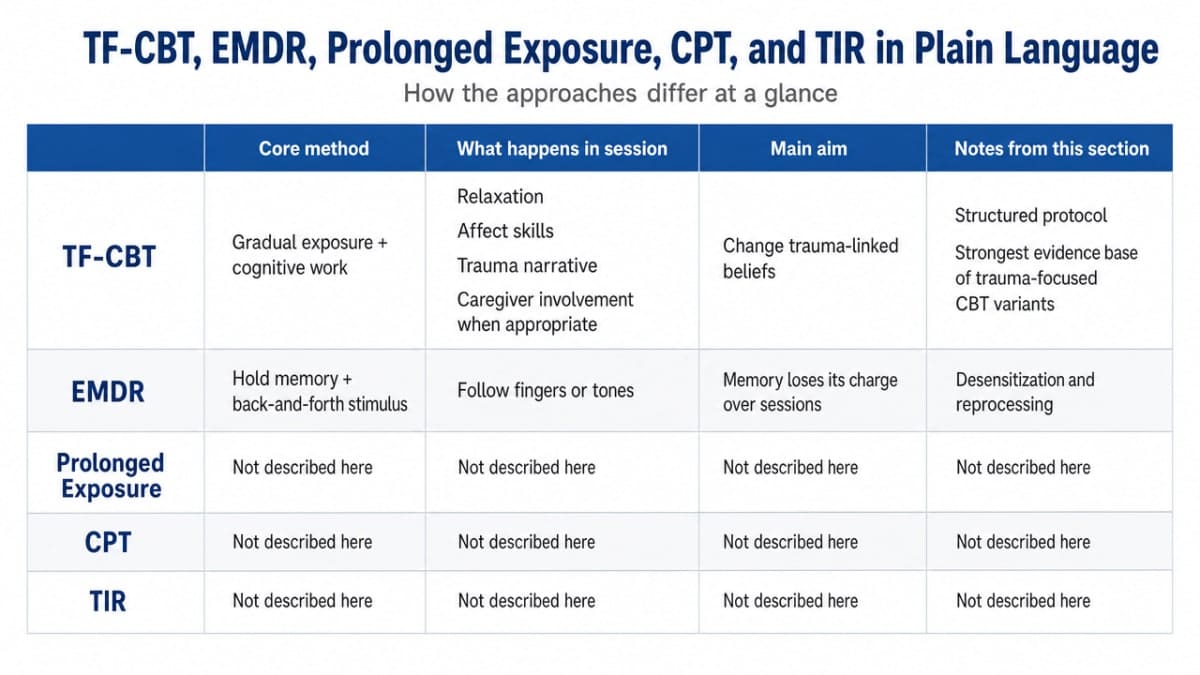
TF-CBT, EMDR, Prolonged Exposure, CPT, and TIR in Plain Language
Here is the vocabulary you need before you can compare any two Arizona programs honestly. The names sound alike, but the treatments do different things.
- Trauma-Focused Cognitive Behavioral Therapy (TF-CBT)
- A structured protocol that pairs gradual exposure to the traumatic memory with cognitive work to change the beliefs that trauma leaves behind (“it was my fault,” “nowhere is safe”). Sessions include relaxation and affect skills, a trauma narrative, and, when appropriate, caregiver involvement. It has the strongest evidence base of the trauma-focused CBT variants 11.
- Eye Movement Desensitization and Reprocessing (EMDR)
- Asks you to hold a piece of the traumatic memory in mind while following a back-and-forth stimulus (usually the therapist’s fingers or tones). Over sessions, the memory loses its charge. You do not have to talk through every detail out loud, which is part of why some people tolerate it better than pure verbal exposure.
- Prolonged Exposure (PE)
- Does what the name says. You revisit the trauma memory, out loud and in detail, in a controlled way with your therapist, and you slowly re-enter safe situations you have been avoiding. It is direct, and it works 8.
- Cognitive Processing Therapy (CPT)
- Focuses less on the memory itself and more on the “stuck points” — the specific thoughts that keep the trauma running your life. You learn to identify them on paper and challenge them. CPT is often chosen when talking through the memory in detail feels too much at the start.
- Traumatic Incident Reduction (TIR)
- A structured, one-on-one method where you review a specific incident repeatedly, from start to finish, until it no longer produces the same distress. It is less studied than the four above but is used in some trauma tracks as an option for clients who want a focused, incident-by-incident approach.
All five are trauma-focused. All five are different. A real trauma program should be able to tell you which ones its clinicians are trained in and which one they are recommending for you, and why.
What the Adult Evidence Actually Says
A comprehensive meta-analysis of psychological therapies for chronic PTSD in adults compared individual trauma-focused CBT, EMDR, non-trauma-focused CBT, supportive therapy, and other approaches. Individual trauma-focused CBT was more effective than waitlist or usual care at a standardized mean difference of −1.62, and EMDR was more effective at −1.17 9. Both meaningfully outperformed doing nothing or receiving generic support, and by a wide margin.
The same meta-analysis found that trauma-focused modalities were, on the whole, broadly similar to each other in short-term efficacy 9. This means the choice between EMDR, TF-CBT, and CPT is less about which one is “better” and more about which one fits your presentation, your tolerance, and what your clinician is genuinely trained to deliver.
The VA and the National Center for PTSD reach the same conclusion from a different angle. They review the evidence and recommend trauma-focused psychotherapies as first-line, ahead of non-trauma-focused options 8.
The adult evidence does not tell you to pick a favorite modality. It tells you to pick a program that actually offers one of these protocols and delivers it with fidelity.
Why One Modality Rarely Covers a Complex Case
If your trauma sits by itself, one well-delivered protocol may be enough. If it sits with substance use, or bipolar disorder, or a depression that has not lifted in years, the picture usually asks for more than one tool.
Symptom trajectories during trauma-focused CBT vary from person to person — some clients respond quickly, some plateau, some need pacing adjustments mid-treatment 6. In adult samples, factors like comorbidity and complexity predict how treatment lands, which means a single protocol applied the same way to everyone is not the right plan for a treatment-resistant case 11.
In practice, a strong trauma track keeps more than one modality on the table. You might start with CPT to build stability and challenge stuck points, then move to EMDR or prolonged exposure once your nervous system can handle direct memory work. If substance use is active, the trauma processing waits until you are physically safe enough to do it — not indefinitely, but long enough that the work sticks.
A program that only offers one modality is not automatically wrong. But if you have already tried that modality, or if your case is complex, ask what else the clinicians are trained in. The answer tells you whether the track can flex with you or whether you will be shaped to fit the track.
Individualized Pacing Is Clinical, Not a Calendar
Why Symptom Trajectories Vary Person to Person
Pacing is one of those words that sounds like marketing until you understand why clinicians take it so seriously. Two people can walk into the same trauma-focused program on the same day with similar diagnoses and follow very different paths. One starts sleeping through the night after three sessions of memory work. The other needs six weeks of stabilization before they can even name the memory out loud. Neither is doing it wrong.
Recent trajectory research on trauma-focused CBT confirms what experienced therapists already see in practice. Symptom change during treatment varies substantially from person to person, with some clients showing steady improvement, others plateauing mid-course, and a smaller group needing pacing adjustments before the work can move forward 6. That variability is not a flaw in the protocol. It is the reason a good trauma track measures your response and adjusts, rather than pushing you through a fixed number of sessions on a fixed schedule.
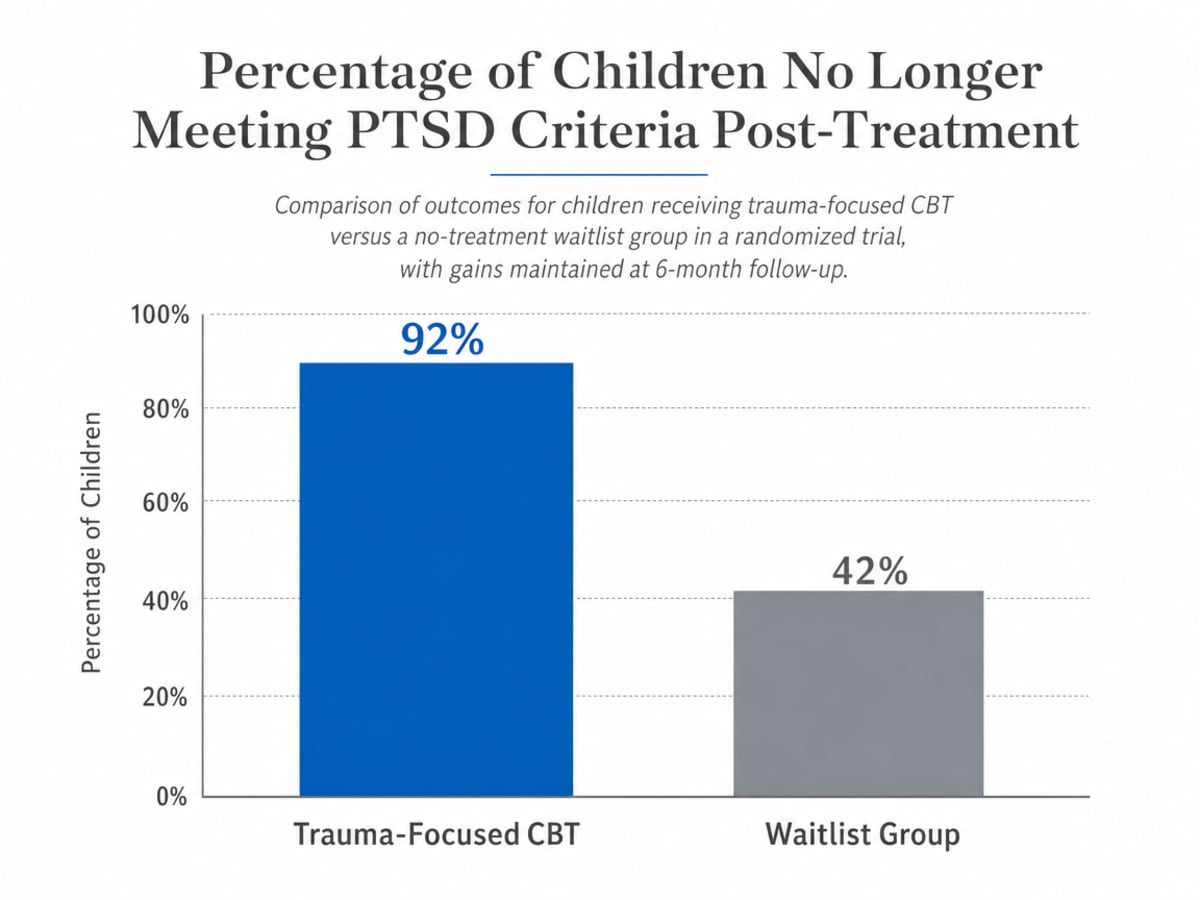
What the underlying evidence still says, even with all that individual variation, is that structured trauma-focused protocols work, and they work far better than waiting. In one controlled pediatric trial cited in the CBT-for-PTSD review, 92 percent of children who received trauma-focused CBT no longer met criteria for PTSD after treatment, compared with 42 percent in the waitlist group, with gains holding at six-month follow-up 1. While this is a pediatric, controlled-trial figure and not an adult outcome guarantee, it demonstrates that a real protocol, delivered well and given time, does something a waiting list cannot.
Stabilization, Processing, Integration: What Good Pacing Looks Like
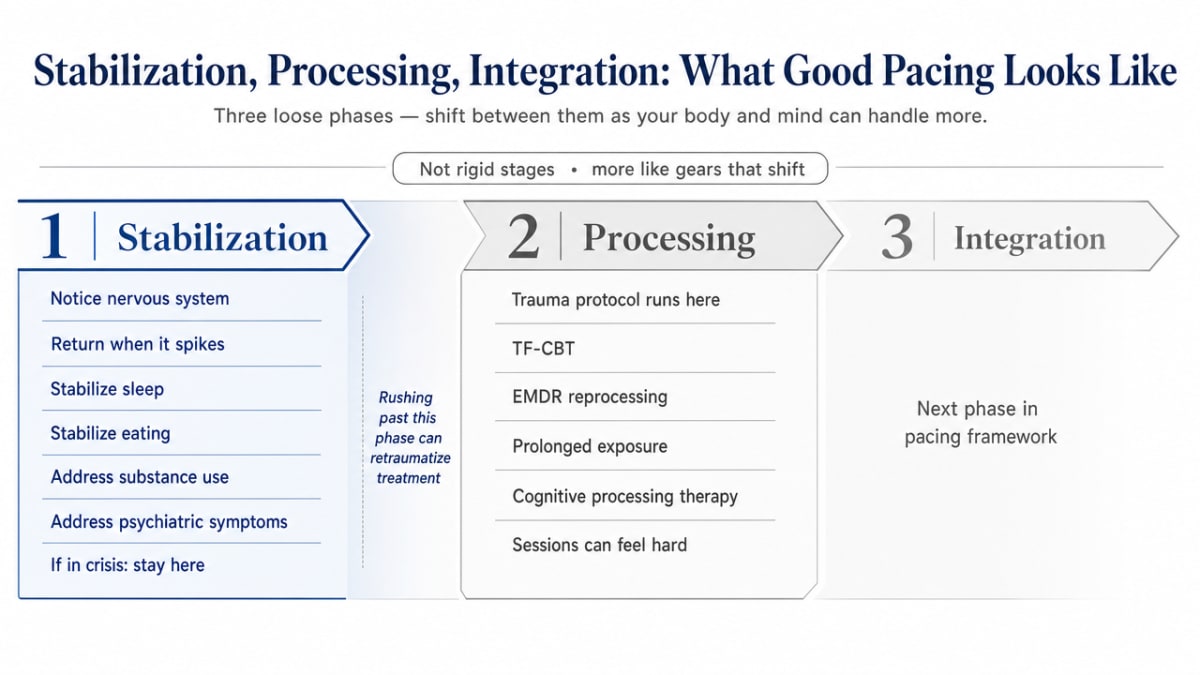
Most trauma-focused programs organize care into three loose phases. They are not rigid stages you graduate from with a certificate. They are more like gears the work shifts between as your body and mind can handle more.
Stabilization comes first. You learn to notice what your nervous system is doing, build skills to bring yourself back when it spikes, and stabilize sleep, eating, and any active substance use or psychiatric symptoms. If you are in crisis, this is where you stay until you are not. Rushing past this phase is how people get retraumatized in treatment.
Processing is the phase most people picture when they think of trauma therapy. This is where the actual protocol runs — TF-CBT sessions, EMDR reprocessing, prolonged exposure work, cognitive processing therapy assignments. Sessions can feel hard. Between them, you may feel more raw before you feel steadier. A skilled therapist watches for that arc and slows the work when your window of tolerance narrows.
Integration is the phase that generic programs skip. It is where new skills, new beliefs, and a quieter memory get folded back into your daily life — your relationships, your work, your sleep, your recovery from substance use if that is part of your picture. Real-world routine care studies show trauma-focused treatment holds up long-term when this phase is honored 11.
When Trauma Sits Alongside Substance Use, Bipolar, or Depression
If you are reading this section carefully, there is a good chance trauma is not the only thing you are carrying. Maybe drinking became the way you slept. Maybe a bipolar diagnosis showed up in your twenties and no one ever asked what happened before it. Maybe a depression that will not lift has quietly been trauma the whole time, wearing a different name.
This is where a lot of Arizona programs quietly fall short. A generalist substance use program may treat the drinking and hand you a worksheet about triggers. A general mental health clinic may adjust your mood stabilizer and refer you out for “trauma work someday.” Neither one is set up to hold both pieces at once. The trauma keeps feeding the drinking. The drinking keeps blocking the trauma work. You end up cycling.
The research is direct about who trauma-focused therapy actually helps in the real world. A 2025 study of trauma-focused CBT in routine care — everyday clinics with everyday patients, including those with multiple traumas and layered diagnoses — found it stayed effective across complex presentations, not just clean single-trauma cases 11. The adult meta-analysis reached a similar place: individual trauma-focused CBT and EMDR meaningfully outperform waitlist and usual care in chronic PTSD, and that includes patients who arrive with the kind of comorbidity you probably have 9.
What that means in practice is sequencing, not skipping. A dedicated trauma track should be able to say, out loud, how it handles active substance use, how it coordinates with a psychiatrist managing bipolar or treatment-resistant depression, and when the trauma processing itself begins. In some cases, stabilization comes first — safer sleep, safer use or abstinence, a mood that is not swinging weekly — and then the memory work starts. In others, the trauma work runs in parallel with medication adjustments, with the psychiatrist and therapist actually talking to each other.
What you are looking for is a program where trauma is not the last thing on the list. If your case is complex, treating one piece and pretending the others will settle on their own is what has already not worked. You deserve a track that was built for the whole picture.
Questions to Ask Any Arizona Trauma Program Before You Commit
You do not need a clinical degree to ask better questions than most intake calls prepare for. You just need a short list, a pen, and permission to keep asking until you get real answers. Here is what to bring to any phone screen with an Arizona trauma program.
Which trauma-focused protocols do your clinicians actually deliver? You are listening for named modalities — TF-CBT, EMDR, Prolonged Exposure, Cognitive Processing Therapy, TIR — not the phrase “trauma-informed care.” If the answer is vague, that is your answer. The VA and National Center for PTSD name these specific protocols as first-line for a reason 8.
What are your therapists’ licenses and trauma-specific trainings? Ask for credentials, not job titles. Therapist licensure and trauma-focused training measurably influence outcomes, so “our staff is trauma-informed” is not the same as “our clinicians are licensed and trained in these protocols” 7.
How do you decide when I’m ready to start memory work, and how do you adjust if I stall? A real program monitors your response and shifts pacing, because symptom trajectories vary from person to person during trauma-focused treatment 6. If they quote you a fixed number of weeks before meeting you, that is a schedule, not a plan.
How do you handle active substance use, bipolar disorder, or treatment-resistant depression alongside the trauma work? You want to hear that the psychiatrist and therapist coordinate on the same case, and that sequencing is a real conversation — not a referral out.
How is my family involved, and how do you communicate with them? Ask what family sessions look like and how updates are shared with your consent.
What happens if this doesn’t work? A program willing to answer that question honestly is the kind of program worth calling back.
ViewPoint’s Trauma-Focused Program in Prescott, Arizona
If you have read this far, you already know the questions to ask. Here is how ViewPoint’s Trauma-Focused Program answers them, described plainly so you can compare it against anywhere else you are looking in Arizona.
The program runs as a dedicated track, not a line item folded into a general mental health schedule. It sits inside ViewPoint Dual Recovery’s Joint Commission-accredited facility in Prescott, Arizona, where the whole clinical model is built around treatment-resistant psychiatric conditions and dual diagnosis. That matters because the people who most need trauma-focused care rarely arrive with trauma alone. Real-world evidence shows trauma-focused CBT stays effective in routine care across single and multiple trauma exposures, including patients with the layered comorbidity ViewPoint is set up to hold 11.
A few specifics worth naming:
Named modalities, not “trauma-informed” language. The track is built around the trauma-focused protocols the VA and National Center for PTSD name as first-line — the family of evidence-based approaches including TF-CBT, EMDR, Prolonged Exposure, and Cognitive Processing Therapy — so your clinician can match the modality to your presentation rather than fit you to one method 8.
Integrated psychiatric care on the same team. Board-certified psychiatry is available on site, so if you are also managing bipolar disorder, treatment-resistant depression, or a psychotic-spectrum condition, medication decisions and trauma work happen inside the same conversation.
Individualized pacing as a clinical practice. Treatment duration is driven by clinical need, not a preset 30/60/90-day slot, which reflects what trajectory research shows about how differently people respond to trauma-focused work 6.
If you want to see exactly what the track includes, the Trauma-Focused Program page walks through the specifics.
If Prior Treatment Didn’t Hold: A Direct Word to Families and Returning Clients
If you have already been through treatment — maybe more than once — and you are reading this because it did not hold, please hear this clearly. That is not a character flaw. It is not a lack of willpower. It is often a sign that the care you received was not built for what you were actually carrying.
Generic supportive counseling and non-directive therapy help less than trauma-focused protocols, and the gap widens the more complex the case 12. When trauma sits alongside substance use, bipolar, or treatment-resistant depression, a program that never directly processed the trauma was always going to leave a door open for relapse. Real-world evidence shows trauma-focused CBT holds up in exactly the kind of complex, comorbid presentations that generic tracks tend to miss 11.
To the family member reading this: your loved one is not starting from zero. Every prior round taught them something about what does not work, and that information matters when the next program is chosen well.
To the person returning to treatment: you are allowed to ask harder questions this time. You have earned that.
Take the First Step Toward Focused Trauma Care
Connect with clinicians who understand complex trauma and can help chart your next course.
Frequently Asked Questions
What’s the difference between trauma-informed and trauma-focused therapy?
Trauma-informed is a care posture. Staff are trained to recognize how trauma shows up, keep the environment safe, and avoid re-traumatizing you. Trauma-focused is a set of specific, evidence-based treatments aimed at the trauma itself — protocols like TF-CBT, EMDR, Prolonged Exposure, and Cognitive Processing Therapy. The VA and National Center for PTSD recommend trauma-focused psychotherapies as first-line care 8. A program can be one without offering the other.
Which trauma-focused therapies are considered first-line for adults?
The VA and National Center for PTSD name Prolonged Exposure, Cognitive Processing Therapy, EMDR, and Trauma-Focused CBT as first-line trauma-focused psychotherapies for PTSD 8. A meta-analysis of chronic adult PTSD found individual trauma-focused CBT and EMDR both meaningfully outperformed waitlist or usual care, and short-term efficacy across trauma-focused modalities was broadly similar 9. The right choice depends on your presentation, your tolerance for direct memory work, and your clinician’s training.
Can I do trauma-focused therapy if I also struggle with substance use or bipolar disorder?
Yes, and this is where a dedicated track matters most. Real-world routine care research shows trauma-focused CBT stays effective in complex, comorbid presentations — not just clean single-trauma cases 11. What you want is a program where the psychiatrist and therapist coordinate on the same case, where sequencing is a real conversation, and where active substance use or mood instability is stabilized enough that the trauma work sticks rather than destabilizing you further.
How long does trauma-focused treatment take?
There is no fixed answer, and any program that quotes you one before meeting you is selling a calendar. Symptom trajectories during trauma-focused CBT vary substantially — some clients respond quickly, others plateau or need pacing adjustments mid-treatment 6. A good track measures your response and shifts pacing accordingly, moving through stabilization, processing, and integration at the speed your nervous system can hold. Treatment duration follows clinical need, not insurance windows.
What questions should I ask an Arizona trauma program before enrolling?
Ask which specific trauma-focused protocols the clinicians deliver (TF-CBT, EMDR, PE, CPT, TIR), not whether they are “trauma-informed” 8. Ask for therapist licenses and trauma-specific trainings, because licensure influences outcomes 7. Ask how pacing is decided and adjusted when you stall 6. Ask how active substance use, bipolar, or treatment-resistant depression are handled alongside trauma work. Ask what family involvement looks like. Ask what happens if this round does not hold.
What if previous therapy or rehab didn’t hold?
That is not a character flaw. Generic supportive and non-directive counseling help less than trauma-focused protocols, and the gap widens for complex cases 12. If your prior program never directly processed the trauma — or paired the trauma work with real psychiatric coordination — it was working with the wrong tools for what you were carrying. Trauma-focused CBT holds up in routine care with comorbid patients 11. You are allowed to ask harder questions this time.
References
- Cognitive behavioral therapy for the treatment of post-traumatic stress disorder: a review. https://pmc.ncbi.nlm.nih.gov/articles/PMC3083990/
- Trauma-Focused Cognitive Behavioral Therapy for Children and Adolescents: An Evidence-Based Practice. https://pmc.ncbi.nlm.nih.gov/articles/PMC4396183/
- A Randomized Effectiveness Study Comparing Trauma-Focused Cognitive Behavioral Therapy and Therapy as Usual for Children and Adolescents. https://pmc.ncbi.nlm.nih.gov/articles/PMC4037845/
- Cognitive behavioral therapy for the treatment of post-traumatic stress disorder: PDF full text. https://pmc.ncbi.nlm.nih.gov/articles/PMC3083990/pdf
- The Large-Scale Implementation of Trauma-Focused Cognitive Behavioral Therapy: Outcomes Across a Statewide System. https://conservancy.umn.edu/server/api/core/bitstreams/e9de989a-5455-4e56-b904-5c93f18a22c6/content
- PTSD Symptom Changes During Trauma-Focused Cognitive Behavioral Therapy: Individual and Group Trajectories. https://pmc.ncbi.nlm.nih.gov/articles/PMC12344687/
- A Randomized Implementation Study of Trauma-Focused Cognitive Behavioral Therapy in Residential Treatment Facilities. https://pubmed.ncbi.nlm.nih.gov/26747845/
- Overview of Psychotherapy for PTSD. https://www.ptsd.va.gov/professional/treat/txessentials/overview_therapy.asp
- Psychological therapies for chronic post-traumatic stress disorder in adults: Systematic review and meta-analysis. https://pubmed.ncbi.nlm.nih.gov/24338345/
- Effectiveness of trauma-focused cognitive behavioral therapy for children and adolescents: A randomized controlled trial in eight German mental health clinics. https://pubmed.ncbi.nlm.nih.gov/27043952/
- Effectiveness in routine care: trauma-focused treatment for PTSD. https://pmc.ncbi.nlm.nih.gov/articles/PMC11827035/
- Trauma-Focused Cognitive Behavioral Therapy for Youth: A Review of the Evidence. https://pmc.ncbi.nlm.nih.gov/articles/PMC4239204/