

Key Takeaways
- Intensity is measured in hours: weekly outpatient offers roughly one hour, IOP requires at least nine, PHP at least twenty, and residential provides 24/7 structure 1, 3.
- Stabilization has to come before trauma processing — sleep, safety, substance-use control, and psychiatric support build the floor that CPT, PE, or EMDR need to land 6, 8.
- Active suicide risk between sessions, substance use interfering with therapy, stalled PCL-5 scores, dissociation, or collapsing function are the clearest signals that weekly contact is no longer the right dose 11, 12.
- For co-occurring PTSD and substance use, ask whether psychiatry, trauma, and substance-use clinicians sit on the same case — coordination between buildings is not the integrated model SAMHSA recommends 9, 10.
The moment weekly therapy stops being enough
You know the feeling. The Tuesday appointment comes and goes, your person says the right things in session, and by Friday the nightmares are back, the drinking has crept up again, or the phone goes silent for three days. Maybe you’re the partner watching this cycle from the kitchen. Maybe you’re the therapist watching the PCL-5 numbers refuse to budge no matter how carefully you pace the work.
That stall is real, and it’s not a character flaw. It’s a signal about intensity of care.
Weekly outpatient therapy gives most adults with PTSD roughly one hour of clinical contact out of 168 hours in a week. For a lot of people, that ratio works. For others, especially those also managing active substance use, suicidal thinking, severe dissociation, sleep collapse, or psychiatric symptoms that keep hijacking the session, one hour a week is a cup trying to catch a waterfall. The VA/DoD clinical guideline is explicit that PTSD assessment has to include substance use, suicide risk, and broader psychiatric comorbidity, because any of those can quietly determine whether weekly therapy is doing anything at all 12.
This piece is about the decision point you’re already standing on. Not whether PTSD treatment works, but whether the current dose of it is doing the job. You’ll get the hours-per-week definitions, the phased clinical structure, the referral criteria therapists can actually use on Monday morning, and an honest look at what intensive care does and doesn’t deliver, so you can tell the difference between a plan that needs more time and a plan that needs more intensity.
What “intensive” actually means in hours per week
Before anything else, you need a number. “Intensive” is one of the most abused words in behavioral health marketing, and until you know what it means in hours, you can’t tell whether a program is a real step up or just a weekly session with a nicer waiting room.
Here is the clearest frame available. The Centers for Medicare & Medicaid Services (CMS) defines an Intensive Outpatient Program (IOP) as requiring a minimum of 9 hours of structured services per week, and a Partial Hospitalization Program (PHP) as requiring a minimum of 20 hours per week 1, 3. Standard weekly outpatient therapy, by contrast, is typically a single 45- to 60-minute session. That is roughly one hour versus nine versus twenty, in a week that holds 168 of them.
Picture the ladder:
- Weekly outpatient: ~1 hour/week
- IOP: ≥9 hours/week
- PHP: ≥20 hours/week
- Residential: 24/7 structured care
Those hours are not padding. In an adult IOP, the SAMHSA clinical guide describes that minimum nine hours as a prearranged schedule of core services: individual counseling, group therapy, family psychoeducation, and case management, built around a treatment plan 4. In substance-use terms, SAMHSA describes intensive outpatient care as generally running 9 to 20 hours of activities per week 5. So when a program says “intensive,” the honest question to ask is: how many hours, doing what, with whom in the room?
For PTSD specifically, the picture gets more concrete. Research on intensive PTSD programs defines them as evidence-based trauma-focused therapy delivered at least two to three times per week, often completed in under four weeks rather than stretched across six to twelve months 17. That is the shift. You are not adding one more hour to a weekly schedule. You are moving from a single hour of contact to a coordinated week of it, with trauma work, skills work, psychiatric oversight, and family involvement happening close enough together that gains in one area can hold while another is addressed.
If you are a referring clinician, you already feel the difference this makes. A client who cannot keep a safety plan intact between Tuesday sessions is a different clinical animal than a client who can. The hours-per-week ladder is the first filter for deciding which animal you are looking at.
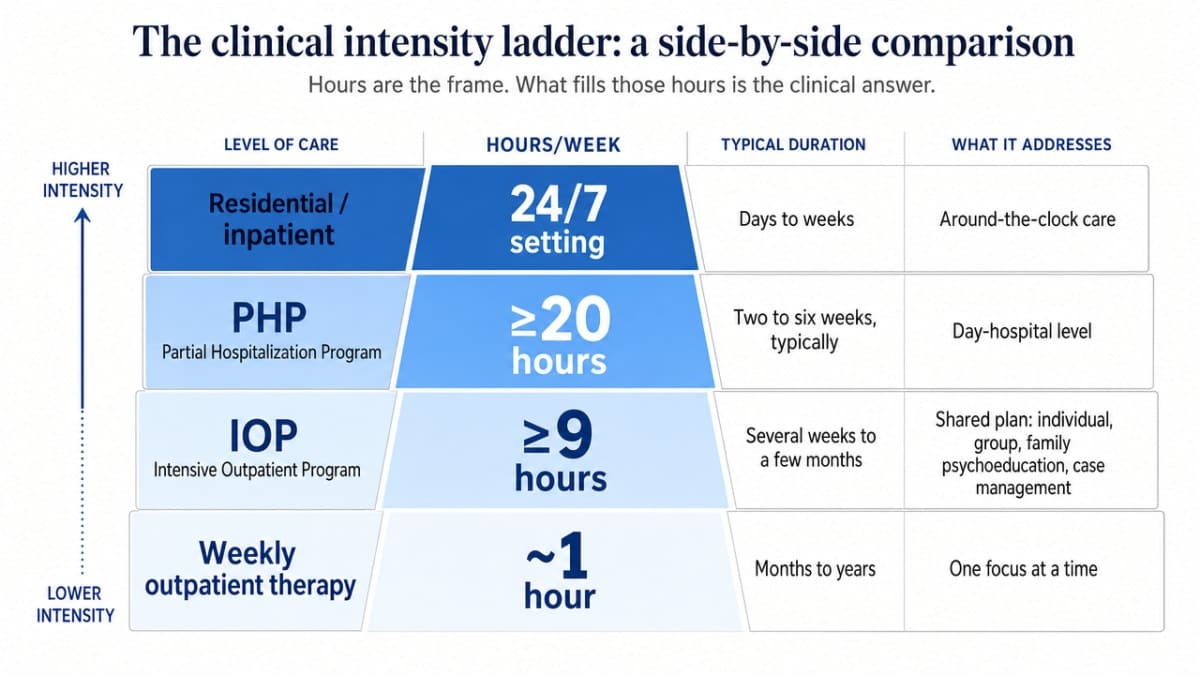
The clinical intensity ladder: a side-by-side comparison
Hours are the frame. What fills those hours is the clinical answer. Here is how the levels actually compare when you line them up.
| Level of care | Hours/week | Typical duration | What it addresses |
|---|---|---|---|
| Weekly outpatient therapy | ~1 hour | Months to years | One focus at a time: usually trauma processing or substance use or medication review, with the person managing the rest of the week alone. |
| Intensive Outpatient Program (IOP) | ≥9 hours 1, 3 | Several weeks to a few months | Prearranged mix of individual counseling, group therapy, family psychoeducation, and case management on a shared treatment plan 4. For PTSD specifically, evidence-based trauma therapy delivered two to three times per week, often finishing in under four weeks 17. |
| Partial Hospitalization Program (PHP) | ≥20 hours 1, 3 | Two to six weeks, typically | Day-hospital level structure for people who would otherwise need inpatient care but do not require 24/7 supervision. Psychiatric oversight is in the room with the therapy, not scheduled separately. |
| Residential | 24/7 | Weeks to months | Full-time structured care when safety, withdrawal, or psychiatric instability cannot be managed outside a treatment setting. |
Read the table across, not down. The jump from one hour to nine is not just more therapy. It is a shift from a single clinician holding one thread to a team holding several threads at once, with family in the loop and case management catching what falls through. The jump from nine to twenty is a shift from supplemental structure to the week’s primary structure. For a person who cannot work, cannot sleep, and cannot stop drinking by Wednesday, that difference is the point.
If you are the family member reading this, the practical takeaway is simple: ask any program for its weekly hours in writing, and ask what those hours contain. If you are the referring clinician, the ladder gives you a cleaner handoff conversation with your client. You are not saying “you’ve failed outpatient.” You are saying the dose needs to match what you’re both seeing between sessions.
Signs weekly therapy is no longer carrying the weight
If you’ve been in this long enough, you can feel the shift before you can name it. Sessions start feeling like damage control instead of forward motion. The homework stops getting done. The person you love cancels, reschedules, shows up late, or shows up quiet. You’re not imagining it. You’re reading the room correctly.
Here are the specific patterns that tell you weekly outpatient has stopped being the right dose.
Safety is slipping between sessions. The VA National Center for PTSD lays out suicide-risk assessment as a decision tool, not a form: current thoughts, intent, plan, access to means, recent preparatory behavior, willingness to use a safety plan, and whether there’s a real person who can stay close 11. When any of those move in the wrong direction between Tuesdays, weekly contact cannot hold the gap. A safety plan that falls apart by Thursday is a level-of-care message.
Substance use is interfering with the therapy itself. VA/DoD assessment guidance is direct that current and past substance use must be screened in anyone with trauma history, because substances quietly determine whether sessions do anything at all 12. If your client is drinking before session, using to sleep, or losing days to a relapse cycle, you are not treating PTSD once a week. You are watching PTSD be re-triggered six days out of seven.
Function is collapsing. Missed work, missed meals, missed custody time, a partner sleeping on the couch because the nightmares shake the bed. CMS criteria for stepping up to IOP include needing coordinated services beyond isolated sessions and lacking enough structure outside of treatment to stay safe and engaged 2. Function is the honest proxy.
The PCL-5 isn’t moving. If you’re the referring clinician reading this, you already track it. Three to four months of steady, well-delivered CPT or PE with no meaningful score change is data. It’s not a verdict on your client’s effort or your skill. It’s the plan telling you the dose is wrong.
Dissociation is eating the session. If the person goes somewhere else for the middle twenty minutes of every appointment, there isn’t enough stabilization in place to do the processing work weekly contact is trying to do.
None of these patterns mean the person has failed. They mean the structure around them is too thin for what they’re carrying. Nine or more coordinated hours a week, with psychiatry and substance-use care in the same plan, is a different intervention than one hour, no matter how skilled the hour is.
Stabilization first, trauma processing second
Here is the part most consumer PTSD content gets wrong. It skips straight to EMDR or CPT like the therapy itself is the answer, when the honest clinical sequence is almost always two beats, not one. Stabilization comes first. Trauma processing comes second. Skip the first beat and the second one either fails or makes things worse.
Stabilization is unglamorous. It is sleep that lasts more than four hours. It is a safety plan the person actually believes in. It is a week without using, or a medically supervised plan to get there. It is a psychiatric medication regimen that is doing what it is supposed to do, so the person can stay in the room during a hard session instead of dissociating out of it. SAMHSA’s TIP 57 is blunt that trauma assessment should not be conducted while a person is intoxicated, and that people carrying both PTSD and substance use have a more severe clinical profile than those with either alone, meaning both have to be addressed in the plan 8. Translation: you cannot process a trauma memory you are currently anesthetizing.
Once the floor is steady, processing becomes possible. The VA/DoD guideline is explicit here. Individual, manualized trauma-focused psychotherapies, specifically Cognitive Processing Therapy (CPT), Eye Movement Desensitization and Reprocessing (EMDR), and Prolonged Exposure (PE), are recommended over medication as the primary PTSD intervention 6, 7. Medication supports the work. It does not replace it. In an intensive program, that distinction becomes visible: psychiatry is in the room making sure sleep, mood, and anxiety are stable enough for the trauma work to land, while the trauma clinician does the actual processing two or more times per week.
Then comes the third beat, which quietly determines whether any of this holds: integration. Relapse prevention, step-down planning, a slower cadence of outpatient contact, family work so the people around your person know what changed and what to protect. This is where the gains either stick or quietly erode in month three.
If you are the family member watching this unfold, the sequence gives you a way to read the plan you are being offered. If a program is pitching trauma processing in week one without a word about sleep, substances, or safety, that is a flag. If you are the referring clinician, the sequence gives you language for the handoff: your client is not failing CPT, your client needs the stabilization floor an intensive setting can build before the processing work can do what it is designed to do.
Does intensity actually help people finish treatment?
Here is the honest question underneath all of this. More hours sound better. But do people actually finish an intensive program at a higher rate than weekly outpatient, and when they do, does the work hold?
The clearest data we have comes from military and veteran samples, and it is worth looking at squarely before anyone claims more than it says.
A 2023 review of intensive PTSD treatment in the military health system defines intensive delivery as at least two to three sessions per week, usually completed in under four weeks, and reports a meta-analytic dropout rate of 11.54% for intensive formats versus 18.64% for standard weekly delivery 17. That is a meaningful gap. For every hundred people who start, roughly seven more finish the intensive version. In a condition where treatment is uncomfortable by design, finishing is not a trivial outcome. It is the outcome.
Individual program evaluations tell a similar story. A VA intensive outpatient program using massed Prolonged Exposure and Cognitive Processing Therapy, delivered three or more times per week over two to four weeks, reported an 87.3% completion rate with a large PCL-5 effect size of d = 1.80 among 172 veterans 13. Compare that to the roughly 40% completion rate cited for standard weekly evidence-based PTSD treatment in similar populations, and the shape of the argument becomes clear: when the schedule is compressed, more people make it to the end 16.
There is also the engagement question. A pilot study offering intensive PTSD treatment in a VA outpatient clinic found that only 3 of 14 veterans offered the program initiated and completed it, which is a reminder that availability and clinical fit are not the same as uptake 15. Transportation, time off work, childcare, insurance authorization, and plain readiness all shape whether an intensive plan is usable for the person in front of you.
What this means practically. If your person or your client has been cycling through weekly sessions without finishing a protocol, the intensity question is not whether a more structured program is theoretically better. It is whether finishing becomes more likely when the work is front-loaded into two to four weeks instead of stretched across a year. For a lot of adults with PTSD, the answer appears to be yes. For some, the answer is only yes if the practical barriers get solved alongside the clinical ones.
Treating PTSD and substance use in the same room, not two systems
Here is where a lot of plans quietly break. Your person has PTSD. Your person also drinks every night to fall asleep, or uses to get through the grocery store, or has been in and out of a sober living house twice this year. The weekly therapist says, kindly, that she can’t do real trauma work until the substance use is under control. The substance-use counselor says, also kindly, that the drinking won’t stop until the trauma is addressed. You’ve been handed two phone numbers and a wait.
That handoff is the problem. SAMHSA’s position on this is not subtle: integrated care, where mental-health and substance-use interventions are coordinated inside one treatment plan rather than parceled out across disconnected systems, is the preferred model for co-occurring disorders 9, 10. The frame they use is “no wrong door” — whichever condition brings the person in, the other gets screened and treated in the same plan 10.
The clinical reason matters. TIP 57 states plainly that people carrying both PTSD and substance use present with a more severe clinical profile than people with either condition alone, and that both have to be addressed in treatment 8. That same guidance warns against conducting trauma assessment while someone is intoxicated, because the data you collect isn’t reliable and the person in front of you cannot consent to processing work she can’t fully feel 8. Those two facts together explain why the serial handoff fails. You can’t stabilize substance use without touching the trauma driving the use, and you can’t process the trauma while the nervous system is pharmacologically muted six nights a week.
In an intensive program built for this, the sequencing happens inside one team. Psychiatry handles withdrawal risk, cravings medication where indicated, and the psychiatric symptoms that make sobriety feel unbearable. The trauma clinician holds the CPT, PE, or EMDR work and paces it to what the person can actually tolerate that week. Case management keeps the practical floor intact. Family work gets the people at home ready for the person coming back. SAMHSA’s co-occurring advisory describes exactly this: concurrent treatment delivered through multiple formats — individual, group, family, peer — with medication decisions embedded in multidisciplinary planning rather than scheduled in a different building 9.
The referral-decision checklist for therapists and prescribers
If you’re the clinician reading this, you don’t need another explainer. You need something you can walk into Monday’s session with. Here is the short list.
Refer up when any of these are true for your client right now:
- Suicide risk is active between sessions. Current ideation with intent, a plan, access to means, or recent preparatory behavior — and a safety plan that isn’t holding across the week 11. Weekly contact cannot carry this.
- Substance use is interfering with the therapy itself. Drinking or using before session, using to sleep most nights, or a relapse pattern that keeps resetting the work. VA/DoD assessment guidance treats this as a core screening finding, not a side issue 12, and TIP 57 is explicit that trauma assessment should not be conducted while a person is intoxicated 8.
- No measurable PCL-5 movement after three to four months of well-delivered CPT, PE, or EMDR. The protocol isn’t failing. The dose is.
- Dissociation is eating the session. If grounding and distress-tolerance work can’t keep your client in the room long enough to process, the stabilization floor isn’t built.
- Function is collapsing. Job loss, custody risk, housing instability, or support systems that cannot cover the hours between appointments. CMS IOP criteria name this directly: coordinated services beyond isolated sessions, with adequate support outside program hours 2.
- Co-occurring psychiatric symptoms are hijacking the work. Severe depression, sleep collapse, or mood instability that medication adjustments in a weekly cadence can’t catch fast enough.
One criterion met is a conversation. Two or more is usually a referral. Frame it with your client as a dose change, not a demotion — the protocol you’ve been using is the right protocol; it needs more hours around it to do what it’s designed to do.
How ViewPoint’s Trauma-Focused Program fits the model
Here is where the framework meets a real example. ViewPoint Dual Recovery, a Joint Commission-accredited psychiatric facility in Prescott, Arizona, runs its Trauma-Focused Program on the stabilization-first, processing-second sequence this article has been building toward — and treats PTSD and substance use inside one plan rather than across two phone numbers.
What that looks like clinically. Stabilization comes first: sleep, safety planning, substance-use stabilization with medical oversight, and psychiatric medication adjustments handled by board-certified psychiatry on site, so the floor is built before any trauma processing starts 8. Then the processing phase uses the manualized trauma-focused psychotherapies the VA/DoD guideline names as first-line — CPT, PE, or EMDR — matched to what the person can tolerate 6. Integration comes last: relapse prevention, family work, and a step-down plan that doesn’t drop the person back into a single weekly hour too soon.
The dual-recovery piece matters here. For clients where PTSD and substance use are feeding each other, the psychiatrist, trauma clinician, and substance-use team sit on the same case, not in separate buildings — the integrated model SAMHSA names as the preferred approach for co-occurring disorders 9. ViewPoint positions itself for the cases other programs find too complex: treatment-resistant presentations and dual diagnosis where standard outpatient has already been tried.
What to ask any intensive program before you commit
Before you sign an intake form, ask the questions that separate a real intensive program from a weekly schedule with better branding. These are the ones that matter.
How many clinical hours per week, and doing what? Get it in writing. Nine or more hours of coordinated individual, group, family, and case-management services is the floor for IOP-level care 4. If the schedule is mostly psychoeducation and process groups with one trauma session tucked in, that is not the dose.
Which trauma-focused protocol, delivered how often? CPT, PE, or EMDR, two or more times per week, with a named clinician holding the protocol 6. Rotating facilitators and loose “trauma group” labels are flags.
Who manages psychiatry, and are they on the same team? Medication decisions should sit inside the treatment plan, not in a referral to someone the trauma clinician has never met.
How is substance use handled in the same plan? Ask whether the substance-use team joins case conference. Coordination between buildings is not integration 9.
What does the stabilization phase look like before processing begins, and what does step-down into weekly care look like after? If either answer is thin, the gains will be too.
Find Out If Intensive PTSD Care Fits Now
Get expert guidance on the right care level for persistent PTSD symptoms.
Frequently Asked Questions
How is an intensive PTSD treatment program different from weekly outpatient therapy?
The core difference is hours and coordination. Weekly outpatient therapy is usually one 45- to 60-minute session with one clinician. An intensive program delivers evidence-based trauma therapy at least two to three times per week, with psychiatric oversight, group work, family involvement, and case management on a shared treatment plan 17. You are not adding a session. You are shifting from one hour of contact to a coordinated week of it.
How long does an intensive PTSD program usually last?
Shorter than most families expect. Published intensive PTSD programs commonly run two to four weeks of concentrated treatment, with evidence-based protocols like CPT or PE delivered multiple times per week rather than stretched across six to twelve months 16, 17. Duration depends on the person’s starting point, co-occurring substance use or psychiatric symptoms, and how the stabilization and step-down phases are built around the processing work.
Can someone enter an intensive PTSD program while still using alcohol or drugs?
Yes, in an integrated dual-diagnosis setting. SAMHSA’s position is that PTSD and substance use should be treated concurrently inside one plan rather than handed back and forth between systems 9, 10. The practical caveat is that trauma assessment should not be conducted while someone is intoxicated, and the clinical profile is more severe when both conditions are present, so sequencing matters 8. A program built for this starts with substance-use stabilization and psychiatric support, then opens the processing work.
What happens if trauma processing starts before someone is stable?
Sessions tend to stall, dissociate, or make symptoms worse. The VA/DoD framework is built on comprehensive assessment of safety, suicide risk, substance use, and psychiatric comorbidity before and during treatment selection, precisely because those factors determine whether processing can land 12. If sleep is in pieces, substances are muting the nervous system six nights a week, or safety is unstable between sessions, the stabilization floor isn’t built yet. Processing on top of that floor often collapses it.
How do I know if my client or loved one needs IOP, PHP, or residential care?
Match the level to what the week outside treatment can hold. IOP fits when the person needs coordinated services beyond isolated sessions but has adequate support outside program hours and isn’t currently dangerous to self or others 2. PHP fits when day-hospital structure is needed to avoid inpatient care. Residential fits when safety, withdrawal, or psychiatric instability can’t be managed outside a 24/7 setting. The suicide-risk assessment framework from the VA guides that call 11.
Does an intensive program replace medication or a psychiatrist?
No. The VA/DoD guideline places manualized trauma-focused psychotherapy — CPT, EMDR, or PE — as the first-line treatment for PTSD, with medication supporting the work rather than substituting for it 6, 7. In an intensive program built for complex cases, psychiatry sits inside the team. Medication decisions for sleep, mood, anxiety, and co-occurring psychiatric symptoms happen alongside the trauma work so one phase doesn’t undercut the other.
References
- Medicare Benefit Policy Manual – Chapter 6. https://www.cms.gov/files/document/r12425bp.pdf
- QSO-24-06-CMHC – Centers for Medicare & Medicaid Services. https://www.cms.gov/files/document/qso-24-06-cmhc.pdf
- CY 2025 Medicare Hospital Outpatient Prospective Payment System and Ambulatory Surgical Center Payment System Final Rule (CMS 1809-FC). https://www.cms.gov/newsroom/fact-sheets/cy-2025-medicare-hospital-outpatient-prospective-payment-system-ambulatory-surgical-center-payment
- CLINICAL ISSUES IN INTENSIVE OUTPATIENT AND RESIDENTIAL PROGRAMS. https://library.samhsa.gov/sites/default/files/pep20-02-01-021.pdf
- What is substance abuse treatment?. https://library.samhsa.gov/sites/default/files/sma14-4126.pdf
- 2023 VA/DoD Clinical Practice Guideline (CPG). https://www.ptsd.va.gov/professional/treat/txessentials/docs/2023-CPG-Key-Recommendations-20230818-NCPTSD-508v012.pptx
- The Management of Posttraumatic Stress Disorder and Acute Stress Disorder. https://healthquality.va.gov/HEALTHQUALITY/guidelines/MH/ptsd/PTSD-in-Annals-2024.pdf
- TIP 57 Trauma-Informed Care in Behavioral Health Services. https://library.samhsa.gov/sites/default/files/sma14-4816.pdf
- Substance Use Disorder Treatment for People With Co-Occurring Disorders. https://library.samhsa.gov/sites/default/files/pep20-06-04-006.pdf
- Managing Life with Co-Occurring Disorders. https://www.samhsa.gov/mental-health/serious-mental-illness/co-occurring-disorders
- Suicide Risk Management – PTSD: National Center for PTSD. https://www.ptsd.va.gov/professional/treat/care/toolkits/rural/suicideriskmanagement.asp
- VA/DOD Clinical Practice Guideline for the Management of Post-Traumatic Stress. https://www.ptsd.va.gov/professional/articles/article-pdf/id88366.pdf
- Feasibility of an intensive outpatient treatment program for posttraumatic stress disorder within the veterans health care administration. https://pubmed.ncbi.nlm.nih.gov/35254845/
- Evaluating Patterns and Predictors of Symptom Change During a Three-Week Intensive Outpatient Treatment for Veterans with PTSD. https://pubmed.ncbi.nlm.nih.gov/30053860/
- If it’s offered, will they come? Practical considerations when offering intensive PTSD treatment in an outpatient Veterans Affairs PTSD clinic. https://pubmed.ncbi.nlm.nih.gov/36856477/
- Feasibility of a Three-Week Intensive Treatment Program for Service Members and Veterans with PTSD. https://pmc.ncbi.nlm.nih.gov/articles/PMC6980160/
- Widening the scope of intensive treatment for PTSD in the military health system. https://pmc.ncbi.nlm.nih.gov/articles/PMC11622576/