Key Takeaways
- A bipolar treatment plan is a written, phased framework covering assessment and safety, acute treatment, continuation, and long-term maintenance, with decision points built in for review and adjustment 1, 2.
- Medication choice depends on which pole you’re vulnerable to and what already worked, with mood stabilizers and atypical antipsychotics anchoring most plans alongside psychotherapy, psychoeducation, and family involvement 2, 8.
- Complex presentations—rapid cycling, mixed features, treatment resistance, or co-occurring substance use—call for specialist reassessment and integrated care, not another quick medication swap 3, 5.
- Focus next on building a written crisis and relapse plan with early warning signs, medication list, contacts, and agreed actions, updated after every episode or medication change 1, 8.
Why a Written Plan Changes How Bipolar Is Managed
If you’ve lived with bipolar disorder for any length of time, you probably already know the pattern: a prescription, a few follow-ups, and then a slow drift until the next episode forces another round of changes. That’s not a treatment plan. That’s a reaction.
A real bipolar treatment plan is a written, phased agreement between you and your care team. It names where you are now, what you’re trying to prevent, which medications and therapies are in play, and what everyone will do when early warning signs show up. The major guidelines treat bipolar as ongoing disease management, not a short course you finish once your mood settles 8. The VA/DoD provider summary builds its recommendations around decision points you move through together: assessment, acute treatment, maintenance, psychotherapy, and monitoring 1.
Having that structure on paper changes things. You stop guessing whether a rough week is a blip or a relapse. Your prescriber stops starting from scratch at every visit. And when the picture gets complex, you have a document to update, not a memory to argue with.
The Four Phases of a Bipolar Treatment Plan
Phase 1: Assessment and Safety Planning
Phase one is where honest conversation does the heavy lifting. Before anyone writes a prescription or picks a therapy, your team needs a full picture: your mood history, your sleep patterns, what past medications did and didn’t do, any family history of bipolar or suicide, your substance use, your medical conditions, and the goals you actually care about. The VA/DoD provider summary treats this diagnostic assessment and triage as the first critical decision point, because everything that follows depends on getting it right 1.
You’ll likely be asked questions that feel invasive. Have you ever had a stretch of days with little sleep but boundless energy? Have you spent money you didn’t have? Have you thought about ending your life, and do you have a plan? These aren’t attempts to catch you out. They’re how a clinician figures out whether you’re in a depressive episode, a hypomanic one, a mixed state, or somewhere in between, and whether you’re safe to go home tonight.
Safety planning starts here, not later. If suicidality is on the table, your plan names who you’ll call, which emergency department you’ll go to, and what firearms, medications, or other means will be secured and by whom. If a recent episode has already damaged your work, finances, or relationships, your team notes that too, because those stressors shape what the next weeks need to look like.
Expect this phase to take more than one visit. A thorough assessment isn’t a form; it’s the foundation your whole plan rests on.
Phase 2: Acute Treatment of Mania, Depression, or Mixed States
Phase two is about putting out the fire. You’re in an episode—manic, depressed, or mixed—and the goal is to bring the acute symptoms down to a level where you can sleep, eat, think, and stay safe. This is the phase where hospitalization is sometimes needed, especially if there’s psychosis, suicidality, or an inability to care for yourself.
Medication choice depends on which pole you’re in. The CANMAT/ISBD 2023 update lists different first-line categories for acute mania than for acute bipolar depression. For bipolar depression, named first-line options in specified contexts include quetiapine, lithium, lamotrigine, and lurasidone 2. Acute mania typically calls for a mood stabilizer or an atypical antipsychotic, sometimes in combination. NIMH describes mood stabilizers and atypical antipsychotics as the common medication categories your prescriber will draw from 8. The specific drug, the dose, and whether anything gets combined is an individualized decision, not a formula.
Mixed states—when manic and depressive symptoms show up together—are harder. Your team should discuss how specific medications fit a mixed presentation so you understand why a certain medication was or wasn’t chosen.
Alongside the medication, acute-phase therapy is more supportive than exploratory. You’re not doing deep trauma work in the middle of a manic episode. You’re stabilizing sleep, limiting high-stakes decisions, and giving the medication time to work.
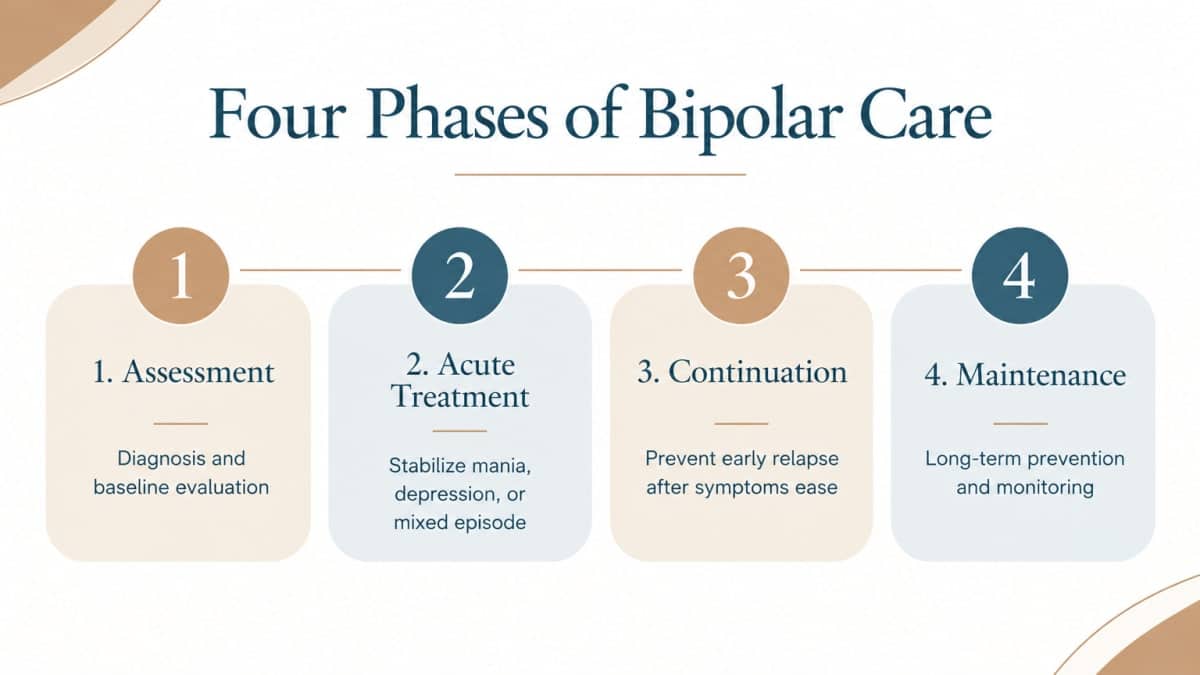
Visits are frequent here—often weekly, sometimes more. Side effects get tracked. Doses get adjusted. If a medication clearly isn’t working after an adequate trial, the plan changes. The four phases of a bipolar treatment plan—Assessment & Safety, Acute, Continuation, and Maintenance—are built around exactly these decision points, with each handoff triggering a review of what’s working and what isn’t 1, 2.
Phase 3: Continuation After You Stabilize
Feeling better is not the same as being well, and this is the phase where a lot of plans fall apart. The acute symptoms have eased. Sleep is closer to normal. You can get through a workday. And the temptation—yours, and sometimes your family’s—is to taper the medication, skip appointments, or quietly decide the diagnosis was overblown.
Appointments usually space out a little during continuation, but they don’t stop. Your prescriber monitors labs, side effects, and any early signals that mood is shifting. Your therapist shifts focus from acute coping to understanding what triggered the episode and what tools you want in place before the next one.
This is a good phase to start a mood log, build a steady sleep schedule, and have the hard conversation with your partner or parent about what warning signs they’re allowed to name. Small, boring consistency does more work here than any single appointment.
Phase 4: Long-Term Maintenance and Relapse Prevention
Maintenance is the long game, and for most people with bipolar disorder, it doesn’t end. NIMH frames bipolar as ongoing disease management, treated with medication, psychotherapy, or both over time 8. The goal shifts from fighting an active episode to keeping the next one from arriving—and if it does arrive, catching it early enough that it doesn’t flatten your life.
The medication list in maintenance may look different from your acute list, or it may be the same. CANMAT/ISBD identifies lithium, divalproex, lamotrigine, quetiapine, and aripiprazole among the important maintenance options, with the specific choice shaped by which pole you’re more vulnerable to, what worked in your acute phase, your side-effect profile, and your preferences 2. Lithium remains a cornerstone for many people.
Monitoring doesn’t stop. Lithium levels, kidney and thyroid function, metabolic markers for atypical antipsychotics, and blood pressure all get followed on a schedule your prescriber sets 1. Therapy continues too, often less frequently but with a clear focus on social rhythm, stress response, relationship repair, and the written relapse plan you keep updated.
Expect your plan to be reviewed, not frozen. Guidelines recommend review at least annually, or more often when concerns arise: Is the medication still doing its job? Are the side effects acceptable? Have your goals changed—new job, new relationship, pregnancy plans, aging body? A good maintenance plan bends with your life instead of pretending your life stays still.
Celebrate the quiet stretches. A year without an episode isn’t luck; it’s the plan working, and you doing the work.
The Core Components Inside the Plan
Medication Strategy: Categories, Not Prescriptions
Your written plan should name the medication strategy clearly, but it shouldn’t read like a prescription pad. What matters is the category, the target, and the reason your prescriber picked this one for you.
For bipolar depression, CANMAT/ISBD lists quetiapine, lithium, lamotrigine, and lurasidone among first-line options in specified contexts 2. For maintenance, that list widens to include divalproex and aripiprazole, with the choice shaped by which pole you’re more vulnerable to and what already worked for you 2. NIMH describes mood stabilizers and atypical antipsychotics as the two medication categories you’ll see most often 8.
A good plan writes down more than the drug name. It records the target symptom, the current dose, the next planned change, the labs you need, and the side effects your prescriber is watching. If you’ve already failed two or three medications, your plan should say that out loud—what you tried, how long you took it, and what happened—so no one has to reinvent that history at the next appointment.
Before anything new gets added, the plan reviews adherence and current status first 2. That isn’t a trust test. It’s basic sequencing: a medication can’t fail if it was never fully in you.
Psychotherapy, Psychoeducation, and Family Involvement
Medication is one leg of the plan. Therapy is the other, and skipping it is one of the most common ways plans quietly fail. NIMH names medication, psychotherapy, or a combination as how bipolar is treated, and most people do better with both 8.
Psychoeducation is where it starts. You and the people closest to you learn what bipolar actually is, what your personal early warning signs look like, and why the medication matters even on the good months. The VA/DoD provider summary builds psychotherapy and family involvement into its decision points, not as optional extras 1.
Named approaches that show up in bipolar plans include cognitive behavioral therapy for mood symptoms and relapse prevention, family-focused therapy that gives your partner or parent a real role, and interpersonal and social rhythm therapy for sleep and daily structure. Your therapist and prescriber should be talking to each other, not working in parallel universes.
Family involvement needs your permission and some ground rules. Who gets called if you stop sleeping? Who holds the medication list? These are better decided when you’re well.
Sleep, Routine, and Social Rhythm Work
Your plan should name a target bedtime, a target wake time, and what you’ll do when they slip. It should name the shift work, travel, newborn, or caregiving reality you’re actually living in, not a sleep schedule designed for someone else’s life.
Daily rhythm matters too: when you eat, when you move, when you see other humans, when you log off screens. None of this replaces medication. All of it protects the medication’s job. Two steady weeks of sleep is a real win—write it down somewhere you’ll see it.
The Written Crisis and Relapse Plan
This is the piece most people don’t have, and it’s the one that saves the worst nights. A crisis and relapse plan is a short written document—one or two pages—that lives somewhere you and the people around you can find it fast. The VA/DoD provider summary treats this kind of planning as part of ongoing monitoring and safety, and NIMH describes bipolar as a condition that needs this kind of ongoing management rather than a one-time intervention 1, 8.
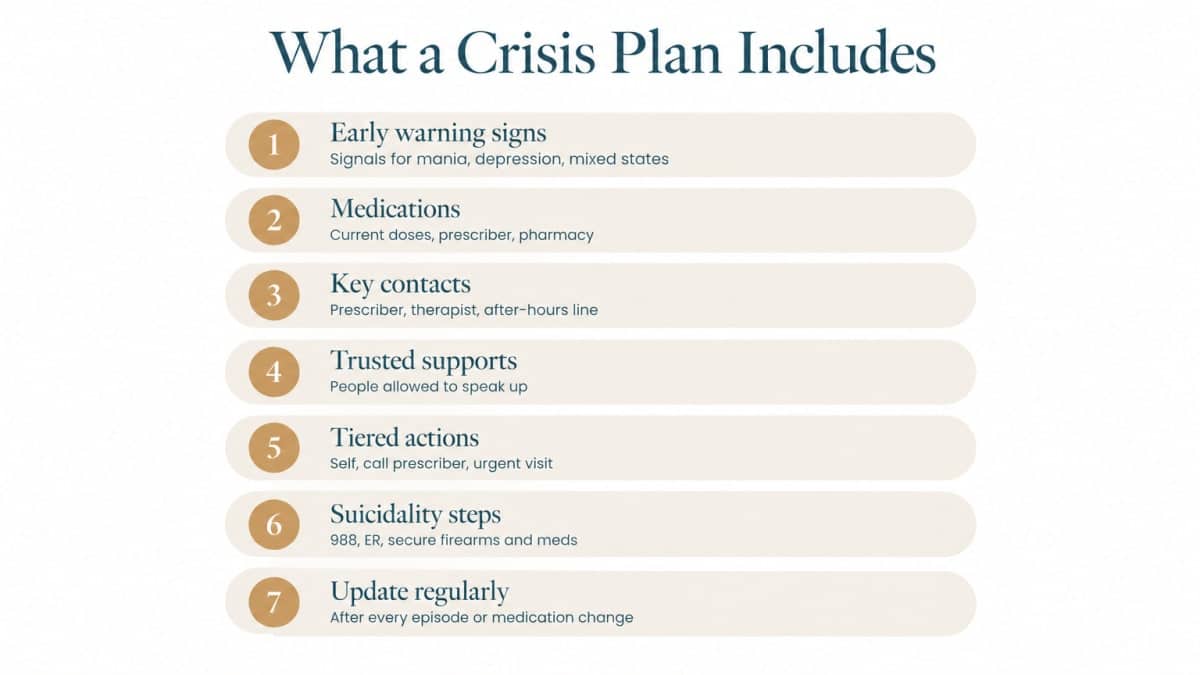
A real crisis and relapse plan names, at minimum:
- Your personal early warning signs for hypomania (sleeping less, spending, racing speech), depression (withdrawal, hopelessness, oversleeping), and mixed states.
- Your current medication list with doses, prescriber, and pharmacy.
- Direct contacts for your prescriber, therapist, and after-hours line.
- Trusted supports—one or two people who have your permission to speak up and what you want them to say.
- Agreed actions for each warning tier: what you’ll do yourself, what triggers a call to your prescriber, what triggers an urgent appointment.
- Suicidality steps: 988, a specific emergency department, and who secures firearms or stockpiled medication.
Update it after every episode and every medication change. A plan written a year ago, with a prescriber you no longer see, is not a plan—it’s a memory.
When the Picture Is More Complex
Rapid Cycling, Mixed Features, and Treatment Resistance
If you’ve been through three or four medication trials and you’re still cycling, it’s not a character flaw and it’s not that you aren’t trying hard enough. It’s a signal that your presentation is more complex than the standard protocol was built for, and that the plan itself needs to change—not just the next prescription.
Rapid cycling has a specific meaning. The clinical review defines it as four or more mood episodes in a year 3. That’s a different animal than the usual pattern of one episode every few years, and it generally calls for a careful look at everything feeding it: antidepressants that may be destabilizing you, thyroid problems, sleep loss, stimulants, and alcohol or drug use. A medication add-on is not the first move when the real driver hasn’t been named.
Mixed features—when depressive and manic symptoms show up at the same time—are also treated differently. Your plan should name mixed features explicitly if that’s what you’ve had, because it changes which medications are considered and how closely you need to be monitored.
Treatment resistance has a definition too. The review describes it as inadequate symptom improvement after roughly 10 to 12 weeks of treatment at adequate dose and adherence 3. That timeframe matters. A medication that didn’t help after three weeks wasn’t a failed trial—it was an incomplete one. Before you or your prescriber call anything resistant, the plan should confirm the dose was right, the duration was long enough, and the pills were actually being taken 2.
When those boxes are checked and you’re still symptomatic, the next step is a specialist reassessment, not another swap. That’s where a plan built around decision points pays off.
Later-Line Options and the Ketamine Evidence
If you’ve reached the end of the first-line menu for bipolar depression and nothing has held, your plan moves into later-line territory. This is where you’ll hear about combinations your prescriber hadn’t tried before, adjunctive medications, electroconvulsive therapy for severe or psychotic depression, and—more recently—ketamine and esketamine.
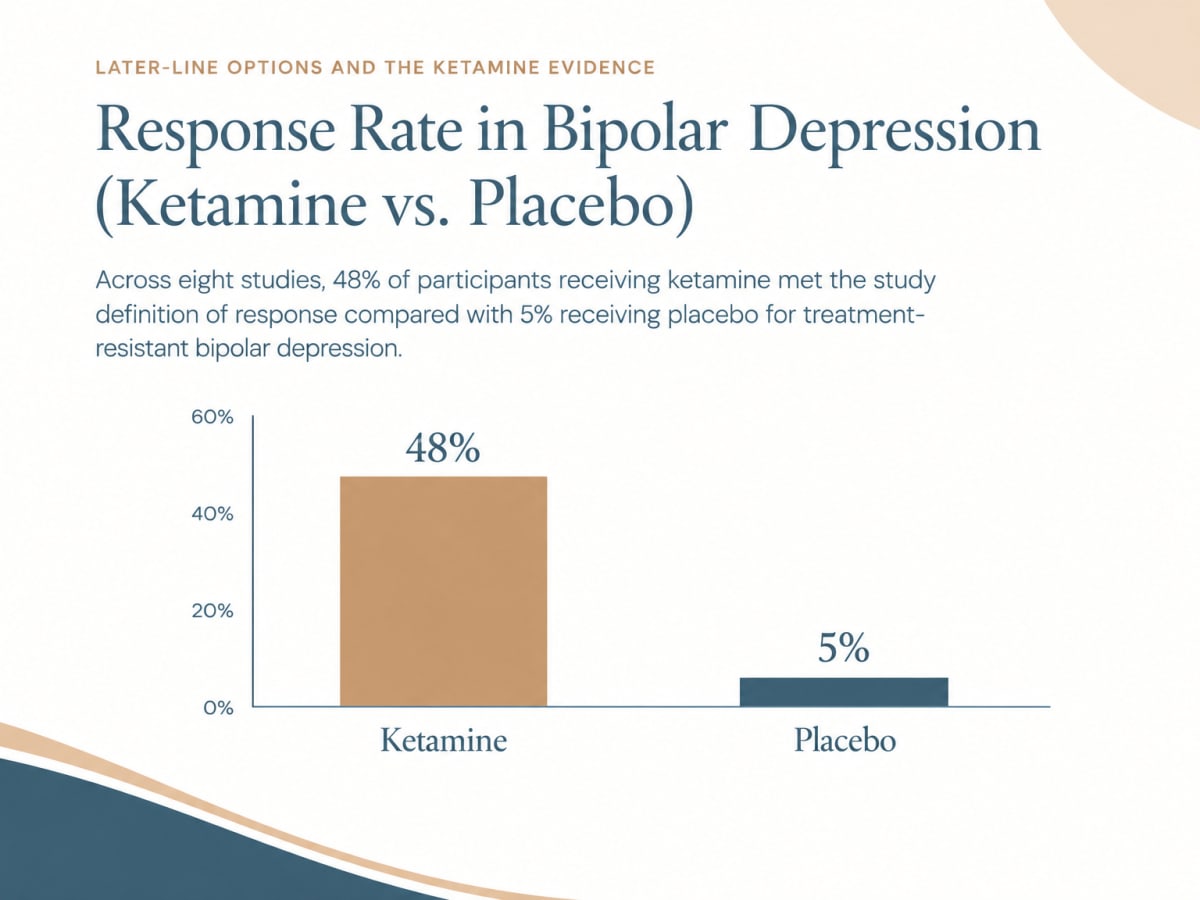
Ketamine deserves honest framing because the headlines often outrun the evidence. A 2023 systematic review looked at eight studies of ketamine for treatment-resistant bipolar depression. Across those studies, 48% of participants receiving ketamine met the study definition of response, compared with 5% of those receiving placebo 4. That’s a meaningful short-term signal.
The limits are just as important. The studies were small and designs varied. Long-term evidence on repeated or maintenance infusions is still thin, and the authors explicitly call for larger randomized trials 4. There’s also a safety signal you need to know about: six participants across the included studies developed hypomanic or manic symptoms after infusion 4. For a condition defined by mood switching, that is not a footnote.
What this means for your plan: ketamine or esketamine may be a reasonable later-line option in the right setting, with careful mood monitoring and a mood stabilizer on board. It is not a first move, and it is not a cure. If a provider sells it that way, that’s a reason to pause.
When Substance Use Is Part of the Picture
If alcohol, cannabis, stimulants, or opioids are part of your life right now, say so, and make sure your plan says so too. Hiding substance use from the person writing your prescription is one of the fastest ways to end up with a plan that doesn’t work—not because the medication is wrong, but because the medication was chosen for a problem that was only half the picture.
Co-occurring bipolar and substance use disorders are common enough that SAMHSA identifies bipolar among common co-occurring mental disorders, and recommends a “no wrong door” approach: whichever service you walk into first should screen you for both 6. The NIH review of 24 guidelines found that integrated treatment—both conditions addressed in the same setting, by a team that talks to itself—is the preferred model 5. SAMHSA’s bipolar-specific guidance says the same thing: pharmacologic and psychosocial treatment, delivered together, with the patient as a collaborator and recovery goals that include both mood and substance use 7.
In practical terms, that means your plan should name the substance, how often, how much, and what you’ve already tried to change. It should set goals in both lanes—mood stability and substance-use outcomes—and measure both. It should flag the medications that interact badly with what you’re using, and it should include relapse-prevention work that recognizes a drink or a line can trigger a mood episode just as surely as missing a dose.
Running mood treatment at one clinic and substance-use treatment at another, with neither side knowing what the other is doing, is the version that fails most often. If that’s what you have now, that itself is a reason for a plan rewrite.
Monitoring, Adjustments, and Measuring Progress
A plan without measurement is just a wish list. Monitoring is how you and your team know whether the current version is holding, drifting, or quietly failing before the next episode announces itself.
Some of what gets tracked is physical. Lithium levels, kidney and thyroid function, metabolic markers for atypical antipsychotics, weight, and blood pressure all follow a schedule your prescriber sets, because side effects you ignore can end a medication that was otherwise working 1. The rest is about mood and life: a weekly mood log, sleep hours, a short check on anxiety or irritability, and honest notes on alcohol or substance use.
Progress isn’t only the absence of episodes. It’s a steady wake time for a month. It’s calling your prescriber before, not after, a bad week. It’s one conversation with your partner that didn’t end in a fight. Write those down—they count.
Expect formal reviews at least annually, or more often when concerns arise. If the plan hasn’t been updated since your last episode, that’s your next appointment 2.
Get Clarity on Your Bipolar Treatment Plan
Discuss your symptoms and treatment history to explore what level of care may fit your needs.
Frequently Asked Questions
How long does a bipolar treatment plan last?
For most people, it doesn’t end. Bipolar is treated as ongoing disease management, with medication, psychotherapy, or both continuing well past symptom relief 8. The plan itself gets reviewed and rewritten over time—at least annually, or more often when concerns arise, and sooner after any episode or medication change—but the underlying commitment to treatment is long-term, not a 30- or 90-day course 1.
What is the difference between acute, continuation, and maintenance treatment?
Acute treatment brings an active manic, depressed, or mixed episode down to a safer level. Continuation holds that gain for the weeks and months after, when relapse risk is highest. Maintenance is the long stretch after that, aimed at preventing the next episode. CANMAT/ISBD recommends continuing an effective acute medication into these later phases, even if it wouldn’t be the top pick in a general maintenance hierarchy 2.
What should a written crisis and relapse plan include?
At minimum: your personal early warning signs for hypomania, depression, and mixed states; your current medication list with doses; direct contacts for your prescriber, therapist, and after-hours line; one or two trusted supports with permission to speak up; agreed actions for each warning tier; and clear suicidality steps including 988 and a specific emergency department 1, 8. Update it after every episode and every medication change.
When should my treatment plan be reassessed by a specialist?
When the pattern itself has changed. Four or more mood episodes in a year meets the definition of rapid cycling, and inadequate improvement after roughly 10 to 12 weeks at an adequate dose with real adherence meets the definition of treatment resistance 3. Mixed features, active substance use, or repeated hospitalizations also count. In those cases, the next step is specialist reassessment, not another quick medication swap 2.
Can bipolar disorder and substance use be treated at the same time?
Yes, and the evidence favors doing it that way. A review of 24 guidelines supported integrated treatment—both conditions addressed in the same setting by a team that communicates—over splitting care across siloed clinics 5. SAMHSA calls this a “no wrong door” approach: wherever you enter first, you get screened for both 6. Your plan should set goals in both lanes and measure both.
Is ketamine a proven treatment for bipolar depression?
It’s a promising later-line option, not a proven first move. A 2023 systematic review of eight studies in treatment-resistant bipolar depression found short-term response signals but called for larger randomized trials and more evidence on repeated infusions 4. Six participants across those studies developed hypomanic or manic symptoms after infusion 4. If it’s considered, it belongs alongside a mood stabilizer with careful monitoring.
References
- VA/DoD Clinical Practice Guideline for the Management of Bipolar Disorder: Provider Summary. https://www.healthquality.va.gov/guidelines/MH/bd/VA-DoD-CPG-BD-Provider-SummaryFinal508.pdf
- The CANMAT and ISBD Guidelines for the Treatment of Bipolar Disorder: Summary and a 2023 Update of Evidence. https://pmc.ncbi.nlm.nih.gov/articles/PMC11058959/
- Bipolar disorders: an update on critical aspects. https://pmc.ncbi.nlm.nih.gov/articles/PMC11732062/
- Ketamine for bipolar depression: an updated systematic review. https://pmc.ncbi.nlm.nih.gov/articles/PMC10524067/
- Co-Occurring Bipolar and Substance Use Disorders. https://pmc.ncbi.nlm.nih.gov/articles/PMC11995909/
- Managing Life with Co-Occurring Disorders. https://www.samhsa.gov/mental-health/serious-mental-illness/co-occurring-disorders
- An Introduction to Bipolar Disorder and Co-Occurring Substance Use Disorders. https://library.samhsa.gov/sites/default/files/sma16-4960.pdf
- Bipolar Disorder. https://www.nimh.nih.gov/health/publications/bipolar-disorder