

Key Takeaways
- Arizona carries 236 mental-health HPSA designations and would need an estimated 227 additional psychiatrists to close the gap 1, which is why generalist bottlenecks and long waits dominate the search for specialized bipolar care.
- Rapid cycling, mixed features, two or more failed medication trials, lingering cognitive issues, repeat hospitalizations, or recurring substance use are the signals that a presentation has outgrown monthly outpatient check-ins.
- Integrated care means one psychiatrist and addiction clinician building a shared treatment plan from day one, since no single intervention consistently works across both mood and substance-use outcomes 4.
- Before admission, ask Arizona programs how they reconfirm diagnosis, document prior trials, decide length of stay against MHPAEA protections 9, and handle a mixed episode on arrival.
When Standard Bipolar Care Stops Working
You’ve done the work. You found a prescriber. You took the lithium, or the lamotrigine, or the quetiapine. You showed up to appointments and tracked your sleep. And somehow, you’re still cycling — a stretch of weeks that feels almost normal, then a crash, then a stretch of racing thoughts you can’t explain to anyone who hasn’t lived inside them.
If that’s where you are, the problem probably isn’t you. It’s the level of care.
Bipolar disorder affects about 4.4% of U.S. adults at some point in their lives 6, and most people start treatment in outpatient psychiatry — a 20-minute medication check every month or two, maybe a therapist on the side. For many, that’s enough to find stability. For a meaningful subset, it isn’t. When episodes keep returning, when a medication that worked last year suddenly doesn’t, when a drink or a stimulant has crept into the picture to blunt the edges, you’ve moved into territory that generalist care wasn’t built to handle.
Specialized bipolar disorder treatment in AZ isn’t about finding a fancier clinic. It’s about matching the complexity of your presentation — rapid cycling, mixed features, treatment resistance, co-occurring substance use — to a program equipped to assess all of it at once. The rest of this guide walks you through how to recognize that threshold, what guideline-concordant specialty care actually involves, and how Arizona’s workforce and insurance realities shape the path to it. You deserve a clear framework, not another referral list.
Recognizing a Presentation That Has Outgrown Generalist Care
Rapid Cycling, Mixed Features, and What the Numbers Actually Mean
Rapid cycling has a specific definition: four or more mood episodes — depression, mania, hypomania, or mixed — within a single year 2. It’s not just moodiness or a bad month. It’s a pattern your psychiatrist should be tracking with dates, not impressions. Mixed features are different and often more frightening: depressive symptoms braided together with manic ones in the same episode, so you feel wired and hopeless at once. If you’ve ever described yourself as “exhausted but can’t stop,” you already know what mixed looks like from the inside.
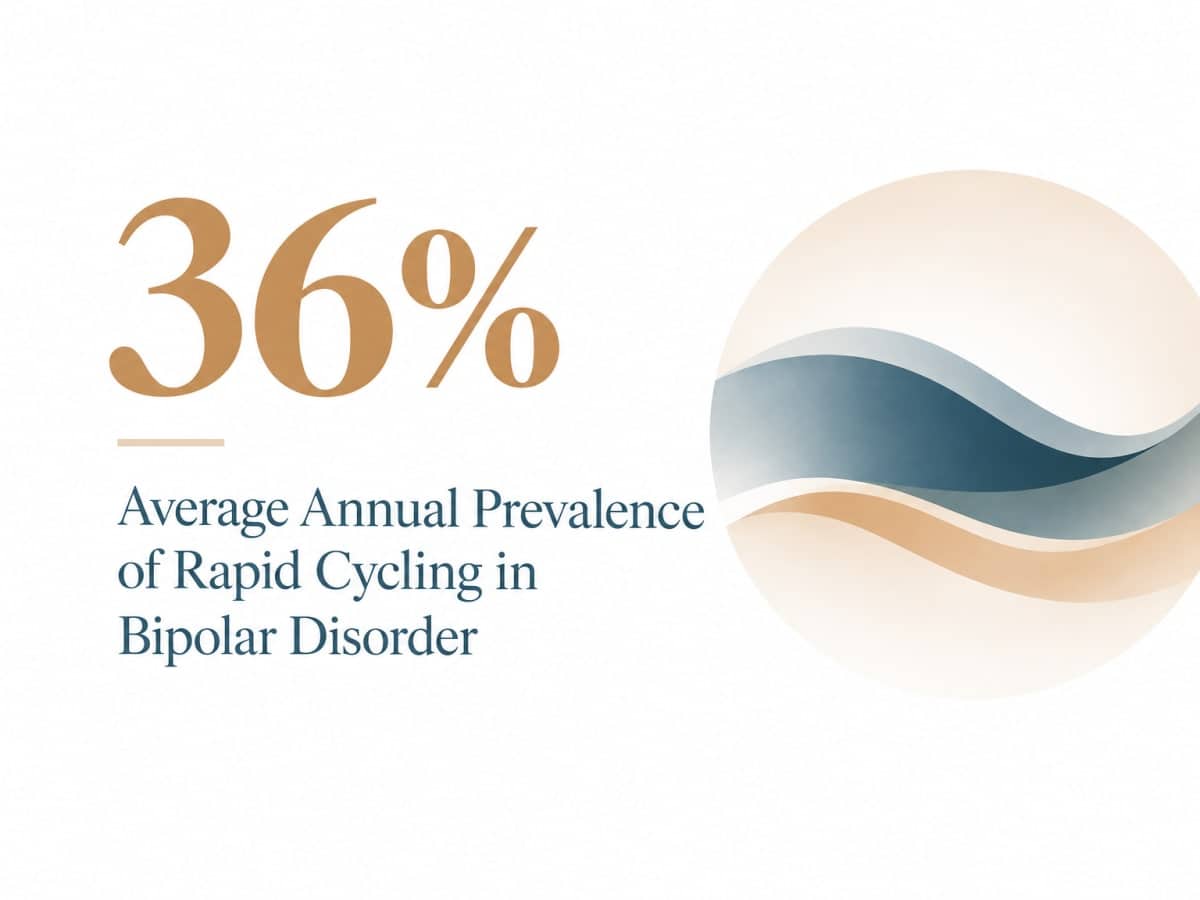
Here’s where the numbers get confusing. A 2024 review reported that, within the specific cohort evidence it examined, rapid cycling averaged about 36% for any year versus 22% in the preceding year — a cohort-level average, not a general-population prevalence 2. A systematic meta-review using stricter inclusion criteria put one-year prevalence at 22.3% and lifetime prevalence at 35.5% 3. Same condition, different lenses — cohort averages versus pooled synthesis — and that’s why you’ll see wildly different figures when you search.
What matters for you isn’t the exact percentage. It’s that rapid cycling is common enough to be a routine part of specialty assessment, and it’s strongly linked to suicide attempts and unsatisfactory response to standard mood stabilizers 3. If your prescriber has never asked you to log episode counts over the past twelve months, that’s a gap. Rapid cycling also responds poorly to antidepressants in some patients and can be worsened by them 2— which is why a specialist review of your medication list is worth more than another dose adjustment. You’re not imagining a pattern. You’re describing one that has a name and a different treatment pathway.
Clinical Signals of Treatment Resistance
Treatment resistance in bipolar disorder isn’t yet defined with the tidy consensus you’ll find for depression. There’s no single trial count that flips a switch. But clinicians who work with complex cases watch for a cluster of signals, and if several of these describe your past two or three years, you’re likely past the limits of generalist outpatient care.
The 2024 systematic review on bipolar relapse identifies a consistent risk profile:
- more severe previous episodes
- earlier age of onset
- rapid cycling
- lower global functioning between episodes
- cognitive impairment that lingers after mood stabilizes 5
Those aren’t personality traits. They’re clinical variables that predict who keeps relapsing on standard regimens.
Translate them into questions you can actually answer:
- Have you had two or more adequate medication trials — meaning the right dose, for long enough, with documented blood levels where relevant — without durable stability?
- Are you still struggling with concentration, memory, or decision-making weeks after an episode ends?
- Has your functioning at work, in relationships, or in daily routines not returned to where it was before the last major episode?
- Have you been hospitalized more than once, or had an emergency-room visit for mood symptoms in the past year?
- Is there a substance — alcohol, cannabis, a stimulant, an opioid — that keeps reappearing when episodes get bad?
Three or more yes answers is a signal, not a sentence. It means your presentation involves more moving parts than a monthly medication check can track. Specialty programs are built for exactly this: documented prior trials, cognitive assessment, substance screening, and a medication strategy that doesn’t start from scratch every visit. You deserve a team that reads your history as evidence, not as a complaint.
What Guideline-Concordant Specialty Treatment Actually Looks Like
The Five-Part Clinical Review Before a Level-of-Care Decision
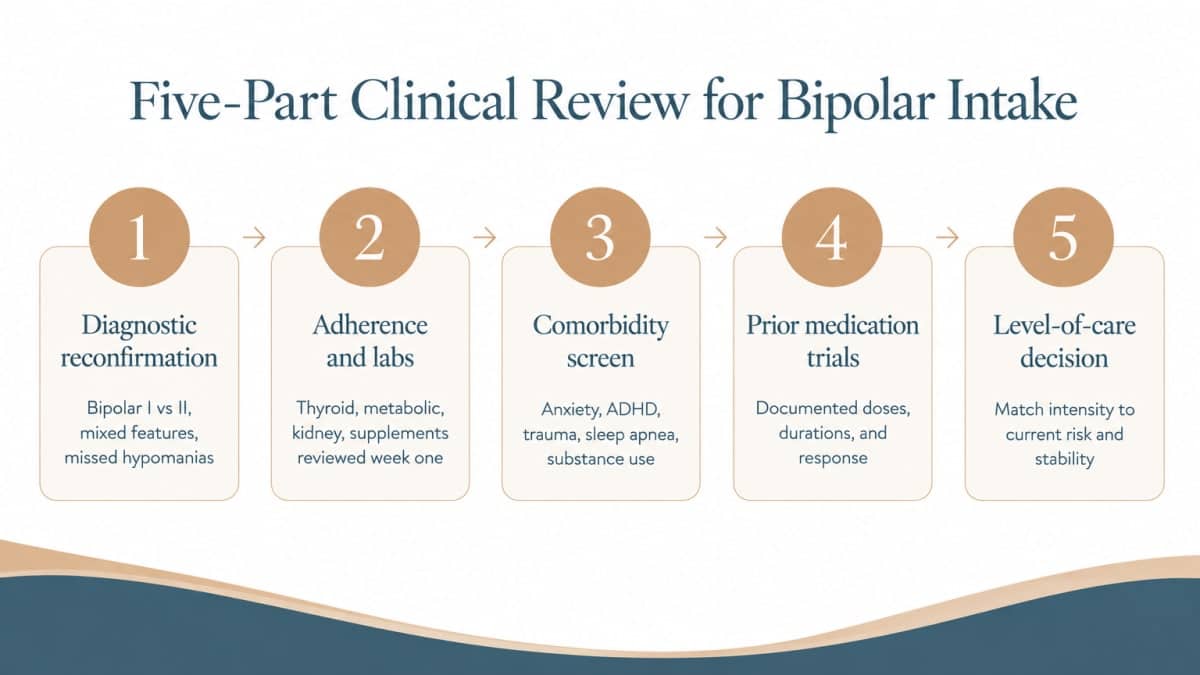
A specialty intake should feel different from a 20-minute med check. It should feel like someone finally sitting down with your whole file. The 2023 VA/DoD clinical practice guideline organizes bipolar care around diagnosis and triage, specialty consultation, mania and hypomania, acute bipolar depression, and maintenance 7. Translated into what actually happens in the room, that structure becomes a five-part review you can use to evaluate any program before you commit.
Diagnostic reconfirmation. A specialist should re-examine the diagnosis itself — bipolar I versus II, mixed features, rapid cycling, whether past “depression” episodes were actually unrecognized hypomanias. Reclassification from depression to bipolar changes the whole medication strategy, which is why a careful second look at prior episodes matters.
Adherence and medical workup. Before adding another drug, a good team asks whether past medications were actually taken as prescribed, at the right dose, long enough. Thyroid studies, metabolic labs, kidney function, and a review of anything else you’re taking — including supplements — belong in week one, not month three.
Comorbidity screen, including substance use. Anxiety, ADHD, trauma, sleep apnea, and alcohol or stimulant use all shape mood stability. A specialty program screens for them on intake rather than discovering them during a crisis.
Documented prior trials. You should leave the first week with a written list of every mood stabilizer, antipsychotic, and antidepressant you’ve tried, the doses, the duration, and what happened. That document is the single most useful artifact of specialty care — it stops the restart-from-scratch cycle.
Level-of-care decision. Only then does the team recommend outpatient intensification, a partial hospitalization program, residential care, or inpatient stabilization. That order matters. If a program sells you a level of care before the first four steps are complete, that’s a red flag.
Medication Strategy Beyond Lithium Monotherapy
Lithium is still a cornerstone, and for good reason. The VA/DoD guideline suggests lithium or quetiapine monotherapy for acute mania 7. If lithium has worked for you and you tolerate it, nobody serious is going to take it away. But if you’ve landed on this page, lithium monotherapy probably hasn’t been enough — and that’s where guideline-concordant specialty care gets interesting.
For acute bipolar depression, the 2023 CANMAT and ISBD update lists quetiapine, lithium, lamotrigine, and lurasidone as first-line monotherapy options, with lurasidone and lamotrigine also recommended as first-line adjunctive agents 8. That’s four distinct mechanisms with different side-effect profiles. Lamotrigine is gentler on cognition but requires a slow titration to avoid rash. Lurasidone needs to be taken with food. Quetiapine can be sedating in ways that help sleep but hurt daytime function. A specialist picks among them based on your polarity history, prior tolerability, cognitive demands at work, and whether you’re planning a pregnancy — not based on which sample the rep dropped off last week.
Rapid cycling adds a specific caution. The 2024 review notes that antidepressants can worsen rapid cycling in some patients, and durable long-term prevention remains understudied 2. If you’re a rapid cycler who’s been on an SSRI for years because of a long-ago depression diagnosis, that medication deserves fresh scrutiny.
Specialty care also opens doors generalists rarely use: structured combination strategies, antipsychotic rotations when metabolic burden climbs, and advanced protocols for treatment-resistant presentations. You should hear your prescriber reason out loud about why they’re choosing a drug, what they expect in four weeks, and what the backup plan is. If the plan is “let’s try this and see,” ask for the reasoning behind it. You’ve earned that answer.
When Bipolar Disorder and Substance Use Travel Together
If a drink, a line, a pill, or a joint has become part of how you manage your moods, you’re not weak and you’re not uncommon. Substance use rides along with bipolar disorder more often than most people realize, and it’s usually trying to do something — flatten a mixed episode, slow a racing mind, lift a flat afternoon, or help you sleep when lithium alone won’t. The problem isn’t the motive. It’s that every one of those substances changes the course of the illness underneath.
True integration looks specific. One team runs both assessments on intake. Mood stabilization and substance-use treatment start the same week, not after you’ve been “sober enough” to earn the psychiatric work. Your psychiatrist knows what you used last night and factors it into tonight’s medication. Your therapist knows what mood state you’re in before they open a trauma conversation. Group work addresses both tracks instead of pretending one doesn’t exist.
Ask directly: Do the psychiatrist and the addiction clinician meet about my case, or just share a chart? If the answer is vague, keep looking. Concurrent treatment from day one isn’t a luxury for complex presentations — it’s the floor.
The Arizona Access Reality
Why Specialized Psychiatry Is Harder to Find Here
If it has taken you months to get a psychiatric appointment, or if the only prescriber available in your town is a primary-care doctor doing their best with a condition outside their specialty, that’s not a reflection of your effort. It’s the shape of Arizona’s workforce.
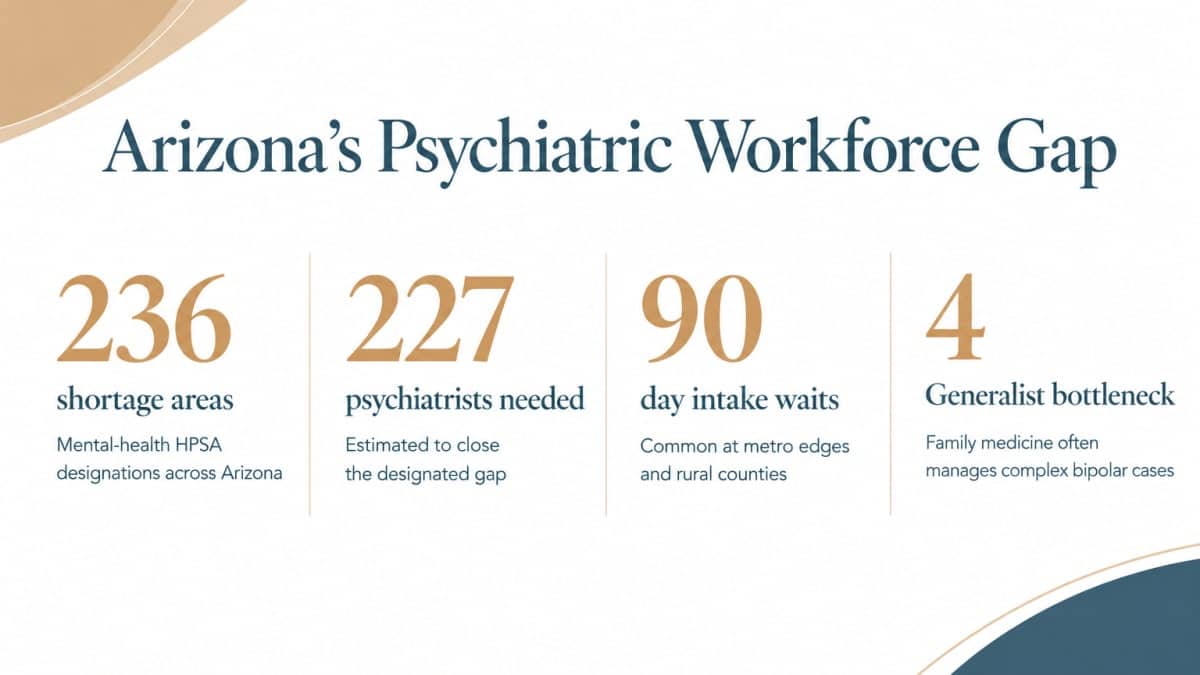
HRSA’s 2025 state overview counts 236 mental-health Health Professional Shortage Area designations across Arizona and estimates the state would need an additional 227 psychiatrists to eliminate those shortages 1. Those numbers describe designated gaps, not every provider in every ZIP code — but they explain a lot about why generalist bottlenecks dominate the real experience of seeking bipolar care here. Rural counties feel it hardest. So do the edges of metro areas, where a 90-day wait for a new psychiatric intake is normal and complex-case consultation can take longer still.
What this means in practice: a lot of Arizonans with bipolar disorder end up managed by whoever has an open slot, often a family-medicine clinician handling medication refills between physicals. That arrangement can work for a stable, textbook presentation. It struggles with rapid cycling, mixed features, and co-occurring substance use — the exact cluster that brought you to this article. Specialty programs exist, but they’re concentrated in a few locations and fill quickly, which is why evaluating fit before you commit matters more here than in states with denser psychiatric workforces.
If you’re calling a program and the first available appointment is weeks out, that’s the market, not a signal of their quality. Ask what to monitor in the meantime and whether a crisis line is attached to the practice. You’re navigating a shortage, not a failure of will.
Insurance, Parity, and Length of Stay as a Clinical Variable
Here’s the part nobody wants to talk about until the clock is ticking: how long you stay in treatment should be a clinical question, not a billing one. In practice, those two things collide, and knowing where the line is gives you leverage.
The Mental Health Parity and Addiction Equity Act is the federal law in your corner. It generally prohibits insurance plans from applying financial requirements or treatment limitations to mental-health and substance-use benefits that are more restrictive than those applied to substantially all medical or surgical benefits in the same classification 9. That covers copays, visit limits, prior authorization patterns, network adequacy, and how out-of-network reimbursement is handled. A 2024 final rule tightened how plans must demonstrate parity in practice, with applicability beginning with plan years starting on or after January 1, 2025, or policy years beginning January 1, 2026, depending on market 9.
What that means for you: if a plan approves five days of inpatient care for a mixed episode because “that’s what’s covered,” but routinely approves longer medical-surgical stays of comparable severity, that pattern can be challenged. If prior authorization is required for a residential psychiatric admission but not for comparable medical admissions, that’s a parity question. Programs that specialize in complex bipolar care usually have utilization-review teams who document medical necessity in parity-aware language — ask whether yours does.
Length of stay deserves the same clinical scrutiny you’d give a medication choice. Rapid cycling, prior relapses, cognitive impairment, and co-occurring substance use are the exact variables that predict a longer stabilization curve 5. A 14-day admission after a two-year pattern of recurrent episodes is often not enough time to confirm a new medication tolerates, let alone works. The right question isn’t “how long will insurance cover,” it’s “how long does my clinical picture actually need, and what documentation supports that?” You can advocate from there.
Safety Planning During Severe Episodes
A severe depressive or mixed episode is not the moment to improvise. It’s the moment a written plan — made during a calmer week — tells you and the people around you exactly what to do. If you have bipolar disorder, a safety plan isn’t a sign that you expect the worst. It’s a sign you’ve been through enough episodes to respect how fast they move.
Arizona recorded 1,516 suicide deaths in 2024, an age-adjusted rate of 18.9 per 100,000 10. That number isn’t about you specifically, and it doesn’t predict any individual outcome. It’s context for why a plan matters, especially when rapid cycling is associated with higher suicide-attempt risk 3.
A workable plan has a few concrete parts:
- Write down the early warning signs you notice first — a lost night of sleep, spending that doesn’t match your budget, a return of hopelessness.
- List two or three people you can call before things escalate, with their numbers already saved.
- Note which medications you can take as directed if symptoms worsen, and which your prescriber has flagged for a same-week check-in.
- Keep 988 in your phone, and the number of a local crisis line attached to your treatment program.
- If firearms or stockpiled medications are in the home, decide now who holds them during an episode.
- Share the plan with one person who will actually use it.
That’s progress you can build on.
How to Evaluate a Program Before Admission
By the time you’re calling programs, you’re tired. The temptation is to pick whichever one answers the phone warmly and has a bed. Resist that for one afternoon. A short, pointed intake call will tell you more about clinical fit than any website ever will.
Start with the team. Ask whether a board-certified psychiatrist is on staff, how often you’ll meet with them in the first week, and whether that same psychiatrist coordinates directly with your therapist and, if relevant, your addiction clinician. If dual diagnosis is part of your picture, the 2024 review on co-occurring bipolar and substance-use disorders found no single intervention consistently superior across both outcomes, which is why integrated, personalized planning from day one matters 4. One shared chart isn’t integration. One shared treatment plan, built together, is.
Ask about the assessment itself. Will they reconfirm the diagnosis, order a medical workup, screen comorbidities, and document every prior medication trial before recommending a level of care? That five-part sequence tracks the VA/DoD guideline structure 7, and a program that compresses it into a 30-minute intake is skipping work you need done.
Ask how they handle length of stay. The honest answer sounds like: “We assess at defined intervals and advocate with your insurer based on documented clinical need.” If the answer is a fixed number of days tied to a plan code, you’ve learned something.
Finally, ask what happens on day one if you arrive in a mixed episode. The specifics of that answer — who sees you, how fast, what gets stabilized first — tell you whether this program is built for complexity or just comfortable with it in marketing.
Explore Specialized Bipolar Care in Arizona
Discuss your symptoms and treatment history to learn whether specialized care may fit your needs.
Frequently Asked Questions
How do I know if my bipolar disorder needs specialized treatment instead of standard outpatient care?
If you’ve had two or more adequate medication trials without durable stability, lingering cognitive problems between episodes, functioning that hasn’t returned to baseline, repeat hospitalizations, or substance use that keeps resurfacing during mood shifts, your presentation likely needs more than monthly check-ins. These are the exact relapse-risk variables flagged in recent evidence 5, and specialty programs are built to assess them together.
What does rapid cycling actually mean, and how common is it?
Rapid cycling means four or more mood episodes — depression, mania, hypomania, or mixed — within a single year 2. Prevalence estimates vary by method: a systematic meta-review put one-year prevalence at 22.3% and lifetime at 35.5% 3. It’s common enough to be a routine part of specialty assessment and is linked to higher suicide-attempt risk and poorer response to standard mood stabilizers.
Can a program treat bipolar disorder and a substance use disorder at the same time?
Yes, and for complex presentations that’s the standard to look for. A 2024 review found no single intervention was consistently superior across both mood and substance-use outcomes, which is why integrated, personalized plans starting day one matter more than sequential care 4. Ask whether your psychiatrist and addiction clinician build one treatment plan together — not just share a chart. Separate buildings usually mean separate thinking.
Why is it so hard to find a bipolar specialist in Arizona?
Arizona carries 236 mental-health HPSA designations and would need an estimated 227 additional psychiatrists to eliminate them, per HRSA’s 2025 state assessment 1. That shortage shows up as long waits, generalist bottlenecks, and primary-care clinicians managing complex cases outside their specialty. Specialty programs exist but fill quickly, so evaluating clinical fit before admission matters more here than in states with denser psychiatric workforces.
How long should specialized bipolar treatment last, and can insurance limit it?
Length of stay should track your clinical picture — rapid cycling, prior relapses, cognitive impairment, and co-occurring substance use predict a longer stabilization curve 5. MHPAEA generally prohibits plans from applying more restrictive limits to mental-health benefits than to comparable medical ones, with a 2024 final rule tightening enforcement for plan years starting on or after January 1, 2025, or policy years beginning January 1, 2026, depending on market 9. Document medical necessity and advocate.
What questions should I ask a program before admission?
Ask whether a board-certified psychiatrist is on staff and how often you’ll meet in week one. Ask whether they reconfirm diagnosis, order a medical workup, screen comorbidities, and document every prior medication trial before recommending a level of care — the structure embedded in the VA/DoD guideline 7. Ask how length of stay is decided, and what happens on day one if you arrive in a mixed episode.
References
- III.B. Overview of the State – Arizona – 2025. https://mchb.tvisdata.hrsa.gov/Narratives/Overview/1b5e6d75-2e45-473f-80a0-97ac744f21a6
- Current Status and Treatment of Rapid Cycling Bipolar Disorder. https://pubmed.ncbi.nlm.nih.gov/38230858/
- Prevalence and outcomes of rapid cycling bipolar disorder: Mixed method systematic meta-review. https://pubmed.ncbi.nlm.nih.gov/37429185/
- Psychosocial and Psychopharmacological Interventions for Comorbid Bipolar Disorder and Substance Use Disorders: A Review. https://pubmed.ncbi.nlm.nih.gov/40843035/
- Clinical, sociodemographic and environmental predicting factors for relapse in bipolar disorder: A systematic review. https://pubmed.ncbi.nlm.nih.gov/38797389/
- Bipolar Disorder. https://www.nimh.nih.gov/health/statistics/bipolar-disorder
- VA DoD CPG for Management of Bipolar Disorder. https://healthquality.va.gov/guidelines/MH/bd/VA-DoD-CPG-BD-Full-CPGFinal508.pdf
- The CANMAT and ISBD Guidelines for the Treatment of Bipolar Disorder: Summary and a 2023 Update of Evidence. https://pmc.ncbi.nlm.nih.gov/articles/PMC11058959/
- The Mental Health Parity and Addiction Equity Act (MHPAEA). https://www.cms.gov/marketplace/private-health-insurance/mental-health-parity-addiction-equity
- Changes in Suicide Rates in the United States From 2023 to 2024. https://www.cdc.gov/nchs/products/databriefs/db572.htm