Key Takeaways
- A Prescott PHP delivers at least 20 structured hours per week as a physician-directed alternative to inpatient psychiatric care, with patients returning home each evening 2, 4.
- The 20-hour federal floor is a minimum, not a design — programs vary widely in psychiatrist contact frequency, staff density, and how daily activities tie to measurable goals 1, 3.
- Standard community PHPs often decline treatment-resistant cases like clozapine titration, rapid-cycling bipolar, or severe co-occurring substance use, which specialized psychiatric PHPs are built to hold 6.
- Before choosing a program, compare psychiatrist contact frequency, staff-to-client ratio, medication complexity accepted, dual-diagnosis integration under one plan, and whether length of stay is set by clinical need or benefit windows.
9 a.m. in a Prescott PHP: What the Day Actually Looks Like
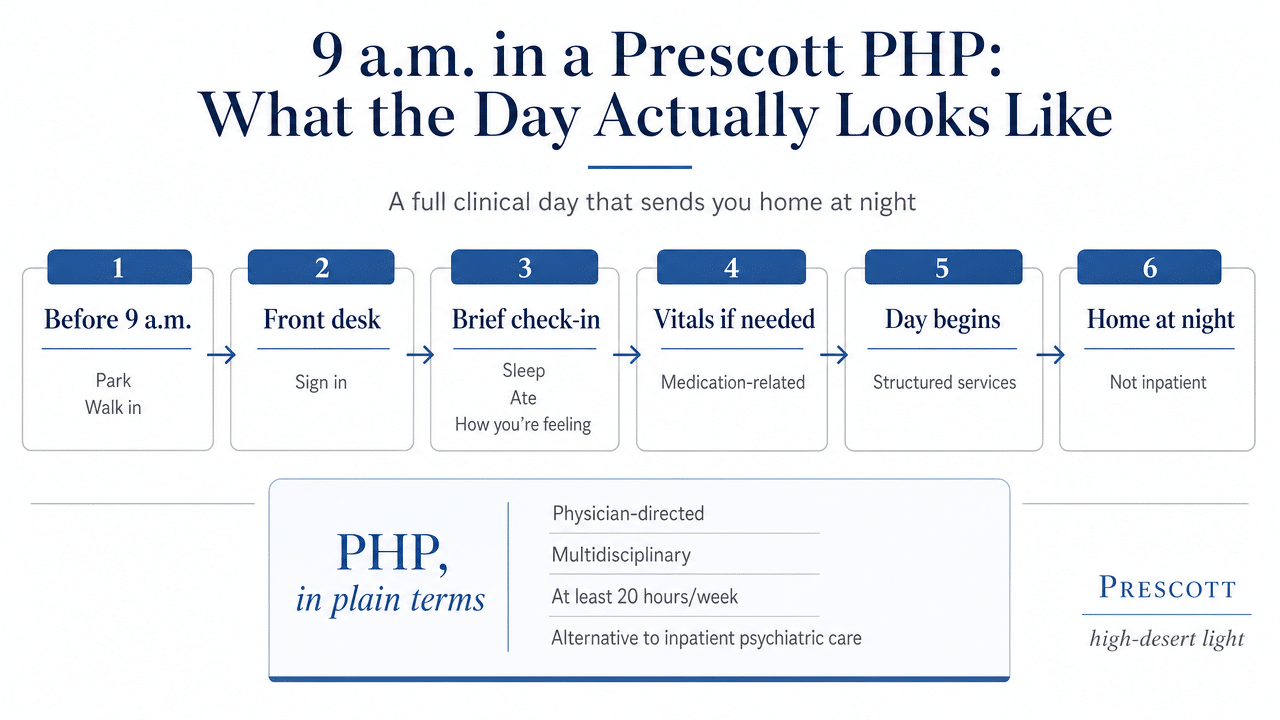
It’s a few minutes before 9 a.m. in Prescott. You’ve parked, walked in past the high-desert light coming through the front windows, and signed in at the front desk. A staff member checks in with you briefly — how did you sleep, did you eat, how are you feeling on a scale you’ve already learned to use. Vitals get taken if you’re on a medication that requires it. Then the day begins.
That’s what a partial hospitalization program looks like from the inside. Not a hospital bed. Not a once-a-week therapist appointment. A full clinical day that sends you home at night.
Under federal and Arizona definitions, a PHP is a physician-directed, multidisciplinary program that delivers at least 20 hours of structured services per week as an alternative to inpatient psychiatric care 2, 4. That floor matters, because it tells you the program has to be real treatment — not a few groups scattered across the week.
A representative weekday in a psychiatric PHP usually moves through five or six anchors:
- a morning check-in with vitals and a brief mood or safety screen
- a psychiatrist contact block for medication review
- a DBT skills group focused on distress tolerance or emotion regulation
- lunch and unstructured peer time
- a CBT or process group in the afternoon
- individual therapy or a family session on scheduled days
- a closing meeting where you walk out with a written plan for the evening 2, 4
If you’ve been in treatment before, you’ll notice what’s different here. The psychiatrist isn’t a 15-minute monthly visit — they’re part of the week. The groups aren’t optional add-ons — they’re where the treatment plan actually gets practiced. And every piece of the day is supposed to tie back to a specific goal written into your record 3.
That’s the shape of the day. The next sections unpack why it’s built this way, who it’s built for, and how a specialized Prescott program like ViewPoint Dual Recovery holds cases that a standard PHP often won’t.
The Federal Floor vs. a Specialized Psychiatric PHP
Here’s the thing worth knowing before you compare programs: the number “20 hours a week” is a minimum, not a recommendation. CMS’s 2025 payment rule describes PHP as an intensive, structured outpatient alternative to psychiatric hospitalization, paid under the hospital outpatient system at that service threshold 1. Arizona’s AHCCCS uses the same floor and requires that those hours be delivered in person 4. That’s the regulatory baseline every PHP in the state has to clear.
What the floor doesn’t tell you is how those hours are built. A program can hit 20 hours by stacking general process groups with a brief weekly psychiatrist check-in and call it a day. Another program can hit the same 20 hours with daily psychiatrist contact, structured DBT and CBT blocks, individual therapy on a predictable cadence, and family or peer time woven in. Same regulatory label. Very different clinical day.
Picture it as a bar chart. The federal floor sits at roughly 20 hours of structured services per week 1, 4. A specialized psychiatric PHP week typically extends past that floor, with hours allocated across psychiatry contact for medication review, DBT skills group, CBT or process group, individual therapy, and family or peer sessions. Exact hour counts vary by program and by week, so treat specific numbers as a question for admissions rather than a published spec.
Two details are worth watching when you compare on paper. First, who directs the plan. CMS policy requires a physician-prescribed, individualized plan with measurable goals tied to preventing relapse or rehospitalization — not a generic group schedule applied to everyone in the room 3. Second, staff density. A 2:1 staff-to-client ratio, which ViewPoint Dual Recovery operates with in Prescott, changes what’s possible during a crisis moment in group or a medication side effect that shows up mid-morning.
Who PHP Is Built For — and Who Standard Programs Often Decline
PHP sits in a specific clinical window. You’re too symptomatic for a weekly therapist and monthly psychiatrist to hold the picture together, but you don’t need a locked unit tonight. That’s the honest definition. CMS policy frames the level of care around active treatment with measurable goals aimed at preventing relapse and rehospitalization — in other words, people whose symptoms are moving, not stable 3.
In practice, the people who fit a psychiatric PHP tend to arrive by one of three routes:
- Some are stepping down from an inpatient stay and need daily structure before returning to standard outpatient care.
- Some are stepping up because their outpatient team has watched symptoms creep past what weekly sessions can hold.
- And some are already in treatment — sometimes for years — and the current combination of medications, therapy, and support simply isn’t producing change.
Here’s where the local picture gets uncomfortable. A standard community PHP is often built for the middle of the bell curve: a first major depressive episode, a stabilizing anxiety disorder, an uncomplicated step-down. When intake sees active psychosis still being titrated on clozapine, a rapid-cycling bipolar presentation mid-medication-adjustment, or severe co-occurring substance use layered on trauma, the response can be a polite decline and a referral list. SAMHSA’s guidance is clear that these co-occurring presentations need integrated psychiatric and substance-use care in one plan, not parallel referrals that leave the patient coordinating their own treatment 6.
If that’s happened to you, your family member, or your patient, the problem usually isn’t the person. It’s that the program’s staffing, psychiatric coverage, and medication capacity weren’t built for that acuity. A specialized psychiatric PHP like ViewPoint Dual Recovery in Prescott is structured specifically to hold these cases — the ones where the chart is thick and the previous program said no.
Two groups don’t belong in PHP, and it’s worth naming them:
- Someone in active medical withdrawal from alcohol or benzodiazepines needs medically supervised detox first.
- Someone at imminent risk of harm to self or others needs inpatient care tonight, not a day program that sends them home at 3 p.m.
PHP is the right level when the clinical picture needs daily eyes and a prescriber in the loop, but the person can sleep safely at home or in a supportive setting.
Everything in between is where this level of care earns its name.
Inside the Clinical Model: DBT, CBT, Individual Therapy, and Medication Management
A PHP day isn’t a single modality applied for six hours. It’s a layered set of interventions — skills groups, cognitive work, individual sessions, and prescriber contact — each doing something the others can’t. Here’s what each piece is actually for, and what the evidence says about where it helps and where it doesn’t.
DBT Skills: What the Evidence Supports (and What It Doesn’t)
Dialectical behavior therapy skills groups are a fixture in psychiatric PHPs for good reason. The curriculum — distress tolerance, emotion regulation, interpersonal effectiveness, mindfulness — gives you concrete things to do in the moments when old patterns used to take over. If you’ve ever been handed a worksheet that felt beside the point, DBT skills tend to feel different because they’re designed to be rehearsed under pressure.
The strongest evidence sits in a specific place. A 2024 systematic review of 18 randomized controlled trials covering 1,755 participants found that most trials supported DBT’s effectiveness for borderline personality disorder, with improvements reported in suicidality, mood instability, impulsivity, and hospitalization rates 9. A separate meta-analysis of five randomized trials found a pooled Hedges’ g of approximately -0.622 favoring DBT for suicidal and parasuicidal behavior — a moderate effect — though the same review found DBT was not significantly different from treatment as usual for depression across three trials 11.
Read that carefully. The effect is real, and it’s largest for a specific target symptom in a specific population. The evidence does not say DBT cures depression on its own, and it does not automatically generalize to schizophrenia or bipolar disorder. In a PHP that treats complex presentations, DBT skills are one lane of the work — valuable, bounded, and most useful when paired with the other pieces of the day.
CBT in a Psychiatric PHP: One Component, Not a Cure
Cognitive behavioral therapy shows up in PHP days as structured group work and inside individual sessions. The focus is practical: catching the thought that fires when a trigger lands, testing it against what you actually know, and building a different response you can repeat.
For psychotic symptoms, the honest read on the evidence is mixed. A meta-review of 20 meta-analyses of CBT for psychosis found small-to-medium effects compared with treatment as usual, but no clear advantage over other psychological or psychosocial therapies for relapse, social functioning, quality of life, or several symptom outcomes — and much of the underlying evidence was rated low or very low quality 10. CBT helps. It is not, by itself, the thing that quiets a voice or lifts a long depressive episode.
In a psychiatric PHP, that reading shapes how CBT is used. You’ll see it running alongside medication management, DBT skills, and individual therapy — not substituting for any of them. If a previous program told you CBT would be enough and it wasn’t, that experience is consistent with what the evidence actually shows. The next step isn’t more of the same modality harder. It’s a plan that layers CBT inside a model built for complexity.
Psychiatrist-Led Medication Management for Complex Cases
Here’s where a specialized PHP separates most clearly from a standard outpatient model. CMS policy requires PHP care to be physician-directed, with an individualized plan that specifies the type, amount, frequency, and duration of services and ties daily activities to measurable goals aimed at preventing relapse and rehospitalization 3. In plain terms: the psychiatrist isn’t a signature on a chart. They’re the one setting the clinical direction of your week.
What this looks like in a treatment-resistant case is specific:
- If you’re on clozapine, there’s bloodwork, metabolic monitoring, and side-effect tracking that has to happen on a schedule — and someone has to actually adjust the plan based on what the labs and your reports say.
- If you’re in a rapid-cycling bipolar presentation, mood charting and medication timing may need to shift inside a single week.
- If a previous SSRI, mood stabilizer, or antipsychotic failed, the next trial has to be chosen with that history in hand, not restarted from scratch.
ViewPoint Dual Recovery’s Prescott PHP is built around board-certified psychiatry with capacity for advanced medication strategies, including clozapine protocols. If your previous program’s prescriber coverage was a brief weekly visit, the difference you’ll notice first is how often the person writing the orders is actually in the room.
Integrated Dual-Diagnosis Care in One Treatment Plan
If you’re carrying both a psychiatric diagnosis and a substance use disorder, the piece that matters most is whether the two get treated in the same plan or handed off between two systems. SAMHSA’s guidance, drawn from Treatment Improvement Protocol 42, is explicit: integrated care treats substance-use and mental disorders concurrently, with coordinated pharmacotherapy discussions and multiple treatment formats — individual, group, family, and peer support — running inside one coordinated model 6. The evidence base supporting integrated dual-diagnosis treatment for people with severe mental illness comes from experimental and quasi-experimental studies 7.
A real integrated plan looks different from parallel referrals. SAMHSA’s implementation guidance calls for plans that address mental illness and substance use together, developed collaboratively with the patient, with measurable interventions and follow-up specified for both 8. That means the psychiatrist adjusting your mood stabilizer knows what your substance-use counselor heard yesterday. The DBT group facilitator knows which triggers you’re working on in individual therapy. Family sessions address both conditions, not one at a time.
If you’ve been bounced between a mental health program that said “get sober first” and an addiction program that said “stabilize psychiatrically first,” that experience isn’t a failing on your part. It’s a gap between systems. A specialized dual-diagnosis PHP is built to close it.
How ViewPoint Dual Recovery Structures Its Prescott PHP
ViewPoint Dual Recovery runs its Prescott PHP as a Joint Commission–accredited, psychiatrist-led program built for the cases that need more than a standard outpatient model can hold. Three structural pieces define it: who’s in the room, how the plan is written, and what the day is designed to do.
The staffing side starts with a 2:1 staff-to-client ratio. Translated into a real clinical day, that density means a group facilitator isn’t alone with twelve people when someone starts to decompensate, and a side effect that shows up at 10:30 a.m. gets noticed by someone who can route it to the prescriber before lunch. Board-certified psychiatry is part of the week rather than a monthly add-on, with capacity for advanced medication strategies — including clozapine protocols with the metabolic monitoring that work requires.
The planning side follows what CMS policy actually asks for: a physician-prescribed, individualized plan that names the type, amount, frequency, and duration of services, ties daily activities to measurable goals, and aims those goals at preventing relapse and rehospitalization 3. For a treatment-resistant case, that means the DBT skills group you attend on Tuesday is linked to a specific target in your chart, and the medication adjustment your psychiatrist proposes on Thursday is informed by what the group facilitator and your individual therapist have been seeing all week.
The dual-diagnosis side runs on one plan, not two. Psychiatric treatment, substance-use interventions, individual therapy, group work, and family sessions are coordinated inside a single integrated model — the structure SAMHSA describes for people whose mental health and substance use conditions have to be treated together to move at all 6, 8.
One more piece worth naming: length of stay is set by clinical need, not an insurance clock. If you’ve been discharged from previous programs the moment benefits ran thin, that difference is the one you’ll feel first.
A Note for Referring Clinicians: Comparing a Standard PHP to a Specialized Psychiatric PHP
A note for referring clinicians: the next few paragraphs shift register. If you’re an outpatient psychiatrist, therapist, or discharge planner comparing where to send a patient a lower-acuity program just declined, here is what matters on the clinical side.
The published definition of PHP is level-of-care language, not program design. CMS requires physician direction, a multidisciplinary team, an individualized plan with measurable goals, and services aimed at preventing relapse and rehospitalization 3. Two programs can meet that definition and still look nothing alike in practice. The dimensions that separate them in a referral decision are consistent.
- Psychiatrist contact frequency
- In a standard community PHP, prescriber coverage is often weekly or less, with mid-level support in between. In a specialized psychiatric PHP, psychiatrist contact is embedded in the week, so medication decisions respond to what group facilitators and individual therapists are observing day to day.
- Staff-to-client ratio
- ViewPoint Dual Recovery’s Prescott program operates at 2:1, which changes what can be absorbed during an acute moment in group, a dissociative episode, or a side-effect presentation that needs same-shift triage.
- Medication complexity accepted
- Clozapine titration with the required hematologic and metabolic monitoring, long-acting injectables mid-switch, lithium or anticonvulsant adjustments in a rapid-cycling bipolar presentation, and MAOI considerations are not uniformly held at community PHPs. ViewPoint’s board-certified psychiatric coverage includes clozapine protocols.
- Dual-diagnosis integration
- SAMHSA’s framework for severe mental illness with co-occurring substance use calls for one coordinated plan, not sequential handoffs between a mental-health program and an addiction program 6, 7. A standard PHP may offer both services under one roof without truly integrating them. A specialized model writes one plan, with pharmacotherapy, individual, group, family, and peer components coordinated through a single team 8.
- Treatment-duration logic
- Community PHP episodes are often shaped by benefit windows. ViewPoint sets duration by clinical need, which matters when a treatment-resistant case needs three medication trials, not one, to show direction.
If your patient has been declined, discharged early, or stepped down prematurely from a standard PHP, those five dimensions are usually where the mismatch sits. A warm handoff with recent records, medication history, and the specific reason the previous level didn’t hold is enough to start the conversation.
For Family Members: What to Expect in the First Two Weeks
If you’re the parent, spouse, sibling, or adult child coordinating this, the first two weeks are going to feel like a lot of information at once. That’s normal. Here’s what tends to actually happen.
Week one is assessment-heavy. Your loved one meets the psychiatrist, completes a full history, and starts attending the daily schedule while the team is still learning what works. Medication changes may start slowly on purpose — the goal is to see what the current regimen is actually doing before adjusting it. You may be asked to sign releases so the team can talk with previous providers and with you. Say yes to the ones you can.
Week two is where the plan sharpens. By then the psychiatrist, individual therapist, and group facilitators have compared notes, and the written treatment plan starts naming specific targets with measurable goals tied to preventing relapse 3. A family session is often scheduled in this window. Come with questions written down.
Two things to watch for at home: sleep and the evening after group. Progress rarely looks dramatic. Showing up for check-in three mornings in a row, or using one DBT skill during a hard Tuesday night, is a real data point. Tell the team what you’re seeing.
Admission, Insurance, and How to Start the Conversation
Starting the conversation is usually the hardest part. Here’s what actually happens on a first call to ViewPoint’s Prescott admissions team, and what to have in hand.
The initial call is a clinical conversation, not a sales pitch. Expect questions about current symptoms, recent treatment history, medications you’ve tried and how they went, any inpatient stays in the last year, substance use if it’s part of the picture, and your current safety. If you’re calling about a loved one or a patient, bring what you have — a recent discharge summary, medication list, and the specific reason the last level of care didn’t hold are the three documents that move the conversation fastest.
On the insurance side, Arizona PHP services are billed under code H0035 for AHCCCS, and Medicare pays PHP under the hospital outpatient system 5, 1. What any specific plan — commercial, Medicare Advantage, or an AHCCCS managed-care contract — will authorize for your case is a question only a benefits check can answer. The admissions team runs that check; you don’t have to guess.
If a previous program said no, say so on the call. That history is useful information, not a reason to hesitate.
Find out if Prescott PHP matches your needs
Get expert input on whether this Prescott program is the right step for complex, treatment-resistant cases.
Frequently Asked Questions
How is a partial hospitalization program different from inpatient care or standard outpatient therapy?
PHP sits between the two. You go home at night instead of staying on a unit, but your week is built around daily structured treatment with a physician-directed team, not a weekly therapist visit. CMS describes it as an intensive, structured outpatient alternative to psychiatric hospitalization 1. If weekly therapy isn’t holding and inpatient isn’t warranted, PHP is the level in between.
How long does someone typically stay in a Prescott PHP?
Length of stay varies by clinical picture. CMS policy ties PHP duration to active treatment aimed at measurable goals and preventing relapse or rehospitalization, with periodic recertification required 3. At ViewPoint Dual Recovery, duration is set by clinical need rather than a benefit clock, which matters when a treatment-resistant case needs more than one medication trial to show direction. Admissions can walk you through specifics.
Can a PHP handle treatment-resistant conditions like rapid-cycling bipolar, schizophrenia on clozapine, or severe co-occurring substance use?
A standard community PHP often can’t, which is why these cases get declined or discharged early. A specialized psychiatric PHP built around embedded board-certified psychiatry, a 2:1 staff-to-client ratio, clozapine protocols, and integrated dual-diagnosis planning is designed to hold them. SAMHSA’s guidance calls for treating psychiatric and substance-use conditions in one coordinated plan rather than parallel referrals 6. ViewPoint’s Prescott program is structured for that acuity.
Does ViewPoint’s Prescott PHP accept insurance, and how does billing work?
In Arizona, mental-health PHP services under 24 hours are billed under code H0035 through AHCCCS, and Medicare pays PHP under the hospital outpatient system 5, 1. What a specific commercial plan, Medicare Advantage product, or AHCCCS managed-care contract will authorize depends on the case. ViewPoint’s admissions team runs the benefits check — you don’t have to figure it out alone.
What should a family member expect in the first week of a loved one’s PHP?
Expect a lot of assessment. Your loved one meets the psychiatrist, completes a full history, and starts the daily schedule while the team learns what works. Medication changes often start slowly on purpose. You may be asked to sign releases so the team can talk with previous providers and with you — say yes where you can. Progress rarely looks dramatic in week one, and that’s okay.
How does a referring clinician start a PHP referral to ViewPoint Dual Recovery?
Call admissions directly. Bring a recent discharge summary, current medication list with trial history, and the specific reason the previous level of care didn’t hold. If your patient was declined elsewhere for acuity, medication complexity, or co-occurring substance use, say so on the call. That history shapes the clinical conversation and shortens the path to an appropriate admission decision.
References
- CY 2025 Medicare Hospital Outpatient Prospective Payment System and Ambulatory Surgical Center Payment System Final Rule (CMS 1809-FC). https://www.cms.gov/newsroom/fact-sheets/cy-2025-medicare-hospital-outpatient-prospective-payment-system-ambulatory-surgical-center-payment
- MLN1986542 – Medicare & Mental Health Coverage. https://www.cms.gov/files/document/mln1986542-medicare-mental-health-coverage.pdf
- CMS Manual System – Pub 100-02 Medicare Benefit Policy. https://www.cms.gov/regulations-and-guidance/guidance/transmittals/downloads/r101bp.pdf
- AHCCCS Fee-For-Service Covered Behavioral Health Services Overview Training Part A. https://www.azahcccs.gov/Resources/Downloads/DFSMTraining/2024/CBHSG_OverviewTrainingPartA.pdf
- BEHAVIORAL HEALTH SERVICES. https://www.azahcccs.gov/PlansProviders/Downloads/FFSProviderManual/FFS_Chap19BehavioralHealth.pdf
- Substance Use Disorder Treatment for People With Co-Occurring Disorders. https://library.samhsa.gov/sites/default/files/pep20-06-04-006.pdf
- Integrated Treatment for Co-Occurring Disorders: The Evidence. https://library.samhsa.gov/sites/default/files/ebp-kit-the-evidence-10242019.pdf
- Integrated Treatment for Co-Occurring Disorders: Building Your Program. https://library.samhsa.gov/sites/default/files/ebp-kit-building-your-program-10112019.pdf
- Efficacy of Dialectical Behavior Therapy in the Treatment of Borderline Personality Disorder: A Systematic Review of Randomized Controlled Trials. https://pubmed.ncbi.nlm.nih.gov/38420274/
- Efficacy of cognitive behavioural therapy in the treatment of psychosis: a meta-review. https://pubmed.ncbi.nlm.nih.gov/31657802/
- Meta-Analysis and Systematic Review Assessing the Efficacy of Dialectical Behavior Therapy (DBT). https://pubmed.ncbi.nlm.nih.gov/30853773/