Key Takeaways
- Distance reshapes caregiving but does not disqualify you; structured releases, scheduled updates, and milestone-timed visits replace the informal check-ins proximity used to provide.
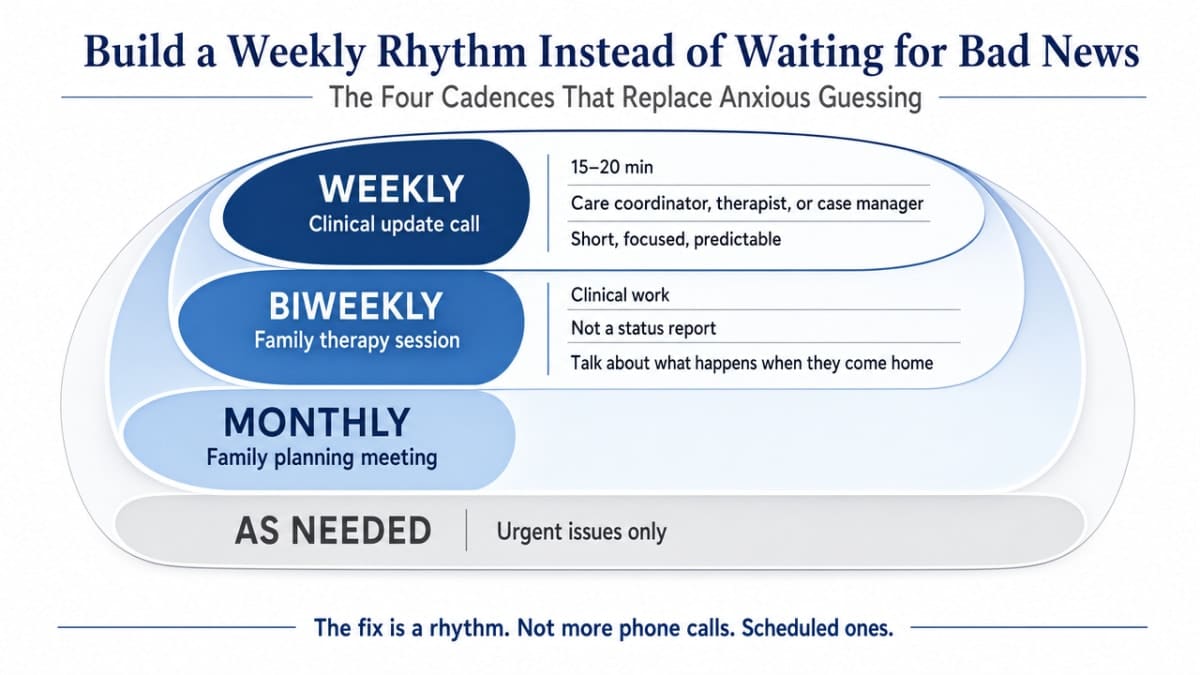
- Set four cadences: weekly clinical update calls, biweekly family therapy, monthly family programming, and pre-discharge planning meetings, with one designated family point of contact owning the calls.
- Treat the release of information as an operating license, naming specific categories like medications, diagnosis, discharge planning, and crisis contact so weekly updates can say something real 1, 2.
- Show up for family therapy as a clinical appointment, since structured family involvement reduces relapse risk and improves caregiver burden, depression, and knowledge 4, 9, 10.
- Plan video sessions around Prescott’s Mountain time, take awkward slots that actually happen, and handle consent, privacy, and location disclosure at the start of each call 6, 8.
- Tie in-person visits to clinical milestones: early stabilization at weeks two to four, mid-treatment intensives, and a pre-discharge planning trip about two weeks out.
- Write the crisis plan on a quiet afternoon, documenting the facility address, local emergency numbers, a nearby contact, and a reconnect protocol if video drops 7.
- Join discharge planning at the midpoint of the stay and confirm a prescriber, therapist, and dated follow-up appointment exist before pickup, pushing for a warm handoff 3, 5.
What Changes When Treatment Is 1,500 Miles Away
Your loved one is at a residential program in Prescott, Arizona. You are in Brooklyn, or Milwaukee, or Chicago, or Honolulu. The clinical team is doing the hands-on work. You are three time zones and a connecting flight away, holding a phone that doesn’t ring often enough.
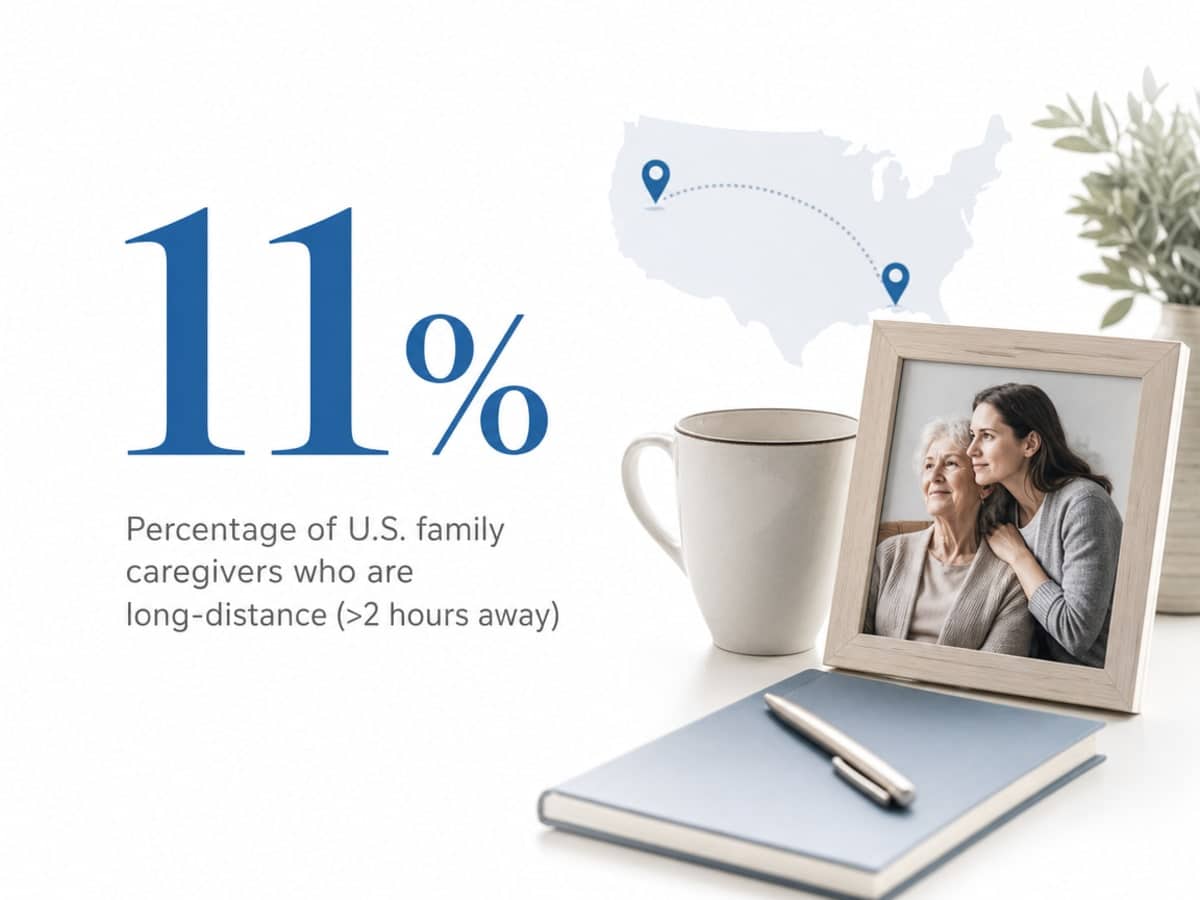
You are not alone in this setup. In the Fordham Long-Distance Caregiving Study, roughly 11% of U.S. family caregivers lived more than two hours from the person they were helping 11. That research centered on caregivers of older adults, not families whose relative is in psychiatric residential care, so treat the number as context rather than a direct match. The structural point still holds: distance is a recognized shape of caregiving, and the families who do it well do it on purpose.
Here is what actually changes when treatment is a flight away. You lose the small, informal check-ins. You can’t read the room. You can’t catch a nurse in the hallway. The clinical team won’t call you every day, and they shouldn’t have to. What replaces proximity is structure: a signed release of information so the team can tell you something real, a scheduled rhythm of updates and family sessions, and a visit plan tied to clinical milestones instead of your anxiety.
That is what the rest of this guide gives you. Not a tips list. A working rhythm you can set up this week, so next week’s call tells you more than “he’s doing okay.” Distance is hard. It is not disqualifying. You can still be a central part of your loved one’s treatment from 1,500 miles away.
Build a Weekly Rhythm Instead of Waiting for Bad News
If the only time you hear from the treatment team is when something has gone sideways, you will spend the rest of the week bracing for the next call. That is exhausting, and it is not how good long-distance involvement works. The fix is a rhythm. Not more phone calls. Scheduled ones.
The Four Cadences That Replace Anxious Guessing
Think of your involvement as four overlapping cadences, each with a different job.
- Weekly: a clinical update call. Fifteen to twenty minutes with a care coordinator, therapist, or case manager. Short, focused, and predictable. You get a read on the week, they get your observations, and nobody is improvising.
- Biweekly: a family therapy session. This is the clinical work, not a status report. You and your loved one sit with a therapist and actually talk about what happens when they come home.
- Monthly: family programming. Education sessions, multifamily groups, or family weekend events. This is where you learn what the diagnosis actually means, what the medications do, and what other families are figuring out alongside you.
- Pre-discharge: planning meetings. Starting several weeks before the projected discharge date, these calls shift from “how is treatment going” to “what does the first month home look like.”
SAMHSA’s guidance for co-occurring disorder treatment supports exactly this kind of layered approach, recommending that programs offer multiple family formats, including individual family sessions, multifamily groups, and family education, and include relatives in assessment and treatment planning when the patient agrees 3. Pick the cadence that fits each job. Then put it on the calendar like you would any other recurring appointment.
Who Owns Which Call: Picking a Primary Point of Contact in Your Family
Pick one person in your family to be the primary point of contact. One. Not a committee.
This is the person whose name goes on the release of information, who takes the weekly clinical call, and who relays what they heard to everyone else. If the clinical team has to figure out whether to call Mom, Dad, the older sister in Chicago, or the aunt in Honolulu, nobody gets called back promptly, and the people who do hear something are playing telephone with the rest of the family.
Choose based on availability, not seniority. Who can reliably take a call during Arizona business hours? Who takes notes well? Who stays calm when the news is mixed? That is your point person.
Then build a short internal routine for them: after the weekly call, send a two-paragraph update to a shared family text thread or email group. Everyone stays informed. The clinical team talks to one voice. Your loved one doesn’t field the same five questions from five different relatives.
Make the Release of Information Do Real Work
A release of information is the single piece of paper that decides whether your weekly call is a real conversation or a polite nothing. Most families treat it as a formality signed once at intake and never thought about again. That is why they end up frustrated. Done right, the release is the operating license for every update, every family session, every medication conversation, and every discharge call that follows.
What HIPAA Actually Says About Talking to You
HIPAA is not a wall. It is a set of rules about when providers can share your loved one’s information, and it leaves plenty of room for you.
Here is the plain version. A provider may share information directly relevant to your involvement in your loved one’s care when your loved one agrees, does not object when asked, or when professional judgment supports the disclosure 1. An adult patient’s objection generally controls, unless the clinician perceives a serious and imminent safety threat and sharing with you could help lessen it 1. HIPAA permits these conversations. It does not force them. Facility policy, state law, and the scope of what your loved one signed off on all shape what the team can actually say.
One more thing worth knowing, because it comes up constantly: even when the team cannot share information back to you, they can almost always listen. If you noticed something before admission, saw a pattern in a phone call, or are worried about something specific, call and say so. You are not violating anything by giving the clinical team information. You are helping them do their job.
What to Put on the Release So the Weekly Call Can Tell You Something
A release that just says “may discuss treatment” is why your updates sound vague. The fix is specificity. HHS guidance makes clear that disclosures to people involved in care must be limited to information directly relevant to that involvement 2. Translation: if you want the team to tell you about medication changes, the release has to authorize that. If you want to be part of discharge planning, same thing.
Ask the facility for a release that names each category you actually need. A useful one covers:
- Named recipients. You, by full legal name, with phone and email. Add a backup contact if there is one. Do not list the whole family.
- Diagnosis and clinical status. So the weekly call can tell you what is being treated and how your loved one is doing.
- Medications. Current medications, changes, and the reasoning behind them.
- Treatment plan and progress. Goals, participation in groups and individual therapy, and milestones hit or missed.
- Discharge planning. Projected timeline, aftercare recommendations, and follow-up providers.
- Crisis contact. Permission to call you if there is a safety concern.
- Duration and revocation. How long the release lasts and the fact that your loved one can revoke or modify it at any time.
Sign it. Keep a copy. Then revisit it. If treatment extends, if the point person in your family changes, or if a new category becomes relevant, ask for an updated release rather than hoping the old one still covers it.
Join Family Therapy Like It’s a Clinical Appointment, Not a Favor
Family therapy sits on most treatment schedules looking like an optional extra. It is not. When a program invites you into a session, that invitation is a clinical appointment with your name on it, and it belongs on your calendar in the same ink as a cardiology follow-up.
Why Family Sessions Are Treatment, Not a Courtesy
You might feel like you are being included as a kindness. You are not. SAMHSA’s Advisory 39 is direct about this: involving family in substance-use-disorder treatment positively affects engagement, retention, and outcomes 4. In other words, your presence in the room changes what happens in the room, and it changes what happens after discharge.
For dual diagnosis care, the picture is similar. SAMHSA’s guidance for co-occurring disorders recommends that programs offer family and peer formats as part of the treatment package, not as a visiting-hour add-on 3. In medication-based treatment, SAMHSA’s TIP 63 goes further and tells clinicians to engage supportive family members with the patient’s written consent, invite them to selected visits, teach them about treatment, and bring them into recovery planning 5.
So when a therapist asks whether you can join a biweekly session by video from Milwaukee or Honolulu, hear what they are actually saying. They are telling you a specific intervention works better when you are in it. Say yes, and treat the slot like you would any other recurring medical appointment.
The Evidence Behind Showing Up
If you need a number to carry in your pocket on the hard days, here is one. A 2023 randomized clinical trial of a brief multifamily psychoeducation program, delivered as six sessions over roughly a month and a half in routine care, found a significant reduction in patient relapse risk at 12 months, plus measurable improvements in caregiver burden, depression, and knowledge 9. The study population was families of adults with schizophrenia receiving routine services, so the findings speak loudest for that group. The structural lesson travels further: a short, structured family program changes outcomes for both sides of the dyad.
A 2024 review of psychosocial interventions in schizophrenia reached a similar conclusion from a wider base, reporting that most family interventions were effective at relapse prevention at follow-up beyond 12 months 10. Again, the diagnosis is specific. The point is not.
Sample Questions to Bring to a Weekly Clinical Call
Fifteen minutes goes fast. If you walk into the weekly call without questions, you will walk out with an impression and no information. Keep a running list on your phone and pick four or five each week.
Starter questions that make an update specific:
- What did this week’s treatment plan focus on, and what shifted from last week?
- How is participation in individual therapy and groups going? Any sessions missed, and if so, why?
- Have there been any medication changes? What is the reasoning, what are you watching for, and when will you reassess?
- What is my loved one working on between sessions, and is there something I should or should not bring up on our personal calls?
- What does the current discharge timeline look like, and what would move it earlier or later?
- Is there anything you’ve noticed that I should know about, or anything you want me to watch for when we talk?
Write down the answers. Short notes. Then send the two-paragraph recap to your family thread, so everyone hears the same thing from the same voice.
Showing Up Virtually From New York, Wisconsin, Illinois, or Hawaii
You will not fly to Prescott every week. Nobody expects you to. What you can do, from a kitchen table in Buffalo or a living room in Honolulu, is show up on video with the same seriousness you would bring to the room. Most of your involvement across a residential stay will happen through a screen, so the screen deserves a little planning.
Time-Zone Math and the Honest Tradeoffs
Prescott runs on Mountain Standard Time year-round. Arizona does not observe daylight saving. That means your clock math changes twice a year even when theirs does not.
From New York, Prescott is two hours behind in winter and three hours behind in summer. From Wisconsin and Illinois, one or two hours. From Hawaii, three or four. A 10 a.m. family session in Prescott is noon or 1 p.m. for you in New York, and 6 or 7 a.m. for you in Honolulu.
Here is the honest tradeoff. The clinical team’s best slots are mid-morning to mid-afternoon their time, which is when therapists are actually in the building and your loved one is between groups. Those slots will not always be convenient for you. Take them anyway. A session at an awkward hour that actually happens beats a perfect-time session that keeps getting rescheduled. Block the time on your work calendar. Tell your manager it is a medical appointment, because it is.
Consent, Privacy, and State Lines on a Video Call
A video family session is still a clinical encounter, which means a few things happen before you join that you might not see.
HHS telebehavioral health guidance is clear that when a caregiver or additional person joins a telehealth visit, that participant also provides consent, and the clinician explains privacy, information-sharing limits, and any special protections that apply to substance-use information 6. Expect a short conversation at the start of your first session covering who else is in the room with you, whether you are recording (do not), and what happens if the connection drops.
State lines matter too, though mostly on the clinician’s side. Behavioral-health professionals generally have to meet licensure requirements in the state where they practice and where the patient is located, and the rules shift when sessions cross borders 8. Your facility handles that side. What you do: join from a private room, use headphones, close the laptop to anyone walking through, and let the therapist know your actual location at the start of each session. Simple things. They protect your loved one and keep the clinical work clinical.
Planning On-Site Visits Around Clinical Milestones
You will visit in person. Maybe twice during a stay, maybe four times, depending on your work, your budget, and how long treatment runs. The question is not whether to go. The question is when going actually matters, because a well-timed trip changes treatment and a poorly timed one just drains you.
When a Visit Actually Helps the Treatment
Visits land best when they are tied to a clinical moment, not to a calendar square. Three windows tend to do the most work.
- Early stabilization, usually weeks two to four. Your loved one has settled in, the initial medication adjustments are taking shape, and the clinical team has enough of a picture to have a real conversation with you in the room. A visit here grounds the treatment plan in a face.
- Mid-treatment, around a planned family intensive or a hard clinical juncture. If the team is adding a family session series, running a trauma-focused block, or working through a significant medication change, your presence gives the therapist something to work with that video cannot replicate.
- Pre-discharge, roughly two weeks out. You walk the aftercare plan with the team, meet the people handing care back to you, and leave with a written plan instead of a hope.
Ask the clinical team which window fits before you book. A 90-minute family session is worth the flight when it anchors a milestone.
Family Weekend Programming and Multifamily Groups
If the facility offers family weekend programming, build at least one trip around it. These weekends compress what would take you months to piece together over scattered calls: education on the diagnosis, skills work you can actually use at home, and time with other families who are living the same week you are living.
Multifamily groups do something a one-on-one session cannot. You hear a father from Illinois ask the question you have been afraid to ask. You watch a spouse from Hawaii describe a relapse-prevention plan that sounds a lot like what you need. SAMHSA’s guidance for co-occurring disorder treatment specifically recommends multiple family formats, including multifamily groups and family education, as part of the treatment package 3. Facilities like ViewPoint Dual Recovery that build family weekend programming around long-distance families are operationalizing exactly that recommendation. Book the weekend. Bring the point-of-contact relative at minimum, and more family if the facility allows it.
Write the Crisis Plan Before You Need It
HHS telebehavioral health guidance lays out the pieces every remote plan should have: the patient’s current physical location documented in the chart, local emergency numbers for that location, a nearby emergency contact or support person, and a specific plan for what happens if a session disconnects during a crisis 7. Your facility handles the clinical side. Your job is to be the useful out-of-state contact, not the first responder.
Ask the team to write down, and share with you under your release, four things. The exact address and phone number of the facility. The local non-emergency and emergency numbers in Prescott. The name of a nearby contact if your loved one leaves the program unexpectedly. And a reconnect protocol if a video session drops mid-crisis, so you know whether to wait, call the facility line, or dial 911 in Arizona.
Then write your own side. Who in your family gets the first call. Who covers childcare or work if you need to fly. Which flight route from your city to Phoenix you have already looked up. Keep the plan on paper and on your phone. You will probably never use it. The families who do have been glad it existed.
Discharge Planning Starts Earlier Than You Think
If you think of discharge as the day your loved one gets on a plane home, you are already behind. The team is building the handoff from the first week, and the version of it you want is one you helped shape rather than one that arrives in your inbox three days before pickup.
The Handoff From Prescott Back to Home
Ask the clinical team, around the midpoint of the stay, to put you on the discharge planning calls. Not a single meeting at the end. A short series, roughly weekly for the last three to four weeks.
What you want written down, under your release, by the time your loved one leaves Prescott: the discharge diagnosis, the current medication list with doses and the reasoning behind each one, a prescriber in your home state who has agreed to take the handoff, a therapist for individual work, any group or intensive outpatient recommendation, and a dated follow-up appointment that already exists on a calendar. SAMHSA’s guidance for co-occurring disorder treatment is explicit that families can be part of treatment planning when the patient agrees, and that includes aftercare 3. For medication-based pieces, TIP 63 goes further and recommends bringing supportive relatives into recovery planning with written consent 5.
If a referral is still “to be determined” the week before discharge, say so out loud on the call. A warm handoff, where the Prescott team actually speaks with the receiving provider, matters more than a list of phone numbers you are expected to work through from Buffalo.
What You, Specifically, Will Do in the First 30 Days Home
The first month home is where good treatment holds or slips. Your job narrows and gets more concrete.
Write down, before pickup, who drives to the first prescriber appointment and the first therapy session. Who refills the medications and where. Which three people in the family know the warning signs the Prescott team flagged, and what each will do if they see one. Keep the crisis plan you built during treatment on the fridge, not in a folder.
Protect two or three recurring slots that already worked: the biweekly family therapy session, now with a local therapist, and any multifamily or peer group your loved one connected with. A 2024 review of psychosocial interventions in schizophrenia found that most family interventions reduced relapse at follow-up beyond 12 months 10. The diagnosis studied is specific. The through-line is not: continuity of family involvement after discharge is part of the treatment, not a wind-down.
Call the Prescott team once in the first two weeks, under the release, with what you are seeing at home. They will want to know.
Find out if advanced care is the next step
Get expert guidance on whether specialized support fits your loved one’s mental health recovery journey.
Frequently Asked Questions
How often should I expect updates from the treatment team when my loved one is out of state?
A workable rhythm is a scheduled weekly clinical update call of 15 to 20 minutes with a care coordinator or therapist, a biweekly family therapy session, and monthly family programming. SAMHSA recommends offering multiple family formats in co-occurring disorder treatment, including individual family sessions, multifamily groups, and family education 3. Put each on the calendar.
Does HIPAA stop the clinical team from talking to me if I live in another state?
No. HIPAA allows providers to share information directly relevant to your involvement when your loved one agrees or does not object 1. State lines do not change that. What limits updates is the scope of the signed release, facility policy, and your loved one’s preferences. Even when the team cannot share back, they can almost always listen to what you tell them.
Can I join family therapy sessions by video from New York, Wisconsin, Illinois, or Hawaii?
Yes, and most long-distance families do. Expect a brief consent step at the start of your first session, since HHS guidance requires additional participants in a telehealth visit to provide consent and understand privacy limits 6. Join from a private room, use headphones, and tell the therapist your actual location at the start of each session.
When is the right time to fly to Prescott for an in-person visit?
Tie visits to clinical milestones, not calendar squares. Three windows do the most work: early stabilization at weeks two to four, a mid-treatment family intensive or significant clinical juncture, and a pre-discharge planning visit about two weeks before pickup. Ask the clinical team which window fits before you book. A family weekend program is also worth building a trip around.
What should go in a crisis plan when I am thousands of miles away?
HHS telebehavioral health guidance names the pieces: the patient’s documented location, local emergency numbers, a nearby contact, and a plan for what happens if a session disconnects during a crisis 7. Ask the facility to share the Prescott address, local emergency and non-emergency numbers, and a reconnect protocol under your release. Add your own side: who flies, who covers home.
How early should discharge planning start, and what is my role in it?
Ask to be included around the midpoint of the stay, with weekly planning calls for the last three to four weeks. SAMHSA guidance supports including families in treatment planning when the patient agrees 3. Your role is to confirm a prescriber, therapist, and dated follow-up appointment exist before pickup, and to push for a warm handoff rather than a list of phone numbers.
References
- Mental Health. https://www.hhs.gov/hipaa/for-professionals/faq/mental-health/index.html
- HIPAA Privacy Rule and Sharing Information Related to Mental Health. https://www.hhs.gov/sites/default/files/hipaa-privacy-rule-and-sharing-info-related-to-mental-health.pdf
- Substance Use Disorder Treatment for People With Co-Occurring Disorders. https://library.samhsa.gov/sites/default/files/pep20-06-04-006.pdf
- THE IMPORTANCE OF FAMILY THERAPY Advisory 39. https://library.samhsa.gov/sites/default/files/pep20-02-02-016.pdf
- Medications for Opioid Use Disorder. https://nida.nih.gov/sites/default/files/tip-63.pdf
- Obtaining informed consent for telebehavioral health. https://telehealth.hhs.gov/providers/best-practice-guides/telehealth-for-behavioral-health/preparing-patients-for-telebehavioral-health/informed-consent-for-telebehavioral-health
- Creating an emergency plan for telebehavioral health. https://telehealth.hhs.gov/providers/best-practice-guides/telehealth-for-behavioral-health/preparing-patients-for-telebehavioral-health/creating-a-telehealth-emergency-plan
- Licensure for behavioral health. https://telehealth.hhs.gov/licensure/licensure-for-behavioral-health
- Family psychoeducation to improve outcome in caregivers and patients with schizophrenia: a randomized clinical trial. https://pmc.ncbi.nlm.nih.gov/articles/PMC10326382/
- Evidence-based psychosocial interventions in schizophrenia: a review. https://pmc.ncbi.nlm.nih.gov/articles/PMC10990032/
- LONG-DISTANCE CAREGIVING: MENTAL HEALTH CONSEQUENCES AND USE OF RESOURCES. https://pmc.ncbi.nlm.nih.gov/articles/PMC6841015/