Key Takeaways
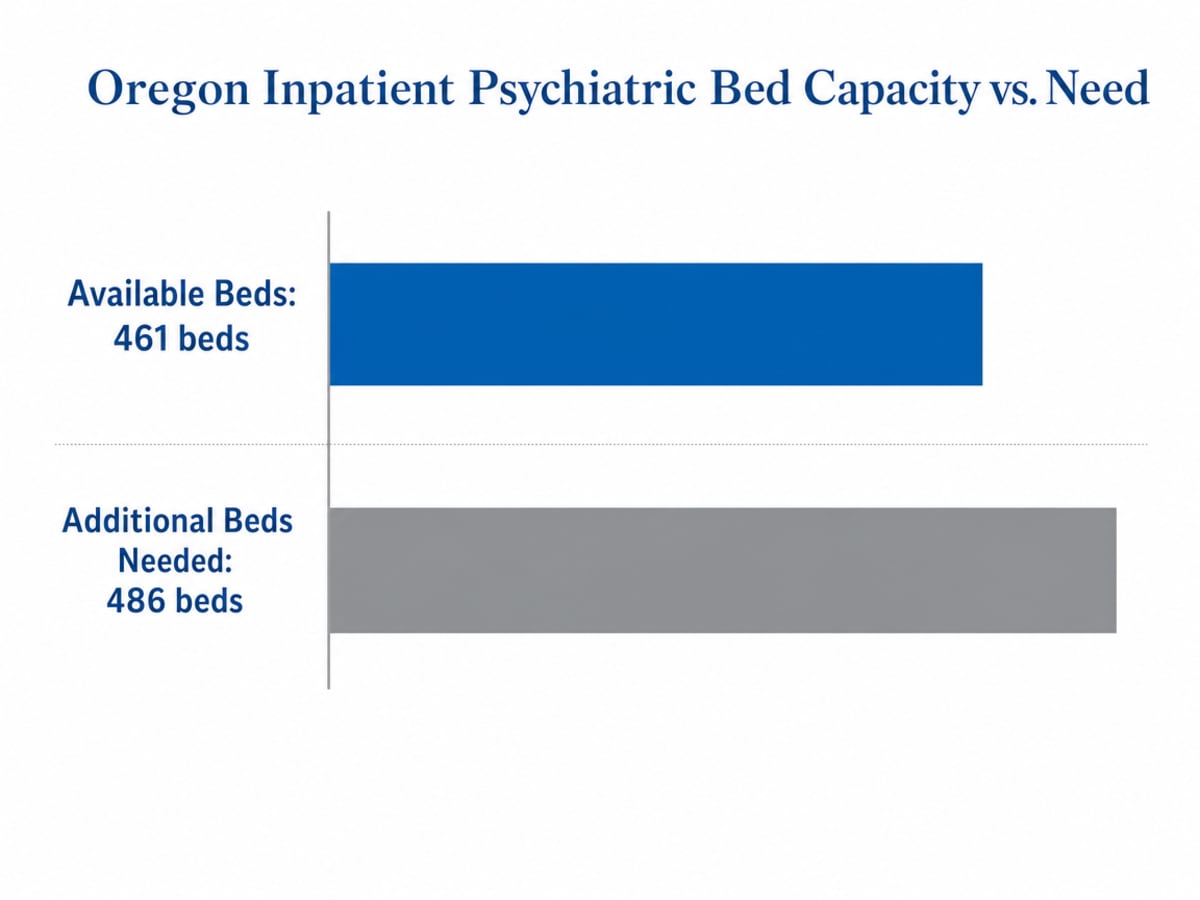
- Oregon’s inpatient psychiatric capacity is measurably short, with 461 beds statewide against a projected need for 486 additional beds, and 32 of 36 counties lacking even one behavioral health provider per 1,000 residents 2, 3.
- Vetting any out-of-state partner means verifying accreditation, current licensure, and the exact level of care staffed and admitting this week, plus depth in treatment-resistant illness including clozapine initiation and monitoring 17.
- For OHP patients, CCO contracts cover out-of-state admissions when timely-access standards cannot be met in Oregon, so document local placement attempts before requesting an out-of-network review 9.
- Reserve 988 and county crisis lines for acute risk, and run specialty referrals for stable-enough patients whose longitudinal illness has outrun primary care and local capacity 11.
When the Patient in Front of You Has Outgrown What Oregon Can Offer This Week
You know the moment. The patient across the exam table is not someone you met today. You have titrated three antidepressants, added an atypical, tried lamotrigine for the mood swings, watched the drinking escalate between visits, and now you are looking at active psychosis, a suicide plan with means, or a rapid-cycling pattern that is not safe for another two-week follow-up in your clinic. You have already made the calls. The nearest adult inpatient psychiatric bed has a wait. The one dual-diagnosis residential program your social worker trusts is not taking referrals this month. The CCO behavioral health line gave you a directory, not a bed.
You are not failing this patient. Oregon is short on the kind of specialty capacity this case needs, and that shortage is not evenly distributed. If you are practicing outside the Portland metro, you already feel it: 32 of Oregon’s 36 counties do not have even one behavioral health provider per 1,000 residents 2. The gap is not an abstraction. It is the reason your referral list is three names long and two are not answering.
This piece is written for you as a peer. It covers what to look for in an out-of-state psychiatric partner when local placement is not clinically acceptable, how the Oregon payer rules actually work for an out-of-state admission, and where ViewPoint Dual Recovery in Prescott fits that bar for the complex cases your clinic cannot hold any longer.
Reading Oregon’s Specialty Capacity Honestly
The Inpatient and Residential Bed Gap
When your clinic calls three facilities and the first bed offered is ten days out, that is not a scheduling problem. It is a capacity problem that Oregon has quantified. The Oregon Health Authority’s residential facility study counted 461 available inpatient psychiatric beds statewide and projected a need for 486 additional beds on top of that 3. In plain terms, the state would need to roughly double its current inpatient footprint to meet modeled demand.
That gap matters for the specific patient you are trying to place. Acute psychiatric beds are not interchangeable with medical beds, with crisis stabilization chairs, or with a residential program that cannot accept someone still actively psychotic. When the inpatient system is running near ceiling, the patients who get bumped first are often the most complex: active substance use alongside psychosis, aggression risk, medical comorbidity, or a history of leaving against medical advice. These are the same cases you are most likely to be escalating out of primary care.
Reading the number honestly also means acknowledging what it does not say. The 461-bed figure reflects a statewide snapshot, not what is open in your region on a Tuesday afternoon. Regional distribution, staffed-versus-licensed status, and payer contracting can all narrow the real options further. If your referral list is coming up empty for a complex case, you are not missing a resource. You are seeing the system at its measured limit.
Workforce Gains That Don’t Reach Your County
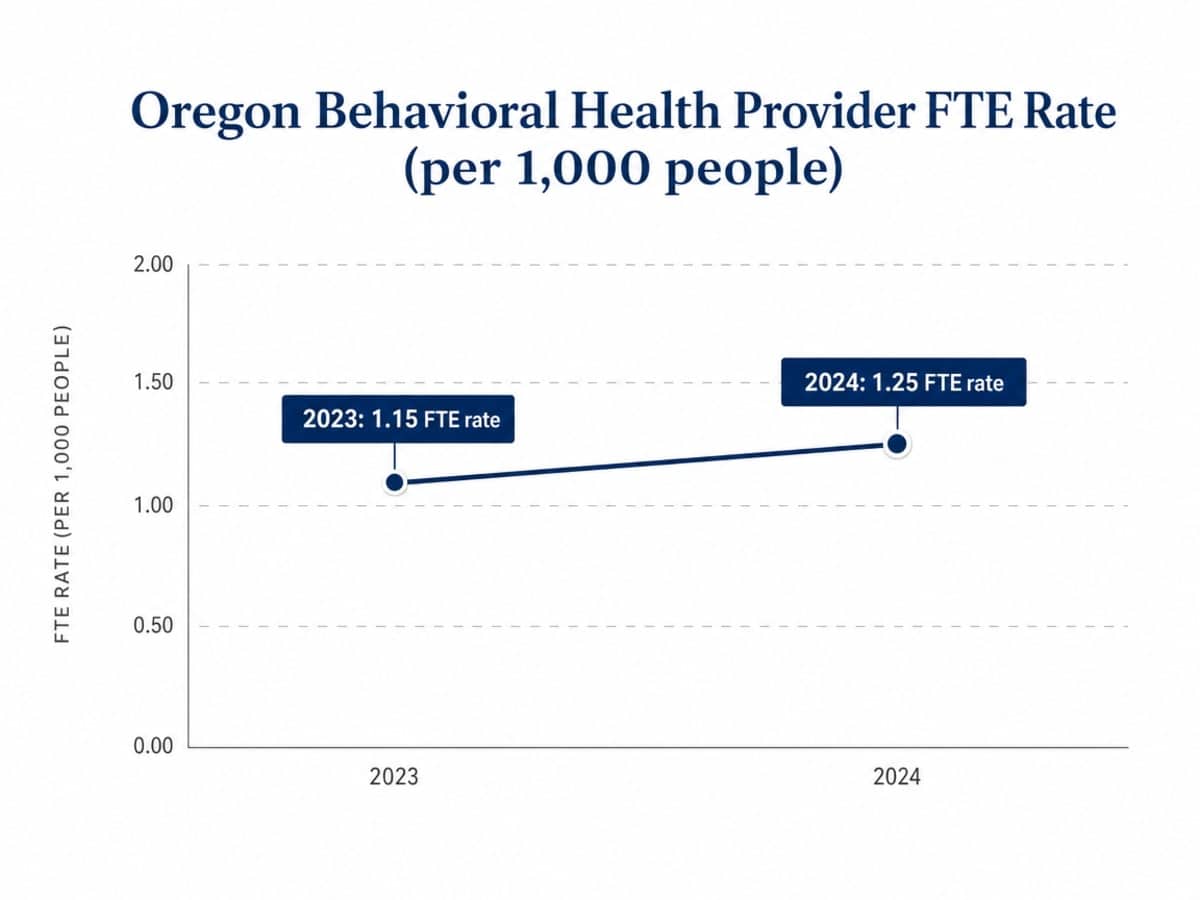
The workforce picture has moved in the right direction, and it is worth saying so. Oregon’s statewide behavioral health provider FTE rate rose from 1.15 per 1,000 residents in 2023 to 1.25 in 2024 1. That is real growth, and it reflects actual hiring, training, and retention work across the state.
Here is the part that complicates the win. Growth at the state level has not fixed geographic distribution. The Oregon Behavioral Health Talent Assessment found that 32 of Oregon’s 36 counties still lack even one behavioral health provider per 1,000 residents 2. If you practice in Harney, Wallowa, Lake, Curry, or most of the counties east of the Cascades, the statewide average is a number you read in a report, not something you see in your referral directory. The same assessment cites HRSA projections that Oregon will need 240 additional FTE psychiatrists by 2030 to close its specialty gap 2.
So when you feel like the shortage is personal to your county, it is. The clinicians Oregon has added are concentrated where they were already concentrated. Board-certified psychiatrists in particular remain scarce outside the Portland metro, and many do not accept Medicaid or Medicare 1. That is not a dig at the growth. It is the honest frame for why a well-vetted out-of-state partner is a legitimate part of your referral toolkit, not a failure mode.
Why ‘Licensed’ Does Not Mean ‘Available’
A directory listing is not a bed. Oregon’s 2025 report on psychiatric residential treatment facility capacity makes this concrete for youth programs, and the pattern applies more broadly. PRTF program beds in Oregon grew from 236 in 2024 to 263 in 2025, which looks like progress on paper. Yet an average of 49 to 65 beds sat empty each month, often because programs could not staff them or could not safely admit the acuity being referred 4.
Keep that number in mind the next time an intake coordinator tells you a facility is “full.” They may mean one of several things:
- The beds exist and are not staffed.
- The staffed beds are open but the clinical team has declined your patient’s acuity.
- The payer mix on the unit cannot accept another Medicaid admission this month.
Each of those is a different problem, and only some of them resolve by waiting.
A Vetting Bar You Can Hand to Any Out-of-State Partner
Accreditation, Licensure, and Level of Care
Start with the paperwork, because the paperwork tells you whether anyone outside the facility can hold it accountable. Ask for the specific accrediting body (Joint Commission, CARF, or equivalent), the current state license from the facility’s home state, and the exact level of care the program is licensed to deliver. Those three answers should come back inside a single email.
The reason to be strict here is that program labels do not travel cleanly across state lines. Oregon’s own framework distinguishes outpatient certification, residential licensure, withdrawal management, and secure residential placement as materially different categories with different rules and oversight cycles 5. Outpatient programs alone can be certified for mental health, substance use, or problem gambling, and each certification carries its own service-delivery requirements 6. A facility that calls itself a “residential psychiatric program” in marketing may actually hold an outpatient certification, or a substance-use license without psychiatric authority, or vice versa.
Your coordinator does not need to become an expert in another state’s administrative code. The ask is simpler: name the accrediting body, send the current license number, and describe the clinical level of care your patient will actually receive on day one. If a partner cannot produce that in writing, you have your answer. OHA notes that licensing itself is not a guarantee of OHP eligibility 5, so verify payer standing separately.
Depth in Treatment-Resistant Illness and Clozapine Monitoring
Any inpatient unit can start an antipsychotic. Fewer have the staffing and lab infrastructure to run clozapine safely, and that single capability is a useful proxy for depth in treatment-resistant psychosis. NIMH identifies clozapine as the option when usual antipsychotics do not improve schizophrenia symptoms, and it requires regular blood testing because of a potentially dangerous adverse effect that occurs in roughly 1 to 2 percent of people 17. If your patient has failed two adequate antipsychotic trials, clozapine is on the table, and the referral partner needs to be able to initiate and monitor it.
Three questions tell you most of what you need:
- Does the program have 24/7 board-certified psychiatric coverage, not just on-call phone backup?
- Does it initiate clozapine on the unit, including ANC monitoring, titration, and management of sedation, hypersalivation, metabolic effects, and myocarditis screening?
- Can it coordinate ongoing REMS-level monitoring with the receiving outpatient prescriber after discharge?
The same bar applies to rapid-cycling bipolar disorder and treatment-resistant depression. Ask what the program does when lithium plus an atypical plus lamotrigine has not held. Ask whether ECT referral or augmentation strategies are routinely used. A partner that answers in specifics is a partner with depth. A partner that answers in brochure language is not the one you want receiving your most complex patient.
Integrated Dual-Diagnosis Care, Not Parallel Referrals
When a patient has active psychosis plus a daily alcohol habit, or rapid-cycling bipolar plus stimulant use, stacking two separate referrals rarely works. You already know how it ends. The psychiatric program discharges with a plan to “follow up for substance use,” the SUD program will not accept until the patient is psychiatrically stable, and the patient falls through the gap between them.
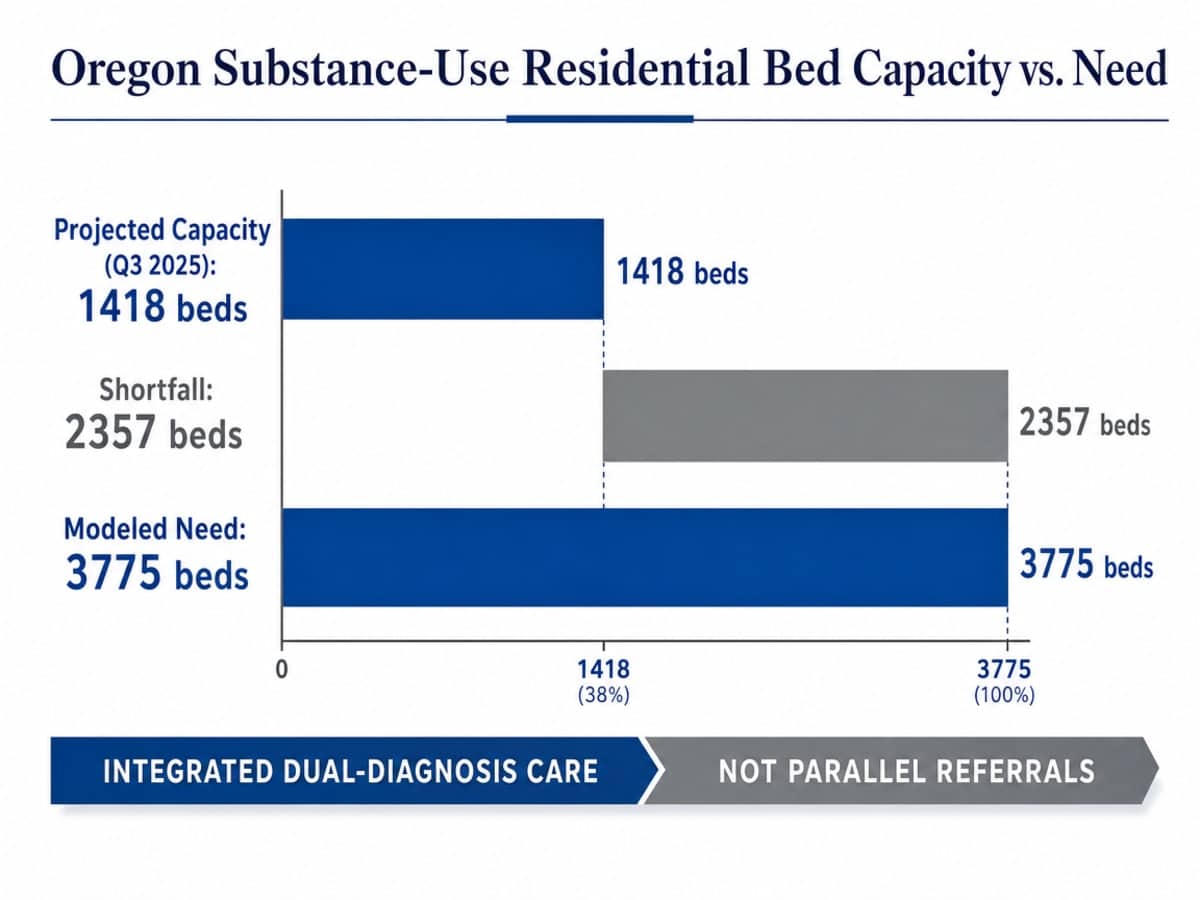
Oregon’s residential capacity data makes this concrete. The OHA residential facility study projected 1,418 substance-use residential beds available by Q3 2025 against a modeled need of 3,775, a shortfall of 2,357 beds 3. For a co-occurring patient, that gap compounds the inpatient psychiatric gap already described in the previous section. Running a parallel SUD referral into a system short 2,357 beds is not a plan.
The evidence for integrated treatment is also clearer than it was a decade ago. A systematic review of integrated care for concurrent mental-health and substance-use disorders found integrated models more effective than conventional nonintegrated models, with reductions in substance use and improvements in mental-health outcomes, along with evidence of cost-effectiveness 14. More recent scoping work supports case management, co-location, and shared decision-making as the operational features that actually drive integration 16.
So the question for an out-of-state partner is not “do you treat both?” It is “does the same clinical team hold both treatment plans, in the same chart, with one psychiatrist responsible for the combined picture?” If the answer is two separate tracks that occasionally talk, you are back to parallel referrals under one roof.
Shared Care Plans and Communication Back to Your Clinic
A referral you never hear about again is a referral that failed, even if the admission went well. The AHRQ integrated-care checklist is explicit on this point: primary care and behavioral health should collaborate through shared care plans, and the organization should actively track referrals to specialty care rather than hoping records find their way back 12. The AHRQ guidebook adds that clear pathways for severe needs requiring outside specialty care should include defined handoffs and support for patients during and after the transition 13.
Translate that into questions the intake coordinator can answer on the first call:
- Who on their team sends an admission note to your clinic within 24 hours?
- Who calls you with the treatment plan after the psychiatric evaluation is complete?
- What is the cadence of updates during the stay, weekly or event-driven?
- Who writes the discharge summary, how fast does it reach you, and does it name the Oregon-based outpatient prescriber, therapist, and CCO care coordinator by name?
Get the names and the timelines in writing before the patient boards a plane. A partner that treats bidirectional communication as a built-in workflow rather than a favor is a partner you can use more than once.
The Oregon Payer and Authorization Path for an Out-of-State Admission
CCO Identification, OHP Rules, and Prior Authorization
Clinical acceptance is one lane. Payer authorization is a parallel lane that moves on its own schedule, and the two have to meet before your patient gets on a plane. Start with the patient’s coverage. If they are on commercial insurance, your referral coordinator already knows the drill. If they are on the Oregon Health Plan, the first operational step is identifying the correct Coordinated Care Organization. OHA assigns CCOs by county of residence, and the CCO holds responsibility for behavioral health authorization, network, care coordination, and in many cases transportation 10. Pull that information from the patient’s OHP card or verify it through OHA’s CCO lookup before you call any facility.
One point worth flagging up front: OHP members generally do not need a PCP referral to access behavioral health services, and most behavioral health services do not require prior authorization in the standard case 8. Your role here is clinical coordination and documentation, not gatekeeping. That said, general no-referral language does not override service-specific rules. OHA has required prior authorization for secure residential treatment facility placement since March 1, 2024 7, and facility-level admission criteria and medical-necessity review still apply at the receiving program.
What to Have Ready Before You Make the Call
The intake call goes faster when you walk in with a packet. Have the following ready:
- The patient’s full name, date of birth, OHP ID, and CCO assignment.
- The current diagnoses with DSM codes, the medication list with doses and trial dates, and a short narrative of what has failed and why primary care cannot hold the case this week.
- Any safety concerns, legal involvement, and medical comorbidities that affect level of care.
Document your local attempts in writing. Which Oregon facilities did you contact, on what dates, and what did each one say? That record is what justifies an out-of-state authorization under the CCO’s timely-access obligation 9. Also have the receiving outpatient prescriber, therapist, and CCO care coordinator identified by name so the discharge plan can be built on day one, not day fourteen. One organized call saves a week of back-and-forth.
Keeping 988 and County Crisis in Their Lane
A quick clarification worth putting in writing. If your patient is in acute crisis right now, with imminent risk to self or others, that is a 988 call or a county Community Mental Health Program dispatch, not an intake call to a residential program three states away. OHA identifies 988 as the 24/7 route and directs people in crisis to county crisis services and substance-use resources 11. Use that lane.
Specialty placement is the different lane. It is for the medically and behaviorally stable-enough patient whose longitudinal illness has outrun primary care and local specialty capacity. The two lanes serve different clinical moments, and conflating them tends to delay both. Stabilize first through 988 or county crisis if that is where you are. Then run the referral workflow in the next sections once the acute risk has been contained.
One Program That Meets the Bar: ViewPoint Dual Recovery in Prescott
Hold up the checklist you just built and run a specific program against it. ViewPoint Dual Recovery in Prescott, Arizona is Joint Commission accredited and licensed by the Arizona Department of Health Services, which answers the first question about third-party accountability and clear level-of-care authority 5. The clinical model is built for the cases your clinic is trying to place: treatment-resistant schizophrenia, rapid-cycling bipolar disorder, treatment-resistant depression, and co-occurring substance use that would otherwise fracture into parallel referrals.
On psychiatric depth, the program offers 24/7 board-certified psychiatric coverage and runs advanced medication strategies on the unit, including clozapine protocols for patients who have failed adequate antipsychotic trials. That matters because clozapine is NIMH’s identified option when usual antipsychotics do not improve symptoms, and it requires the kind of ongoing blood monitoring and adverse-effect management that only a program with real infrastructure can carry safely 17.
On integration, psychiatrists and therapists hold a single treatment plan for each patient rather than running separate tracks that occasionally meet. That is the operational feature the dual-diagnosis evidence base keeps pointing back to, and it is the reason an integrated program handles co-occurring presentations better than two stacked referrals 14, 16.
Treatment duration is set by clinical need rather than a default insurance clock, and the care team coordinates discharge planning back to the Oregon-based prescriber, therapist, and CCO care coordinator you name on intake. That meets the shared-care-plan and referral-tracking bar AHRQ describes as the difference between a handoff that holds and one that disappears 12. ViewPoint is one program that clears the bar. The decision stays yours.
Direct Referral Pathway for Oregon PCPs
When you decide ViewPoint is the right fit, the handoff is designed to run on your clock, not theirs. The admissions line is staffed 24/7 and goes to a clinician who can take a clinical report, not a scheduler who will call you back Monday. Have the patient’s name, date of birth, OHP ID and CCO assignment, current diagnoses and medication trial history, acute safety concerns, medical comorbidities, and a short record of your local Oregon placement attempts ready when you call.
From there, the sequence is clinical acceptance, payer confirmation through the patient’s CCO under its out-of-state timely-access provision 9, and travel coordination. ViewPoint’s intake team will send an admission note back to your clinic and name the Oregon-based prescriber, therapist, and CCO care coordinator who should receive discharge planning, consistent with the shared-care-plan workflow AHRQ describes 12. If this patient does not fit, you will get that answer on the same call. One organized conversation is the whole pathway.
Start a direct consult for complex psychiatric cases
Receive expert input on referral fit and next steps for your most challenging psychiatric patients.
Frequently Asked Questions
When should an Oregon PCP consider an out-of-state psychiatric referral instead of waiting for a local bed?
When the clinical risk of waiting exceeds the risk of transfer. If your patient has treatment-resistant psychosis, rapid-cycling bipolar, or co-occurring substance use, and your documented local attempts cannot produce a staffed, clinically appropriate bed in a safe window, out-of-state is a legitimate option. Oregon’s CCO contracts explicitly cover services outside the state when timely-access standards cannot be met in state 9.
Does an Oregon Health Plan patient need a PCP referral for behavioral health admission?
Generally no. OHA states that OHP members do not need a PCP referral to access behavioral health services, and most behavioral health services do not require prior authorization in the standard case 8. Your role is clinical coordination and documentation. Service-specific exceptions exist, including prior authorization for secure residential treatment facility placement since March 1, 2024 7.
How does a CCO cover an out-of-state psychiatric admission for an Oregon member?
Identify the patient’s CCO by county of residence through OHA’s CCO lookup 10. Then call the CCO behavioral health line and request an out-of-state review based on documented local placement attempts and the clinical reason the wait is unsafe. The CCO self-evaluation checklist confirms CCO responsibility for services outside Oregon when timely-access standards cannot be met in state 9. Authorization is case by case.
What should I ask an out-of-state facility about treatment-resistant schizophrenia and clozapine capability?
Three questions. Does the unit have 24/7 board-certified psychiatric coverage, not just on-call phone backup? Does it initiate clozapine on site, including ANC monitoring, titration, and management of sedation, metabolic effects, and myocarditis screening? NIMH identifies clozapine as the option when usual antipsychotics do not improve symptoms and notes agranulocytosis in roughly 1 to 2 percent of people 17. Can it coordinate ongoing REMS monitoring with the receiving Oregon prescriber?
Why insist on an integrated dual-diagnosis program rather than parallel psychiatric and SUD referrals?
Parallel referrals leave gaps that complex patients fall through. A systematic review of integrated care for concurrent disorders found integrated models more effective than nonintegrated models, with reductions in substance use and improvements in mental-health outcomes along with cost-effectiveness evidence 14. A scoping review supports case management, co-location, and shared decision-making as the operational features that drive real integration 16. One team, one plan, one responsible psychiatrist.
What clinical information should I have ready before calling an out-of-state intake line?
Patient name, date of birth, OHP ID, and CCO assignment. Current diagnoses with DSM codes, full medication list with doses and trial dates, and a short narrative of what has failed. Acute safety concerns, legal involvement, and medical comorbidities affecting level of care. A written record of your Oregon placement attempts, which justifies out-of-state authorization under the CCO’s timely-access obligation 9.
References
- Oregon’s Health Care Workforce Needs Assessment 2025. https://www.oregon.gov/oha/HPA/HP-HCW/Documents/2025-Health-Care-Workforce-Need-Assessment-report-final.pdf
- Oregon Behavioral Health Talent Assessment. https://www.oregon.gov/highered/strategy-research/Documents/Reports/2025-Oregon-Behavioral-Health-Talent-Assessment-Report-final.pdf
- Oregon Behavioral Health Residential+ Facility Study. https://www.oregon.gov/oha/HSD/AMH/DataReports/Behavioral-Health-Residential-Facility-Study-June-2024.pdf
- 2025 Annual Report on Psychiatric Residential Facility Capacity. https://www.oregon.gov/oha/HSD/BH-Child-Family/Documents/2025%20Annual%20Report%20on%20Psychiatric%20Residential%20Facility%20Capacity.pdf
- Oregon Health Authority : Licensing and Certification : Providers. https://www.oregon.gov/oha/bh/providers/pages/licensing-certification.aspx
- Behavioral Health Outpatient Treatment Programs – Oregon.gov. https://www.oregon.gov/oha/HSD/AMH-LC/Pages/OP.aspx
- Oregon Health Authority : Behavioral Health Services Rules and Guidelines. https://www.oregon.gov/oha/HSD/OHP/Pages/Policy-BHS.aspx
- Oregon Health Plan (OHP) Behavioral Health Coverage. https://www.oregon.gov/oha/hsd/ohp/pages/behavioral-health.aspx
- BehavioralHealth_P&Pselfevaluationchecklist_2025.xlsx. https://www.oregon.gov/oha/HSD/OHP/CCO/BehavioralHealth_P%26Pselfevaluationchecklist_2025.xlsx
- Coordinated Care Organizations (CCOs) : Medicaid. https://www.oregon.gov/oha/ohp/pages/ccos.aspx
- Need Help Now?/¿Necesita Ayuda? : Lifespan. https://www.oregon.gov/oha/bh/lifespan/pages/get-help.aspx
- Patient-Centered Integrated Behavioral Health Care: Principles and Checklist. https://integrationacademy.ahrq.gov/sites/default/files/2020-07/7_AIMS_Principles_Checklist_final.pdf
- Integrating Behavioral Health and Primary Care. https://integrationacademy.ahrq.gov/sites/default/files/2020-06/AHRQ_AcademyGuidebook.pdf
- A Review of Integrated Care for Concurrent Disorders: Cost Effectiveness and Clinical Outcomes. https://pubmed.ncbi.nlm.nih.gov/30806190/
- Review of integrated mental health and substance abuse treatment for patients with dual disorders. https://pubmed.ncbi.nlm.nih.gov/9853791/
- A systematic scoping review of interventions to integrate physical and mental healthcare for people with serious mental illness and substance use disorders. https://pubmed.ncbi.nlm.nih.gov/32521251/
- Mental Health Medications. https://www.nimh.nih.gov/health/topics/mental-health-medications