Key Takeaways
- Chicago’s behavioral-health system is built for crisis response and outpatient maintenance, leaving families managing treatment-resistant or dual-diagnosis cases stuck in the thinly staffed middle between hospitalization and biweekly appointments.
- Caregiver exhaustion is a clinical signal that acuity has outgrown the home environment, with burden peaking around admissions, discharges, and medication changes rather than during stable periods 2.
- Before considering an out-of-state placement, compare what the setting describes about staffing density: around-the-clock psychiatry, integrated psychiatric and substance-use teams, in-house medication management including clozapine, and structured family psychoeducation 9.
- Insurance coverage for residential care depends on the specific plan, medical-necessity determinations, and authorization rules, so request benefits verification and out-of-pocket exposure in writing before committing 5, 6.
The 2 A.M. Reality of Caregiving in Chicago
It’s almost 2 a.m. The kettle whistled an hour ago and you forgot about it. Your phone is face-down on the kitchen table because you can’t look at the group text again. Down the hall, your son, your wife, your brother, your mom is finally quiet, and you are afraid to move in case the floor creaks and starts the next hour.
You already know this room. The pill organizer with the Thursday slot still full. The folder of discharge papers from the last ER visit at Northwestern or Rush or Mount Sinai. The co-pay receipts you’ve stopped opening. A second chair that nobody sits in anymore because you’re the one who stays up.
If you’re searching for Chicago caregiver burnout psychiatric treatment options at this hour, you are not overreacting. You are the person who has been holding a hospital-level situation together inside a two-bedroom apartment, and you have been doing it for months, maybe years. The 72-hour hold ended. The outpatient waitlist is still a waitlist. The CARE team came, de-escalated, and left a phone number. The medication worked for six weeks and then it didn’t.
None of that is your failure. It is what trying to manage treatment-resistant mental illness or a dual diagnosis looks like when the local system wasn’t built for the acuity you’re carrying. Across Illinois, roughly 1.2 million adults are doing some version of this work, and more than one in five of them report frequent mental distress of their own 1.
Before we talk about options, let’s talk about why you feel the way you feel.
Why Your Exhaustion Is a Clinical Signal, Not a Weakness
The exhaustion has a shape by now. You wake up already behind. You rehearse the day’s variables before your feet touch the floor: did he take the Thursday dose, is she speaking to you this morning, is the voicemail from the clinic a callback or a cancellation. You are not tired because you are weak. You are tired because the clinical weight of a treatment-resistant case does not get lighter just because it moved out of a hospital bed and into your hallway.
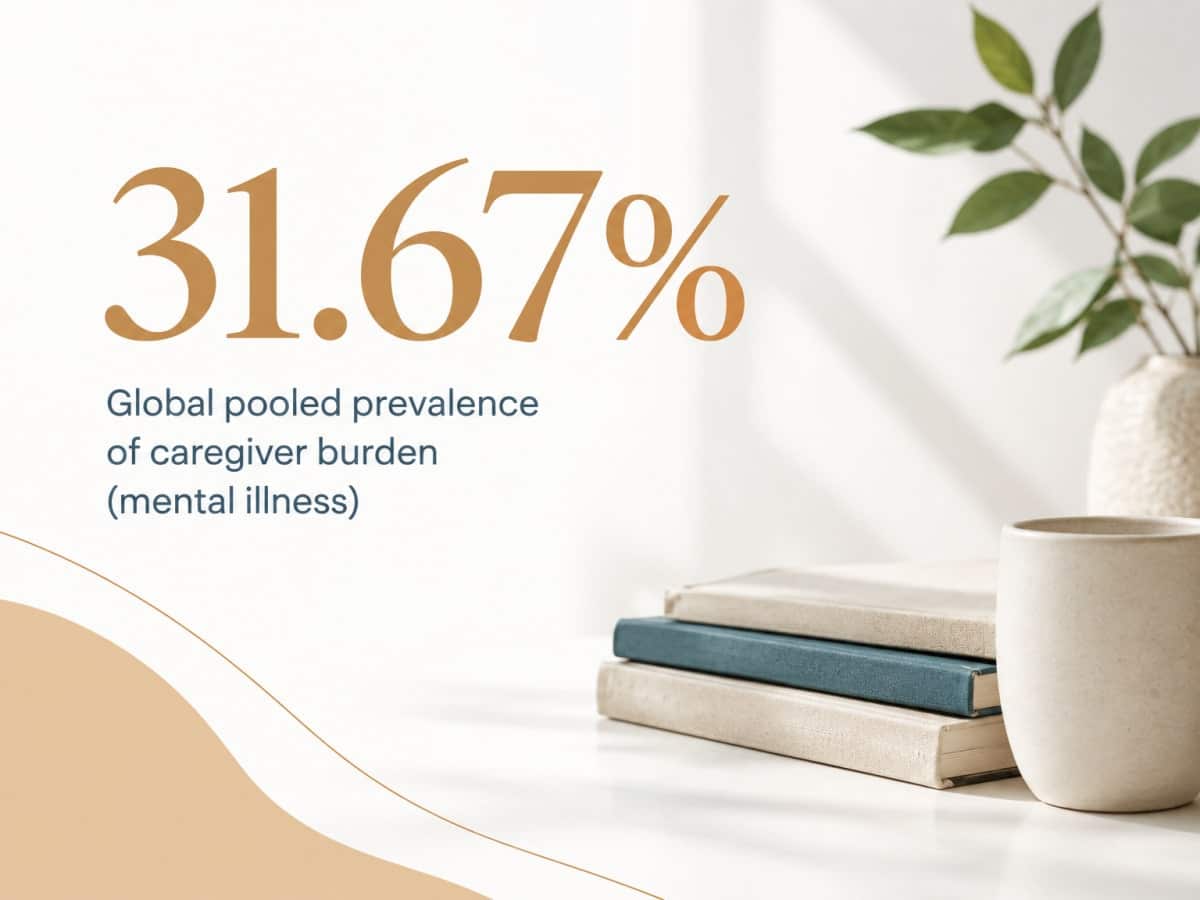
Research backs up what your body already knows. A meta-analysis of 39 studies covering 5,034 caregivers across 23 countries found that caregiver burden was present in about 31.67% of family members supporting someone with mental illness overall, and climbed to 36.06% when the loved one was receiving hospital-level treatment 2. That is a global pooled estimate, not a Chicago figure, and the instruments varied across studies. Still, the direction is unmistakable: the higher the acuity, the heavier the weight on the person coordinating care.
Sit with that for a second. Burden does not peak during the quiet months of stable medication. It peaks around the admissions, the discharges, the medication changes, the repeat ER visits. The season of your life you are in right now has a name in the literature, and it is the season when caregivers are measurably the most depleted.
None of that means you are failing. It means your nervous system is doing exactly what a human nervous system does when it is asked to hold hospital-grade uncertainty with household-grade resources. You are not a facility. You do not have a night shift. You do not have a prescriber on call at 3 a.m. when the agitation starts again. You have you, and maybe a sibling who texts back, and a work calendar that keeps asking why you rescheduled another meeting.
That is the honest frame for everything that follows. You are not looking for options because you have run out of commitment. You are looking because the acuity has outgrown the environment, and your body is the first instrument to register it.
What Chicago’s System Was Built For, and What It Wasn’t
Chicago has real behavioral-health infrastructure. It also has a specific shape, and that shape matters when you’re trying to understand why your family keeps falling through it. The system is built around moments of crisis and the slow work of outpatient maintenance. The space in between, where treatment-resistant and dual-diagnosis cases actually live, is the thinnest part of the net.
Crisis Response vs. Sustained High-Acuity Care
Think about what happens when things escalate at home. You call 911, or a mobile team arrives, or you drive to the ER yourself. Something gets stabilized. A hold is placed, or isn’t. A referral is handed to you on a printed sheet. Then everyone goes home.
That rhythm is not an accident. It is what the public system was designed to do. Chicago’s CARE program, now staffed by Chicago Department of Public Health behavioral-health clinicians and emergency medical technicians, has responded to more than 1,500 referred 911 calls since September 2021, with follow-up at one, seven, and 30 days after an encounter 4. That is meaningful work. It also tells you exactly what the model is built for: de-escalation, warm handoffs, and short-window check-ins. Not sustained care for a treatment-resistant case.
The same pattern shows up at the hospital level. A 72-hour hold is a safety intervention. An inpatient stay is a stabilization window. Both are supposed to end with a step-down plan, which usually means outpatient. For someone with rapid-cycling bipolar disorder, treatment-resistant schizophrenia, or psychiatric symptoms tangled up with active substance use, outpatient is often the wrong intensity. The appointment is every two weeks. The medication titration takes months. The relapse happens in three days.
None of that means the clinicians failed you. It means the available dose of care, measured in hours per week, does not match the clinical weight your person is carrying. The system was built for crisis and for maintenance. It was not built to hold someone through the slow, high-acuity middle. That middle is where you have been living.
The Access Gap You Already Feel
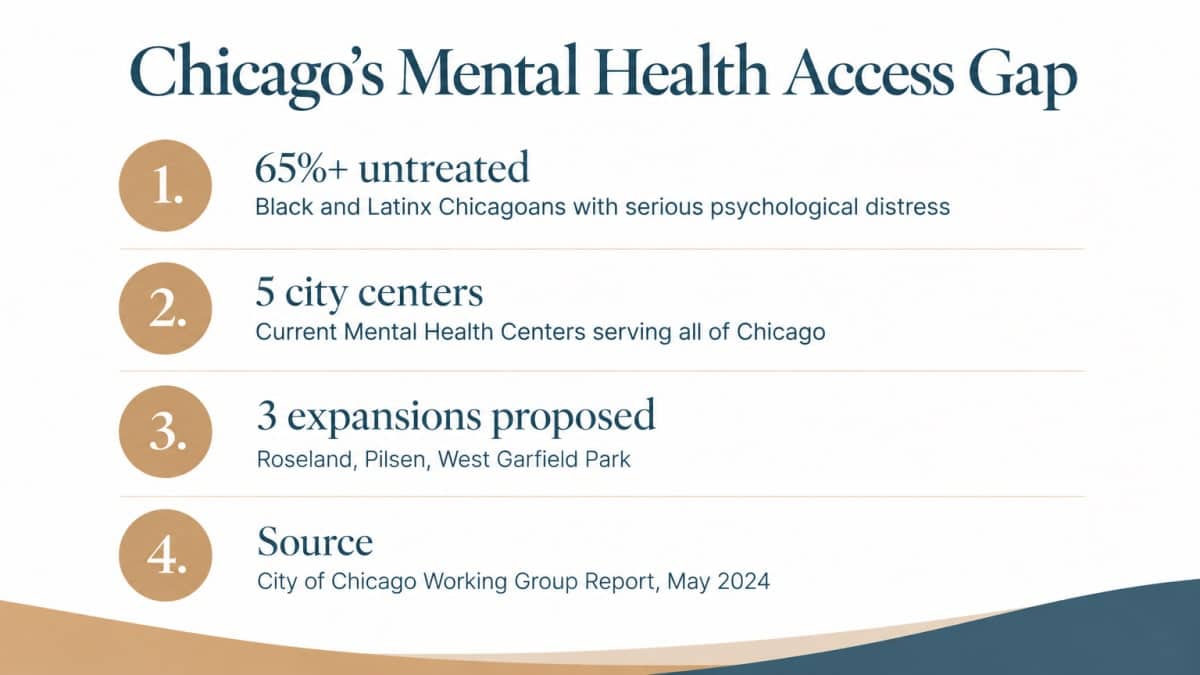
There is also the simple matter of who is getting care and who isn’t. The City of Chicago’s own Mental Health System Expansion Working Group Report, published in May 2024, found that more than 65% of Black and Latinx Chicagoans with serious psychological distress were not receiving treatment 3. That is a city-planning finding, not a clinical outcome measure. It describes unmet demand, not treatment failure. But it tells you something you probably already sensed on the days you couldn’t get a callback: the pipes are undersized.
At the time of that report, the city offered services at five Mental Health Centers, with expansion proposed in Roseland, Pilsen, and West Garfield Park 3. More capacity is coming. That is genuinely good news for the next family. It is a slower kind of news when you are trying to get your person into a bed this week.
Here is the quiet truth of the access gap. Even when the care exists on paper, the path to it is paved with waitlists, intake calls, insurance verifications, and referral loops that assume you have a 9-to-5 schedule and a landline. If your loved one has already cycled through two or three local programs, you have probably learned that “we don’t have an opening” and “this isn’t the right level of care for them” are the same sentence spoken two ways.
You are not imagining the gap. You are standing in it. Recognizing that is not giving up on Chicago. It is naming what the city’s own planners have named, so you can stop grading yourself on a test that was never scaled for your situation.
Reframing Out-of-State Residential Care as a Clinical Decision
Somewhere along the way, “out-of-state” started to sound like a punishment. A banishment. The thing families whisper about when they’ve run out of patience. If that word has been sitting heavy on your chest, it’s worth putting down for a minute and picking up a different one: staffing.
The real question is not how many miles separate your kitchen from the treatment setting. The real question is how many hours per day a board-certified psychiatrist is physically available to the person you love, and whether the team treating the psychiatric symptoms is the same team treating the substance use. That is a clinical variable. Distance is a logistics variable. They often get confused with each other because the clinical variable is harder to see from the outside.
Think about what you’ve actually been shopping for all these months. You weren’t looking for a nearby program. You were looking for a program with enough prescriber hours, enough overnight coverage, enough titration time, and enough integrated expertise to hold a treatment-resistant case without handing it back to you in 72 hours. If a Chicago program had that density of care available this week, you would already be in it.
Out-of-state becomes a reasonable answer when the clinical density you need exists somewhere, and the somewhere happens to be past the Illinois border. That is not scenery-swapping. That is matching acuity to setting. A residential environment with full-time psychiatry on-site can do things a weekly outpatient appointment cannot, no matter how skilled the outpatient prescriber is, because the dose of clinical attention is measured in a different unit.
There is also something quieter at work. Staying in the same apartment, the same routines, the same triggers, the same arguments can be the very thing that keeps a dual-diagnosis cycle spinning. A structured residential setting interrupts that loop. Not by erasing your family, but by giving your person a room where sleep, meals, medication, therapy, and sobriety are the architecture of the day instead of a wish list.
Choosing an out-of-state placement does not mean you failed to love them enough at home. It means you finally gave the clinical problem a clinical answer.
What Full-Time Clinical Staffing Actually Looks Like
When people hear “residential treatment,” the picture that comes to mind is usually the building. The campus. The bedroom with the window. Those details are real, but they are not what makes residential care clinically different from what you have been trying to do at home. The difference is the staffing pattern.
Full-time clinical staffing, as a model, means a few specific things, and they stack on each other.
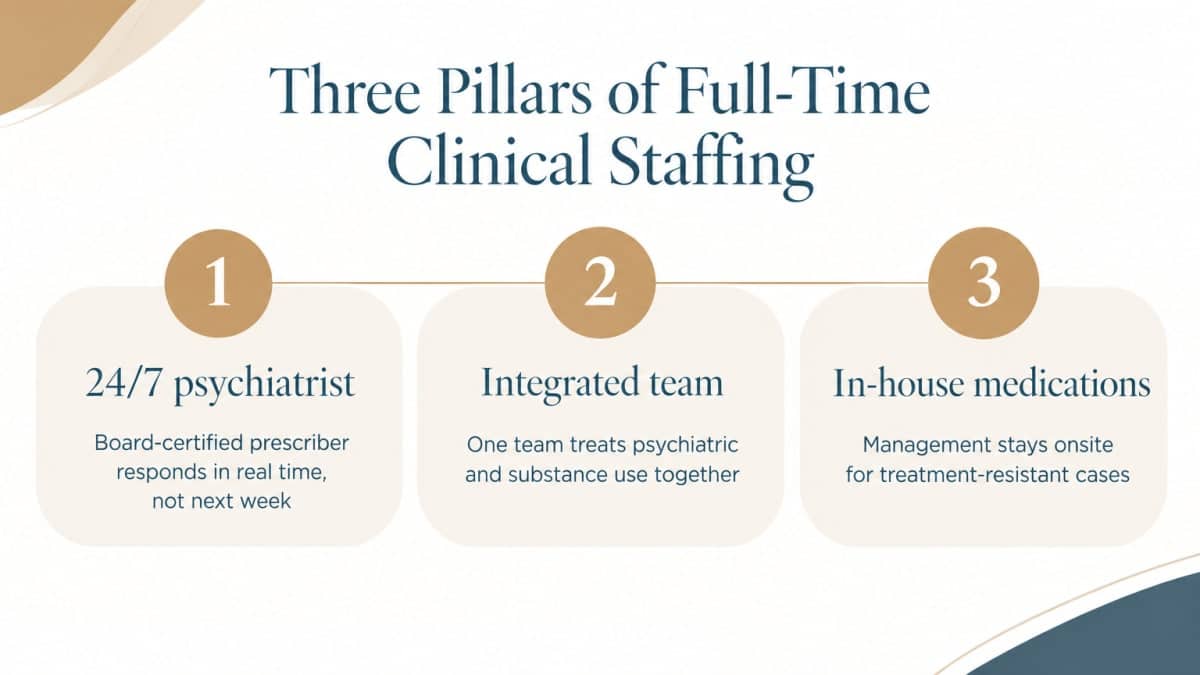
- A board-certified psychiatrist is available around the clock, not just during the Tuesday morning med-check window. That matters because treatment-resistant symptoms do not keep business hours. The agitation that shows up at 11 p.m., the side effect that lands on day four of a titration, the sudden refusal to take a dose, all of it meets a prescriber who can respond in real time instead of a voicemail that gets returned Thursday.
- The team treating the psychiatric symptoms is the same team treating the substance use. From day one. That sounds obvious until you remember how often it does not happen. Many programs run the mental-health track and the addiction track on parallel rails that rarely cross, so the patient ends up translating between two sets of clinicians who have never spoken. Integrated care collapses that gap. The person managing the mood stabilizer knows what the counselor heard in group that morning.
- Medication management lives in-house. For treatment-resistant schizophrenia, that includes the ability to initiate and monitor clozapine on-site, with the lab draws, the dose adjustments, and the overnight observation handled by the same team. Clozapine often requires a level of coordination that an outpatient clinic simply cannot deliver on a weekly cadence.
- Your family is part of the plan, not a visitor to it. A 2023 systematic review and meta-analysis of five randomized controlled trials covering 320 caregivers found that face-to-face group psychoeducation reduced caregiver burden at one week, six months, and twelve months compared with routine care 9. Structured family involvement is not a courtesy. It is one of the few interventions with evidence that your burden can actually come down.
Taken together, that is what the staffing dose looks like. It is why the setting can hold what your living room cannot.
Where ViewPoint Dual Recovery Fits In
Up to this point, we have talked about the shape of the gap. Now the specific question: what kind of place is built to sit inside it. ViewPoint Dual Recovery, in Prescott, Arizona, is one answer worth looking at honestly.
ViewPoint describes itself as a Joint Commission-accredited psychiatric facility that works specifically with the cases other programs flag as too complex. Treatment-resistant schizophrenia. Rapid-cycling bipolar disorder. Severe depression threaded through active substance use. The presentations that have already outlasted a short hospitalization, an outpatient referral, and the hopeful medication trial that didn’t hold. Accreditation and operational details are worth confirming directly with the admissions team.
What the facility describes as making its setting different is the staffing density you have been quietly looking for. ViewPoint states that board-certified psychiatry is available around the clock, so the overnight agitation or the day-four side effect does not wait for Tuesday. According to the program, the psychiatric team and the substance-use team are the same team, working one case from day one, instead of two parallel tracks that rarely compare notes. The program also describes medication management as living in-house, including clozapine initiation and monitoring for treatment-resistant schizophrenia, which is a protocol most outpatient settings cannot run on a weekly cadence. Ask the admissions team to confirm each of these details in writing before making a decision.
Length of stay still interacts with medical-necessity determinations and plan authorization rules, so ask admissions to walk through how clinical progress and insurance review are coordinated for your specific plan 5, 6, 7. For a case that has been cycling for years, that coordination matters.
Your family is written into the plan through structured counseling and psychoeducation, which has evidence behind it for reducing caregiver burden over months, not just discharge day 9. ViewPoint is not the only facility in the country doing high-acuity work. It is a place built for the specific weight you have been carrying, and that is why it is worth a conversation.
Insurance, Medical Necessity, and the Real Rules of Coverage
Here is where a lot of caregivers brace for bad news. You’ve already added up the co-pays, the missed shifts, the parking at the hospital, the pharmacy runs. The idea that residential treatment might also become a billing fight is enough to close the browser tab. Stay with it for a minute, because the picture is more workable than the worst-case story in your head, and more complicated than a yes-or-no.
Start with parity. In Illinois Marketplace coverage, mental-health parity means that covered mental-health and substance-use-disorder treatments have to be covered under rules comparable to medical and surgical treatment 6. Illinois Medicaid and CHIP managed-care plans were reviewed under the same principle, and the state’s 2022 parity analysis found parity between behavioral-health and medical/surgical services in the plans examined, with individual plan performance still subject to review 7. That is a floor, not a guarantee. Parity governs how limits are set. It does not erase prior authorization, network rules, or medical-necessity determinations, and a parity finding does not demonstrate that a particular out-of-state residential facility is in-network or that a high-acuity admission will be authorized.
Residential treatment is a specific example of where that distinction matters. Under Illinois state employee coverage, residential treatment became an eligible behavioral-health benefit under the Quality Care Health Plan effective July 1, 2014, as long as the stay meets medical-necessity requirements 5. Other plans handle it differently. Commercial, Marketplace, Medicare, and Medicaid plans each have their own rules, their own in-network lists, and their own definitions of what makes a residential admission necessary.
Bringing the Family Into the Treatment, Not Out of It
One of the quiet fears you may be carrying is that a residential admission means your voice drops out of the care plan. That the clinicians will take over, and you will become a visitor on a Sunday phone call. A well-built residential setting works the opposite way. Your knowledge of your person, what sets them off, what calms them down, which medications they refused last August and why, is clinical information. The team needs it.
There is also evidence that structured family involvement does something for you, not just for them. A 2023 systematic review of five randomized controlled trials covering 320 caregivers of adults with schizophrenia found that face-to-face group psychoeducation reduced caregiver burden at one week, six months, and twelve months compared with routine care 9. The small trial count limits certainty about format, but the direction is consistent. Learning the illness in a structured setting, alongside other families, lightens the load you have been carrying alone.
So the frame shifts. Residential care is not a hand-off. It is the first time in a long time that someone else is holding the clinical weight while you learn, rest, and plan the version of home your person is coming back to.
Asking ViewPoint What a Placement Would Mean for You
You don’t have to decide anything tonight. The next useful step is smaller than that. It’s a conversation.
Call ViewPoint and ask what a placement would actually look like for your person. Not in general terms. For this diagnosis, this medication history, this pattern of relapse, this insurance card in your wallet. Ask them to walk you through:
- what the first week would include,
- how the psychiatric team and the substance-use team would share your person’s case,
- how clozapine or any other complex medication would be handled,
- how accreditation and staffing coverage are documented, and
- how your family would be looped into the treatment plan from the start.
Ask about benefits, too. A good admissions team will verify your coverage, request authorization, and tell you in writing what medical necessity, prior authorization, and your out-of-pocket exposure actually mean for your situation 5, 6. That conversation costs you nothing and gives you back something you’ve been running low on: real information.
You’ve carried this long enough to know the difference between a sales pitch and a clinical answer. Ask for the clinical answer.
Explore Whether Higher-Level Care Fits
Talk through your loved one’s needs and what an out-of-state placement could mean for your family.
Frequently Asked Questions
Is sending my loved one to an out-of-state residential program the same as giving up on them?
No. Choosing a residential setting is matching the acuity of the illness to a care environment that can hold it around the clock. You have been doing hospital-level work in a home that does not have hospital-level staffing. Moving your person into a setting that describes full-time board-certified psychiatry is a clinical decision, not a withdrawal of your love. The commitment is still yours. The clinical weight finally isn’t.
Why would residential care in Arizona work when Chicago hospitalizations and outpatient clinics haven’t?
Chicago’s public system is largely built for crisis stabilization and outpatient maintenance, with crisis teams like CARE focused on 911 response and short-window follow-up 4. A 72-hour hold ends. A biweekly appointment can’t titrate complex medications. A residential program that offers around-the-clock psychiatry, integrated substance-use treatment, and in-house medication management provides a different dose of clinical attention, measured in continuous hours rather than scheduled visits. The setting is the variable, not the state line.
What does 24/7 psychiatric staffing actually mean in a residential setting?
It means a board-certified psychiatrist is available to your person around the clock, not just during a weekly med-check. The agitation at 11 p.m., the side effect on day four of a titration, the sudden refusal of a dose, all meet a prescriber who can respond in real time. The same team manages psychiatric symptoms and substance use together, and complex medications like clozapine can be initiated and monitored on-site instead of referred out.
Will insurance cover residential psychiatric treatment for my family member?
Possibly, but it depends on the plan. Illinois mental-health parity requires covered behavioral-health services to follow rules comparable to medical and surgical care 6, and Illinois Medicaid and CHIP plans were found to meet parity standards in the state’s 2022 review 7. Residential care can be an eligible benefit when medical-necessity requirements are met 5. Ask the admissions team to verify benefits, request authorization, and give you out-of-pocket exposure in writing.
What happens to our family’s role once our loved one is in residential care?
Your role shifts, but it does not disappear. A well-built program folds you in through structured counseling and psychoeducation, which has evidence behind it for reducing caregiver burden at one week, six months, and twelve months 9. You stay a source of history, context, and planning for life after discharge. What changes is that someone else is holding the clinical weight overnight, so you can rest, learn, and prepare.
How do I start a conversation with ViewPoint without committing to anything?
Call and ask what a placement would mean for your specific situation. Share the diagnosis, the medication history, the pattern of relapse, the insurance card in your wallet. Ask how the psychiatric and substance-use teams would share the case, how medications like clozapine would be handled, and how your family would be looped in. Request benefits verification and out-of-pocket exposure in writing. The conversation is informational, not a commitment.
References
- Caregiving Burden Brief. https://dph.illinois.gov/content/dam/soi/en/web/idph/publications/idph/topics-and-services/diseases-and-conditions/alzheimers/caregiver-burden-brief-2024-il-dph-03-07-2024.pdf
- Caregiver Burden among Caregivers of Patients with Mental Illness. https://pmc.ncbi.nlm.nih.gov/articles/PMC9777672/
- Mental Health System Expansion Working Group Report. https://www.chicago.gov/content/dam/city/sites/treatment-not-trauma/pdfs/MHSE/MHSE-Report-May-31-2024.pdf
- City of Chicago Transitions Mental Health Crisis Response Program to Public Health Staffing. https://www.chicago.gov/city/en/depts/mayor/press_room/press_releases/2024/september/Mental-Health-Crisis-Response-Program.html
- Mental Health Residential Treatment Coverage. https://cms.illinois.gov/benefits/stateemployee/mental-health-residential-treatment-coverage.html
- Essential health benefits. https://getcovered.illinois.gov/plans-and-cost/essential-health-benefits.html
- 2022 Mental Health Parity Analysis Summary Report. https://hfs.illinois.gov/content/dam/soi/en/web/hfs/sitecollectiondocuments/il202223mhparitysumreport.pdf
- Youth Hospital Encounters for MHSU Disorders. https://dph.illinois.gov/content/dam/soi/en/web/idph/publications/idph/topics-and-services/life-stages-populations/maternal-child-family-health-services/child-health/youth-hospital-visits-for-mental-health-substance-use.pdf
- Effectiveness of Psychoeducation on Burden among Family Caregivers of Adults with Schizophrenia: A Systematic Review and Meta-Analysis. https://pmc.ncbi.nlm.nih.gov/articles/PMC10522442/