Key Takeaways
- Arizona depression care operates as a tiered ladder from outpatient therapy through IOP, PHP, residential, and advanced interventions like TMS, esketamine, ketamine, and ECT 2, 26.
- AHCCCS members can contact a contracted behavioral-health provider directly without a referral, while commercial plans may require pre-authorization for higher levels of care 1, 4.
- Rural Arizonans face 236 designated mental-health shortage areas, making telepsychotherapy and collaborative care practical, though TMS, esketamine, and ECT still require in-person visits 11, 15, 17.
- If two antidepressants have not worked or substance use is also present, ask providers directly about treatment-resistant options and integrated dual-diagnosis care from one team 25, 26, 27.
When the First Prescription Didn’t Fix It: Where Arizona Care Actually Begins
You tried the first antidepressant. Maybe you tried a second one, waited the full six to eight weeks the NIMH says it can take to see a response, and still felt the same flat weight you felt before 25. That is a disheartening place to sit, and it is also where a real conversation about depression care in Arizona should begin, not end.
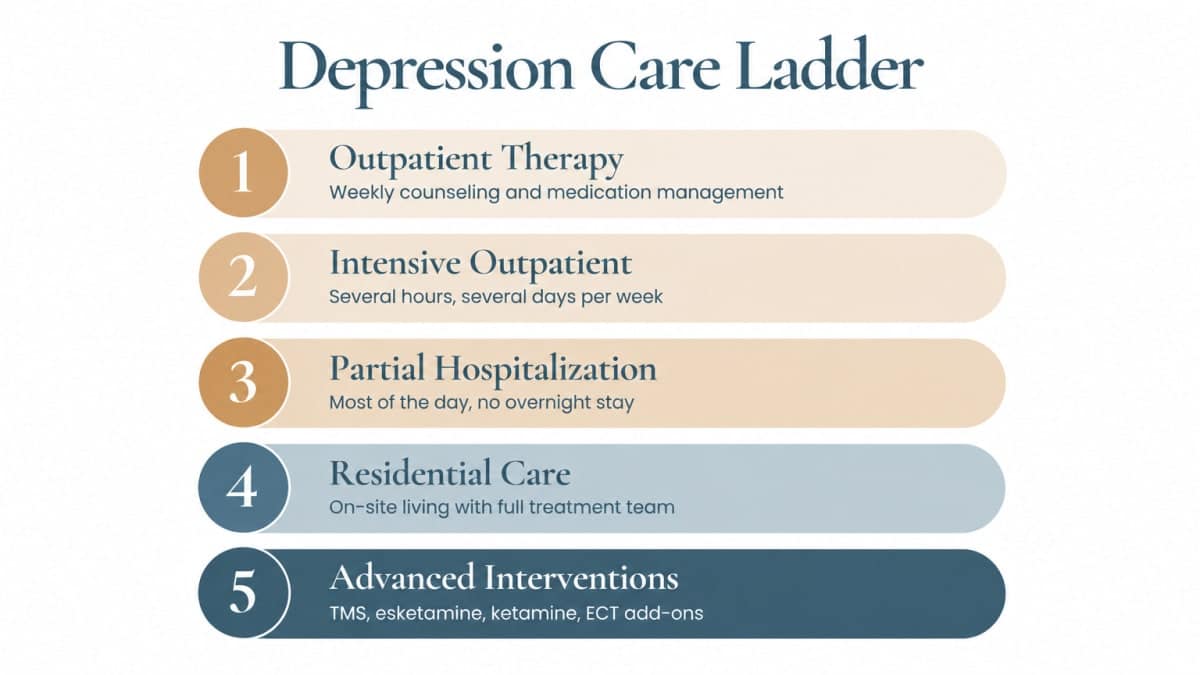
Depression treatment in this state is not one door. It is a tiered system that runs from outpatient therapy and medication management through intensive outpatient and partial hospitalization programs, residential care, and advanced interventions like TMS, esketamine, ketamine, and ECT 2, 26. If you are on AHCCCS, you can contact a contracted behavioral-health provider directly; no referral is required to start services 1. If you have commercial insurance, your pathway looks different, but the care ladder itself is the same.
What follows is a practical map of that ladder, who it is designed for, what to ask when standard medications have not worked, and how to think about dual-diagnosis care when depression travels with substance use.
How Depression Care Is Organized in Arizona
The Levels of Care, From Outpatient Therapy to Residential
Think of depression care in Arizona as a ladder, not a menu. At the bottom rung is traditional outpatient care: weekly or biweekly therapy with a licensed counselor, medication management with a primary care clinician or psychiatric prescriber, and sometimes a collaborative care arrangement where your primary care office works with a behavioral-health consultant. For many people, this rung is enough. For others, it is where the real diagnostic work begins.
When symptoms do not lift at that level, the next rung is more structured outpatient care. Intensive outpatient programs (IOPs) typically meet several hours a day, several days a week, while partial hospitalization programs (PHPs) run most of the day without an overnight stay. Both are covered behavioral-health services under AHCCCS when medically necessary 2. Above those sit behavioral-health residential facilities, where you live on-site for a period of weeks while a treatment team coordinates psychiatric care, therapy, and medical oversight. Residential care under AHCCCS requires prior and continued authorization, and the per-diem rate does not include room and board 4.
Running alongside this ladder, not above it, are advanced interventions: repetitive and deep TMS, intranasal esketamine, IV ketamine protocols, and ECT. These are usually added to outpatient or higher-level care rather than replacing it 26. Every level of care, from the first therapy appointment to residential admission, is supposed to begin with a structured behavioral-health assessment and a written treatment or service plan 3. That plan is your map, and you have every right to ask to see it.
Starting Services Through AHCCCS or Private Insurance
If you are enrolled in AHCCCS, here is something worth sitting with: you do not need a referral to start behavioral-health services. You can contact a provider directly, as long as that provider is contracted with your health plan and the services become part of your treatment plan 1. That one fact removes a bureaucratic step that often stalls people when they are already exhausted.
The practical sequence usually looks like this. Call your AHCCCS health plan’s member services line, or go straight to a contracted behavioral-health provider in your area, and ask for an initial assessment. The clinician will complete a structured evaluation and build a service plan that documents your diagnosis, goals, and the specific services you need 3. From there, outpatient counseling, psychotherapy, medication management, IOP, PHP, and rehabilitation services are all on the covered list when medical necessity is met 2.
Commercial insurance works differently. Some plans still require a primary care referral or pre-authorization for IOP, PHP, residential care, TMS, or esketamine. Call the behavioral-health number on the back of your card and ask three things:
- which in-network providers offer the level of care you need,
- what authorization is required, and
- what your out-of-pocket responsibility looks like.
Residential admissions, in particular, often involve a separate room-and-board charge that insurance does not cover 4.
Access Realities: Rural Counties, Workforce Gaps, and Telehealth
Arizona is roughly 7.6 million people spread across a geography that includes dense metros, reservation lands, and frontier counties 21. The clinical workforce is not evenly distributed to match. HRSA has designated 236 mental-health Health Professional Shortage Areas in Arizona and estimates the state would need 227 additional psychiatrists to eliminate those shortages 11. If you live in Yavapai, Mohave, Navajo, Apache, Graham, or Greenlee counties, that number is not abstract. It shows up as a six-week wait for a psychiatric appointment, a two-hour drive for TMS, or a therapist with a closed caseload.
Telehealth and collaborative care have changed what is possible in those gaps. A systematic review of 17 studies in rural adult populations found that collaborative care arrangements, telepsychotherapy, and structured self-management support were associated with reduced depressive symptoms 17. In practice, that can mean a video visit with a psychiatric prescriber in Phoenix while your primary care clinician in Payson handles labs and medication refills, with a care manager tracking your PHQ-9 scores between appointments.
When Standard Treatment Hasn’t Worked: Treatment-Resistant Depression
What ‘Treatment-Resistant’ Actually Means Clinically
If two antidepressants have not worked for you, that is not a verdict on your character, your effort, or your willingness to get better. It meets a clinical definition. The National Institute of Mental Health describes treatment-resistant depression as depression that has not improved after at least two adequate antidepressant trials, and it notes that antidepressants commonly take four to eight weeks to show whether they are working 25. That timing matters. A medication abandoned at week three because nothing felt different was not necessarily the wrong medication; it may have been the right one measured too soon.
“Adequate” is doing real work in that definition. A trial generally means the right medication at a therapeutic dose, taken consistently, for long enough to show an effect. If you stopped early because of side effects, or if the dose was never raised past a starter level, your prescribing clinician may not count that trial toward the two-failure threshold. This is worth clarifying out loud at your next appointment.
Meeting the clinical definition of treatment-resistant depression changes what should happen next. The VA/DoD Clinical Practice Guideline for Major Depressive Disorder recommends considering rTMS, ketamine or esketamine augmentation, and ECT in specific clinical situations after inadequate response to pharmacologic treatment 26. The pathway shifts from “try another SSRI” to a coordinated conversation about neuromodulation, augmentation, and more intensive care.
What a Thorough Re-Evaluation Should Cover
Before anyone adds a fourth medication or schedules you for an advanced procedure, a careful re-evaluation should happen. This is the step where good psychiatric care distinguishes itself from a prescription refill. Under AHCCCS, a structured behavioral-health assessment and documented treatment or service plan are part of what covered care looks like, not optional extras you have to request 3.
A thorough re-evaluation should cover:
- Confirm the diagnosis itself. Is this unipolar depression, or has anyone screened carefully for bipolar II? Mild hypomanic episodes are easy to miss, and antidepressants given without a mood stabilizer can make bipolar depression worse.
- Look for psychotic features, which change treatment entirely.
- Ask about trauma history, because unaddressed PTSD can look like treatment-resistant depression that will not budge.
- Screen for substance use, including alcohol, cannabis, and benzodiazepines, since active use blunts medication response and raises safety risk.
Medical contributors deserve the same seriousness. Thyroid function, vitamin D, B12, sleep apnea, chronic pain, and certain medications can all mimic or worsen depressive symptoms. Suicide risk should be assessed directly, not inferred. If this list sounds exhausting, that is because it is thorough, and thorough is what you deserve before the care plan escalates.
Advanced Treatment Options Available in Arizona
rTMS, Deep TMS, and What the Response Numbers Show
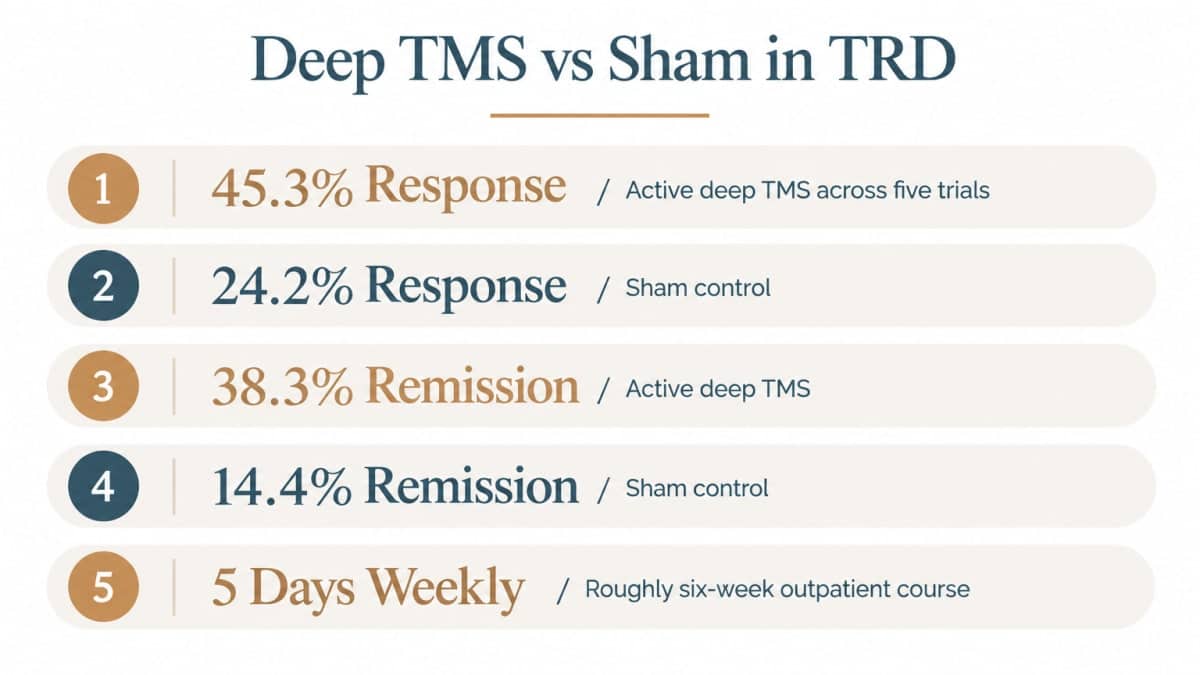
Transcranial magnetic stimulation is usually the first advanced option a psychiatrist raises after medication failure, and for understandable reasons. You sit in a chair, awake, while a coil delivers magnetic pulses to a targeted region of your prefrontal cortex. There is no anesthesia, no IV, and you drive yourself home. A typical course runs five days a week for about six weeks.
The response data give you something concrete to hold onto. Across five randomized trials of adults with treatment-resistant depression (n=507), active deep TMS produced a 45.3% response rate versus 24.2% for sham control, and a 38.3% remission rate versus 14.4% 23. Roughly speaking, that is close to double the response and more than double the remission compared with a convincing sham. A broader network meta-analysis of 69 trials and 10,285 participants also placed rTMS and theta-burst stimulation among the interventions with higher response rates than placebo or sham in TRD 22. The VA/DoD depression guideline reflects that evidence by including rTMS among the options to consider after an inadequate response to pharmacologic treatment 26.
Deep TMS is not identical to standard rTMS; devices, coils, and protocols vary. Ask which protocol your clinic uses, how response is being measured, and what the plan is if week three brings no change. The daily schedule is the real friction, especially from a rural county, which is why some Arizona patients coordinate a short stay in Phoenix, Tucson, or Prescott around the treatment course.
Esketamine, IV Ketamine, and the Monitoring Requirements You Should Expect
Ketamine-based care is the option most often misunderstood by friends, family, and sometimes the internet. There are two very different versions of it in Arizona clinics. Esketamine (Spravato) is an FDA-approved intranasal medication for treatment-resistant depression 16. IV ketamine is used off-label, usually in a series of infusions in a monitored clinic setting. Both are typically added to an oral antidepressant rather than replacing one 26.
The efficacy signal for esketamine is real but measured. A 2025 meta-analysis of five randomized trials reported a response-rate risk ratio of 1.99 compared with control, alongside increased dizziness and nausea 14. Think of that as roughly double the odds of response, with side effects that are usually transient but not trivial.
The monitoring picture is where you should slow down and ask hard questions. The FDA requires that esketamine be administered in a certified setting under a restricted REMS program, with observation for at least two hours after each dose because of sedation, dissociation, risk of impaired judgment, and misuse potential 15, 24. You cannot drive yourself home afterward. The label also carries warnings about respiratory depression and suicidal thoughts and behaviors 24. Before your first appointment, confirm who is monitoring you, how blood pressure is being tracked, what happens if dissociation lingers, and how you will get home. IV ketamine clinics vary more widely in protocol, so ask whether the prescriber is board-certified in psychiatry, how patients are selected, what the taper or maintenance plan looks like, and how the clinic coordinates with your primary psychiatric team.
ECT and Why It Still Matters for Severe or Urgent Cases
Electroconvulsive therapy carries a cultural weight that does not match the current clinical reality. Today it is performed under brief general anesthesia with a muscle relaxant, in a monitored medical setting, usually two or three times a week for a course of six to twelve sessions. The VA/DoD guideline recommends considering ECT for severe major depression with catatonia, psychotic features, severe suicidality, the need for a rapid definitive response, or poor response and intolerable side effects from multiple antidepressants 26.
Comparative evidence is more nuanced than any single headline suggests. A systematic review of ECT in TRD describes it as highly effective but resource-intensive, with results that can differ between inpatient and outpatient contexts 19. A secondary analysis of the ELEKT-D trial reported greater improvement with IV ketamine than ECT among outpatients with nonpsychotic, moderately severe to severe depression 18. A separate 2025 network meta-analysis found no significant differences in response, remission, or tolerability among IV ketamine, rTMS, and ECT, while rating confidence in the evidence as very low 28. The honest reading: ECT is not obsolete, and it is not automatic. If you are facing severe suicidality, psychotic depression, catatonia, or need a response in weeks rather than months, it belongs in the conversation.
Medication Augmentation and Psychotherapy as Part of the Advanced Toolkit
Advanced care is not only about devices and infusions. Medication augmentation remains a core option, and in some analyses it holds its own against the headline interventions. The TRD network meta-analysis of 69 trials found that aripiprazole, among other agents, showed higher response rates than placebo in treatment-resistant depression 22. Lithium, thyroid hormone augmentation, and switching antidepressant classes are familiar strategies NIMH describes as part of the treatment-resistant pathway 25.
Psychotherapy belongs in this toolkit too, not as a consolation prize. Structured therapies, including cognitive-behavioral and interpersonal approaches, can be delivered alongside TMS, esketamine, or ECT, and are explicitly part of covered AHCCCS behavioral-health services when clinically indicated 2. A good advanced-care plan usually combines something that changes brain chemistry or circuitry with something that changes how you respond to what the day throws at you. If a program is offering only the procedure, you are getting half the plan.
When Depression and Substance Use Travel Together
Why Integrated Care Matters More in Arizona Than in Most States
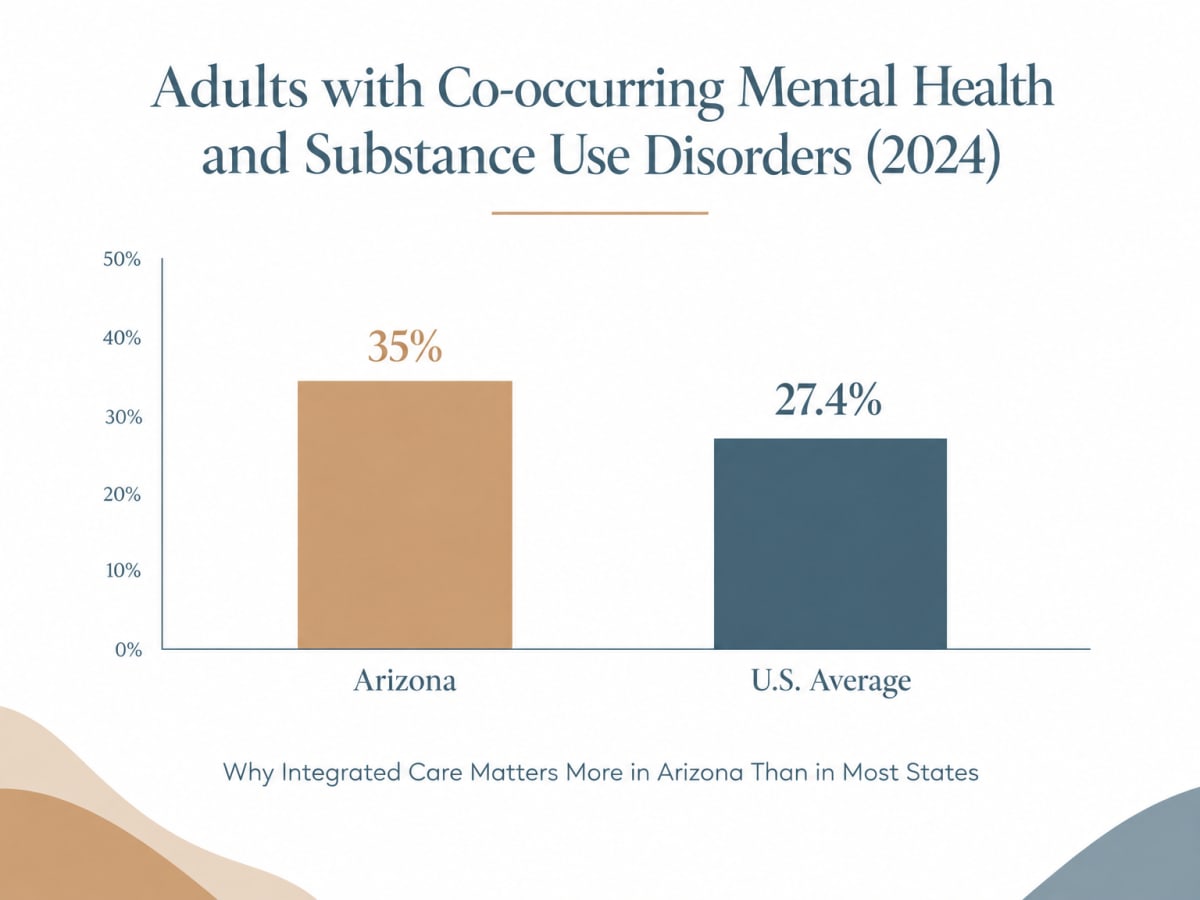
If you are drinking more than you used to, using cannabis to sleep, or leaning on a benzodiazepine prescription that was supposed to be short-term, you are not an outlier in Arizona’s depression population. You are closer to the center of it than the national average suggests.
In fiscal year 2024, 35.0% of adults served through Arizona’s state mental-health authority had a co-occurring mental-health and substance-use disorder, compared with a 27.4% U.S. average 6. That is a public-system figure, not a prevalence estimate for every Arizonan with depression, and it reflects the people the state is actively treating. Still, the gap is meaningful. More than one in three adults in that system is working on two problems at once, and the share is noticeably higher here than in the country as a whole.
That matters for how your care should be built. SAMHSA’s treatment-improvement protocol on co-occurring disorders is direct about this: workforce shortages, inadequate training, and fragmented systems routinely push people into sequential care, where you are told to “get the substance use under control first, then we’ll treat the depression,” or the reverse 27. For many people, neither problem waits politely for the other. Untreated substance use blunts antidepressant response and raises safety risk; untreated depression keeps pulling you back toward whatever helped you cope. Integrated care treats both at the same time, from the first assessment forward.
What Integrated Treatment Looks Like in Practice
Integrated care is a specific operational model, not a marketing word. In practice, it means one clinical team, one treatment plan, and one set of goals that address depression and substance use together. Under AHCCCS, that plan should begin with a structured behavioral-health assessment that screens for both conditions and documents how they interact 3. The covered services, counseling, psychotherapy, medication management, IOP, PHP, and rehabilitation, are available for either diagnosis when medically necessary, which is what makes true integration possible inside the benefit 2.
Here is the uncomfortable part. Nationally, SAMHSA counted 15,953 substance-use treatment facilities, 14,091 mental-health treatment facilities, and 8,839 facilities offering combined services in 2024 20. Combined-service facilities are the minority, which is why many people end up bouncing between a therapist who does not manage medications and a substance-use program that does not treat depression.
When you call a program, ask three questions:
- Will the same team manage both my depression and my substance use?
- Is psychiatric medication management available on-site, including options after standard antidepressants have not worked?
- And how do you coordinate if I need residential care or an advanced intervention like TMS or esketamine 4?
Clear answers signal integration. Vague ones usually mean parallel care wearing one name.
What to Ask a Provider Before You Commit
By the time you are calling a program, you have probably already told your story to three or four people. You deserve to spend that energy on questions that will actually change what happens next. Here are the ones worth asking out loud before you sign anything.
About the assessment. Will my first visit include a structured behavioral-health assessment that screens for bipolar features, trauma, substance use, medical contributors, and suicide risk, and will I get a written treatment or service plan I can see? Under AHCCCS, that structured assessment and documented plan are part of covered care, not an upgrade 3.
About medications and treatment-resistance. If I have already tried two antidepressants, do you consider that treatment-resistant depression, and what are the next options you would recommend? A clear answer should reference augmentation, rTMS, ketamine or esketamine, and ECT in the clinical situations where each is indicated 25, 26.
About advanced care logistics. If TMS or esketamine is on the table, who administers it, what monitoring happens on-site, and how do you coordinate with my outpatient prescriber? For esketamine specifically, confirm the two-hour post-dose observation and REMS requirements 15, 24.
About dual diagnosis. If I am also drinking or using, will the same team treat both at the same time, or will I be sent somewhere else first 27? Vague answers here usually mean parallel care, not integrated care.
Finding a Path Forward
If you have read this far, you already know more about Arizona’s depression care system than most people do when they make their first call. That matters. The gap between a frustrating prescription and a coordinated treatment plan is usually not willpower or luck; it is the quality of the next conversation you have with a provider.
Start where you can. If you are on AHCCCS, call a contracted behavioral-health provider and ask for an assessment 1. If you have commercial insurance, call the number on the back of your card and ask what levels of care are in-network. If two antidepressants have not worked, say that out loud at your first appointment and ask what comes next 25, 26. If depression and substance use are both in the room, ask for one team that will treat both from day one 27. The path forward is rarely a single door. It is the next honest question, asked of the right person.
Explore Your Depression Treatment Options
Get guidance on whether specialized care may fit your needs and what steps to consider next.
Frequently Asked Questions
Do I need a referral to start depression treatment through AHCCCS?
No. AHCCCS members can contact a behavioral-health provider directly without a referral, as long as that provider is contracted with your health plan and the services become part of your treatment plan 1. Call your plan’s member services line or a contracted provider and ask for an initial assessment.
What counts as treatment-resistant depression?
The National Institute of Mental Health defines treatment-resistant depression as depression that has not improved after at least two adequate antidepressant trials, and notes that antidepressants typically take four to eight weeks to show whether they are working 25. “Adequate” means the right dose, taken consistently, for long enough to measure a response.
How do TMS, ketamine, esketamine, and ECT compare for treatment-resistant depression?
A 2025 network meta-analysis found no significant differences in response, remission, or tolerability among IV ketamine, rTMS, and ECT, while rating confidence in the evidence as very low 28. The VA/DoD guideline reserves ECT for severe cases, including psychotic depression, catatonia, or severe suicidality 26. Selection depends on your clinical picture, not a universal ranking.
What monitoring is required if I try esketamine (Spravato)?
Esketamine must be given in a certified setting under a restricted REMS program, with observation for at least two hours after each dose because of sedation, dissociation, and impaired judgment 15, 24. You cannot drive yourself home. The label also carries warnings about respiratory depression and suicidal thoughts and behaviors 24.
What are my options if I live in a rural Arizona county with few psychiatrists?
HRSA has designated 236 mental-health shortage areas in Arizona 11, so you are not imagining the gap. A systematic review of 17 studies found that collaborative care, telepsychotherapy, and structured self-management support reduced depressive symptoms in rural adults 17. Advanced interventions like TMS, esketamine, and ECT still require in-person visits, so travel may enter the plan.
What if I’m dealing with depression and substance use at the same time?
Ask for one team that treats both from the first assessment. SAMHSA’s guidance on co-occurring disorders warns that fragmented, sequential care leaves people bouncing between systems that each address only half the problem 27. Under AHCCCS, assessment, counseling, medication management, IOP, PHP, and rehabilitation are covered for either diagnosis when medically necessary 2.
References
- How To Access Behavioral Health Services. https://www.azahcccs.gov/AHCCCS/Downloads/HowToAccessBehavioralHealth.pdf
- AMPM Policy 310-B. https://www.azahcccs.gov/shared/Downloads/MedicalPolicyManual/300/310B.pdf
- AMPM Policy 320-O. https://www.azahcccs.gov/AHCCCS/Downloads/MedicalPolicyManual/NotEffective/300/320-O.pdf
- AMPM Policy 320-V – Behavioral Health Residential Facilities. https://www.azahcccs.gov/shared/Downloads/MedicalPolicyManual/300/320-V.pdf
- Behavioral Health Services Annual Report Fiscal Year 2025. https://www.azahcccs.gov/shared/Downloads/Reporting/2026/BehavioralHealthProgrammaticExpenditureReport.pdf
- Arizona 2024 Uniform Reporting System Mental Health National Outcome Measures. https://www.samhsa.gov/data/sites/default/files/reports/rpt56435/Arizona.pdf
- 2024 National Survey on Drug Use and Health: Arizona State Estimates. https://www.samhsa.gov/data/sites/default/files/reports/rpt56986/2024-nsduh-sae-state-tabs1/2024-nsduh-sae-state-tabs-arizona.pdf
- 36-422 – Application for license; notification of proposed change in ownership; temporary license. https://www.azleg.gov/ars/36/00422.htm
- 36-425.06 – Secure behavioral health residential facilities. https://www.azleg.gov/ars/36/00425-06.htm
- Annual and Cumulative Estimates of the Components of Resident Population Change for Counties in Arizona: April 1, 2020 to July 1, 2025. https://www2.census.gov/programs-surveys/popest/tables/2020-2025/counties/totals/co-est2025-comp-04.xlsx
- III.B. Overview of the State – Arizona – 2025. https://mchb.tvisdata.hrsa.gov/Narratives/Overview/1b5e6d75-2e45-473f-80a0-97ac744f21a6
- Systematic review of clinical effectiveness of interventions for treatment resistant late-life depression. https://pubmed.ncbi.nlm.nih.gov/40024346/
- Combination of Transcranial Magnetic Stimulation and Ketamine in Treatment-Resistant Depression: A Systematic Review. https://pmc.ncbi.nlm.nih.gov/articles/PMC11327889/
- Efficacy of esketamine nasal spray for treatment-resistant depression: a systematic review and meta-analysis. https://pubmed.ncbi.nlm.nih.gov/40020133/
- Depression. https://www.fda.gov/consumers/womens-health-topics/depression-medicines
- Approval Letter_211243Orig1s016ltr. https://www.accessdata.fda.gov/drugsatfda_docs/appletter/2025/211243Orig1s016ltr.pdf
- Primary Care Models and Depression Outcomes in Rural Populations: A Systematic Review. https://pmc.ncbi.nlm.nih.gov/articles/PMC11376465/
- Ketamine vs Electroconvulsive Therapy for Treatment-Resistant Depression: A Secondary Analysis of a Randomized Clinical Trial. https://pubmed.ncbi.nlm.nih.gov/38916891/
- Electroconvulsive therapy in adult patients with treatment-resistant depression: a systematic review. https://pmc.ncbi.nlm.nih.gov/articles/PMC13170079/
- National Substance Use and Mental Health Services Survey 2024. https://www.samhsa.gov/data/sites/default/files/reports/rpt56696/2024-nsumhss-annual-report.pdf
- Annual Estimates of the Resident Population for Counties in Arizona: April 1, 2020 to July 1, 2025. https://www2.census.gov/programs-surveys/popest/tables/2020-2025/counties/totals/co-est2025-pop-04.xlsx
- Relative effectiveness of antidepressant treatments in treatment-resistant depression: a systematic review and network meta-analysis of randomized controlled trials. https://pubmed.ncbi.nlm.nih.gov/39739012/
- Deep transcranial magnetic stimulation for treatment-resistant depression: A systematic review and meta-analysis of randomized controlled studies. https://pubmed.ncbi.nlm.nih.gov/38574492/
- SPRAVATO (esketamine) nasal spray, CIII. https://www.accessdata.fda.gov/drugsatfda_docs/label/2025/211243s019lbl.pdf
- Depression. https://www.nimh.nih.gov/health/publications/depression
- VA/DoD Clinical Practice Guideline for the Management of Major Depressive Disorder: Provider Summary. https://www.healthquality.va.gov/guidelines/MH/mdd/VADoDMDDCPG_ProviderSummary_Final_508_updated.pdf
- Substance Use Disorder Treatment for People with Co-Occurring Disorders. https://library.samhsa.gov/sites/default/files/pep20-06-04-006.pdf
- A systematic review and network meta-analysis. https://pmc.ncbi.nlm.nih.gov/articles/PMC12206548/