Key Takeaways
- Arizona care runs on two parallel tracks: the AHCCCS and RBHA public pathway with SMI designation, and a clinical team making week-to-week medication and therapy decisions 9.
- SMI evaluation is available regardless of AHCCCS enrollment, and a co-occurring substance use disorder does not automatically disqualify someone from the designation or its services 10.
- The FDA’s June 13, 2025 removal of the clozapine REMS program eliminated the federal paperwork barrier that long complicated access for treatment-resistant schizophrenia 4.
- Save 1-844-534-HOPE, request an SMI evaluation in writing, and bring a full medication history to your prescriber to raise clozapine, LAIs, and expanded support services 17.
Where Arizona’s schizophrenia care actually gets decided
If you’re reading this, you’ve probably already been through intake forms, medication trials, and at least one appointment where someone handed you a brochure instead of a plan. You don’t need another overview of what schizophrenia is. You need to know where the real decisions about your care, or your family member’s care, actually get made in Arizona, and how to influence them.
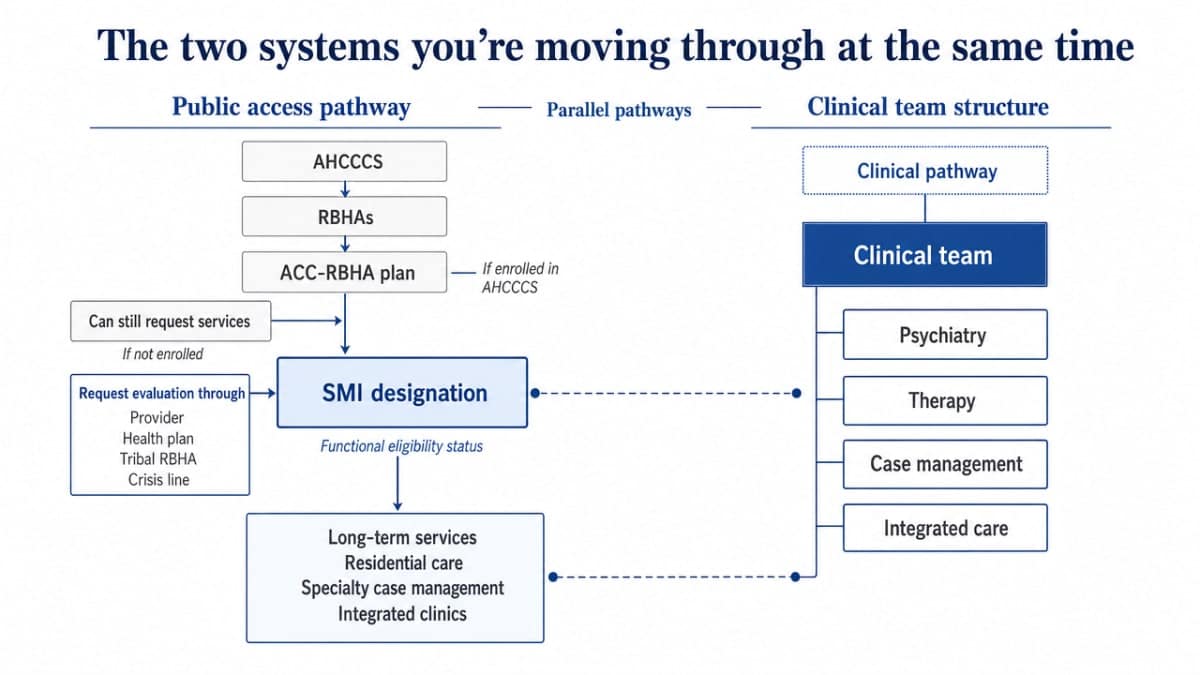
Here’s the shape of it. Arizona runs two systems you’re moving through at the same time: a public access pathway built around AHCCCS, regional behavioral health authorities, and the Serious Mental Illness designation9, and a clinical pathway where a psychiatrist and a treatment team make week-to-week choices about medications, therapy, and level of care. One decides what you’re eligible for. The other decides what actually happens.
A recent federal change matters here. The FDA removed the clozapine REMS program on June 13, 2025, which lifted a long-standing administrative barrier to the medication most tied to response in treatment-resistant schizophrenia4. If you’ve tried two antipsychotics without the stability you hoped for, that shift is relevant to your next conversation.
The two systems you’re moving through at the same time
The public access pathway: AHCCCS, RBHAs, and SMI designation
The public side of Arizona care runs through AHCCCS, the state Medicaid agency, which contracts with regional behavioral health authorities (RBHAs) to deliver services in each part of the state. If you’re already enrolled in AHCCCS, your plan is probably an ACC-RBHA, which bundles physical and behavioral care under one plan. If you’re not enrolled, you can still request services, which surprises most families.
The gate you want to understand is the Serious Mental Illness designation. SMI isn’t a diagnosis. It’s a functional eligibility status that opens the door to long-term, individualized services, including residential care, specialty case management, and integrated clinics9. You or a family member can request an evaluation through a provider, a health plan, a Tribal authority, corrections, or crisis services. Initial assessment should be scheduled within seven business days of your request, and the determination itself is generally issued within about seven days after that11.
The clinical treatment pathway: who runs your care week to week
Eligibility opens a door. The clinical pathway is what happens inside the room. Here, a psychiatrist or psychiatric nurse practitioner is making the medication decisions, a therapist or counselor handles the psychotherapy, and a case manager or care coordinator pulls the pieces together between appointments. Under Arizona policy, your service plan is supposed to extend well beyond the prescription pad: it should include individualized goals, family support services, peer and recovery support, care coordination, and informal community supports14.
That matters because the people most likely to feel stuck are those whose care has been reduced to a 15-minute med check every couple of months. If your current plan looks like that, you can ask your care team to document the full set of supports available to you, including peer support and family education. The policy framework assumes they’re part of the plan, not optional add-ons.
Who leads the week-to-week work depends on your setting. In an SMI clinic, a case manager usually anchors the plan and coordinates specialists. In a general outpatient practice, the burden tends to fall on you or a family member to coordinate across prescribers, therapists, labs, and pharmacies. Knowing which model you’re in helps you ask the right question first.
What the public system actually delivered in 2024
Scale matters when you’re trying to understand why some services feel abundant and others feel impossible to get into. In 2024, Arizona’s state mental health authority system reported 520,791 clients served across all diagnoses and age groups. Within that same reporting period, 790 clients were enrolled in first-episode-psychosis coordinated specialty care, supported by $3,725,193 in SFY 2024 FEP expenditures6.
Hold those numbers next to each other for a moment. More than half a million people moved through the system. Fewer than eight hundred had access to the specialized early-psychosis model that most research supports for recent-onset illness. That gap isn’t a reflection of what the state believes works. It’s a reflection of program capacity, geographic reach, and the narrow eligibility window FEP programs use.
If you or your relative has been living with schizophrenia for years, you’re almost certainly outside that 790-person FEP cohort. That’s not bad news; it just means your pathway is a different one, built around medication optimization, case management, residential or outpatient services, and, when appropriate, specialized treatment-resistant care. Knowing the system’s actual shape helps you stop waiting for the wrong door to open.
If this is a first episode: coordinated specialty care
What CSC includes and who it is for
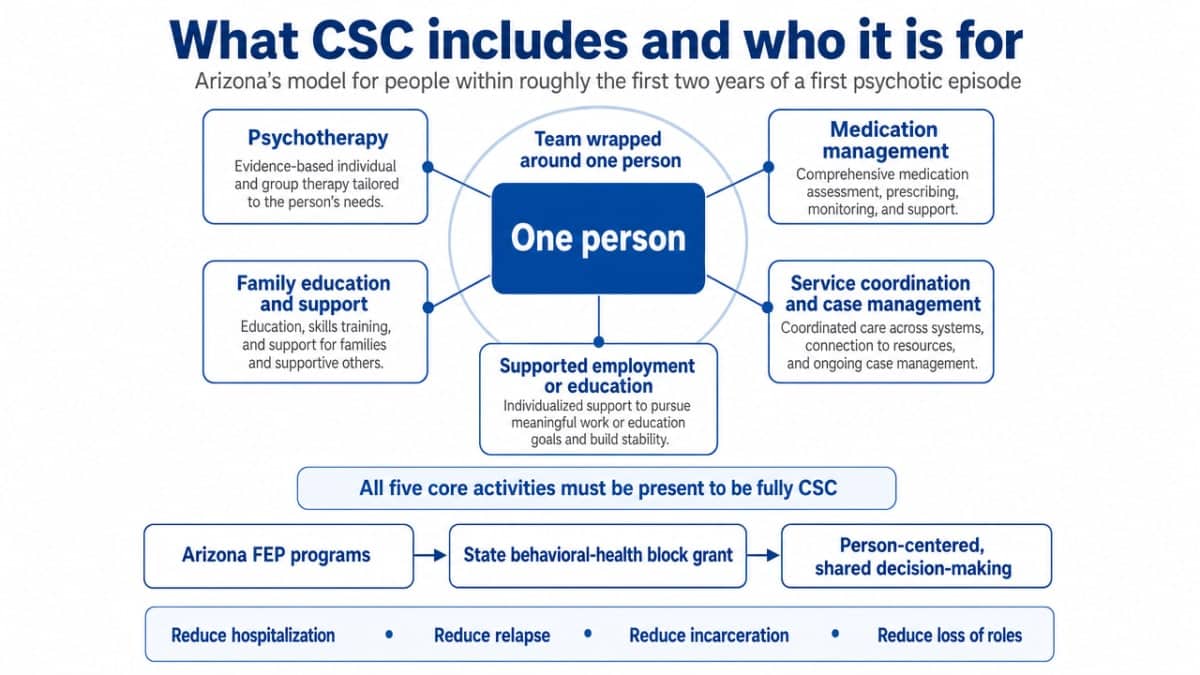
Coordinated specialty care, or CSC, is the model Arizona uses for people within roughly the first two years of a first psychotic episode. It is not a single clinic or a single medication; it is a team wrapped around one person. Federal guidance identifies five core activities that have to be present for a program to call itself CSC:
- psychotherapy (usually cognitive behavioral)
- medication management
- family education and support
- service coordination and case management
- supported employment or education21
If your program is missing one of those pieces, it is not fully CSC, and you can ask why.
Arizona runs this through its FEP programs under the state behavioral-health block grant, with person-centered, shared-decision-making principles baked into the model12. The intent is to reduce hospitalization, relapse, incarceration, and the loss of school or job trajectory that often follows a first break. SAMHSA describes the team as mental-health clinicians working alongside vocational and educational specialists, plus structured family support20.
Who it is for matters as much as what it includes. CSC is designed for recent-onset psychosis, which is the window where early, intensive, multidisciplinary care has the strongest evidence. If your diagnosis is years old, this is not your door, and that is worth naming now rather than later.
Transitioning out of CSC without losing ground
CSC programs are time-limited by design, usually two to three years. The transition out is where progress often slips, so plan for it well before the end date. Ask the team, in writing, who will take over medication management, who handles the therapy relationship, and how your case manager hands off to a longer-term outpatient coordinator or SMI health home.
If your symptoms have persisted or returned despite good adherence inside CSC, that is clinical information, not failure. It is also the appropriate moment to raise treatment-resistance planning, including whether clozapine should be on the table4. Vocational and educational supports often disappear fastest after discharge; ask whether your plan under Arizona policy 320-O can continue peer support, supported employment, and family education after you leave the program14. The goal is a soft landing, not a cliff.
When first- and second-line medications haven’t worked
What treatment resistance means clinically
If you’ve tried two antipsychotics at adequate dose and duration without the response you hoped for, that experience has a name. Treatment-resistant schizophrenia, or TRS, is generally defined as persistent positive symptoms after two appropriate trials of different antipsychotics, each given long enough and at a therapeutic dose. It is a clinical signal, not a verdict on effort or willpower.
Before anyone labels you treatment resistant, a careful clinician will rule out other explanations:
- missed doses
- drug interactions
- substance use
- thyroid or metabolic issues
- inadequate blood levels
- a dose that was reduced too soon because of side effects
These are not accusations. They are the questions that keep you from skipping the medication most likely to help next.
Once pseudo-resistance is ruled out, the conversation shifts. Guidelines point toward clozapine, and the planning around you should expand to include adherence support, medical comorbidity, suicide and aggression risk, substance use, housing, and work or school supports.
Clozapine after the 2025 REMS removal
For years, clozapine carried a reputation as the medication nobody could get. The drug itself has been available since the 1990s, but a federal Risk Evaluation and Mitigation Strategy, or REMS, required prescribers, pharmacies, and patients to enroll in a central database and report each absolute neutrophil count, or ANC, before a prescription could be filled. Miss a lab, miss a dose. Pharmacies refused to dispense. People stopped and relapsed.
That changed on June 13, 2025, when the FDA removed the clozapine REMS program4. You, your prescriber, and your pharmacy no longer have to be enrolled in the REMS database, and ANC results no longer have to be reported to the federal system for the medication to be dispensed5. If your experience with clozapine was shaped by that older system, or if a prescriber once told you access would be too complicated to try, that answer is out of date.
What has not changed is the clinical reason monitoring existed in the first place. Severe neutropenia remains a real but rare risk, and your clinician should continue ANC testing before you start and at the intervals specified in the prescribing information4. The practical difference is that your lab draws are now part of ordinary clinical care rather than a federal paperwork chain that could block a refill at the pharmacy counter. That is a meaningful shift. For many people who gave up on clozapine for logistical reasons, it is worth asking again.
How your clinician reads the clozapine evidence now
Clozapine has carried the title of gold standard for TRS for a long time, and most practice guidelines still recommend it after two failed antipsychotic trials. A 2023 network meta-analysis pooling 60 studies and 6,838 participants found clozapine and olanzapine more efficacious than several comparators, while also linking clozapine to more sedation and both drugs to more weight gain2. That is the backdrop your psychiatrist has been working from.
The picture has gotten more nuanced. A 2025 individual-patient-data meta-analysis of blinded randomized trials found only a small and uncertain difference between clozapine and other second-generation antipsychotics in TRS, with the point estimate actually favoring the comparators by a fraction of a PANSS point1. Separately, a 2024 network meta-analysis of 47 studies suggested that some augmentation strategies produced statistically significant symptom reductions relative to clozapine, though with varying evidence quality3.
None of this means clozapine is off the table. It means your clinician may frame the choice as a real decision rather than a reflex. If they discuss olanzapine, augmentation, or a sequenced plan before clozapine, that is not neglect. Ask what response they would need to see, over what window, before moving to clozapine. Put the answer in writing.
Long-acting injectables and the adherence question
If your psychiatrist has brought up a long-acting injectable, or LAI, it is almost always about adherence. Missing doses of an oral antipsychotic is the most common path back to the hospital, and it rarely feels like a decision. A rough week, a lost bottle, a side effect you did not want to mention, and three days have passed. An injection every two to four weeks removes that daily failure point.
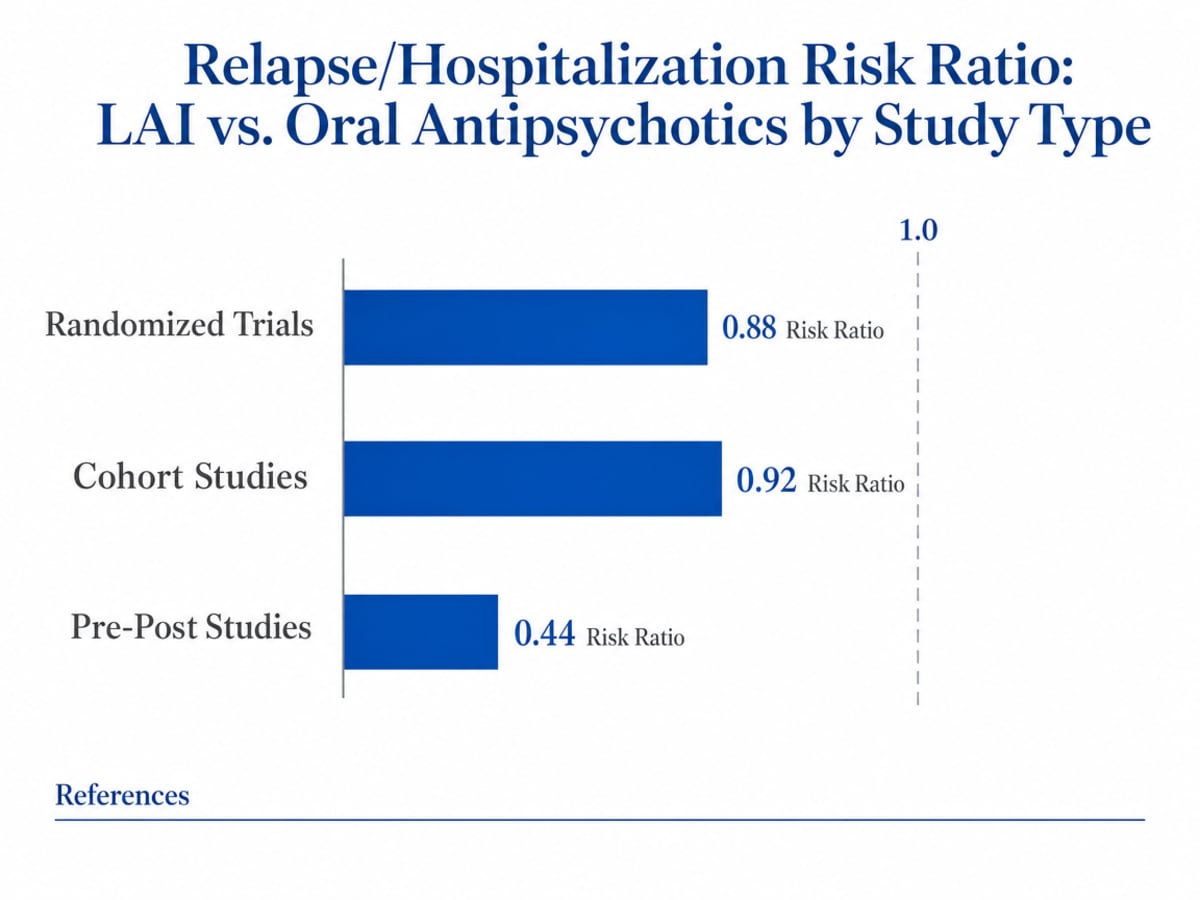
The evidence for LAIs depends heavily on how you ask the question. A meta-analysis of randomized trials, cohort studies, and pre-post studies reported risk ratios for hospitalization or relapse of 0.88 in randomized trials, 0.92 in cohort studies, and 0.44 in pre-post studies23. Read that spread carefully. In the most controlled comparisons, LAIs show a modest edge. In studies that follow the same person before and after switching, the benefit looks dramatic, because real-world adherence improves and the comparison captures it. A separate network meta-analysis of 32 oral and injectable antipsychotics for maintenance treatment found no clear winner for relapse prevention among active treatments, and recommended letting tolerability guide the choice22.
What this means for your conversation: if adherence has been a recurring issue, an LAI is likely to help you more than the randomized-trial number alone suggests. If adherence is not your issue, the oral and injectable options are closer than clinic marketing sometimes implies. Choose the molecule you tolerate; then choose the delivery that fits your life.
Co-occurring substance use, housing, and the rest of the plan
Medication is one lever. The rest of your plan is what keeps the medication working. If you also live with a substance-use disorder, that is not a reason to be pushed out of psychiatric care in Arizona. SMI evaluation and services remain available, and co-occurring SUD does not automatically disqualify you from the designation or the services it opens10. Integrated treatment, meaning both conditions addressed by the same team at the same time, is the standard worth asking for by name.
Housing instability is the other quiet derailment. Symptoms that look like relapse often start as a lost apartment, a conflict with a roommate, or a shelter stay where sleep and medication times fall apart. Arizona’s covered behavioral-health services for people with SMI include residential care, crisis stabilization, counseling, specialized assessment, substance-use treatment, and discharge planning, and waitlists for those covered services are prohibited16. If a provider tells you to wait weeks for a covered service, ask for that denial in writing and escalate to your health plan.
Residential care itself has a defined place. Behavioral Health Residential Facilities are available when a behavioral-health condition causes significant functional impairment plus at least one area of meaningful risk of harm13. That is a specific threshold, not an open door, but it is also not reserved for the most extreme crisis. Your service plan should still carry the full set of supports around any residential stay: individualized goals, family support, peer and recovery support, care coordination, and informal community supports14. Every stable week counts, and the plan is what keeps them stacking.
Crisis, hospitalization, and court-ordered treatment
Using 1-844-534-HOPE and mobile crisis teams
Crisis services in Arizona are available to everyone, regardless of insurance coverage or AHCCCS eligibility, and they do not carry a copayment18. That rule exists so cost never becomes the reason you hesitate. The hotline can dispatch a mobile crisis team to your home, a parking lot, or a shelter, which often prevents an emergency-room trip and the handcuff-in-the-hallway experience that comes with it.
What the hotline cannot do is replace your longitudinal care. If you find yourself calling repeatedly, that pattern is itself information. Bring it to your psychiatrist and ask for a plan change, not another de-escalation.
Inpatient timelines and what Arizona requires of the hospital
If admission does happen, the hospital is on a clock. Under AHCCCS rules for people living with SMI, a preliminary inpatient treatment and discharge plan must be in place within three days of admission, and a full plan within seven days16. Those dates are your leverage. Ask the social worker, in writing, for both documents.
Also know this: waitlists for AHCCCS-covered behavioral-health services are prohibited16. If a hospital tells you discharge is delayed because the step-down residential bed will not open for weeks, or that outpatient follow-up cannot be scheduled, that is a plan-level problem to escalate, not a timeline you have to accept quietly. Call your health plan’s member-services line and name the policy.
Court-ordered treatment under ARS §36-540 when anosognosia is in the way
Some of the hardest moments in schizophrenia care involve a person who does not believe they are ill. Anosognosia is a neurological feature of the illness, not stubbornness, and it is often the reason voluntary care breaks down. Arizona has a legal pathway for these situations through Arizona Revised Statutes §36-540, which governs court-ordered treatment after a petition and evaluation.
A judge can order treatment on findings that the person is a danger to self, a danger to others, persistently or acutely disabled, or gravely disabled, based on clear and convincing evidence19. The court is required to consider available alternatives and order the least restrictive treatment alternative available, which can mean outpatient commitment with required medication and appointments, not only inpatient admission19.
This is a serious step with real costs to autonomy and the relationship. It is also, for some families, the door that finally opens after years of crisis cycles. If you are considering it, call your county’s screening agency, often reached through the crisis line, and ask what a petition requires in your area. Prepare specific, dated examples of behavior that put the person or others at risk.
A practical sequence for the next 30, 60, and 90 days
If the systems and acronyms above feel like a lot, here is how to turn them into movement. You do not have to do everything at once. You have to do the next right thing, and then the one after that.
In the next 30 days, save 1-844-534-HOPE (4673) in every family phone, and request an SMI evaluation through a provider, health plan, or the crisis line if that designation is not already in place17. Ask for the determination in writing. If you are already on medication, pull the list of every antipsychotic tried, the dose, the duration, and why it was stopped. That one page changes every psychiatry appointment that follows.
In the next 60 days, bring that medication history to your prescriber and name the question directly: given the 2025 clozapine REMS removal, is clozapine on the table for you now, and if not, why not4? Ask whether a long-acting injectable fits your situation if adherence has been slipping. Request that your service plan document peer support, family education, and care coordination, not only the prescription14.
In the next 90 days, look at the pattern. Fewer ER visits. One more stable week than last month. A conversation you were able to finish. Those are the wins that compound. If progress has stalled, that is clinical information worth bringing back to the team, not evidence that you have failed. Specialized treatment-resistant programs exist in Arizona for exactly this moment, and asking for a referral is a reasonable next step.
Find Out if Advanced Schizophrenia Care Fits You
Get expert guidance on your next steps for effective schizophrenia treatment in Arizona.
Frequently Asked Questions
How do I start the SMI designation process in Arizona, and do I need AHCCCS first?
You can start by requesting an SMI evaluation through a provider, your health plan, a Tribal authority, corrections, or the crisis line. You do not need AHCCCS enrollment first; evaluations are available regardless of Medicaid eligibility10. Initial assessment should be scheduled within seven business days, with a determination generally issued within about seven days after that11.
What changed about clozapine access after the 2025 REMS removal?
Effective June 13, 2025, you, your prescriber, and your pharmacy no longer need to enroll in the federal REMS database, and ANC results no longer have to be reported there for a prescription to be filled4. Your clinician should still monitor absolute neutrophil counts before you start and during treatment, because severe neutropenia remains a real risk5.
If my family member refuses treatment, what are our options under Arizona law?
Arizona Revised Statutes §36-540 allows a court to order treatment when clear and convincing evidence shows danger to self, danger to others, persistent or acute disability, or grave disability19. The judge must consider alternatives and order the least restrictive option, which can include outpatient commitment, not only hospitalization19. Start by calling your county’s screening agency through the crisis line.
Is a long-acting injectable actually better than oral medication, or is my psychiatrist just worried about adherence?
Both. A meta-analysis found LAIs lowered hospitalization or relapse risk with risk ratios of 0.88 in randomized trials, 0.92 in cohort studies, and 0.44 in pre-post studies23. The large pre-post benefit reflects real-world adherence gains. If missed doses have been your pattern, an LAI likely helps more than trial numbers alone suggest. If adherence is solid, tolerability should guide the choice22.
Can my relative get into a coordinated specialty care program if they’ve had schizophrenia for several years?
Probably not. CSC is designed for recent-onset psychosis, usually within the first two years of a first episode, and Arizona served only 790 FEP clients in 20246. For longer-standing illness, the right pathway is SMI-designated care with medication optimization, case management, and, when criteria are met, clozapine or specialized treatment-resistant services9. Ask your team for a direct referral.
What should I do during a psychiatric crisis if we don’t have insurance?
Call 1-844-534-HOPE (4673), or text 4HOPE (44673). Arizona’s crisis services are available to everyone regardless of insurance or AHCCCS enrollment, and there is no copayment18. The line can dispatch a mobile crisis team to your home, which often prevents an emergency-room trip. Crisis stabilization is not a substitute for ongoing care, so follow up afterward to request an SMI evaluation17.
References
- Efficacy of clozapine versus second-generation antipsychotics in people with treatment-resistant schizophrenia: a systematic review and individual patient data meta-analysis. https://pubmed.ncbi.nlm.nih.gov/40023172/
- A network meta-analysis of efficacy, acceptability, and tolerability of antipsychotics in treatment-resistant schizophrenia. https://pubmed.ncbi.nlm.nih.gov/37526675/
- Efficacy of pharmacological agents for the management of treatment-resistant schizophrenia: a network meta-analysis. https://pubmed.ncbi.nlm.nih.gov/38269529/
- FDA removes risk evaluation and mitigation strategy (REMS) program for antipsychotic drug clozapine. https://www.fda.gov/drugs/drug-safety-communications/fda-removes-risk-evaluation-and-mitigation-strategy-rems-program-antipsychotic-drug-clozapine
- FDA Removes Risk Evaluation and Mitigation Strategies (REMS) for Clozapine. https://www.fda.gov/media/188418/download
- Arizona 2024 Uniform Reporting System Mental Health Data Results. https://www.samhsa.gov/data/sites/default/files/reports/rpt56435/Arizona.pdf
- ARIZONA. https://www.samhsa.gov/data/sites/default/files/reports/rpt56986/2024-nsduh-sae-state-tabs1/2024-nsduh-sae-state-tabs-arizona.pdf
- Metropolitan and Micropolitan Statistical Area Population Estimates. https://www.census.gov/newsroom/press-releases/2025/population-estimates-counties-metro-micro.html
- SMI Designation. https://www.azahcccs.gov/Members/AlreadyCovered/MemberResources/SMIDesignation.html
- The Serious Mental Illness (SMI) Determination Process. https://www.azahcccs.gov/AHCCCS/Downloads/SMIDeterminationProcess.pdf
- SERIOUS MENTAL ILLNESS ELIGIBILITY DETERMINATION. https://www.azahcccs.gov/Resources/Downloads/Solicitations/Open/RFPs/YH23-0001/320-P_Policy.pdf
- Substance Use Block Grant (SUBG) and Mental Health Block Grant (MHBG) Frequently Asked Questions. https://www.azahcccs.gov/shared/Downloads/Grants/FrequentlyAskedQuestions.pdf
- AMPM Policy 320-V. https://www.azahcccs.gov/shared/Downloads/MedicalPolicyManual/300/320-V.pdf
- AMPM Policy 320-O – Behavioral Health Assessment, Service and Treatment Planning. https://www.azahcccs.gov/shared/Downloads/MedicalPolicyManual/300/320-O.pdf
- COVERED BEHAVIORAL HEALTH SERVICES GUIDE. https://www.azahcccs.gov/PlansProviders/Downloads/MedicalCodingResources/AHCCCSCoveredBHServicesManual.pdf
- Medically Necessary Behavioral Health Services: Individuals Living With Serious Mental Illness. https://www.azahcccs.gov/Members/Downloads/RandRBrochures/CoveredBHServices_IndividualsLivingWithSMI.pdf
- Crisis Hotlines. https://www.azahcccs.gov/BehavioralHealth/crisis.html
- Frequent Questions About Crisis Services. https://www.azahcccs.gov/BehavioralHealth/Downloads/FrequentQuestionsAboutCrisisServices.pdf
- 36-540 – Court options; immunity; rules. https://www.azleg.gov/ars/36/00540.htm
- Finding and treating early serious mental illness promptly. https://library.samhsa.gov/sites/default/files/early-recognition-esmi-pep24-01-006.pdf
- Interdepartmental Serious Mental Illness Coordinating Committee. https://www.samhsa.gov/sites/default/files/ismicc-rtc-2024.pdf
- Comparative efficacy and tolerability of 32 oral and long-acting injectable antipsychotics for the maintenance treatment of adults with schizophrenia: a systematic review and network meta-analysis. https://pubmed.ncbi.nlm.nih.gov/35219395/
- Long-acting injectable versus oral antipsychotics for the treatment of schizophrenia: a systematic review and meta-analysis of randomised trials and observational studies. https://pubmed.ncbi.nlm.nih.gov/33862018/