Key Takeaways
- A credible IOP delivers at least nine weekly hours 16, one integrated team treating mental health and substance use together, and standardized measurement that actually changes the treatment plan.
- For appropriately selected substance-use patients without active withdrawal or acute instability, IOP outcomes can match residential care, with 50 to 70 percent reporting abstinence at follow-up 1, 3.
- Dual diagnosis only works when one team treats both conditions concurrently with cross-trained staff 5; parallel care across separate systems is where complex cases typically relapse.
- Before enrolling, press programs on integration, psychiatric hours, clinical specialization, measurement practices, and the step-down plan—vague answers signal a program that cannot hold a complex case.
When Weekly Therapy Isn’t Holding
You already know the pattern. A fifty-minute session on Tuesday, then six days alone with the same thoughts, the same cravings, the same 3 a.m. ceiling. By the time you sit down again, you’ve lost ground you spent the last session trying to gain. If weekly therapy hasn’t been enough, that isn’t a verdict on you or on your therapist. It’s information about dose.
Some problems respond to one hour a week. Treatment-resistant depression, bipolar episodes that keep rotating, trauma that spikes every evening, drinking or using that starts again within days of a hospital discharge—these usually don’t. They need more contact, more structure, and more chances to practice something different before the week erodes it.
That’s the gap intensive outpatient therapy was built to fill. SAMHSA’s clinical guidance describes IOP as a defined level of care that sits between weekly outpatient sessions and residential treatment, with enough hours and clinical depth to stabilize people who need more than talk therapy but don’t need a bed for the night 3. For many adults with substance use disorders, and for a growing share of people with serious psychiatric conditions, that middle rung is the one that actually holds.
The rest of this guide is about what makes an IOP strong enough to carry a complex case—and how to tell the serious programs apart from the ones that just fill a schedule.
What Makes an IOP Actually Intensive
The word “intensive” is doing heavy lifting here, and not every program earns it. On paper, an intensive outpatient program is a defined level of behavioral health care that falls just below partial hospitalization and well above a weekly appointment. In practice, three structural ingredients separate a program that will hold a hard case from one that mostly fills a calendar.
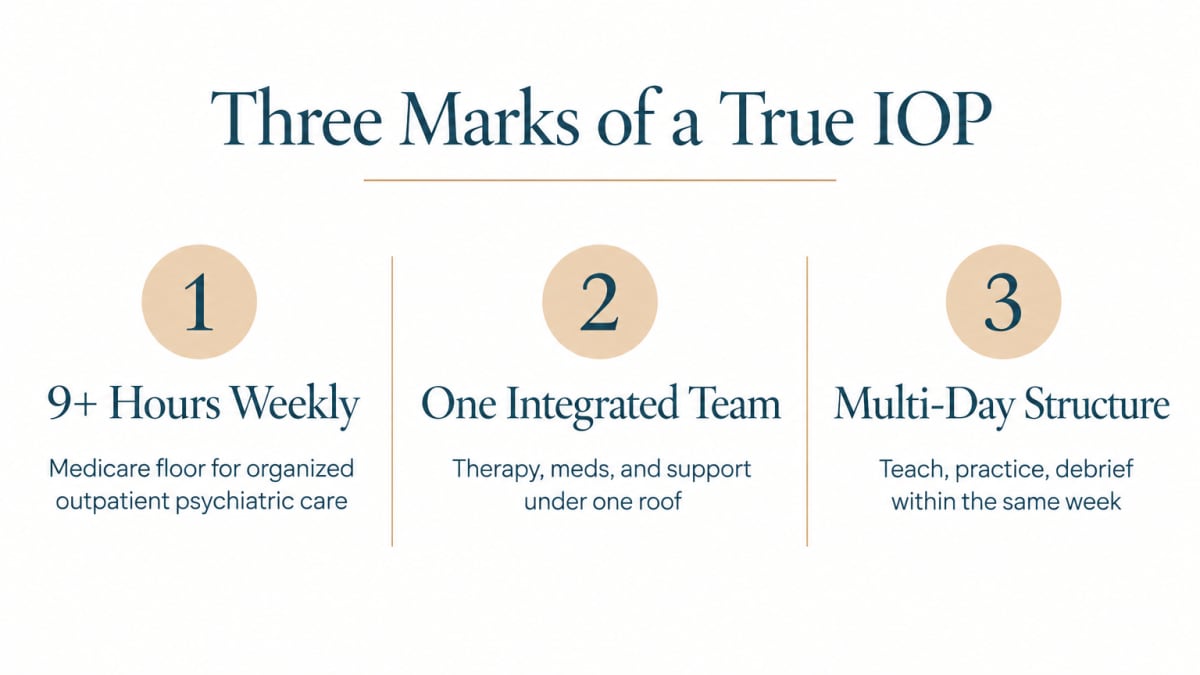
Enough hours to change the week. Under the Medicare payment system that took effect in 2024, an IOP must deliver a minimum of nine hours of services per week to qualify as an organized outpatient psychiatric or substance-use program 16. Think of nine hours as the floor, not the ceiling. Serious programs often exceed that minimum, usually blending groups, individual sessions, and psychiatric check-ins across multiple days. That volume is what makes it possible to teach a coping skill on Monday, practice it in a group on Wednesday, debrief what went wrong on Friday, and still have a therapist in the room before the weekend hits.
One team treating the whole person. SAMHSA’s implementation guide for co-occurring disorders is blunt about what integrated care actually requires: stage-wise interventions, comprehensive services under one roof, shared outreach, group treatment, and health-focused supports organized by a single team rather than referred out to a stranger across town 6. In a strong IOP, the psychiatrist managing your medication can walk down the hall and talk to the therapist running your trauma group. Your substance-use counselor sees the same chart your prescriber sees. That’s not a scheduling convenience. It’s what prevents the handoff gaps where complex cases usually fall apart.
Measurement that drives the next session. If a program can’t tell you how it will know treatment is working, the answer is probably “it won’t.” SAMHSA’s 2024 report on measurement-based care defines the practice as using standardized, valid, repeated measurements to track progress and inform shared decisions with the patient 19. In an IOP, that looks like short symptom check-ins at the start of groups, scored depression or anxiety measures every week or two, substance-use tracking, and safety screens that actually change the treatment plan when scores move the wrong way. Without that feedback loop, a program is guessing, and so are you.
Hours, integration, and measurement are the structural test. A program that offers one or two of them is doing something useful. A program that delivers all three is what the research describes when it talks about IOP working. SAMHSA’s clinical guidance is also clear about where that structure stops being enough: active withdrawal, the need for 24-hour supervision, and acute medical or psychiatric instability belong in a higher level of care first 2. Intensive outpatient is not a lighter version of a hospital. It’s a different tool, and when it’s built right, it does work a hospital bed cannot.
The Evidence IOP Can Match Residential Care—For the Right Patient
Here’s the sentence most marketing pages won’t write honestly: intensive outpatient therapy can match residential treatment outcomes, but only for the right patient, measured on the right outcome, inside a program with the right structure. The research supports that claim. It also sets limits around it, and those limits matter if you’re trying to decide whether to pack a bag or stay home.
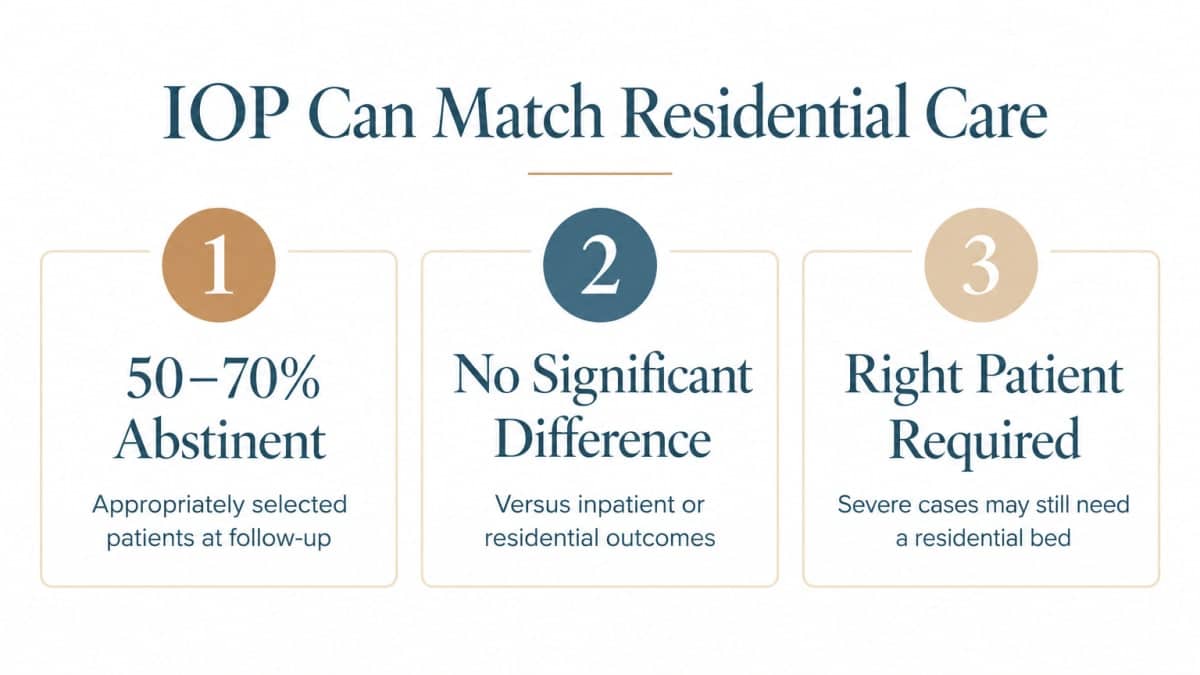
The strongest evidence comes from a review conducted by researchers at Oregon Health and Science University, Westat, and SAMHSA, which examined randomized trials, quasi-experimental studies, and naturalistic analyses of substance-use IOPs. Across those studies, roughly 50 to 70 percent of appropriately selected participants reported abstinence at follow-up, and most comparisons found no significant difference in outcomes between IOP and inpatient or residential care 1. That’s a serious finding. It means that for many adults with substance use disorders, going home at night and showing up to a structured program three to five days a week produced results on par with staying in a facility twenty-four hours a day.
Read that sentence again, though, because every word is doing work. Appropriately selected is not filler. The review flagged real uncertainty about which patients with the most severe substance-use or psychiatric problems still need a residential bed, and SAMHSA’s clinical guidance update draws the same line: IOP outcomes can be comparable to residential services for people with minimal acute withdrawal risk, stable medical status, and manageable psychological risk, and IOP is most effective as part of a continuum rather than a standalone episode 3. If you’re in active withdrawal, if your psychiatric symptoms are unstable, or if your home environment is actively unsafe, the evidence does not say IOP will match residential care. It says the opposite.
There’s also a scope boundary worth naming out loud. The comparability finding is strongest for substance-use IOPs. The psychiatric and dual-diagnosis evidence is more mixed—promising, but drawn from smaller studies, more varied populations, and fewer head-to-head comparisons. A good program will tell you that. A sales pitch won’t.
What the evidence actually gives you, then, is permission to consider IOP as a real alternative to residential care rather than a consolation prize—provided the clinical picture fits and the program is built to carry it. The next sections are about what that fit looks like, starting with the one issue that quietly derails more complex cases than any other: whether the mental health side and the substance use side are being treated by the same team or just in the same building.
Why ‘Dual Diagnosis’ Fails in Parallel and Works Integrated
Almost every treatment program says it treats dual diagnosis. Far fewer actually do. The difference comes down to one question: when your depression and your drinking are both getting worse at the same time, is the same clinical team making decisions about both, or are you being handed between two systems that email each other on a good week?
SAMHSA calls the preferred model integrated care, and the language is specific. It means mental health and substance-use interventions are coordinated under one team, treated concurrently rather than in sequence, and delivered by staff trained in both conditions 4. The TIP 42 advisory is even more direct: integrated care is the preferred model for co-occurring disorders, and the two conditions should be screened, diagnosed, and treated at the same time with appropriately cross-trained personnel 5, 18. Parallel care—where a psychiatrist across town prescribes your medication while a separate substance-use counselor runs your groups—is what SAMHSA’s implementation guide was written to replace, not to describe 6.
The research on integration is honest in a useful way. A randomized trial of people with substance use disorders and co-occurring anxiety or depression found that both integrated treatment and treatment as usual reduced substance use—but the integrated group showed a significantly greater increase in motivation for substance-use treatment at 12 months, with an estimate of 1.76 (p = 0.043) 14. A separate randomized study of people with psychosis and substance dependence found that integrated, disorder-specific group therapy produced higher abstinence motivation (p = 0.009), lower substance use at three months (p = 0.039), and greater treatment satisfaction (p = 0.011) than usual psychiatric care 15. Note what these studies show and don’t show. Integration tends to move engagement and motivation first. The symptom deltas often lag. That’s not a weakness of integrated care; it’s how recovery actually unfolds in people with two illnesses pulling against each other.
When you’re calling programs, the question isn’t whether they “offer” dual diagnosis treatment. It’s whether the psychiatrist and the substance-use clinician are in the same room on the same case. One team, one plan, one record. If a program needs to fax something to answer that question, you have your answer.
Can IOP Hold a Complex Psychiatric Case?
If your situation involves more than a diagnosis of mild depression or a first episode of problem drinking, the real question isn’t whether IOP exists for complex cases. It’s whether people with hallucinations, suicidal thoughts, or serious mental illness actually stay in the room long enough for treatment to do anything. The honest answer, from the research that exists, is that they do more often than you might expect—when the program is built for them.
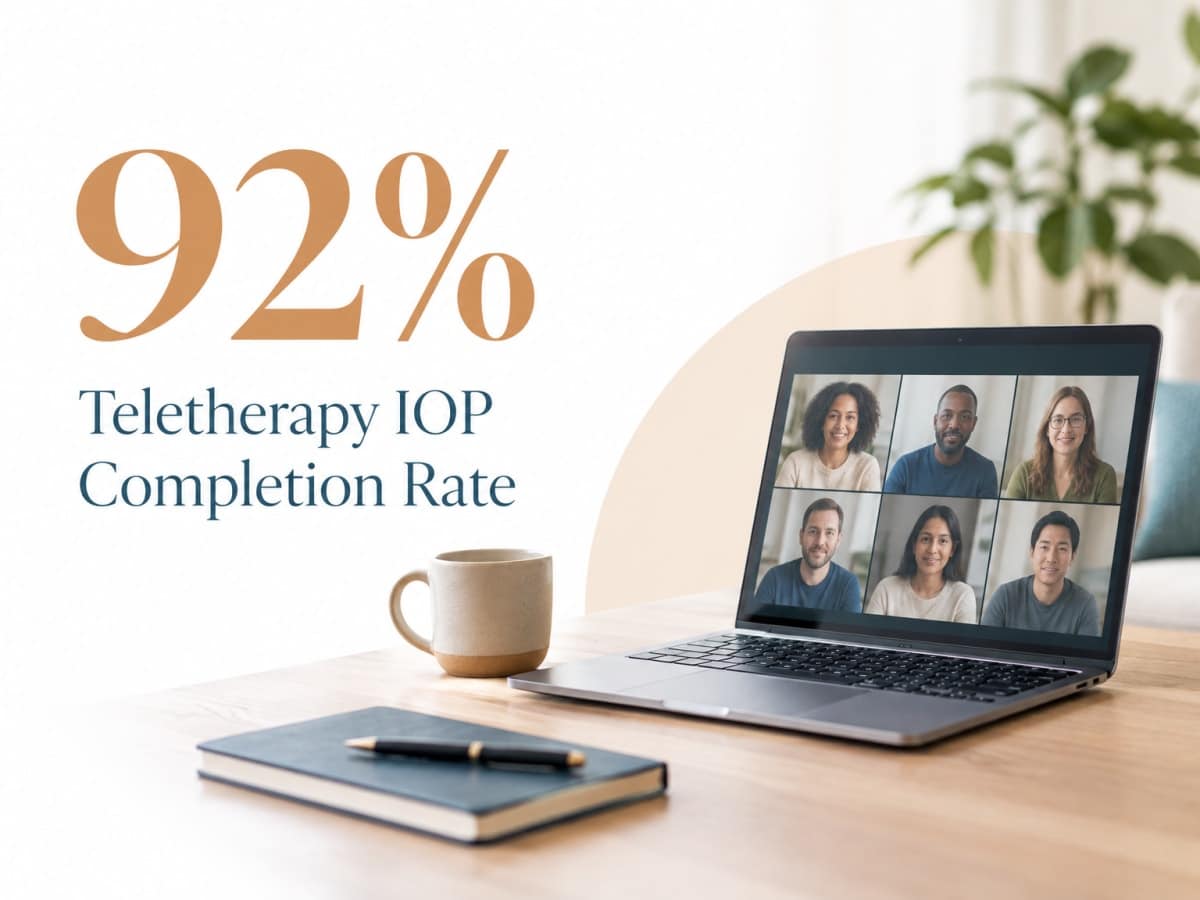
A psychosis-specific IOP studied in a peer-reviewed evaluation enrolled 92 adults with complex psychotic symptoms. Seventy-one of them completed the program, a 77.2% completion rate, and the participants who finished showed significant improvement across five of eight symptom domains, including hallucinations, delusions, disorganized speech, depression, and mania. Average satisfaction landed at 86.6 on a 0 to 100 scale 9. A separate study of a three-week, group-based teletherapy psychiatric day program for adults with serious mental illness who were at risk of hospitalization reported a 92% completion rate, with mean attendance of 14.43 days and 95% of participants scheduling at least one behavioral-health aftercare appointment before discharge 10.
Hold those numbers next to what you probably expect for serious mental illness—missed appointments, dropped treatment, revolving-door hospitalizations—and the contrast is the point. When people with psychosis or serious mental illness are placed in a program designed around their actual symptoms, with the right staff and the right pacing, most of them finish.
A few honest caveats belong here. Neither study was a randomized controlled trial, so improvement during treatment cannot be fully separated from medication adjustments or regression to the mean. Both were done in specialized settings, not every IOP that advertises services for serious mental illness. And completion is not the same as cure. What these numbers do establish is that the structural claim—IOP can hold a complex psychiatric case—is backed by programs that actually did it, not by hope.
What makes the difference inside those programs is specialization, not generic group therapy. Trauma-focused IOPs use evidence-based, trauma-focused interventions delivered intensively enough that patients work through material instead of circling it. Psychosis-specific IOPs train clinicians to work with cognitive symptoms, not around them. Programs that handle treatment-resistant depression have psychiatric prescribers who are experienced with augmentation strategies and complex medication regimens, available often enough to actually adjust the plan as scores move. When you ask a program whether it can hold a complex case, you’re really asking whether that depth is there Monday through Friday—or whether complexity gets referred out the first time something gets hard.
What Serious Programs Treat: Trauma, Depression, Suicidality, Psychosis
Not every IOP is built to handle every condition, and the ones worth your time will tell you that upfront. The programs that actually move the needle on complex presentations tend to specialize, because the clinical skills required for post-combat PTSD are not the same ones required for a first psychotic break or a decade of treatment-resistant depression.
Trauma. A credible trauma IOP delivers trauma-focused interventions on a schedule intensive enough that patients work through traumatic material rather than reopening and reclosing the same wound each week. A pilot of one such intensive outpatient PTSD program found that four of six participants no longer met PTSD diagnostic criteria after treatment, with a large effect size on symptom reduction at three-month follow-up 12. Six people is a small number, and the authors said so. The signal is still worth naming: when trauma-focused work is delivered at IOP dose, people get through it.
Depression and suicidality. Depression that hasn’t responded to medication and weekly sessions often needs a different environment, not a stronger pill. A study of 855 adolescents in an IOP for depression, suicidal ideation, and nonsuicidal self-injury found depression scores improved weekly with an estimated slope of -0.79, suicidal ideation and behavior decreased with an odds ratio of 0.59, and self-injury decreased with an odds ratio of 0.51 across successive weeks of treatment 8. A separate evaluation of DBT-informed IOP care showed mean depression scores among IOP-only patients fell from 29.49 at intake to 12.77 at discharge 11. The common thread is skills practiced daily instead of discussed monthly.
Psychosis. Programs that handle psychosis well train clinicians to work with cognitive symptoms, pace groups accordingly, and keep a prescriber close enough to adjust medication the same week symptoms shift 9. If a program can’t name what it specializes in, that’s your answer about whether it specializes in anything.
Questions to Ask Any IOP Before You Enroll
By the time you’re calling programs, you’ve already done the hard part—deciding something needs to change. The intake coordinator you reach is going to sound reassuring either way. The point of the questions below is to find out what’s behind the warmth. Write these down. Ask them in the first call, not the fifth.
Who treats both conditions, and when? If you or your family member has a co-occurring psychiatric and substance-use condition, ask whether the same clinical team manages both, meeting together on your case, or whether the mental health side and the substance-use side run on separate tracks. SAMHSA’s advisory names integrated, concurrent treatment with cross-trained staff as the preferred model—not referral between two systems 5. If the answer is “we coordinate with an outside provider,” that’s parallel care wearing an integrated label.
How many psychiatric hours are actually in the week? A program can hit the nine-hour minimum under the applicable Medicare payment system 16 with mostly group therapy and almost no prescriber contact. For a complex case—treatment-resistant depression, bipolar, psychosis—ask specifically how often you’ll see a psychiatrist, who covers after hours, and how the program handles complex or advanced medication regimens.
What does the program specialize in? “We treat everything” usually means no specialized protocol for anything. Ask about the program’s trauma-focused approach, the DBT or CBT structure, and the groups built for psychosis if that applies. SAMHSA’s TIP 47 lays out what structured IOP should include; a program should be able to describe its version in plain terms 2.
How will we know it’s working? Ask which standardized measures are used, how often, and how scores change the plan. SAMHSA defines measurement-based care as repeated, valid measurement that informs shared decisions 19. “We check in” is not an answer.
What’s the step-down plan on day one? Ask what happens after IOP, who schedules it, and how continuity is handled if your schedule or safety changes mid-treatment. If the answer comes together only at discharge, it will come together poorly.
Access, Coverage, and the Virtual Option
The money question comes up fast, and it should. Intensive outpatient therapy is more expensive than a weekly session and dramatically less expensive than a residential stay, which is one of the reasons insurers and federal programs have been moving to make it easier to access. A new Medicare benefit category for IOP services took effect January 1, 2024, covering acute behavioral-health care in hospital outpatient departments, community mental health centers, federally qualified health centers, and rural health clinics 17. The CY 2025 payment rule carried that framework forward and reiterated the nine-hour-per-week service minimum under the applicable Medicare payment system 16. Commercial and Medicaid plans vary—some cover IOP generously, some apply prior authorization and session limits, some still treat substance-use and mental-health benefits unevenly despite parity law. Before you enroll, ask the program’s billing team to verify your specific plan, and ask what happens if coverage runs out before the clinical team thinks you’re ready to step down.
The virtual question matters too, especially if you work full time, live an hour from the nearest program, or have childcare that doesn’t bend. Early evidence is cautiously encouraging. A study comparing in-person and fully virtual psychiatric partial hospitalization during the pandemic reported 89.5% attendance in the virtual program versus 84.5% in person, lower hospitalization rates during the study period, and 74.3% of patients reporting improvement in their condition 7. The adolescent IOP study mentioned earlier found comparable symptom improvement for in-person and telehealth delivery during the same period 8. The scope matters: these were pandemic-era programs with selected patients, not blanket proof that virtual care fits every clinical picture. For someone in active crisis, for people whose home is part of the problem, or for complex psychiatric cases where in-person observation changes the medication plan, a physical room with a clinician in it still does something a camera cannot.
How You’ll Know It’s Working
Progress in intensive outpatient therapy is rarely a single lightning-strike moment. It’s a series of small, concrete shifts that show up in your week before they show up on a score sheet. The programs most likely to help you notice those shifts are the ones that track them on purpose.
SAMHSA defines measurement-based care as using standardized, valid, repeated measurements to follow progress and shape shared decisions with you about treatment 19. In practice, that means a short depression or anxiety scale every week or two, substance-use tracking that doesn’t rely on your memory, safety screens that actually trigger a plan change when scores move the wrong way, and a clinician who shows you the trend line instead of keeping it in a chart you never see. If your scores drop and the plan stays identical, measurement isn’t driving care. It’s decoration.
The lived signals matter too, and they’re the ones you’ll notice first. Sleeping through the night again. Getting to your daughter’s recital sober. Making it through a Sunday without the usual spiral. Fewer ER trips, fewer missed workdays, a step-down plan already on the calendar before discharge rather than scrambled together at the end 11. If your program can name what it’s measuring and show you the numbers moving, you have an answer. If it can’t, that’s also an answer.
Find Out If Intensive Care Fits
Discuss your needs with a clinical team and learn which level of care may be appropriate.
Frequently Asked Questions
How is intensive outpatient therapy different from weekly therapy?
Weekly therapy gives you about an hour of clinical contact and six days to hold on alone. Intensive outpatient therapy delivers at least nine hours of structured services across multiple days each week under the applicable Medicare payment system 16, usually blending group therapy, individual sessions, and psychiatric check-ins. That dose is what lets you practice a skill, test it in real life, and bring the result back before the week unravels.
Can IOP really work as well as residential treatment?
For appropriately selected substance-use patients, yes. A peer-reviewed evidence review from researchers at Oregon Health and Science University, Westat, and SAMHSA found most studies showed no significant outcome difference between IOP and inpatient or residential care 1. The caveat matters: that comparability holds for people without active withdrawal, acute instability, or a need for 24-hour supervision 3. For complex psychiatric cases, the evidence is more mixed and program-dependent.
Is IOP appropriate for someone with a dual diagnosis?
It can be, if the program actually treats both conditions together. SAMHSA identifies integrated care—one team, concurrent treatment, cross-trained staff—as the preferred model for co-occurring mental health and substance-use disorders 5. Parallel care, where a psychiatrist and a substance-use counselor work in separate systems and rarely talk, produces the gaps where complex cases usually relapse. Ask whether both clinicians sit on the same team before you enroll.
When is IOP not the right level of care?
SAMHSA’s clinical guidance is specific. IOP is not appropriate when someone needs medical detoxification, 24-hour supervision, or stabilization of substantially unstable psychiatric or medical conditions 2. Active withdrawal, acute suicidality that can’t be safely managed at home, a home environment that’s actively unsafe, or psychiatric symptoms that need around-the-clock observation all point to a higher level of care first. IOP is often the right next step after stabilization—not instead of it.
Does insurance cover intensive outpatient therapy?
Coverage has expanded. A new Medicare benefit category for IOP services took effect January 1, 2024, covering hospital outpatient departments, community mental health centers, federally qualified health centers, and rural health clinics 17. Commercial and Medicaid plans vary, with different prior-authorization rules and session limits. Before you enroll, ask the program’s billing team to verify your specific plan and ask what happens if coverage ends before clinicians think you’re ready to step down.
Can IOP be done virtually, or does it have to be in person?
Both exist, and virtual works for some people. A study of a fully virtual psychiatric partial hospitalization program reported 89.5% attendance and 74.3% of patients reporting improvement in their condition 7. The scope is narrow, though—selected patients, pandemic-era delivery. For someone in active crisis, when home is part of the problem, or for complex psychiatric cases where in-person observation changes the medication plan, a physical room with a clinician still does something a camera cannot.
References
- Substance Abuse Intensive Outpatient Programs: Assessing the Evidence. https://pmc.ncbi.nlm.nih.gov/articles/PMC4152944/
- Clinical Issues in Intensive Outpatient Treatment. https://library.samhsa.gov/sites/default/files/sma13-4182.pdf
- Clinical Issues in Intensive Outpatient Treatment for Substance Use Disorder. https://library.samhsa.gov/sites/default/files/pep20-02-01-021.pdf
- Managing Life with Co-Occurring Disorders. https://www.samhsa.gov/mental-health/serious-mental-illness/co-occurring-disorders
- Substance Use Disorder Treatment for People With Co-Occurring Disorders. https://library.samhsa.gov/sites/default/files/pep20-06-04-006.pdf
- Integrated Treatment for Co-Occurring Disorders: Building Your Program. https://library.samhsa.gov/sites/default/files/ebp-kit-building-your-program-10112019.pdf
- Positive Outcomes in a Virtual Partial Hospitalization Program. https://pmc.ncbi.nlm.nih.gov/articles/PMC9395212/
- Treatment Outcomes of an Adolescent Intensive Outpatient Program for Depressed and Suicidal Youth. https://pmc.ncbi.nlm.nih.gov/articles/PMC12414322/
- Feasibility and Effectiveness of a Psychosis-Specific Intensive Outpatient Program. https://pmc.ncbi.nlm.nih.gov/articles/PMC9477231/
- Feasibility and Initial Outcomes of a Group-Based Teletherapy Psychiatric Day Program for Adults With Serious Mental Illness: Open, Nonrandomized Trial in the Context of COVID-19. https://pmc.ncbi.nlm.nih.gov/articles/PMC7954114/
- Discussion. https://pmc.ncbi.nlm.nih.gov/articles/PMC7513610/
- Intensive outpatient treatment for PTSD: a pilot feasibility study. https://pmc.ncbi.nlm.nih.gov/articles/PMC8128113/
- Evaluation of an Integrated Intensive Cognitive Behavioral Therapy Program. https://pmc.ncbi.nlm.nih.gov/articles/PMC6985065/
- The effectiveness of integrated treatment in patients with substance use disorders co-occurring with anxiety and/or depression – a group randomized trial. https://pmc.ncbi.nlm.nih.gov/articles/PMC3974008/
- Trans-Sector Integrated Treatment in Psychosis and Addiction. https://pmc.ncbi.nlm.nih.gov/articles/PMC4643160/
- CY 2025 Medicare Hospital Outpatient Prospective Payment System and Ambulatory Surgical Center Payment System Final Rule. https://www.cms.gov/newsroom/fact-sheets/cy-2025-medicare-hospital-outpatient-prospective-payment-system-ambulatory-surgical-center-payment
- CMS Makes Hospital Prices More Transparent and Expands Access to Behavioral Health Care. https://www.cms.gov/newsroom/press-releases/cms-makes-hospital-prices-more-transparent-expands-access-behavioral-health-care
- Substance Use Disorder Treatment for People with Co-Occurring Disorders Based on TIP 42. https://www.samhsa.gov/resource/ebp/advisory-substance-use-disorder-treatment-people-co-occurring-disorders-based-tip-42
- Financing Measurement-Based Care in Community Behavioral Health Settings. https://library.samhsa.gov/sites/default/files/cfri-financing-measurement-based-care-pep24-01-007.pdf